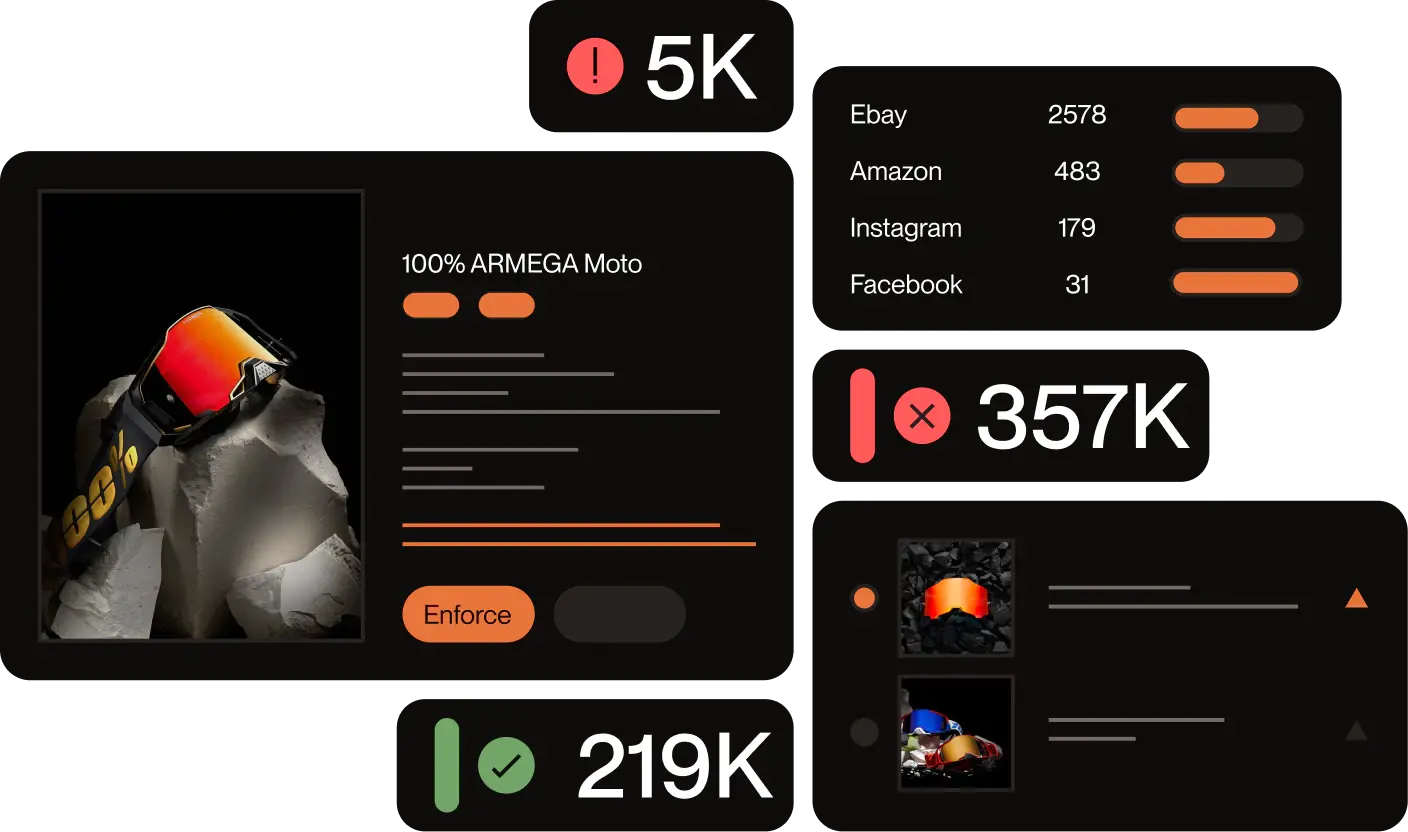









The OECD estimates that counterfeit and pirated goods account for $467 billion globally, representing 2.3% of world trade. In the EU alone, fake goods reach 4.7% of total imports. That activity is accelerating, not shrinking.
At the same time, brand abuse has expanded far beyond marketplaces. Fake websites, paid social ads, unauthorized sellers, and pricing violations now operate simultaneously across every major online channel.
This is the gap Red Points’ Brand Intelligence Platform solves by providing insights on how brand abuse actually spreads, where revenue is leaking, or which actions change outcomes.
That is why leading brands are moving beyond takedown-focused software and adopting brand intelligence platforms.
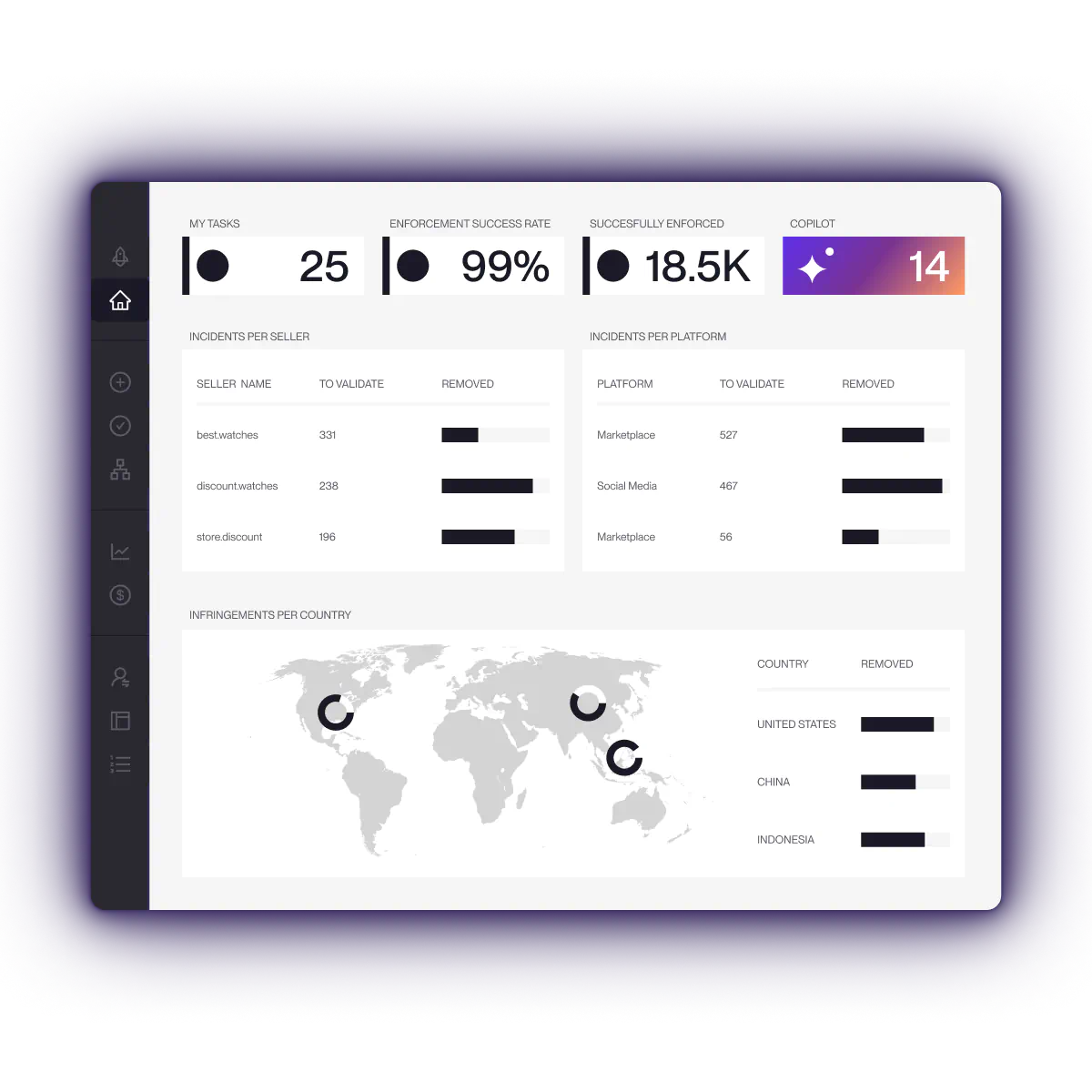
What a Brand Intelligence Platform must cover
Brand risk spans three distinct but connected markets :
- Black market – counterfeits, piracy, scams, fake websites, impersonation.
- Gray market – authentic products sold by unauthorized resellers or circulated outside the intended distribution channel or territory, including cross-border diversion and parallel imports.
- White market – authentic products sold by authorized sellers who may still be non-compliant with pricing (e.g., MAP), territory, or distribution agreements.
A brand intelligence platform is designed to monitor, connect, and act across all three at once, instead of treating them as separate problems.
1. The illegal layer – stopping outright abuse
The most visible layer is outright abuse: counterfeits, piracy, scams, fake websites, impersonation, and fraudulent ads.
This is where most brand protection programs start – and often stop.
Enforcement here focuses on detection and takedown. That work is necessary, but on its own it is reactive. Actors reappear. Listings resurface. Domains rotate. Without broader context, teams are forced into an endless takedown loop.
A brand intelligence platform treats illegal activity as signal, not just noise – connecting listings, sellers, domains, and ads to understand who is behind them and how they operate.
2. The semi-legitimate layer – controlling unauthorized commerce
The second layer is more subtle and often more damaging commercially.
Here, the products are genuine, but the sellers are not authorized. This includes parallel imports, cross-border diversion,and unknown resellers winning marketplace visibility.
Because the goods are real, this layer often escapes traditional IP enforcement. Yet it drives:
- Price erosion
- Buy Box loss
- Channel conflict
- Weakened distributor relationships
A brand intelligence platform continuously tracks who is selling, where they are selling, at what price, and in what volume, turning unauthorized selling from a blind spot into a measurable risk.
This is where brand protection becomes revenue protection.
3. The legitimate layer – enforcing compliance, not just authorization
Even authorized sellers create risk when compliance is unmanaged.
Pricing violations, Minimum Advertised Price (MAP), territory breaches, stock inconsistencies, and off-strategy promotions all happen inside approved partner networks. Without visibility, brands lose control not because of bad actors, but because of drift.
A brand intelligence platform monitors this layer continuously, enabling brands to:
- Enforce pricing and territory rules consistently
- Detect early signs of channel breakdown
- Protect compliant partners from unfair competition
- Base enforcement on data, not exceptions
This layer is critical because it connects brand protection directly to distribution strategy and long-term brand equity.
Why most solutions fail to address all three risk layers
Most brand protection tools focus almost entirely on the illegal layer.
That leaves two major gaps:
- Unauthorized sellers continue diverting revenue
- Authorized partners continue operating without accountability
The result is fragmented enforcement, internal misalignment, and diminishing returns on takedowns.
Brand intelligence exists because brand risk is systemic, not isolated. When all three layers are visible in one system, enforcement decisions stop being reactive and start being strategic.
The bottom line
Brand protection has outgrown point solutions.
In a market where black, gray, and white activities overlap constantly, brands need a holistic intelligence layer that shows what is happening, why it is happening, and where to act for maximum impact.
That is the role of a brand intelligence platform – and why it is becoming foundational infrastructure for modern brand protection teams, not an optional add-on.