

Finding your artwork, product images, logos, or brand designs copied on Redbubble can be frustrating, especially when the same design appears across shirts, stickers, phone cases, and other products within minutes. For creators and brands, the issue is not only the copied work itself. It is the time spent finding the listings, proving ownership, submitting takedowns, and checking whether the same content comes back under another account.
This guide explains how to report copyright infringement on Redbubble, what information you need before filing a takedown notice, how Redbubble’s Notice and Takedown process works, and what to do when manual reporting is no longer enough.
TL;DR
- To report copyright infringement on Redbubble, rights holders or authorized representatives should submit a Notice and Takedown Report.
- Your report should include the infringing Redbubble listing URLs, a description of the protected work, ownership details, supporting evidence, and the required good faith and accuracy declarations.
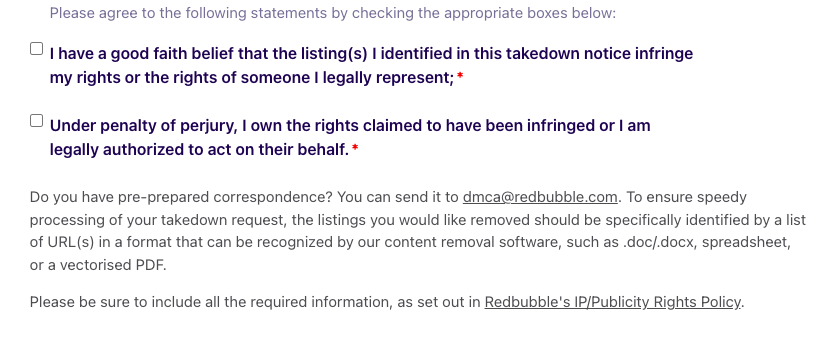
- If you need to report multiple listings, Redbubble also allows prepared correspondence to be sent to dmca@redbubble.com with the infringing URLs in a structured format.
- Only the copyright owner, trademark owner, or someone legally authorized to act on their behalf can submit a valid IP takedown notice.
- Redbubble says it will be in touch within 48 hours, but review times can vary depending on the completeness and complexity of the report.
- Manual reporting can work for isolated listings, but brands facing repeat uploads or high-volume infringement need ongoing monitoring, evidence collection, and scalable enforcement.
Is Redbubble a legitimate platform?
Yes. Redbubble is a legitimate print-on-demand marketplace where independent artists sell original designs on products such as clothing, stickers, phone cases, home decor, accessories, and art prints. Redbubble says it connects more than 700,000 artists and designers with buyers around the world.
The issue for brand owners is not whether Redbubble is real. The issue is that its open upload model can be exploited by bad actors who upload copyrighted artwork, logos, characters, product images, or brand assets without permission.
Redbubble has an intellectual property reporting process, but it depends on rights holders identifying the infringement and submitting a valid takedown notice. That makes the platform manageable for occasional issues, but more difficult for brands dealing with repeat uploads or hundreds of infringing listings.
What is Redbubble?
Redbubble is an online marketplace founded in Australia in 2006. It allows artists to upload designs that can be sold on physical products without the artist managing production, inventory, or fulfillment.
Although the model makes Redbubble valuable for legitimate creators, it also creates risk for brands and rights holders. A seller can upload a design quickly and place it on multiple products, including shirts, stickers, phone cases, mugs, posters, tote bags, and other merchandise.
For brands with recognizable logos, characters, designs, slogans, or visual assets, unauthorized versions of their IP can appear on Redbubble before the rights holder knows they exist.
This is why Redbubble should be monitored as part of a broader marketplace protection and copyright enforcement strategy.

Why do bad actors target Redbubble?
Bad actors target Redbubble because the platform makes it easy to reach buyers without holding inventory. A seller can upload a design once and offer it across multiple product types.
For infringers, that creates three advantages:
- They can monetize recognizable artwork, logos, characters, or brand assets without producing physical inventory.
- They can test demand quickly across different products.
- They can re-upload similar designs if a listing is removed.
Redbubble does act on valid takedown notices, but rights holders still need to identify the specific infringing content and report it. Redbubble’s own help content explains that content is removed when it is specifically identified in a legally valid takedown notice, and that Redbubble generally does not look for similar works to remove from the marketplace automatically.
For brands, the practical takeaway is simple: one takedown may remove one listing, but it does not necessarily solve the wider infringement pattern.
What is copyright infringement on Redbubble?
Copyright infringement happens when someone uses your original creative work without authorization. On Redbubble, this usually means a seller uploads protected content and sells it on physical products.
Common examples include:
- Uploading someone else’s artwork or illustration
- Selling products with copied graphics or designs
- Using a protected photograph without permission
- Making minor edits to someone else’s work and presenting it as original
- Selling merchandise that uses protected characters, artwork, or visual assets
- Using product photos or campaign images copied from a brand website
Copyright protects original creative works. This can include artwork, illustrations, photographs, graphic designs, product imagery, written copy, and other original assets.
A copyright registration is not always required for a work to be protected, but registration can strengthen your position if you need to escalate the issue legally.
For a broader explanation, see Red Points’ guide to copyright infringement.
What is the difference between copyright and trademark infringement on Redbubble?
Copyright and trademark are different types of intellectual property, and both can be infringed on Redbubble.
Copyright protects original creative works, such as artwork, images, illustrations, designs, photos, and written content.
Trademark protects brand identifiers, such as names, logos, slogans, symbols, and other signs that identify the source of goods or services.
On Redbubble, a single listing can involve both.
For example:
- A seller uploads your original illustration without permission. That may be copyright infringement.
- A seller uses your brand logo on a shirt. That may be trademark infringement.
- A seller copies your product photo and uses your logo in the listing. That may involve both copyright and trademark infringement.
Redbubble’s IP/Publicity Rights Policy covers copyright, trademark, publicity rights, and other rights.
What is Redbubble’s copyright policy?
Redbubble’s IP/Publicity Rights Policy states that Redbubble respects the intellectual property rights of others and asks its users to do the same.
If a rights holder believes their content has been used in a way that infringes their rights, Redbubble asks them to submit a Notice and Takedown Report. The notice must include key information such as:
- A signature from the rights holder or authorized representative
- A description of the work or rights being infringed
- The location of the infringing content on Redbubble
- Contact details
- A good faith statement that the use is not authorized
- A statement, under penalty of perjury, that the information is accurate and that the filer is authorized to act
Redbubble also says that, in certain circumstances, it may suspend or terminate users who purposely infringe the copyrights, trademarks, publicity rights, or other rights of others.
Before you file: what makes a valid Redbubble takedown notice?
A strong takedown notice makes the review easier and reduces the risk of delays, rejection, or reinstatement.
Before you file, confirm the following.
You are the rights holder or legally authorized to act for them
Only the person or company that owns the IP, or someone legally authorized to act on their behalf, can submit a valid takedown notice.
If you are not the rights holder, Redbubble recommends contacting the rights holder so they can submit the notice directly.
You have the specific Redbubble listing URLs
Redbubble processes notices at the listing level. Do not submit a search results page, category page, or general profile page as your main evidence.
Use the direct listing URL for each infringing item.
Redbubble’s form specifically notes that submitting one URL per listing covers all product types associated with that listing, and that submitting a search results page can delay processing.
You can explain what work is being infringed
Describe the original work clearly.
This may include:
- Title of the work
- Description of the work
- Original publication URL
- Copyright registration, if available
- Trademark registration, if relevant
- Product catalog reference
- Original artwork file or source document
- Screenshot of the original work
You can explain how the Redbubble listing infringes it
Do not only say “this is copied.” Explain what was copied and why the use is unauthorized.
For example:
The Redbubble listing uses our original illustration without permission. The original artwork appears on our official product page here: [URL]. The Redbubble listing reproduces the same artwork on shirts and stickers without authorization.
You have supporting documentation
Useful supporting evidence may include:
- Original source files
- Copyright registration certificates
- Trademark registration records
- Screenshots of your original work
- Links to official product pages
- Catalog references
- Prior takedown references
- Proof that you are authorized to act for the rights holder
Incomplete or vague notices are easier to challenge and may slow the process.
How to report copyright infringement on Redbubble
There are two main ways to submit a Redbubble takedown notice: the online Notice and Takedown Report form, or email for prepared or bulk submissions.
Option 1: Submit Redbubble’s Notice and Takedown Report form
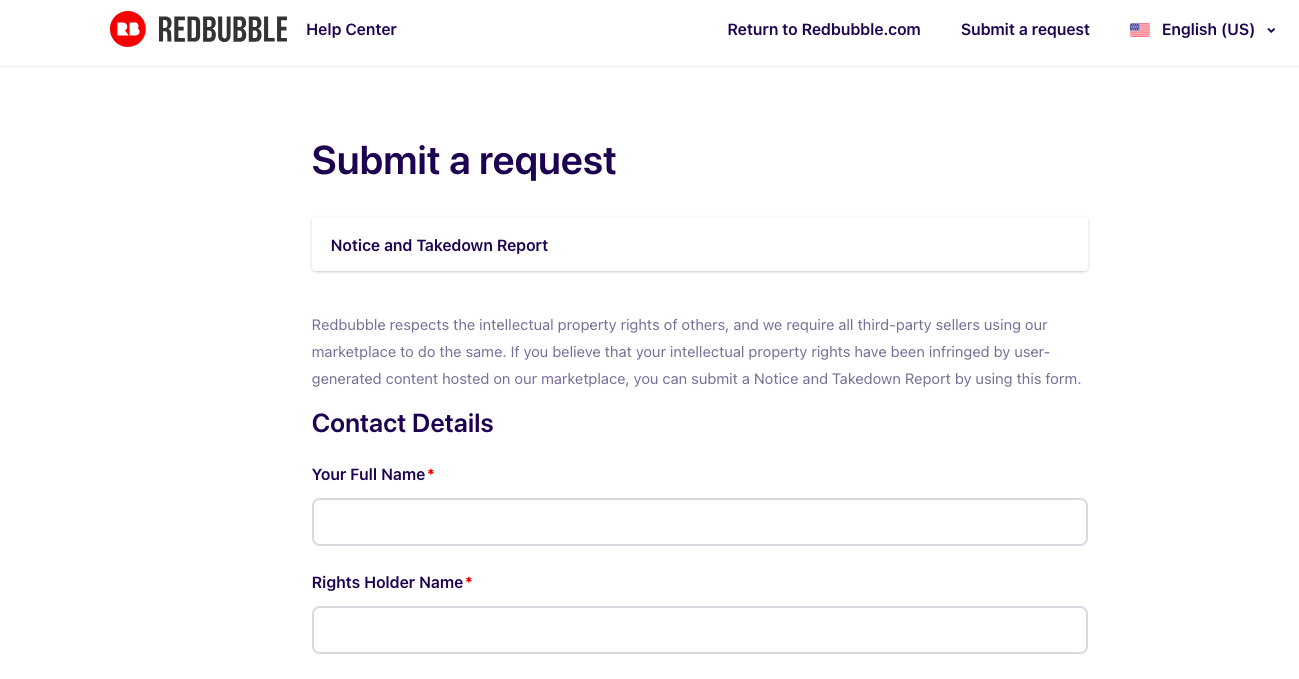
Use Redbubble’s Submit a request page and select Notice and Takedown Report.
The form asks for the information Redbubble needs to review your claim.
Step 1: Enter your contact information
Provide your name, email address, phone number, and any other contact details requested.
Use an email address you monitor regularly because Redbubble may ask for more information before acting.
Step 2: Confirm your relationship to the rights holder
Confirm whether you are the rights holder or legally authorized to act on their behalf.
If you are filing for a brand, client, or company, make sure you can prove that authorization if Redbubble requests it.
Step 3: Describe the protected work
Explain what work is being infringed.
Include relevant details such as:
- Name or title of the work
- Type of work
- Copyright or trademark registration details, if available
- Original URL where the work appears
- Description of the original asset
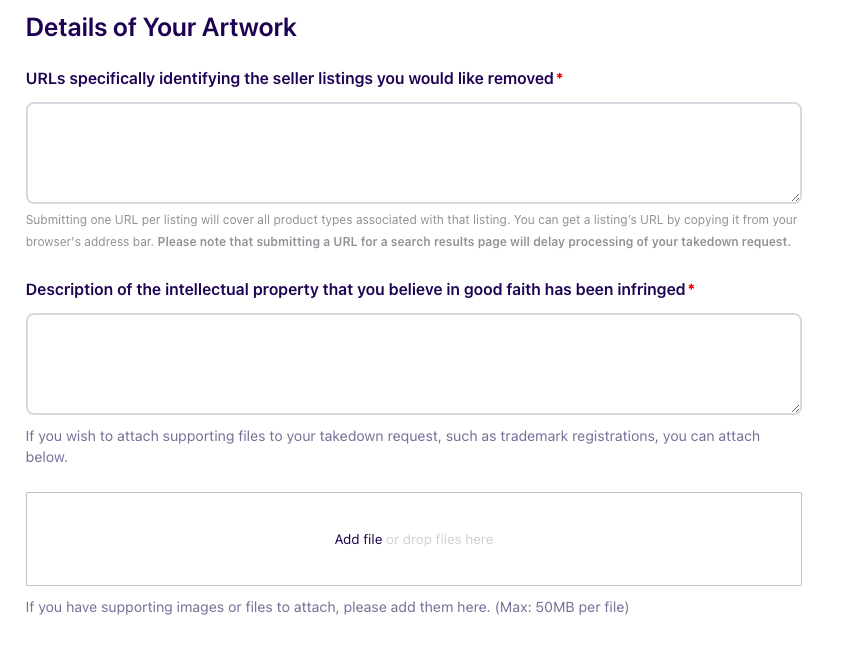
Step 4: Add the infringing Redbubble URLs
Add the direct URLs of the infringing Redbubble listings.
Use one URL per listing. Do not use search result URLs, category pages, or broad profile links as a substitute for specific infringing listings.
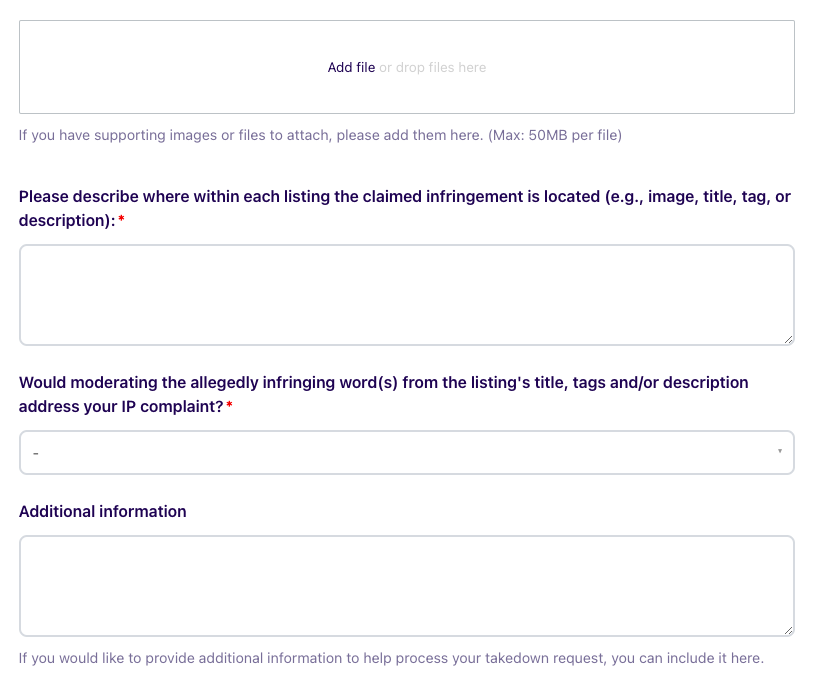
Step 5: Upload supporting evidence
Attach documents that support your claim.
This may include original artwork files, copyright records, trademark registrations, screenshots, product catalog references, or authorization letters.
Step 6: Sign the declaration and submit
Review the information carefully before submitting.
The declaration usually confirms that you have a good faith belief the use is unauthorized and that the information you provided is accurate.
How to report multiple Redbubble listings by email
For bulk submissions or prepared takedown correspondence, Redbubble says rights holders can send information to dmca@redbubble.com.
This route is useful when you are reporting dozens or hundreds of URLs.
For faster processing, structure your submission clearly. Use a spreadsheet, document, or vectorized PDF with one infringing URL per row or line.
Include:
- Rights holder name
- Authorized representative details, if applicable
- Contact email and phone number
- Description of the infringed work
- Type of infringement
- Direct Redbubble listing URLs
- Supporting evidence
- Good faith statement
- Accuracy and authorization statement
- Digital or physical signature
Keep your own copy of everything you submit. For repeat issues, it helps to track which URLs were reported, when they were reported, and what happened afterward.
For broader takedown guidance, see Red Points’ DMCA Takedown Service.
Can you report Redbubble content if you are not the rights holder?
You can report general concerns, but you cannot submit a legally valid IP takedown notice unless you own the rights or are authorized to act for the rights holder.
Redbubble’s Reporting a Concern page says users can report artwork or design concerns through the “Report Content” link found at the bottom of a work page. But if the issue is rights infringement, Redbubble directs users to the Notice and Takedown Report form.
So the distinction is:
| Situation | What to do |
| You own the copyright or trademark | Submit a Notice and Takedown Report |
| You represent the rights holder | Submit a Notice and Takedown Report |
| You are a fan or user who noticed possible infringement | Contact the rights holder or use general content reporting |
| You are reporting unacceptable content or behavior | Use Redbubble’s general reporting tools |
For brands, this matters because enforcement should come from the legal owner or an authorized partner, not from customers or unaffiliated users.
What happens after you report copyright infringement on Redbubble?
After you submit a notice, Redbubble reviews the report and decides whether it is complete and actionable.
Possible outcomes include:
- Redbubble removes the reported content.
- Redbubble asks for more information.
- Redbubble decides the notice is incomplete.
- Redbubble decides not to remove the content.
- The reported seller submits a counter notice.
- In repeated or serious cases, Redbubble may suspend or terminate the seller.
Redbubble says it will be in touch within 48 hours through its Help Center. Its Reporting a Concern page says most reviews occur within a few days, but some cases may take longer depending on complexity and resolution needs.
For this reason, avoid promising a fixed removal timeline internally. A complete notice may be handled quickly, but incomplete notices, unclear ownership, disputed claims, or counter notices can extend the process.
What if Redbubble does not remove the content?
There are several reasons Redbubble may not remove content after a report.
The notice is incomplete
If the notice does not include the required information, Redbubble may ask for more details or be unable to process it.
Common gaps include:
- Missing direct listing URLs
- No proof of ownership
- Unclear description of the original work
- No explanation of the infringement
- Missing authorization to act for the rights holder
- Generic search pages instead of specific listing URLs
The claim is unclear
A Redbubble reviewer needs to understand what was copied and why the use is unauthorized.
A stronger report compares the original work with the Redbubble listing and explains the rights basis clearly.
The seller files a counter notice
If the seller believes the work was removed by mistake or misidentification, they can submit a counter notice.
Redbubble’s Counter Notice FAQ says that if Redbubble forwards the counter notice to the complainant, the complainant has 14 days to contact the user or take legal action. If that does not happen, the user may ask Redbubble to reinstate the artwork, after which Redbubble conducts a final evaluation.
If you receive a counter notice and believe the infringement is clear, involve legal counsel.
What if the same Redbubble design keeps reappearing?
Repeated uploads are common on open marketplaces.
A seller may remove or lose one listing and then:
- Re-upload the same design
- Change the title
- Slightly alter the artwork
- Use a different account
- Apply the same design to more products
- Move to another print-on-demand platform
This is why a single takedown is rarely enough for brands with recognizable creative assets.
When the same design keeps reappearing, track:
- Listing URLs
- Seller usernames
- Product types
- Image variations
- Upload dates
- Reused titles or descriptions
- Related accounts
- Prior takedown references
This evidence can help support repeat-infringer escalation and gives your team a clearer picture of whether the problem is isolated or part of a larger pattern.
Are Redbubble reviews useful for spotting copyright infringement?
Redbubble reviews can help buyers assess product quality, delivery experience, sizing, or general satisfaction. They are less useful for proving whether a design infringes copyright.
A product can have good reviews and still use unauthorized artwork. A product can also have poor reviews without infringing anyone’s rights.
For rights holders, the strongest evidence is not the review score. It is the direct listing URL, screenshots, original work evidence, ownership documentation, and a clear comparison between the original work and the Redbubble listing.
That said, reviews can sometimes provide supporting context. For example, if buyers mention that a design looks copied, unofficial, low-quality, or misleading, capture those comments as secondary evidence.
What if you have hundreds of Redbubble listings to monitor?
Manual reporting is practical when infringement is occasional. It becomes unsustainable when a brand has many products, recognizable visuals, or a large fan base.
The problem is structural:
- You can only report listings you find.
- Listings can appear across many product types.
- Sellers can re-upload after removal.
- Similar designs may appear under different accounts.
- Every report requires documentation.
- Your team has to track outcomes manually.
- The same infringement may spread to other marketplaces.
For one or two listings, Redbubble’s Notice and Takedown process is a reasonable starting point. For high-volume or repeat infringement, brands need a wider workflow that includes detection, validation, enforcement, tracking, and escalation.
For high-volume or repeat infringement, brands need a wider workflow that includes detection, validation, enforcement, tracking, and escalation.
How Red Points helps brands manage Redbubble infringement
Red Points helps brands monitor Redbubble and other marketplaces for unauthorized use of copyrighted works, trademarks, logos, product imagery, and other protected assets.
For Redbubble and similar print-on-demand platforms, Red Points can help brands:
- Detect suspected infringements across marketplace listings
- Monitor copyrighted artwork, product images, logos, and brand terms
- Prioritize cases by risk and business impact
- Submit enforcement through the appropriate platform routes
- Track whether listings are removed
- Identify repeat uploads and recurring seller patterns
- Report trends to legal, ecommerce, and brand protection teams
This reduces the manual burden of searching, documenting, and reporting every listing one by one. It’s important to notice that, before enforcing any listing, there’s a validation process to make sure no legitimate seller is taken down, and no listing is enforced without the authorization of the original brand.
If you are dealing with repeat Redbubble uploads, copied artwork, unauthorized product images, or marketplace IP abuse, request a demo to see how Red Points can help.
Frequently asked questions
Use Redbubble’s Notice and Takedown Report and include your contact details, rights ownership information, a description of the protected work, direct Redbubble listing URLs, supporting evidence, and the required good faith and accuracy declarations.
Redbubble says it will be in touch within 48 hours through its Help Center. Most reviews occur within a few days, but timing can vary depending on the completeness of the notice, the complexity of the case, and whether the seller disputes the removal.
No. Only the rights holder or a legally authorized representative can submit a valid Notice and Takedown Report. If you are not the rights holder, you can report general concerns or contact the rights holder so they can submit the notice.
Yes. Redbubble allows prepared correspondence to be sent to dmca@redbubble.com. For faster processing, include the infringing URLs in a structured format, such as a spreadsheet or document, with one listing URL per row or line.
Copyright protects original creative works, such as artwork, illustrations, photos, graphics, and written content. Trademark protects brand identifiers, such as names, logos, slogans, and symbols. A Redbubble listing can infringe one or both, depending on what it uses.
“Redbubble DMCA” usually refers to Redbubble’s Notice and Takedown process for copyright complaints. Rights holders can submit a takedown request when they believe their copyrighted work is being used without authorization on Redbubble.
Not necessarily. Redbubble’s help content explains that it removes content that has been specifically identified in a legally valid takedown notice. Similar works may remain live unless they are also identified and reported.
If Redbubble forwards the seller’s counter notice to you, you have 14 days to contact the user or take legal action. If you do not, the user may ask Redbubble to reinstate the artwork, and Redbubble will conduct a final evaluation.
Yes. Redbubble is a legitimate print-on-demand marketplace founded in 2006. The issue for rights holders is not whether Redbubble is real, but that unauthorized users can upload infringing designs through its open marketplace model.
Reviews may help identify buyer concerns, but they do not prove copyright infringement. Rights holders should rely on direct listing URLs, screenshots, ownership evidence, and a clear comparison between the original work and the Redbubble listing.
Use Redbubble’s Notice and Takedown Report form for copyright complaints. For prepared correspondence or bulk submissions, Redbubble lists dmca@redbubble.com as the contact route for IP complaints.
Track each re-upload, seller account, listing URL, product type, and variation. Repeat uploads may indicate a broader enforcement issue that requires ongoing monitoring, not only one-off takedown requests.