


If someone is using your videos, product photos, music, logos, or other original creative on TikTok without permission, you can report it through TikTok’s copyright infringement process. The workflow itself is fairly simple: identify the copyrighted work, show ownership, add the infringing URLs, and submit the report. TikTok’s policy also makes two things clear: it does not allow infringing content, and not every unauthorized use is automatically infringement, since some uses may fall under exceptions like fair use or fair dealing.
This guide walks through the reporting process step by step. It also explains what TikTok’s current copyright policy says, what happens after you submit a report, and why manual reporting often becomes difficult to sustain once infringement starts happening repeatedly or at scale.
TL;DR
- TikTok allows rightsholders to report alleged copyright infringement through its online form or through in-app reporting.
- You will usually need contact details, proof of ownership, and links to both the original work and the infringing content.
- TikTok may contact you if information is missing, and it may share information about your report with the reported user, such as the name of the copyright owner.
- TikTok also allows rightsholders to ask that future copies of the same video be prevented from reappearing on the platform.
- Manual reporting can work for isolated cases, but repeated infringement across posts, accounts, and related scam surfaces usually requires a more scalable enforcement process.
TikTok copyright reporting process at a glance
| Step | What you do | Why it matters |
| Step 1 | Open the TikTok copyright infringement form | Starts the formal reporting process in the correct place |
| Step 2 | Enter your contact information | Identifies the reporter and copyright owner |
| Step 3 | Show a representation of your copyrighted work | Helps TikTok understand what content you own |
| Step 4 | Describe the copyright and add documentation | Supports the claim with ownership details and proof |
| Step 5 | Link the content to be reported | Points TikTok to the exact posts or accounts at issue |
| Step 6 | Agree to the terms, sign, and submit | Completes the report so TikTok can review it |
Video walkthrough
Before you start
Before opening the form, gather everything TikTok is likely to ask for in one place. In most cases, that means your business contact details, proof that you own or represent the copyrighted work, links showing the original content, and the URLs of the TikTok posts or accounts you want reviewed. Doing this upfront makes the process much smoother and reduces the chances of delays caused by missing information. TikTok states that failure to include necessary information may limit its ability to investigate your claim and may result in the report being denied.
How to report a TikTok copyright infringement: step by step
The basic steps for how to report a copyright infringement on TikTok include opening the correct form, entering your contact information, providing copyright ownership proof, linking the infringing content, and agreeing to the terms of the report. Let’s walk through the steps.
Step 1: Open the TikTok copyright infringement form
Start by opening a TikTok copyright infringement form. You can either visit the form directly at the link or arrive there by reporting a post on TikTok and selecting intellectual property as the reason.
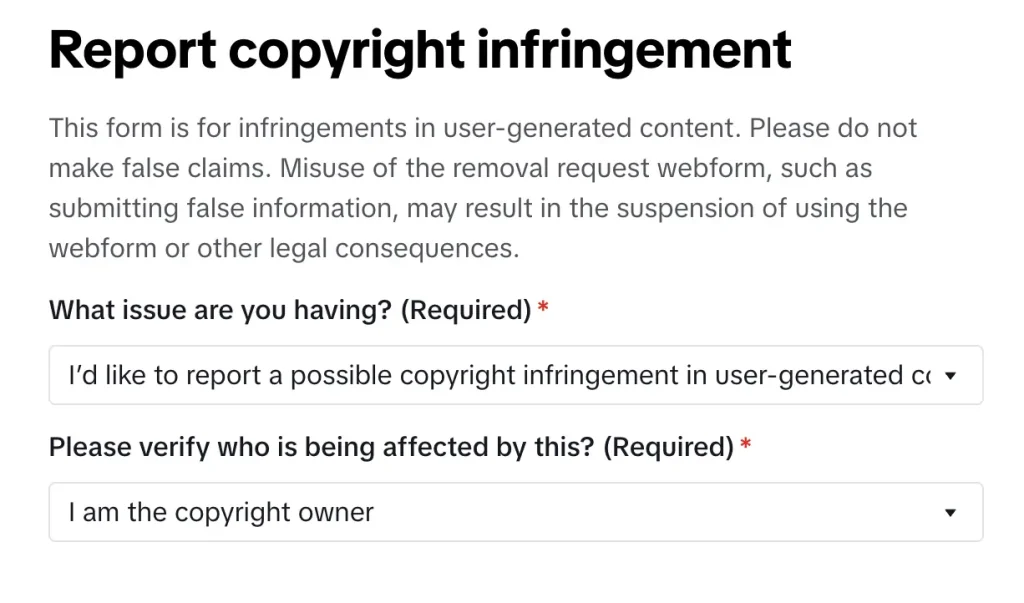
Tip: Gather information ahead of time
TikTok’s form requires contact information (which may be shared with the infringer), evidence of copyright ownership with documentation, and URLs for content to report. Gather these materials before you start to simplify the process.
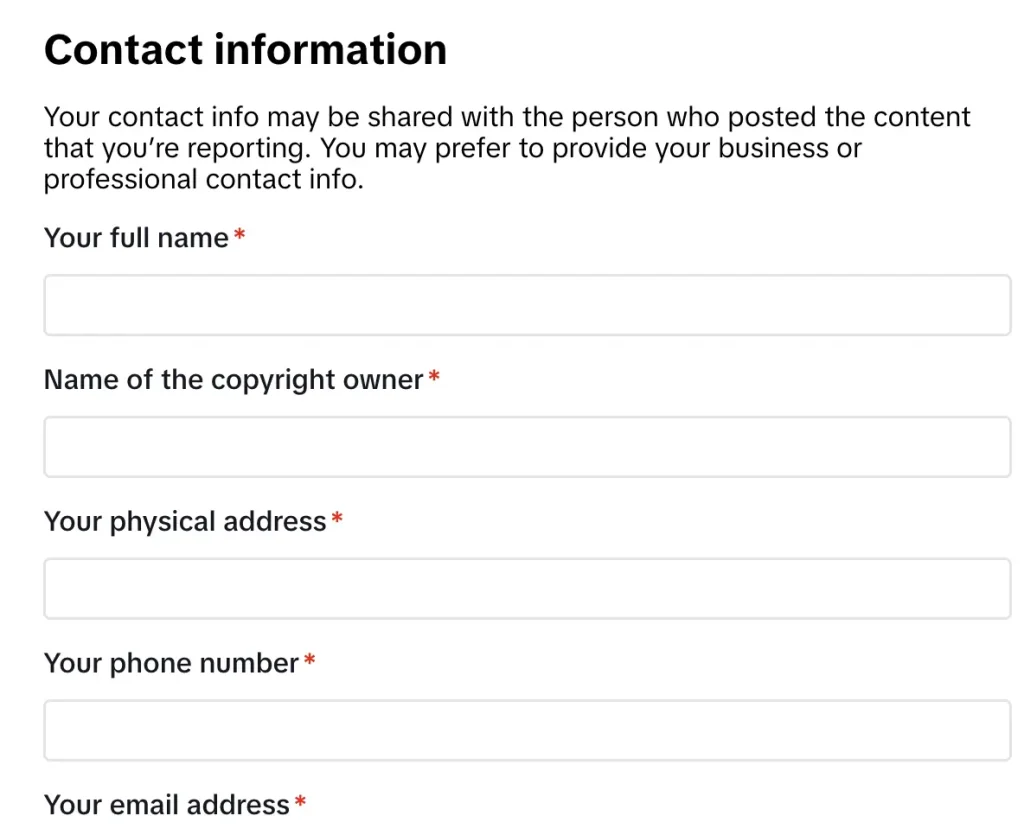
Step 2: Enter your contact information
The next step is to add basic information about yourself, including your full name, the copyright owner’s name, your email address, your physical address, and your phone number. TikTok may share your contact information with the person who has posted the alleged infringed content. So, make sure to provide only your business email and office number for privacy.
Step 3: Show a representation of your copyrighted work
Next, choose what type of copyright you own and provide ownership details. You can report an infringement for video, original music, non-music audio, photo, logo, or something else. Then, select whether the source of your copyrighted material is on your TikTok account, an account you represent, or outside of TikTok. In many cases, infringers on TikTok steal images and logos from outside the app, so this last option lets you provide URLs to examples outside TikTok.
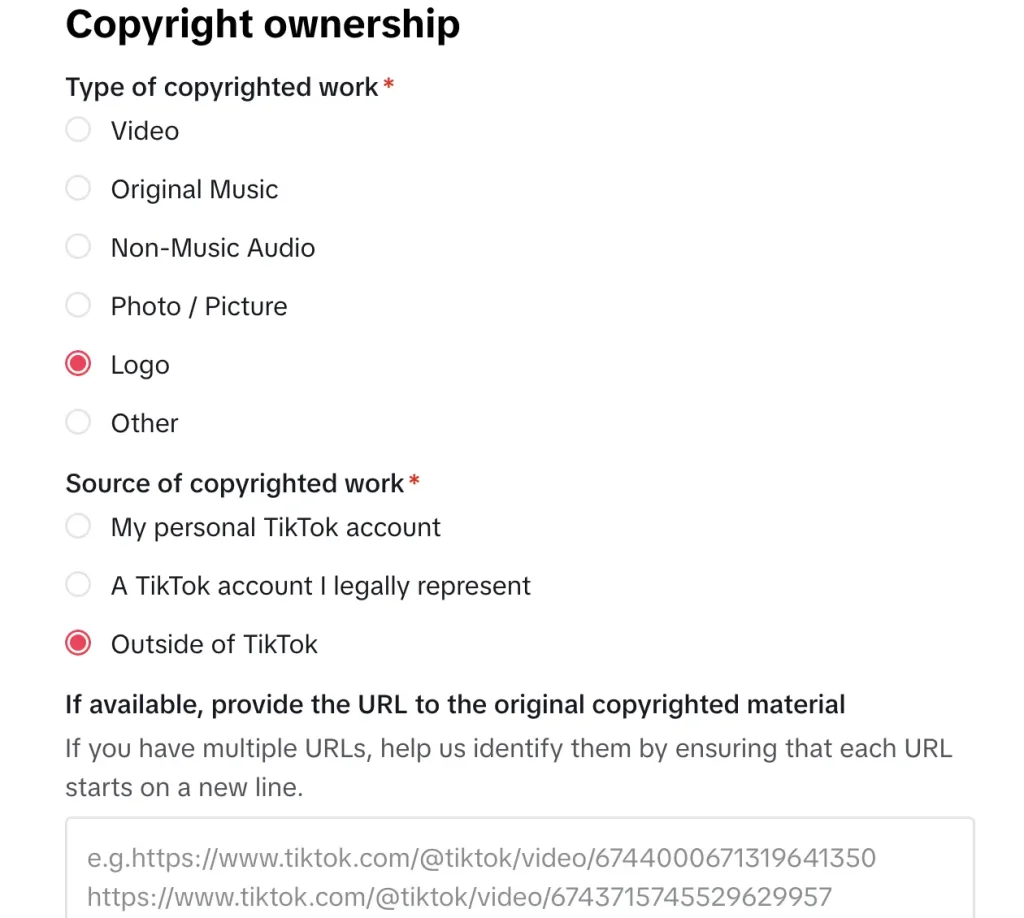
Step 4: Describe the copyright and add documentation
Now, provide a clear description of the work that was infringed by a TikTok account. Describe the type, appearance, usage, and any other details to support your case.
At this step, you’ll also upload copyright documentation, like a certificate or license agreement. If you are acting on behalf of the copyright owner, you’ll have to supply a power of attorney or a signed statement describing your relationship to the owner.
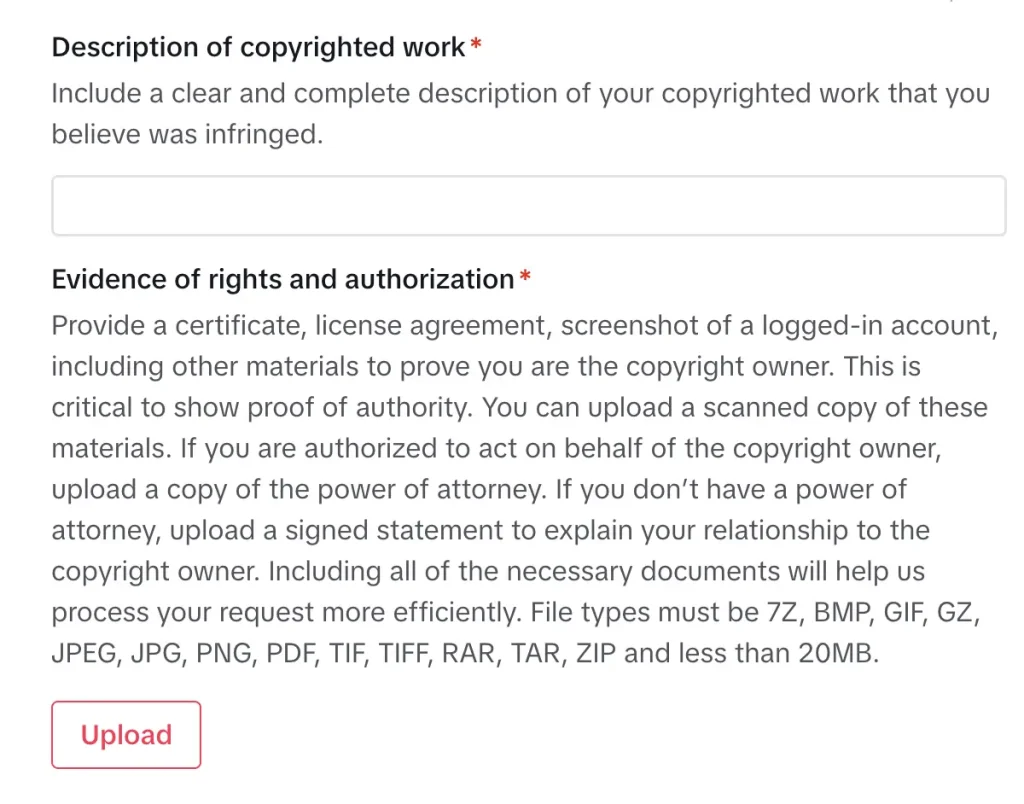
Step 5: Link the content to be reported
Provide URLs to all infringing TikTok posts or accounts that apply to this copyright. You can also request TikTok to prevent future infringing videos, which may help prevent the same video from appearing again.
This step gives you the option to add additional information, as well. This could include screenshots of the TikTok accounts or screenshots of phishing websites the TikTok page links to if applicable.
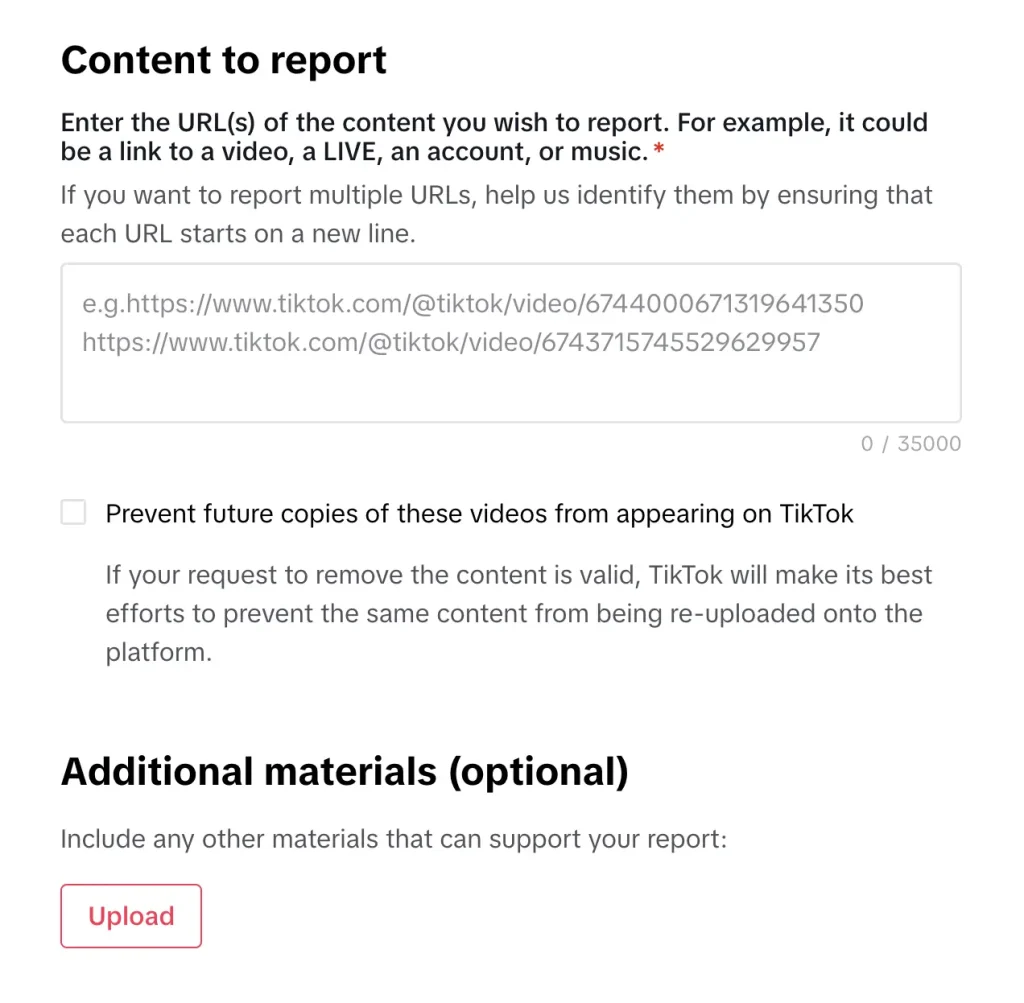
Step 6: Agree to the TikTok terms, sign the form, and submit
The final step is to agree to the terms set out by TikTok. This includes acknowledging that the information you have shared in the form may be shared with the user you are reporting for copyright infringement. Sign with your name and, finally, submit the form.
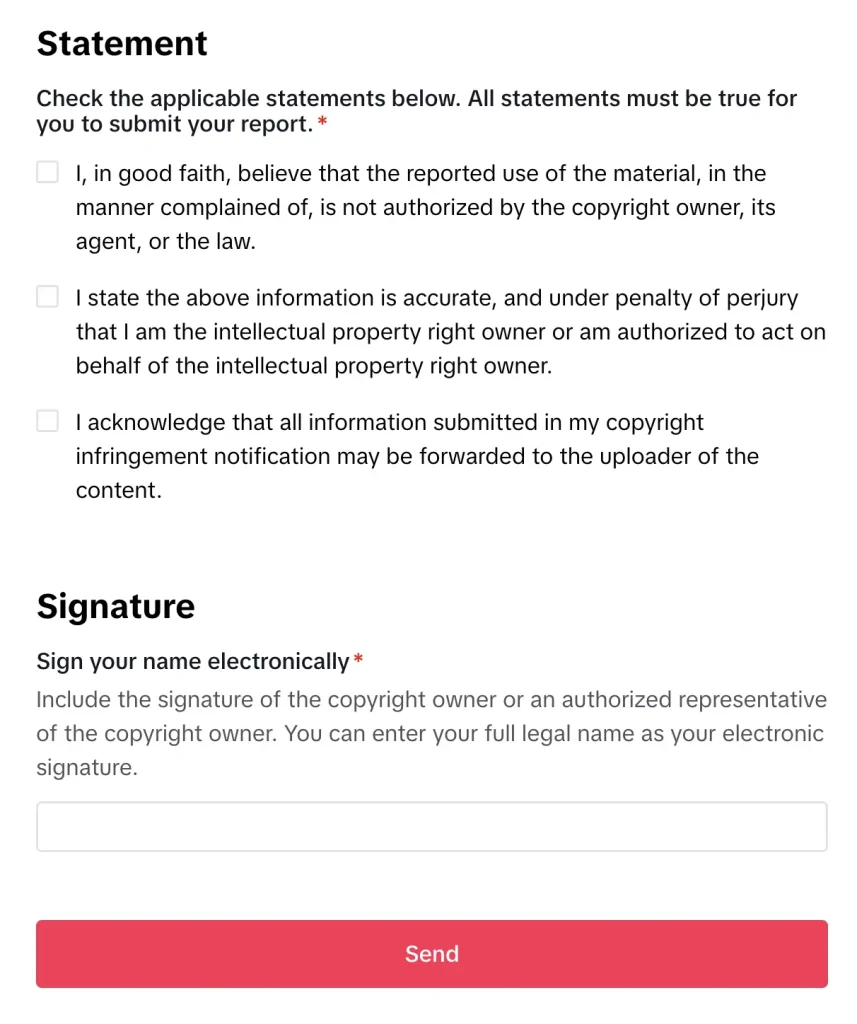
Copyright and IP infringement on TikTok Shop: a different reporting path
TikTok Shop operates a separate IP protection system from TikTok’s standard copyright form. If the infringement you’re dealing with is a product listing on TikTok Shop — a seller using your brand name, logo, or product imagery to sell counterfeits through the shopping tab — the standard copyright report form does not apply.
TikTok Shop has its own Brand Protection Program, accessible through the TikTok Shop Seller Center and through TikTok’s IP protection portal. Rights holders need to register their IP with TikTok Shop’s system separately, after which they can submit infringement complaints directly against Shop listings.
The key distinction:
- Content copyright (videos, audio, photos used in TikTok posts) → use the TikTok copyright form covered in this guide
- Product listing infringement (counterfeits, unauthorized use of brand assets in TikTok Shop listings) → use TikTok Shop’s separate IP protection system
For brands dealing with both simultaneously — infringing Shop listings and infringing content posts — both processes need to run in parallel.
Note: This guide covers copyright infringement reporting. If your brand name, logo, or slogan is being used without authorization on TikTok — a trademark issue — TikTok provides a separate trademark infringement report form. You can access it through TikTok’s IP reporting portal by selecting Trademark as the infringement type.
What is TikTok’s intellectual property policy?
TikTok’s Intellectual Property Policy states that it does not allow content that infringes someone else’s copyright. More specifically, it says that using copyrighted content without proper authorization or another legally valid reason may violate its policies. It also says that infringing content may be removed, LIVE access may be restricted in some cases, and accounts that repeatedly commit copyright infringement may be banned.
At the same time, TikTok also makes clear that not all unauthorized uses automatically amount to infringement. Its policy explicitly refers to exceptions such as fair use in the United States, fair dealing in the European Union, and other equivalent exceptions under local laws. That matters because a strong report is not only about showing ownership. It is also about making clear why the use is infringing.
Examples of copyright infringement on TikTok
Common examples include reposting someone else’s original video without permission, using copyrighted product photos or branded creative to advertise goods without authorization, or reusing protected music, audio, images, or logos in a way that does not fall under a legal exception. These are the kinds of situations where TikTok’s reporting process is most relevant for brands and creators trying to remove unauthorized uses quickly.
Is all unauthorized use automatically infringement?
No. Some uses may be lawful under copyright exceptions. TikTok’s own policy says this directly, which is why it is important to review the context before filing a complaint. If the content is clearly unauthorized and harmful, report it. If the situation is more ambiguous, make sure your evidence and explanation are especially clear.
What happens after you submit the report?
After you submit a TikTok copyright infringement form, the platform reviews the report to verify its validity. The practical timeline can vary. The current reporting guide notes that removal can take anywhere from a day to a couple of weeks, and TikTok also states that it may contact you if it has questions about your report.
That delay is one of the main reasons manual enforcement becomes frustrating so quickly. By the time one report has been reviewed, new posts, new accounts, or slight variations of the same content may already be live again.
What if something is wrong with the report?
TikTok says that missing required information may limit its ability to investigate your claim and may result in the report being denied. In practice, that means the cleaner and more complete the submission is, the better your chances of avoiding delays, follow-up emails, and resubmissions.
When manual TikTok reporting stops being enough
Learning how to file a complaint is useful. But for many brands, the real challenge is not understanding the form. It is keeping up with the volume.
Manual reporting starts to break when the same assets are reused across multiple posts, seller accounts, creator accounts, or scam funnels. A team has to find the infringement, validate it, gather proof, submit the report, monitor outcomes, and repeat the process when the content reappears. Even when each individual submission is simple, the overall workload becomes difficult to sustain.
That is usually the turning point. The problem is no longer “How do I report this post?” It becomes “How do we keep this under control every day without spending our internal team on repetitive enforcement work?”
How Red Points scales TikTok copyright enforcement
When copyright infringement becomes frequent, repeated, or business-critical, brands need more than a manual reporting process. They need a workflow that can continuously detect new abuse, validate it quickly, and move into enforcement without creating bottlenecks.
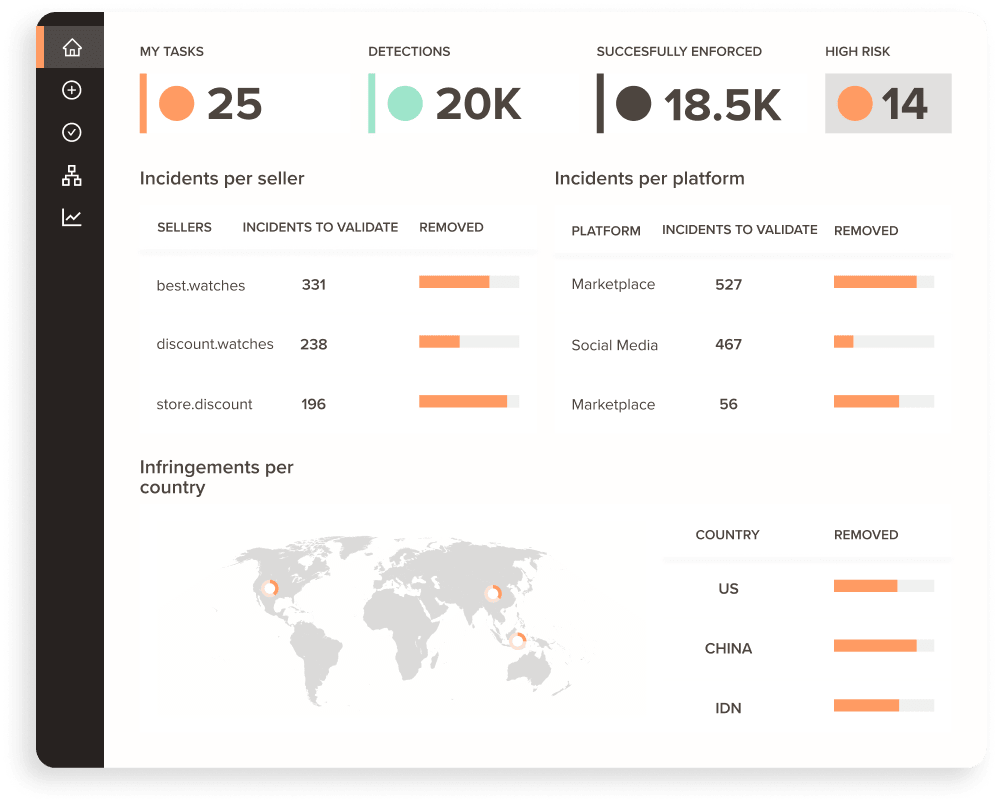
That is where a managed approach becomes valuable. Red Points combines always-on detection, expert-led enforcement, and platform-specific escalation paths so brands do not have to treat copyright reporting as a one-by-one administrative task. Red Points offers end-to-end protection, fully managed by experts, with continuously adapting detection logic, automation rules, and enforcement that evolves with infringement tactics.
This matters especially on social platforms, where the same infringing content can reappear in slightly different forms, spread through multiple accounts, or lead users toward fake stores, phishing websites, or unauthorized sellers. Red Points addresses this with their Social Media Protection Software, providing always-on social media protection that detects impersonation in real time, validates large volumes of infringements with AI-assisted review, and removes harmful content quickly across social media and the wider digital ecosystem, including websites, ads, marketplaces, domains, and search engines.
It also matters when speed is a priority. Red Points highlights platform priority capabilities including API connections, priority reporting, and regional escalation paths, alongside an always-on model with unlimited detection and enforcement 24/7. For brands dealing with repeated infringement, that is a very different operating model from manually filing one report at a time.
Red Points AI is trained on 2.7 billion data points monthly, and more than 1,300 brands trust the platform. These proof points support the same idea: once volume increases, copyright enforcement stops being a simple form-filling exercise and becomes an operational challenge that needs scale, speed, and consistency.
Frequently asked questions about TikTok copyright infringement
How do I report copyright infringement on TikTok?
You can report alleged copyright infringement through TikTok’s online copyright infringement form or, in some cases, through in-app reporting. The report typically requires your contact details, information about the copyrighted work, and links to the infringing content.
What do I need before filling out TikTok’s copyright form?
You should have your business contact information, proof that you own or represent the copyrighted work, links to the original content, and the URLs of the TikTok posts or accounts you want reviewed. TikTok states that incomplete reports may be denied.
Can TikTok share my information with the reported user?
Yes. TikTok says it may provide the user with information about your report, such as the name of the copyright owner. That is why it is best to use business contact details when submitting a complaint.
Can I ask TikTok to stop future copies of the same video?
Yes. TikTok says you may ask it to prevent future copies of a video from reappearing on the platform when you submit a report through its online copyright infringement form.
How long does TikTok take to review a copyright report?
It depends. The current reporting guide notes that removal can take anywhere from a day to a couple of weeks, and TikTok also says it may contact you if additional information is needed.
Is all unauthorized use on TikTok copyright infringement?
No. TikTok explicitly says that not all unauthorized uses constitute infringement. Some uses may fall under fair use, fair dealing, or similar copyright exceptions depending on the jurisdiction and the context.
What happens if my report is incomplete?
TikTok says missing necessary information may limit its ability to investigate your claim and may result in the report being denied.
Can TikTok ban repeat infringers?
Yes. TikTok says it has a repeat infringer policy and may ban accounts that repeatedly commit copyright infringement. It also says it may immediately ban accounts in cases of severe violations.
When should a brand move beyond manual reporting?
Usually when infringement is frequent, repeated, spread across multiple accounts, or part of a broader cross-channel problem. At that point, continuous detection, managed enforcement, and priority escalation tend to be more effective than repeated one-by-one reporting.