

Password sharing can mean several different things for a subscription business. A paying customer might give their login to another person, several people might regularly use one account, or credentials may be copied and resold to people who have no relationship with the original subscriber.
Those situations should not all be treated in the same way. Some account sharing may fall within a service’s permitted use, while other activity may breach subscription terms or involve unauthorized access. The most effective response starts by defining what legitimate use looks like, identifying the behavior that creates commercial or security risk, and applying controls proportionately.
The commercial impact extends beyond individual accounts. Parks Associates has forecast that cumulative U.S. streaming-service revenue losses associated with piracy—including credential sharing—could surpass $113 billion by 2027.
For subscription businesses, software providers, streaming services, online learning companies, and other digital platforms, password sharing is closely connected to the wider challenge of software piracy. Preventing it requires a combination of account controls, user communication, monitoring, and action against organized credential resale.
TL;DR
- Password sharing can range from permitted household use to organized resale of account access, so businesses should distinguish between different behaviors before taking action.
- Clear account-sharing rules help customers understand who can use an account, on which devices, and under what circumstances.
- Authentication, session controls, device management, and behavioral signals can help identify unusual account use without relying on a single indicator.
- Businesses should monitor the open web and other relevant channels for offers to sell credentials, subscriptions, session cookies, or account access.
- A strong prevention program combines technical controls with proportionate enforcement and regular review of recurring sharing patterns.
What is password sharing?
Password sharing occurs when login credentials for a digital service are used by someone other than the person or organization for whom the account was intended.
The term covers several distinct situations.
| Activity | What is happening | Typical business response |
| Permitted account use | Multiple people use an account in a way allowed by the subscription terms | No action required |
| Casual password sharing | A customer gives access to another person outside the intended account scope | Communicate policy or apply account controls |
| Large-scale sharing | One subscription is used repeatedly across many people, devices, or locations | Investigate account behavior and apply proportionate restrictions |
| Credential resale | Access to paid accounts is offered or sold to third parties | Detect the offer, preserve evidence, and pursue enforcement where appropriate |
| Stolen credentials | Login data is obtained without the account holder’s authorization | Secure the affected account and investigate the source of compromise |
| Session or token sharing | Access is transferred without sharing the original password | Review session security and monitor unauthorized access methods |
This distinction matters because platforms should avoid assuming that every unfamiliar login is evidence of deliberate misuse. Travel, shared households, corporate teams, device changes, accessibility needs, and network configurations can all affect account activity.
A prevention system should therefore combine multiple signals rather than treating one IP address, location change, or new device as conclusive evidence.
Why platforms prevent password and account sharing
The goal is to protect the paid-access model while maintaining a reasonable experience for legitimate subscribers.
Protect subscription revenue
When one paid account provides access to people who would otherwise require separate subscriptions, it can affect the relationship between usage and paid membership.
The impact depends heavily on the business model. A consumer entertainment subscription, enterprise software licence, educational platform, and specialist SaaS product may all define legitimate account use differently.
Platforms should therefore measure sharing against their own subscription rules rather than applying a universal definition.
Improve account security
Credential sharing can make it harder to determine who has access to an account and whether every active session is authorized.
The risk becomes more significant when credentials have been obtained through phishing, malicious software, data leaks, or other forms of credential theft.
Stolen credentials should be treated as an account-security issue rather than ordinary customer sharing.
Keep customer and usage data reliable
Subscription businesses often use account-level activity to understand how customers engage with a service.
When many unrelated users operate through one identity, usage patterns can become harder to interpret. This may affect personalization, product analytics, account recommendations, licensing decisions, or support.
Protect paid digital products
Credential sharing is one part of a broader digital piracy landscape. Software licences, paid memberships, access keys, session cookies, premium accounts, and other forms of digital access can all be redistributed beyond their intended audience.
Platforms facing several of these issues together may benefit from treating password sharing as part of a wider digital piracy prevention strategy.
Password sharing vs. credential theft
Password sharing and credential theft are sometimes discussed together, but they require different responses.
With voluntary sharing, the legitimate customer has intentionally provided access to another person. The central questions are whether that use falls within the subscription terms and whether the activity creates a commercial issue.
With credential theft, access has been obtained without the account holder’s permission. The immediate priorities are securing the account, invalidating exposed sessions or credentials, and protecting the customer.
Threat actors can obtain login information through methods such as phishing, malware, or credentials exposed through unrelated data breaches. Reused passwords can also increase the likelihood that credentials obtained from one service are tested against another.
Platforms should make this distinction clear internally so security teams, fraud teams, customer support, and anti-piracy teams are not responding to fundamentally different incidents in the same way.
How to prevent password and account sharing
A strong account-sharing program uses several layers of protection. No single technical control can reliably distinguish every legitimate user from every unauthorized one.
Step 1: Define acceptable account use
Start with the subscription itself.
Your terms and customer-facing guidance should explain:
- Who may use the account
- Whether household or family sharing is permitted
- Whether business accounts can be shared between employees
- How many simultaneous sessions or devices are allowed
- What happens when account limits are exceeded
- Whether credentials may ever be transferred or resold
Avoid vague language where possible. Customers are more likely to follow a rule they can understand.
The same definition should also be reflected in internal enforcement rules. A customer support team should not interpret sharing differently from the security or subscription team.
Step 2: Strengthen authentication
Authentication controls can reduce the value of a shared or exposed password.
Depending on the service and level of risk, businesses can use measures such as multi-factor authentication, login verification, passwordless authentication, trusted-device controls, and step-up verification for unusual activity.
The objective is not to challenge every login. Repeated unnecessary verification can create friction for legitimate customers.
Instead, stronger authentication is most useful when triggered by meaningful risk signals.
Step 3: Monitor devices, sessions, and account behavior
Account activity usually provides more context than a password alone.
Useful signals may include:
- Number of active devices
- Number of simultaneous sessions
- Frequent changes between distant locations
- Repeated creation of new sessions
- Unusual usage volumes
- Rapid changes in devices or browsers
- Patterns inconsistent with the subscription type
No single signal proves that credentials are being shared.
For example, a location change might reflect travel, a mobile network, or a VPN. Device changes may simply mean a customer has replaced their phone or computer.
Businesses should combine signals and set thresholds that reflect their actual customer behavior.
Step 4: Protect sessions and access tokens
Some unauthorized access does not rely on a reusable password.
Account access can also be transferred through saved sessions, cookies, authentication tokens, access keys, or other mechanisms that allow a user to remain signed in.
Businesses should therefore review the full authentication lifecycle rather than focusing only on password complexity.
Controls can include session expiry, the ability to remotely sign out devices, token revocation, re-authentication for sensitive actions, and visibility into currently active sessions.
Step 5: Give legitimate users a clear way to manage access
Prevention works better when customers can easily understand and control their own accounts.
Consider giving users tools to:
- See active devices
- End unfamiliar sessions
- Change their password
- Review recent sign-ins
- Update trusted devices
- Recover a compromised account
- Move to an appropriate subscription tier when their needs change
This gives customers a way to resolve accidental or unwanted access without immediately escalating the situation.
Step 6: Monitor for credential resale
Technical controls inside your own service only show what is happening after access reaches the account.
Organized sharing may begin elsewhere, with subscriptions, passwords, account access, session cookies, or activation methods being offered online.
Monitoring relevant websites, marketplaces, forums, social channels, and other online sources can help businesses identify how paid access is being distributed.
The goal is to understand where the access originates, how it is being advertised, whether the same seller appears repeatedly, and which products or subscription tiers are being targeted.
Step 7: Respond proportionately
Not every account-sharing signal requires the same response.
A proportionate escalation model might begin with a notification or re-authentication request, followed by session limits or account review when unusual behavior continues.
Where there is evidence of commercial credential resale or organized unauthorized access, platforms may need a separate enforcement process focused on the external seller or distribution source.
This prevents ordinary customer-management issues from being treated in the same way as organized access resale.
How credential sharing appears outside your platform
For anti-piracy teams, one of the most useful distinctions is between what happens inside the account and what happens outside it.
Internal account systems may show unusual access. External monitoring can reveal why that access is happening.
A seller might advertise:
- Discounted access to a paid subscription
- Shared premium accounts
- Temporary account access
- Login credentials
- Session cookies or tokens
- Access to paid software without an individual licence
- Instructions for bypassing subscription restrictions
The wording may change over time. Sellers can avoid using the exact product name or describe access indirectly.
This is why keyword monitoring alone may not be enough for a mature program. Teams should also look at pricing, screenshots, account-access language, seller history, linked channels, and repeat behavior.
What Red Points found when investigating pirated software subscriptions
Red Points’ investigation into pirated software subscriptions shows how organized account sharing can develop into a commercial resale model.
The Anti-Piracy team conducted 60 test purchases across 14 marketplaces in eight countries, covering subscription services such as productivity software, design tools, antivirus products, AI services, and streaming subscriptions. The investigation found that unauthorized access was being sold through repeatable methods rather than isolated one-off offers.
Four distribution models were particularly relevant to businesses trying to prevent password and account sharing:
- Family or group-plan resale. Sellers divided subscriptions designed for households or groups into individual slots and sold access separately to unrelated buyers. This effectively turns a legitimate multi-user feature into an unauthorized resale model.
- Shared credentials. Some sellers distributed the same username and password to multiple customers, sometimes managing access through spreadsheets and giving buyers specific usage windows to reduce simultaneous-use conflicts.
- Regional arbitrage. Sellers acquired subscriptions in markets where pricing was lower and resold access to customers elsewhere. This can make unauthorized subscriptions appear significantly cheaper than the official offer while still providing access to the genuine service.
- Third-party access layers. In more sophisticated cases, buyers were directed through merchant-operated interfaces rather than logging into the official service directly. This allowed sellers to manage access for many customers without providing each buyer with the underlying account credentials.
The investigation also showed why monitoring price and transaction behavior can complement account-level signals. The average pirated software purchased in the study cost $4.66, representing an average discount of 44% from the retail price, with some offers discounted by as much as 98%. Meanwhile, 21.7% of the test transactions failed completely, with buyers receiving no working access.
Another pattern was movement between channels. Some sellers redirected buyers away from the original marketplace conversation to messaging services to arrange access or complete the transaction. For businesses, this means an offer discovered in one channel may be only the visible entry point into a wider distribution process.
These findings reinforce an important distinction for account-sharing prevention. Casual sharing between individuals and organized credential resale are different problems. Once sellers are packaging subscription access, managing multiple customers, exploiting group plans, or operating dedicated access infrastructure, businesses need external monitoring and anti-piracy enforcement alongside their internal authentication and account controls.
Common password-sharing prevention mistakes
Treating every unfamiliar login as account sharing
Unusual activity is a signal, not a conclusion.
A customer may be travelling, using several devices, connecting through different networks, or signing in after replacing hardware. Automated controls should leave room for legitimate explanations.
Focusing only on passwords
Passwords are only one way to transfer access.
Session cookies, tokens, shared devices, access keys, and permanently logged-in browsers can all provide access without another person knowing the original password.
Making the policy difficult to understand
If customers cannot tell what the subscription allows, enforcement becomes harder to explain and harder to apply consistently.
Account rules should be written for customers rather than only for legal teams.
Waiting until revenue data shows a problem
By the time subscription performance reveals a clear pattern, account access may already be circulating through external resale channels.
Monitoring account behavior and external offers provides earlier signals.
Blocking without investigating the source
Disabling one account may solve the immediate incident without explaining how access was distributed.
For repeated abuse, teams should record the seller, channel, language, product tier, account source, and recurrence pattern. This turns individual incidents into useful anti-piracy intelligence.
What should businesses do next?
The most useful metric is the share of flagged activity that represents legitimate use, casual out-of-scope sharing, compromised accounts, or deliberate commercial resale, rather than the raw number of accounts that triggered a rule.
Start by defining those categories.
Then measure which ones occur most frequently, which subscription products are most affected, where unauthorized access is being advertised, and how often the same patterns return after action is taken.
This creates a prevention program based on evidence rather than on progressively stricter login rules.
How Red Points helps businesses address credential sharing
Red Points helps digital businesses identify and act against unauthorized account access being offered or resold online through its Anti-Piracy solution.
For businesses dealing specifically with account access, our Anti-Piracy solution supports monitoring and enforcement against unauthorized credential sharing and resale.
Red Points’ Digital Rights Management Software also helps businesses find and address leaked or resold software and entertainment logins, document evidence, and take action against unauthorized credential offers.
The workflow can help businesses:
- Detect online offers for account access, credentials, subscriptions, or related piracy
- Monitor relevant online channels continuously
- Validate detected incidents before enforcement
- Connect recurring sellers and distribution patterns
- Submit and track enforcement actions
- Measure results across digital piracy cases
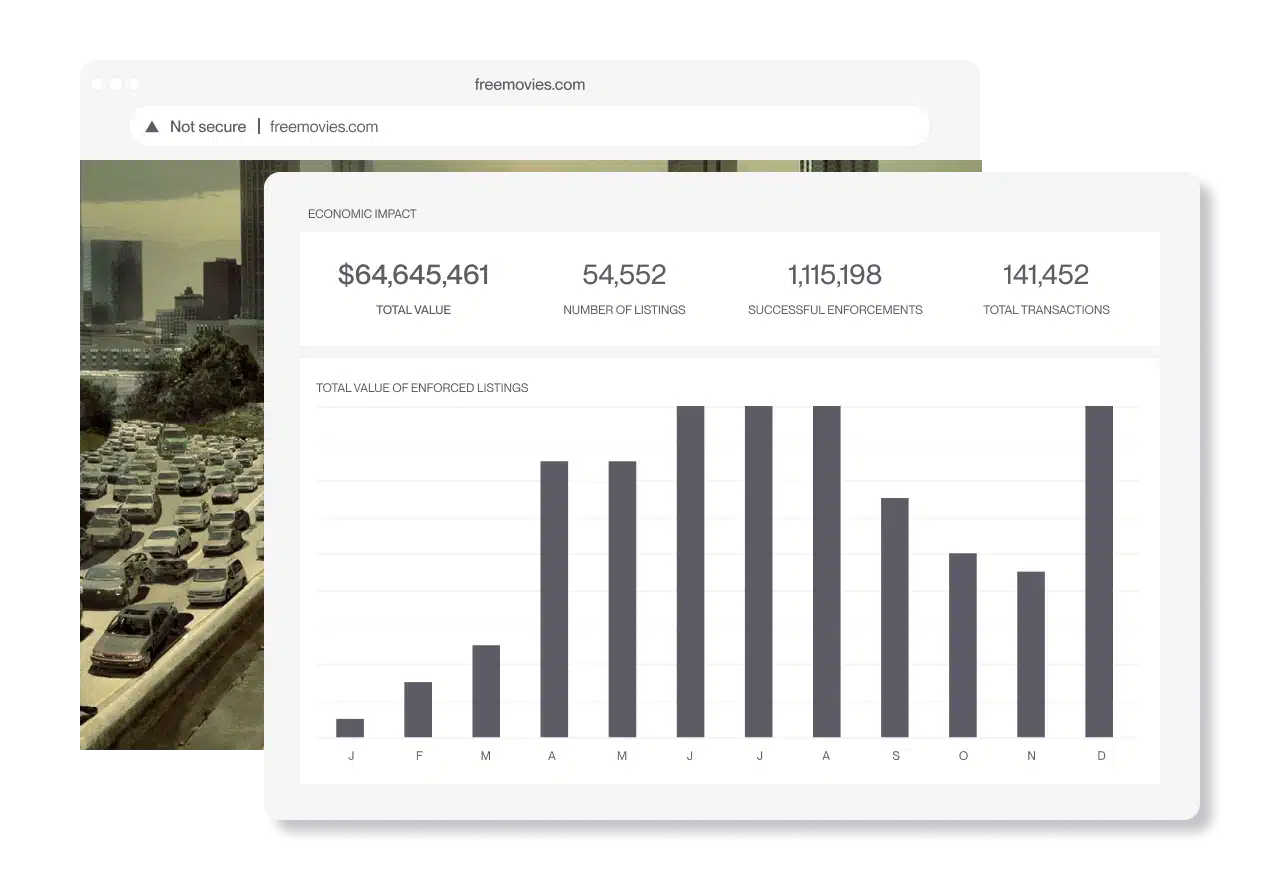
Red Points processes more than 5.1 million enforcements per year across piracy, websites, marketplaces, social media, search engines, and other digital channels.
Automation does not mean businesses need to surrender control over enforcement decisions. Red Points combines technology with specialist oversight, while teams can choose where they want to participate in validation and enforcement workflows.
A recent Red Points customer story also shows how account-sharing enforcement can be combined with action against piracy-related tutorials and unauthorized software access across online channels. Read the account-sharing case study for the full example.
Request a demo to see how Red Points can help identify and enforce against credential sharing and unauthorized account resale.
Frequently asked questions
What is password sharing?
Password sharing is the use of one person’s or organization’s login credentials by another user. Depending on the subscription rules, that use may be permitted, outside the intended account scope, or unauthorized.
Is password sharing illegal?
Not automatically. Whether password sharing creates a legal issue depends on factors such as how access was obtained, what the service’s terms allow, the applicable jurisdiction, and whether the activity involves unauthorized access, fraud, theft, or commercial resale.
For instance, in the United States, the Computer Fraud and Abuse Act addresses certain forms of unauthorized access to protected computer systems and trafficking in passwords used for unauthorized access. Whether the law applies to a particular password-sharing situation depends on the specific facts and jurisdiction.
Businesses should distinguish possible legal issues from ordinary breaches of subscription terms and obtain legal advice for specific cases.
Is password sharing the same as credential theft?
No.
Password sharing normally implies that an authorized account holder deliberately gives another person access. Credential theft involves obtaining or using login information without the account holder’s permission.
The two situations can create similar account activity but require different responses.
How can a business detect password sharing?
Businesses can review signals such as active devices, concurrent sessions, authentication events, location patterns, unusual usage, new-device frequency, and account-access behavior.
These signals should be considered together. A single device, network, or location change should not automatically be treated as proof of password sharing.
Can multi-factor authentication prevent password sharing?
Multi-factor authentication can make unauthorized access more difficult, particularly when someone only has the password.
It does not prevent every form of deliberate account sharing because an authorized user may still approve access for another person. MFA is therefore one part of a broader account-control strategy.
What is credential resale?
Credential resale occurs when account access is offered to third parties, normally in exchange for money or another benefit.
The seller may provide a username and password, a pre-configured account, a session cookie, an authentication token, or another method of reaching paid content or software.
How can businesses find credentials being sold online?
Businesses can monitor online channels for their brand name, subscription names, product terminology, account-access phrases, screenshots, pricing patterns, and other indicators associated with resale.
For larger programs, dedicated anti-piracy monitoring can reduce the need to search each source manually.
Should a business block every shared account?
Not necessarily.
The appropriate response depends on the account rules, confidence in the detection, customer context, and severity of the activity. A warning, re-authentication request, session reset, account review, or subscription change may be more appropriate than immediate blocking in some cases.
How can businesses prevent password sharing without affecting legitimate customers?
Use layered controls rather than one rigid rule.
Define permitted use clearly, combine several account signals, introduce step-up verification only where risk is higher, allow customers to manage trusted devices and sessions, and provide a straightforward way to resolve unusual activity.
Can Red Points help with password and account sharing?
Yes. Red Points’ Anti-Piracy solution and broader Anti-Piracy capabilities are designed to help businesses monitor online credential sharing and resale, validate incidents, enforce against unauthorized offers, and track recurring activity across digital channels.