


Amazon has invested over $1.2 billion and deployed more than 15,000 people to fight counterfeits, and still, fake listings appear every day. For brand owners, the damage is immediate: lost revenue, negative reviews caused by low-quality fakes, and customers who associate the bad experience with your brand, not the seller who defrauded them.
The good news is that Amazon has invested heavily in anti-counterfeit infrastructure. For brands, knowing how to use these tools can make counterfeit removal faster and help limit repeat infringement.
TL;DR
- Counterfeits, listing hijackers, and unauthorized sellers all damage your brand, and Amazon gives you more tools to fight them than any other marketplace.
- The fastest removal path is Brand Registry, then the Report Infringement form, then Report a Violation escalation, then Project Zero for instant takedowns.
- For long-term protection, layer Brand Registry, brand gating, the Transparency Program, Project Zero, Brand Catalog Lock, and continuous monitoring.
- Commingled FBA inventory is a specific Amazon counterfeit risk. A bad actor who sends fake units under your ASIN can have them shipped to customers buying from you. Opting into the FBA Label Service, also called stickered inventory, eliminates this.
- Project Zero gives eligible brands instant counterfeit removal, but access depends on Brand Registry enrollment and a reporting accuracy rate of at least 99%.
- Manual reporting works for isolated cases. Persistent counterfeits, hijackers, and unauthorized sellers require continuous monitoring and enforcement across Amazon and other marketplaces.
What does counterfeiting on Amazon look like?
Counterfeiting on Amazon takes several forms, and not all of them are obvious. The most straightforward case is a seller listing an outright fake: a product that copies your brand’s trademark, trade dress, or product design without authorization. But counterfeit activity also includes listing hijacking, where a third party attaches their offer to your legitimate product page and sells inferior or fake goods through your own ASIN.
Then there is the commingled inventory problem. Amazon’s default fulfillment model pools stock from multiple sellers into shared inventory bins. If an unethical seller sends in counterfeit units under your product’s ASIN, those units get mixed with your authentic stock. A customer who buys from you might receive a fake, and your listing collects the negative review.
The scale of the problem is significant. The OECD estimates that the global trade in counterfeit and pirated goods reached $509 billion in recent years. On Amazon specifically, third-party sellers account for more than 60% of all sales, creating a vast surface area that counterfeiters actively exploit.
Amazon Brand Registry: your starting point for everything
Amazon Brand Registry is the foundation of every brand protection tool on the platform. Without it, you have limited ability to edit your own listings, no direct access to Amazon’s enforcement tools, and no eligibility for advanced programs like Project Zero or Transparency.
Brand Registry is free and open to brands with an active registered trademark in a country where Amazon operates. Enrollment gives you enhanced control over your product detail pages, priority handling on counterfeit reports, and access to Amazon’s brand protection specialists rather than the general support queue.
To enroll, go to brandservices.amazon.com, enter your brand name exactly as it appears on your trademark registration, provide your registration number and the issuing trademark office, and verify ownership through the email address on file with that office. Once enrolled, you unlock the Report a Violation tool, A+ Content, Brand Analytics, and eligibility for Project Zero and Transparency.
Brands with pending trademark applications can access Brand Registry faster through Amazon’s IP Accelerator program, which connects you with vetted IP law firms to expedite trademark registration and reduce the gap between launching on Amazon and having full Brand Registry protection.
If you sell branded products on Amazon, Brand Registry is effectively non-negotiable. It is the prerequisite for everything else in this guide.
How to remove a counterfeit from Amazon: step by step
Step 1: Document the infringing listing before you do anything else
Before filing any report, collect evidence. Amazon’s enforcement forms ask for specific information, and a well-documented submission gets processed faster and with fewer follow-ups.
Screenshot the infringing listing in full: seller name, ASIN, product images, and any brand elements being misused. Record the exact listing URL and the seller’s storefront URL. If you can, purchase a sample unit. A physical counterfeit is the strongest evidence you can have, and the shipping label will often reveal additional information about the seller. Keep a log of when you first spotted the listing and any prior communications with the seller.
Step 2: File a report through Amazon’s Report Infringement form
Navigate to amazon.com/report/infringement. Select “Counterfeit” or “Trademark infringement” depending on what you can prove. For fake products, counterfeit is typically the right category.
Enter your trademark registration details, the infringing ASIN, and a clear description of why the listing violates your rights. Attach your documentation.
Amazon does not publish one fixed review timeline for every type of claim, and timing can vary by case complexity and reporting route. Standard submissions are commonly reviewed within a few business days. If the report is accepted, the listing is removed. If rejected, you will receive an explanation and can resubmit with additional evidence.
Step 3: Escalate through Brand Registry’s Report a Violation tool
If your standard submission is rejected or goes unanswered, escalate through Brand Registry. In Seller Central, go to Brand > Report a Violation and search for the infringing ASIN directly. This routes your case to brand protection specialists rather than the general queue, and gives you a dedicated case number for tracking.
For recurring or high-volume infringement, such as multiple sellers listing fakes across many ASINs, use the bulk submission tool, which lets you submit up to 100 ASINs in a single report.
Step 4: Use Project Zero for instant removal, if you are eligible
Amazon Project Zero is the fastest available tool for confirmed counterfeits. Brands enrolled in Project Zero can remove a counterfeit listing immediately using the self-service removal tool, without waiting for Amazon to review the case.
Project Zero also includes automated protections that proactively scan Amazon for potentially infringing listings and remove them before you even need to file a report. To access it, apply through Seller Central > Brand > Project Zero.
Eligibility requires Brand Registry enrollment and a reporting accuracy rate of at least 99%. Incorrect removals count against your standing and can result in loss of access to the self-service tool.
Use self-service removal only when you have direct, clear evidence of counterfeiting. This is not the place for borderline cases.
Step 5: Report unauthorized sellers separately
Unauthorized sellers and counterfeiters are related but distinct problems. An unauthorized seller may be selling a genuine product, just one that came through a channel you did not authorize. Both are worth addressing, and Amazon has separate enforcement mechanisms for each.
To report an unauthorized seller, go to their storefront page, which you can access by clicking their name on your product listing, and click “Report abuse.” Select the most accurate category: “Selling without authorization” if the seller is not in your approved distribution network, or “Selling counterfeit or fake items” if you have evidence of a fake product. Include documentation of your authorized distribution channels and, if relevant, any evidence that the seller’s stock is not legitimate.
If you have set up brand gating, unauthorized sellers who have not received pre-approval should not be able to list at all. Report any who slip through as a direct violation of your selling restrictions.
Step 6: For repeat offenders, consider legal action
Amazon’s enforcement tools are effective for removing individual listings. They are less effective at preventing the same counterfeiter from returning under a new seller account.
For repeat offenders, document identifying details from the original account and include them in every follow-up report. For serious operations, consider escalating to Amazon’s Counterfeit Crimes Unit, which works with law enforcement on criminal cases, or pursue legal remedies including cease-and-desist letters and civil litigation.
Amazon’s brand protection programs: a closer look
Amazon Project Zero
Beyond the self-service removal tool, Project Zero includes two additional layers. Automated protections continuously scan Amazon for listings that may infringe your brand and remove them proactively, without any action on your end. Product serialization lets you apply unique codes to your products that Amazon verifies before shipping, blocking uncoded units, including counterfeits, from reaching customers.
Project Zero is powerful, but it also gives brands significant responsibility. Amazon requires brands using the self-service counterfeit removal tool to maintain a reporting accuracy rate of at least 99%, so it should only be used for confirmed counterfeit cases where the evidence is clear.
The Amazon Transparency Program
The Amazon Transparency Program takes authentication one step further. You apply unique, scannable Transparency codes to every unit at the point of manufacture. Amazon scans these in fulfillment centers before shipment. Any unit without a valid code is blocked. Customers can also scan the code themselves to verify the product is genuine.
Transparency carries a per-unit cost, roughly $0.01 to $0.05 depending on volume, and requires codes to be applied during manufacturing or packaging, which means coordinating with your production team. For brands where counterfeiting is a recurring issue, it effectively closes the FBA loophole that counterfeiters use to inject fake units into Amazon’s fulfillment network.
Amazon Brand Registry
Brand Registry is the prerequisite for all other programs. If you have not enrolled yet, start there.
Brand Registry gives you stronger control over product detail pages, access to Amazon’s infringement reporting tools, and eligibility for advanced programs like Project Zero, Transparency, and Brand Catalog Lock. It also gives Amazon clearer confirmation that you are the rights holder, which helps enforcement teams evaluate your reports more efficiently.
Brand gating
Brand gating restricts who can list products under your brand on Amazon. When gating is active, a third-party seller who wants to list one of your products must first obtain pre-approval, typically by submitting invoices proving they are an authorized reseller. This directly blocks unauthorized sellers at the point of listing rather than after the fact.
Brand gating is not self-service. You need to request it through Amazon Seller Support or your Brand Registry contact, and Amazon evaluates each request based on your brand’s infringement history and account health. Prepare authorization letters, documentation of your distribution channels, and evidence of ongoing infringement if you have it.
Brand Catalog Lock
Brand Catalog Lock is a Brand Registry enhancement introduced in 2025. It gives brand owners the ability to lock key product detail fields, including titles, images, bullet points, and descriptions, so they cannot be modified by unauthorized sellers or resellers.
This is especially useful for brands dealing with listing hijacking. If a third party attaches to your ASIN and attempts to alter your product page, Brand Catalog Lock helps keep the official brand-controlled version intact. It protects listing consistency, reduces customer confusion, and makes it harder for hijackers to manipulate the product page to support counterfeit or misleading offers.
The Amazon Patent Evaluation Express (APEX) program
Counterfeit and trademark tools do not resolve one specific situation: a seller offering a product that copies your patented invention rather than your brand. For utility-patent disputes, Amazon runs the Amazon Patent Evaluation Express program, also known as APEX or the Utility Patent Neutral Evaluation procedure. A neutral, Amazon-appointed evaluator — typically a patent attorney in private practice — decides whether the accused listing infringes your patent. Amazon does not rule on the dispute itself; it removes the listing if the evaluator finds in the patent owner’s favor and leaves it live if not.
The process is deliberately narrow. Each APEX request covers a single U.S. utility patent and a single patent claim, and only granted utility patents qualify — design patents and non-U.S. patents are not eligible. After the patent owner submits a request, Amazon notifies each accused seller, who can remove the listing, decline to participate (which results in automatic removal), or opt in. If at least one seller opts in, both sides submit a refundable deposit to the evaluator and exchange written arguments on a fixed schedule. The patent owner typically gets 21 days for opening arguments, the seller 14 days to respond, and the patent owner 7 days for an optional reply, with a written decision usually issued within roughly 90 days of opt-in. The losing party forfeits its deposit to cover the evaluator’s fee; the winner is refunded.
APEX is often faster and far cheaper than federal patent litigation, which makes it a practical route for smaller brands. There is no appeal within the program, though either party can still pursue a lawsuit in federal court. Because it hinges on a well-constructed claim chart mapping your patent to the accused product, it works best when the infringement is clear and the patent is straightforward to read against the listing.
How to prevent listing hijacking and unauthorized sellers
Amazon listing hijacking happens when a third-party seller attaches their offer to your existing product page without authorization. They piggyback on your images, copy, and reviews to sell products that may be counterfeit, gray-market, or simply misrepresented. The most effective prevention is structural rather than reactive.
Enroll in Brand Registry before you launch
Early enrollment gives you control over your listing content from day one and makes it harder for third parties to alter your detail page.
Lock your listing content with Brand Catalog Lock
Amazon introduced Brand Catalog Lock in 2025 as part of its Brand Registry enhancements. Once activated, it prevents anyone other than your authorized representatives from modifying key product detail fields, including titles, images, bullet points, and descriptions.
This directly addresses one of the most common hijacker tactics: altering your listing content to misrepresent the product or redirect customers. To enable Brand Catalog Lock, use the Brand Registry dashboard or contact your Brand Registry support route for the ASINs you want to protect. Amazon interface paths can change, so confirm the exact activation flow in your current Seller Central or Brand Registry account before publishing internal instructions.
Control your Buy Box
If you sell your products directly on Amazon, maintaining competitive pricing and strong seller metrics keeps the Buy Box in your hands. A hijacker who cannot win the Buy Box has far less visibility.
Tighten your distribution
The more paths exist for your products to reach resellers, the more opportunities there are for unauthorized sellers to acquire stock. Use authorized reseller agreements with enforcement provisions, and consider minimum advertised price (MAP) policies to reduce the incentive for gray-market activity.
Monitor your ASINs continuously
Set up alerts for new sellers attaching to your listings. Early detection means you can act before a hijacker builds up reviews or organic traffic.
How commingled inventory creates a counterfeit risk, and how to fix it
Amazon’s default FBA model pools identical products from multiple sellers into shared bins. This is called commingled inventory. It can create a serious counterfeit risk because units from different sellers may be stored together under the same ASIN.
If a bad actor sends counterfeit units into the FBA network under your product’s ASIN, those units can be mixed with authentic inventory. A customer who buys from you may receive a counterfeit unit, and your brand may be blamed through negative reviews, customer complaints, or loss of trust.
The fix is straightforward: enroll in the FBA Label Service, also called stickered inventory. This requires individually labeling every unit you send in with a unique barcode, so your stock is never pooled with other sellers’ stock. There is a small per-item fee, but it ensures that any unit shipped to a customer under your ASIN actually came from your inventory.
Amazon counterfeit protection: layering your defenses
No single program eliminates the counterfeit risk entirely. The brands that manage it most effectively layer multiple tools:
- Brand Registry provides the reporting infrastructure and gates access to everything else.
- Project Zero adds proactive automated scanning and instant removal capability.
- Transparency blocks counterfeits at the fulfillment stage before they reach customers.
- Brand Gating restricts who can list at the entry point.
- Brand Catalog Lock protects listing content from unauthorized edits.
- Continuous monitoring catches new threats before they scale.
The goal is to make it difficult enough for a counterfeiter to persist on your listings that they move on. No brand can eliminate all risk, but layered defenses raise the cost of counterfeiting significantly.
How Red Points helps protect your brand on Amazon
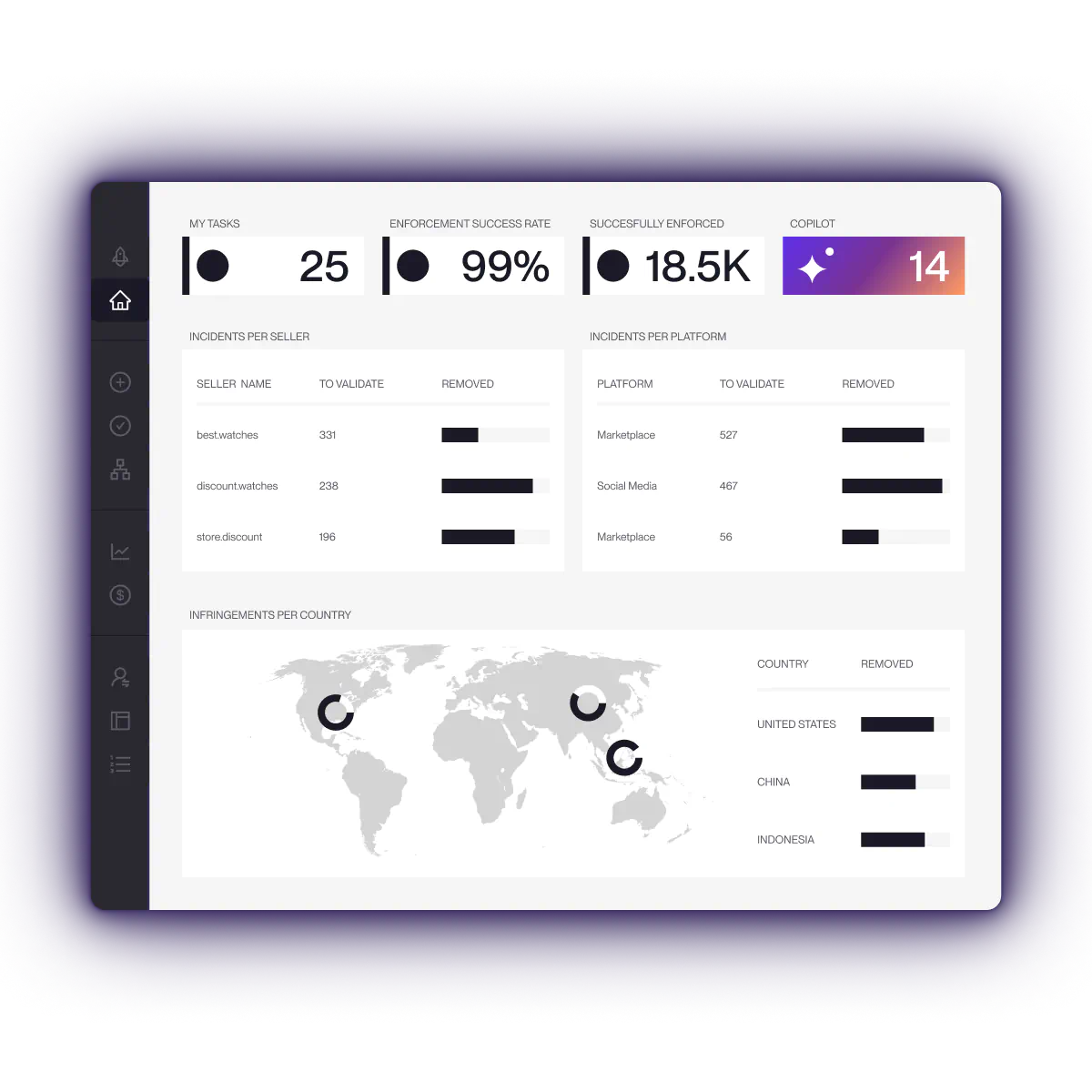
Red Points’ Brand Protection platform automates the detection and enforcement work that, done manually, is a full-time job with no finish line. Using AI trained over more than 10 years on brand protection data, Red Points continuously scans Amazon and 5,000+ other marketplaces for counterfeit listings, unauthorized sellers, and listing hijackers, and enforces against them automatically.
Red Points processes 90M+ new links per day and delivers 5.1M+ enforcement actions per year across 1,300+ brands. For Amazon specifically, that means continuous monitoring across seller accounts, ASINs, and search results without requiring your team to run manual searches, plus automated enforcement that files reports directly with Amazon’s systems at the volume individual reporting cannot match.
For brands dealing with Amazon counterfeits, that means:
- 24/7 monitoring across seller accounts, ASINs, and search results without requiring your team to run searches manually.
- Automated enforcement that files reports directly with Amazon’s systems at scale.
- Data and trend reporting that shows where counterfeiting activity is concentrated, which sellers are repeat offenders, and how the problem is evolving over time.
Brands using Red Points move from reactive, case-by-case reporting to a systematic protection model: one where most infringements are caught and actioned before they affect customers or organic rankings.Protect your brand on Amazon → Request a demo
Frequently asked questions
Standard submissions through the Report Infringement form are commonly reviewed within a few business days, though timing can vary depending on the claim type, evidence quality, and case complexity. Submissions through Brand Registry’s Report a Violation tool are often faster, since they route to brand protection specialists. If you are enrolled in Project Zero, self-service removals can process within minutes.
Yes. Project Zero gives eligible brands a self-service removal tool that lets you take down confirmed counterfeit listings immediately. Eligibility requires Brand Registry enrollment and a reporting accuracy rate of at least 99%. Brands should only use this tool for clear counterfeit cases, because incorrect removals can affect access to Project Zero.
A counterfeit is a fake product that replicates your brand’s trademark or trade dress without authorization. An unauthorized seller may be selling a real product, just one outside your approved distribution network. Both are addressable on Amazon, though counterfeit reports typically trigger stronger enforcement action.
Brand Registry is a free program for registered trademark holders that gives you enhanced listing control, access to reporting tools, and eligibility for Project Zero and Transparency. It requires an active trademark registration or, in some cases, a pending trademark application through Amazon-supported routes such as IP Accelerator. For any brand selling on Amazon, it is effectively essential.
Brand gating restricts who can sell under your brand on Amazon. Third-party sellers must get pre-approval before listing your products, which directly blocks unauthorized sellers. It is not self-service. You need to request it through Amazon Seller Support or your Brand Registry contact.
Transparency lets you apply unique serialized codes to your products at manufacture. Amazon scans these in fulfillment centers, and units without valid codes are blocked from shipping. Customers can also scan the codes to verify authenticity. There is a per-unit cost, and codes need to be applied at the production stage.
Project Zero combines automated brand protection scanning, a self-service counterfeit removal tool, and optional product serialization. It proactively removes suspected infringing listings and allows eligible brands to take down confirmed counterfeits instantly. Amazon requires brands using the self-service tool to maintain at least 99% accuracy.
Brand Catalog Lock is a Brand Registry enhancement that lets brand owners lock key product detail fields, including titles, images, bullet points, and descriptions. This helps prevent unauthorized sellers, resellers, or hijackers from changing listing content and misrepresenting the product.
Document identifying information from the original seller, including storefront name, location if visible, listing patterns, and repeated ASINs targeted, and include it in all follow-up reports. For serious repeat offenders, consider escalating to Amazon’s Counterfeit Crimes Unit or pursuing legal action such as cease-and-desist letters or civil litigation.
Red Points automates detection and enforcement. Instead of manually searching for fakes and filing individual reports, Red Points’ AI monitors Amazon continuously and enforces against infringing listings automatically. Brands get full visibility into the scope of the problem across all their ASINs and markets, and can act at scale rather than case by case.