


A customer sees an Instagram profile using your logo, your product photos, and your brand voice. They click through, buy from a scam link, receive nothing or a counterfeit product, and blame your brand. That is how fake Instagram accounts turn into lost revenue, support tickets, and brand damage fast. The good news is that Instagram gives brands, creators, and rights holders several ways to report severe violations, including impersonation, copyright infringement, and trademark abuse.
The manual workflow is not complicated. The real challenge is volume. One fake account is manageable. Ten lookalikes across Instagram, Facebook, TikTok, and scam websites is where most teams start losing time and control. Red Points’ own materials position this as the core break point between ad hoc reporting and scalable enforcement, supported by 24/7 monitoring, image recognition, and human-in-the-loop review for complex cases.
TL;DR
- Instagram allows rightsholders to report fake or infringing accounts using dedicated impersonation and IP reporting flows, including official copyright and trademark forms.
- You need strong evidence – for example, a government ID for impersonation claims, or registration details, ownership information, and URLs for trademark or copyright complaints.
- There is no magic number of reports required. A single thorough report can be enough, especially when the violation is serious and well documented.
- Manual reporting works for isolated cases, but repeated impersonation, stolen content, scam funnels, and copycat accounts usually require continuous monitoring and repeatable enforcement.
Instagram banning process at a glance
| Step | What you do | Why it matters |
| Step 1 | Select the correct reporting form | Directs your claim to the right Instagram review team |
| Step 2 | Enter contact information | Identifies the reporter and copyright owner |
| Step 3 | Provide evidence and documentation | Proves identity or IP ownership |
| Step 4 | Link the offending content | Points Instagram directly to the violation |
| Step 5 | Submit and track | Initiates the review process |
Before you start
Preparation matters because the wrong form slows everything down. If the problem is a fake profile pretending to be your founder, executive, creator, or brand rep, use the impersonation path. If the problem is stolen product photos, a copied logo, or trademark misuse, use the copyright or trademark path instead. Red Points’ current Instagram article explicitly warns that the impersonation form is not the right route for trademark claims.
Gather your evidence first. In practice, that means your full contact details, proof you are the rights owner or authorized representative, copies of any registration certificates or ownership records, and the exact Instagram profile URLs, post URLs, and screenshots you want reviewed. The TikTok guide uses the same logic – getting the evidence ready upfront reduces delays and missing-information rejections.
One more thing matters here – be precise. Instagram’s reporting systems are built to evaluate specific content or accounts, not vague descriptions like “they copied our page.” Exact links, exact assets, and exact ownership details give your report a much better chance of moving quickly.
How to ban an Instagram account: Step-by-step
Instagram does not treat all reports the same. Impersonation and intellectual property claims go through different paths, require different proof, and can lead to different outcomes. That is why the safest way to handle this is to split the workflow into two separate reporting tracks.
Path A: Report an account for impersonation
Impersonation is the clearest route when a fake Instagram profile is pretending to be you, your brand, your founder, your executive team, or someone you represent. Instagram provides both in-app reporting and a separate impersonation form for this.
On mobile
Go to the offending Instagram profile,then:
- Visit the Instagram profile you want to report in the Instagram app
- Tap the three dots in the upper right for the menu and tap Report
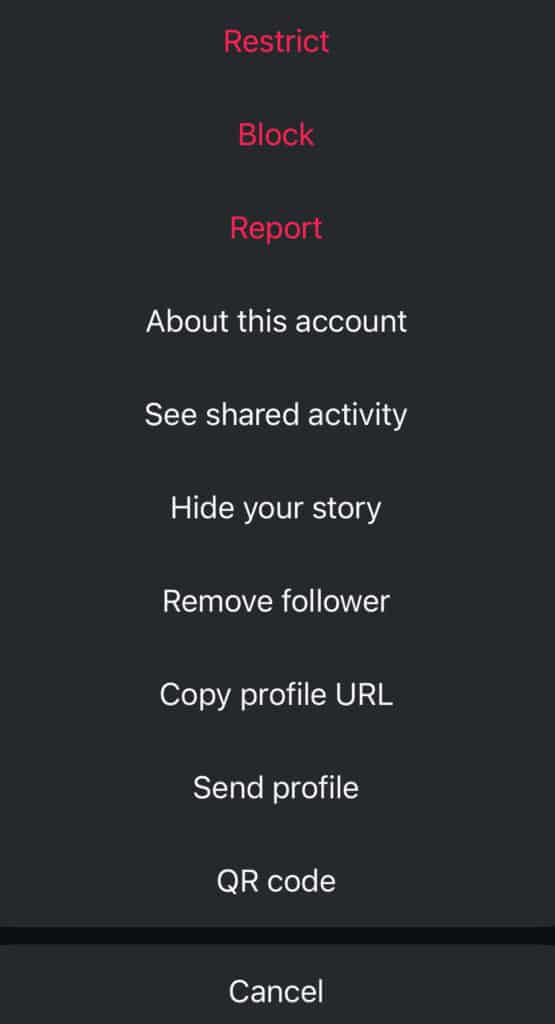
3. Tap Something about this account
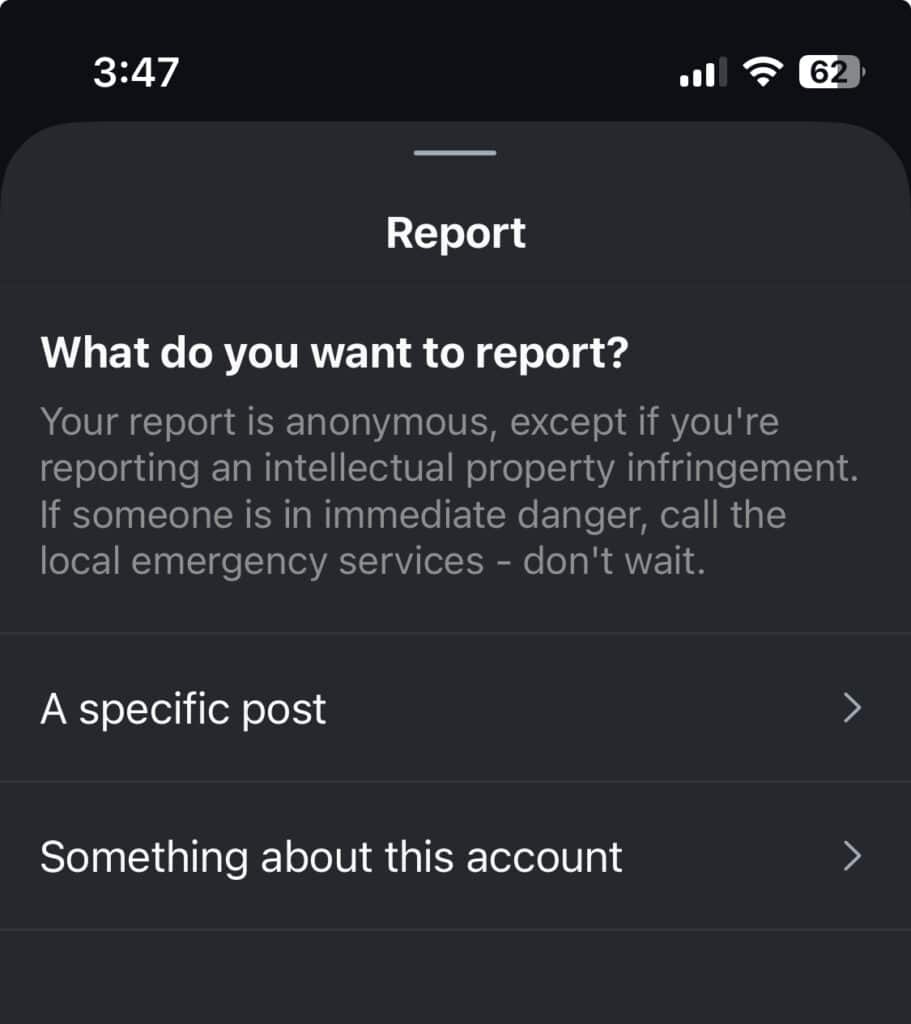
4. Tap They are pretending to be someone else
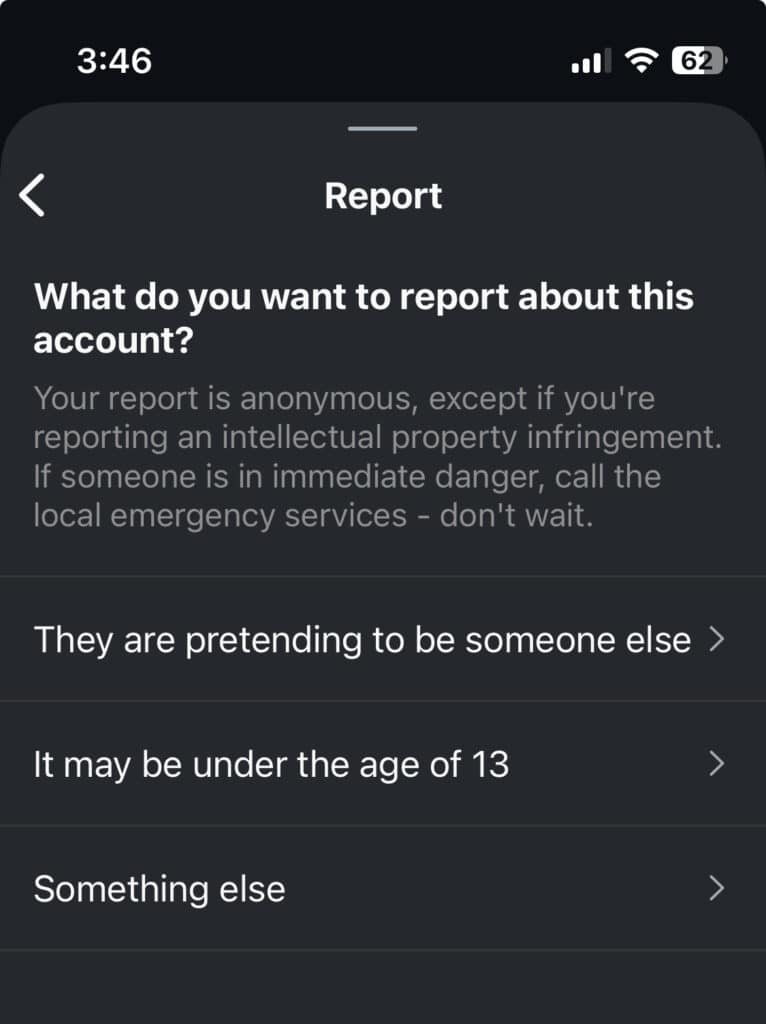
5. Choose Me or Someone else depending on who they’re impersonating
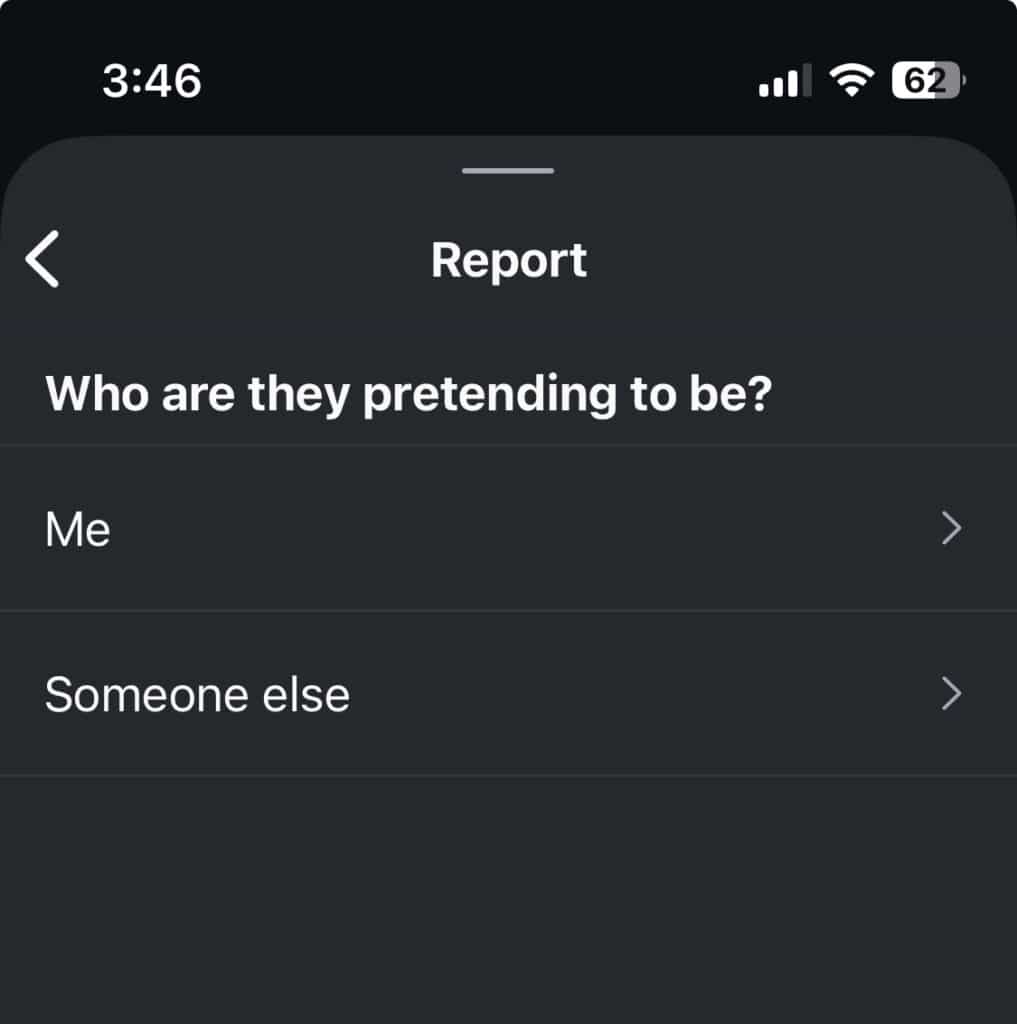
6. Once you select Me, Instagram will file the report.
7. If you select Someone else, you’ll search for another Instagram account and then file the report.
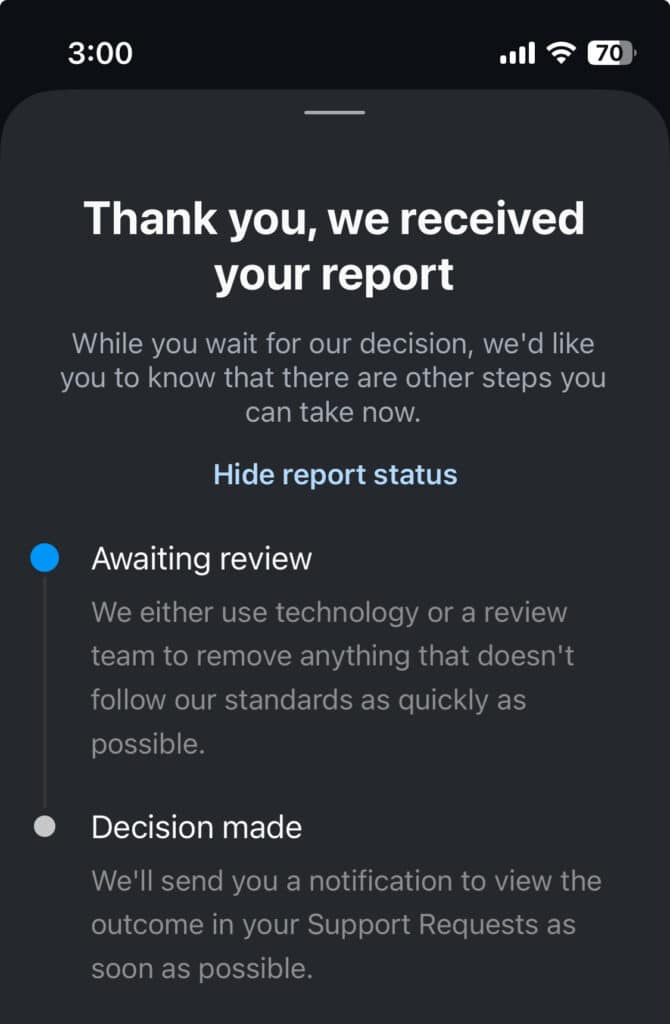
8. Now, wait until Instagram reviews the report.
On desktop
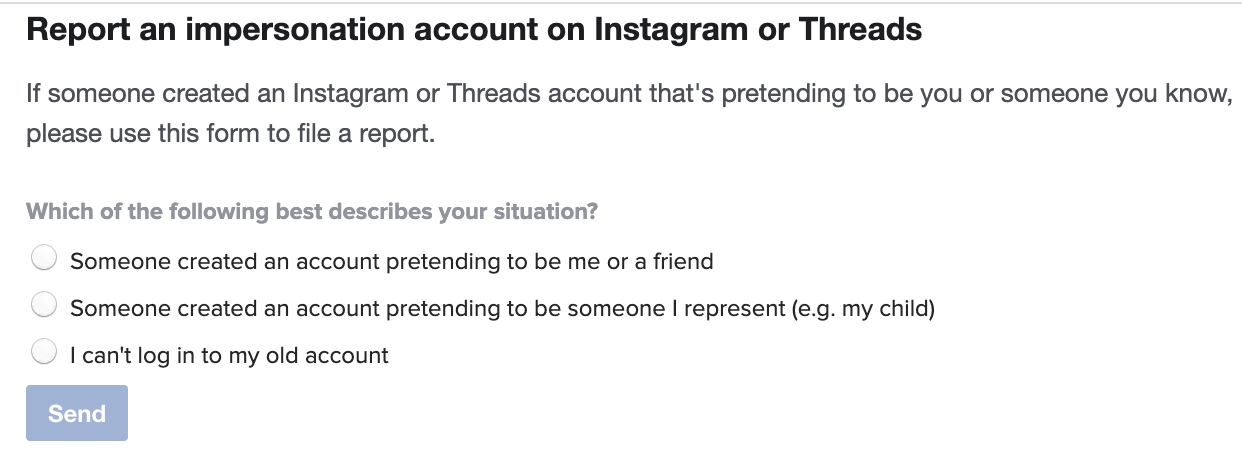
- Visit the Instagram Help Center impersonation report form.
- Choose someone created an account pretending to be me if you’re being impersonated.
- Choose someone created an account pretending to be someone I represent if you’re reporting on behalf of someone else.
4. Next, fill out your full name and email plus the Instagram account name and username you’re reporting.
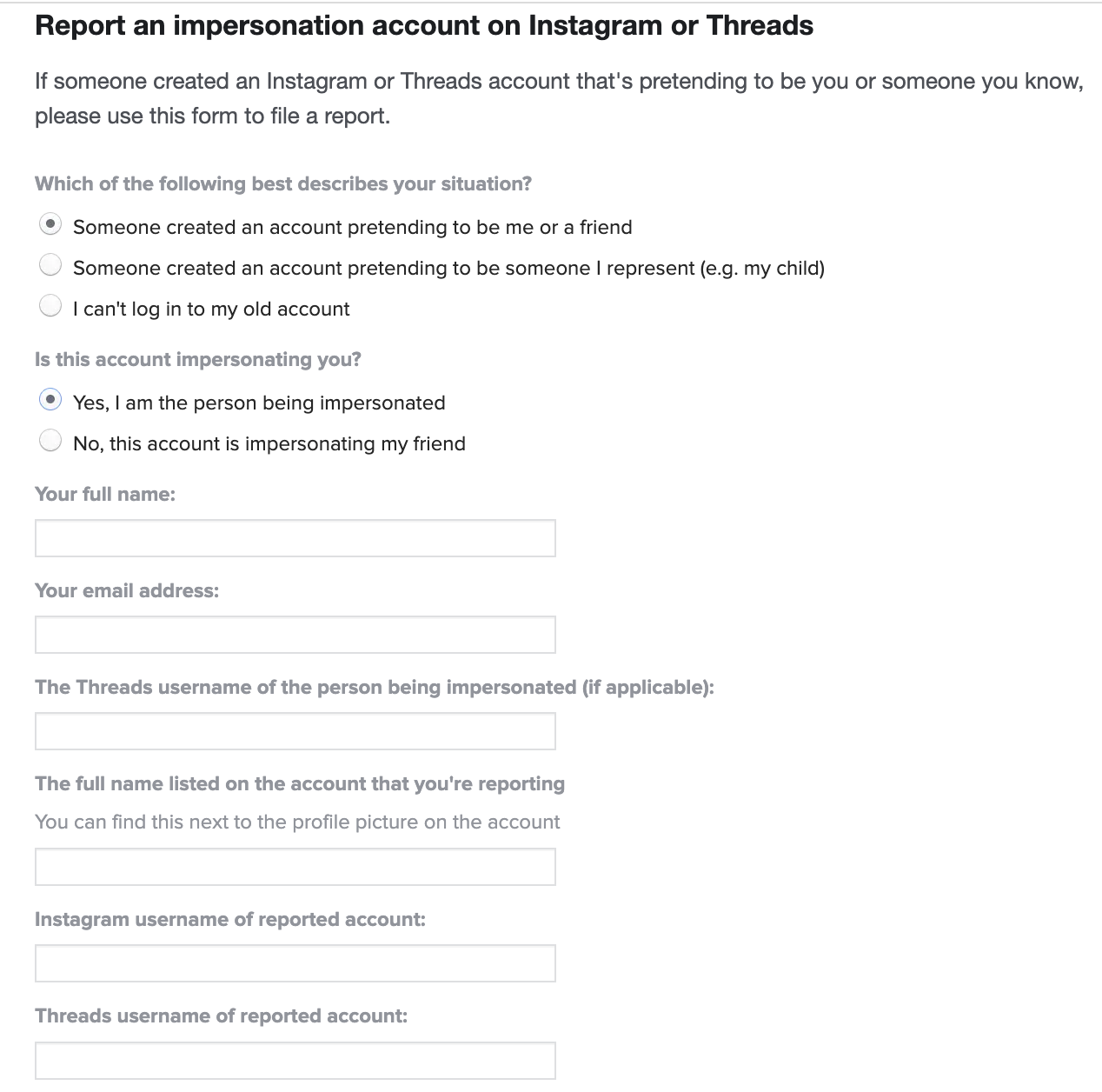
5. If you’re representing someone else, you’ll include your relationship to the person being impersonated.
6. Finally, upload a photo of yourself holding your government ID and click submit.
7. If you’re representing someone else, you’ll upload a photo of that person holding their ID.

Path B: Report an account for copyright or trademark infringement
Copyright and trademark complaints follow a different review path because they are not primarily about identity deception. They are about unauthorized use of protected assets such as product photography, campaign creatives, logos, slogans, packaging, or branded visuals. Instagram provides dedicated official forms for both types of IP claims.
Instructions for mobile reporting
- Like above, visit the offending profile on Instagram, open the menu, and select Report
- Next, tap Something about this account
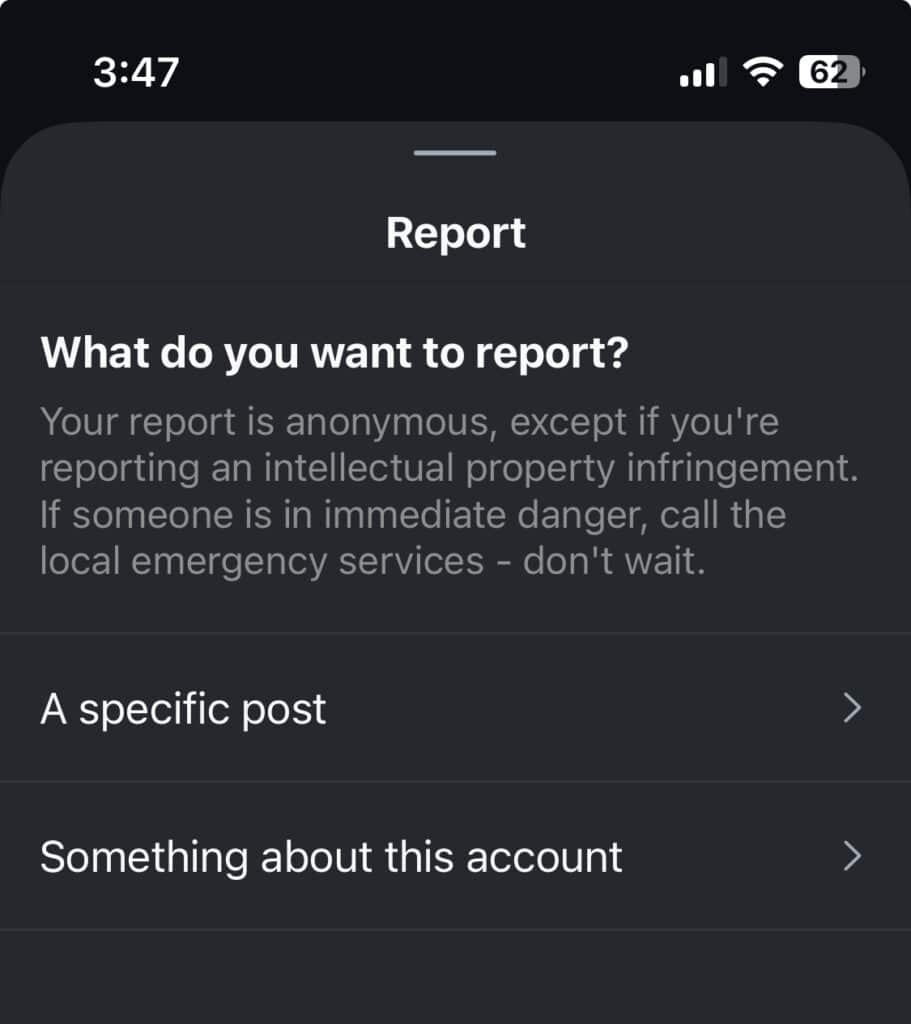
3. Then tap Something else
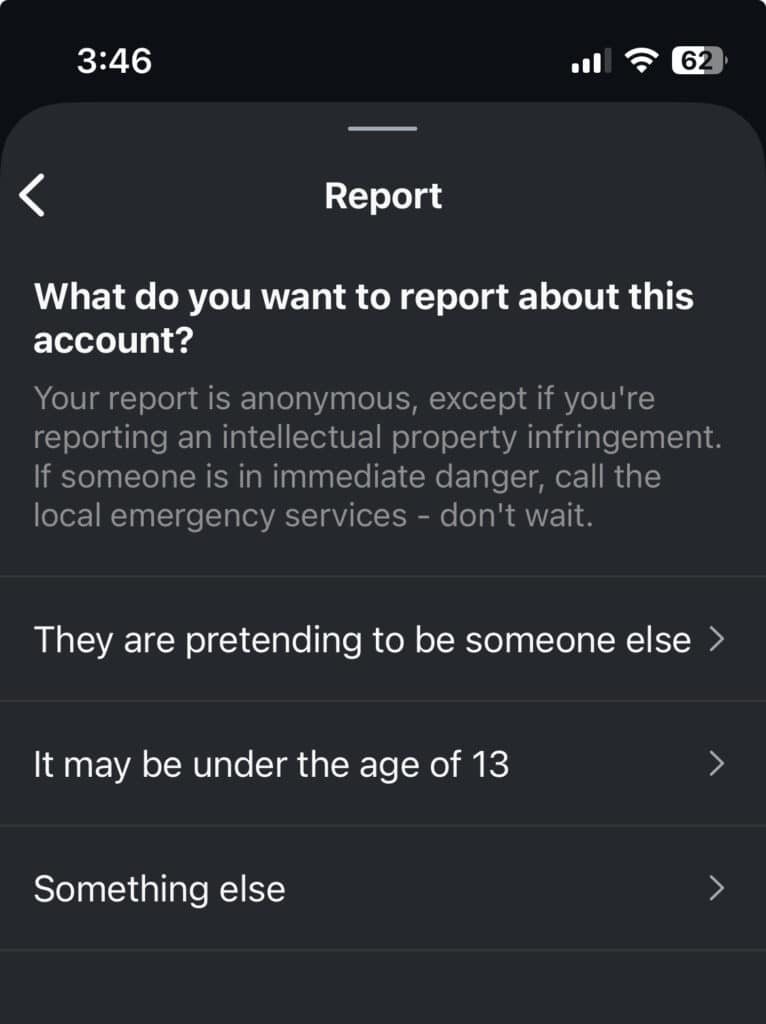
4. Now, scroll down until you see Intellectual property violation and tap
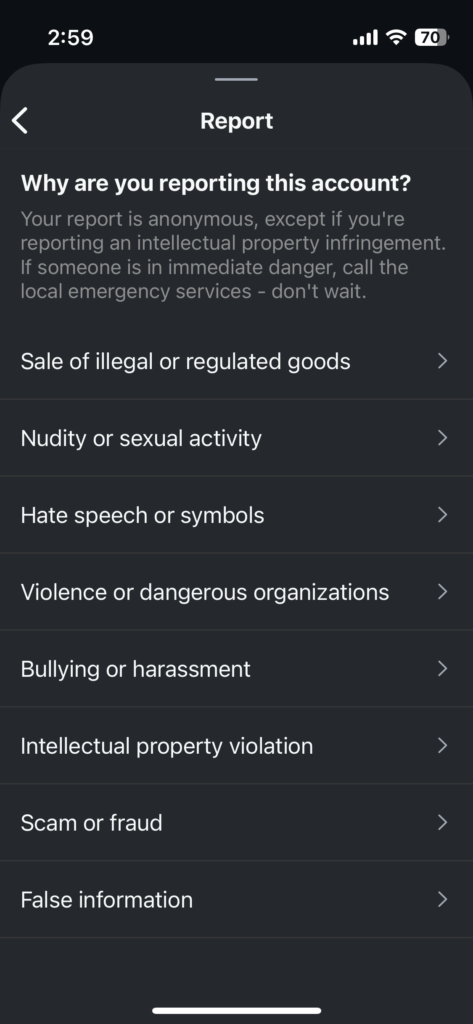
5. Tap Report in Help Center to begin a trademark report. Instagram will open a browser window for you to fill out a detailed report.
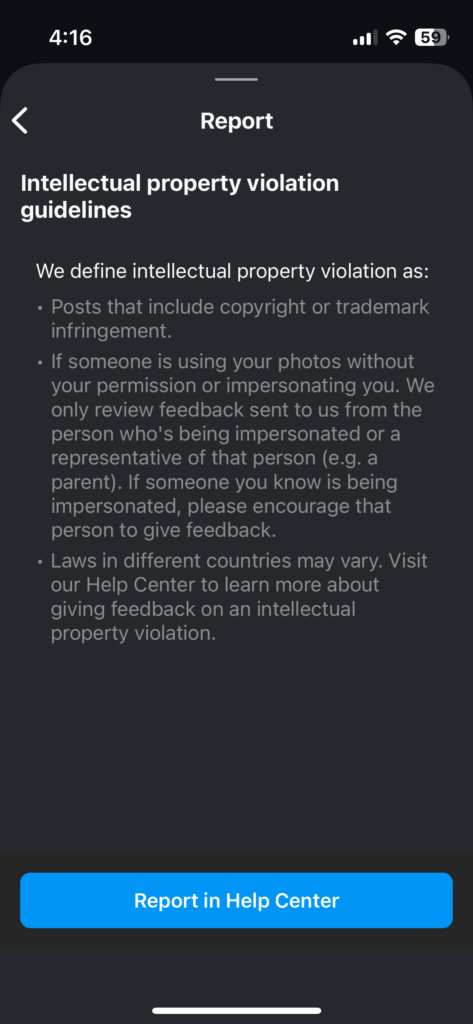
6. Navigate to the links Learn more about trademarks then click fill out this form.
Note: use desktop if you can. Desktop is usually easier because the forms often require more detail and sometimes supporting attachments. We recommend the trademark form flow on desktop because it is easier to add ownership details and documentation cleanly
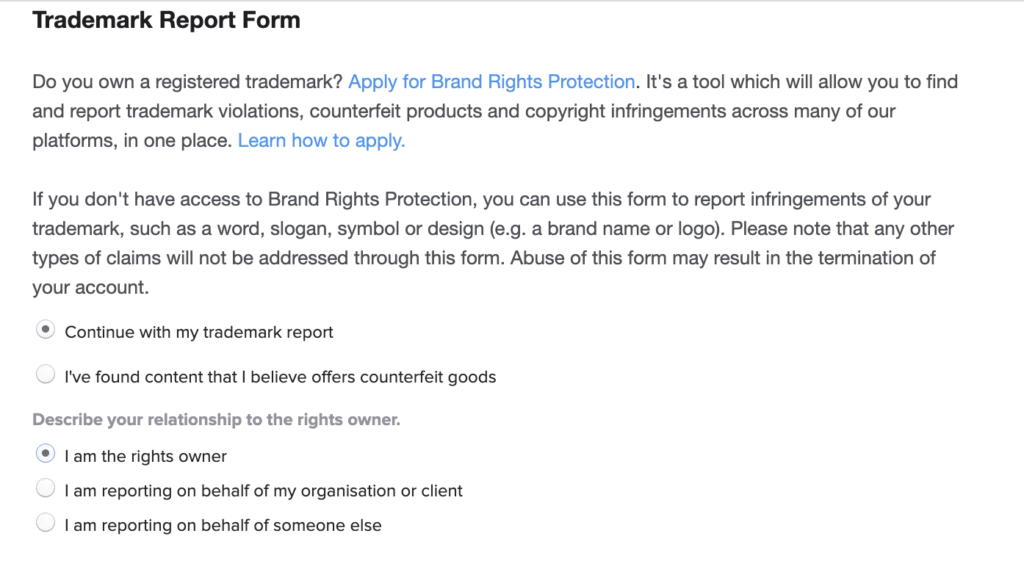
7. Select Continue with my trademark report and choose whether you or someone else is the right’s owner.
8. Continue filling out the form by adding your full name, address, email, name of the rights owner, and a link to the official online presence.
9. For each trademark, list what it is, where it’s registered, and the registration number.
10. Attach registration certificates if possible.
11. Choose how the content you’re reporting infringes the trademark.
12. Provide links to the content you want to report then submit the form.
For copyright claims
Use Instagram’s copyright form when the fake account is reposting your original photos, videos, graphics, or other copyrighted content without authorization. You should include:
- a description of the copyrighted work,
- the URLs of the infringing content,
- and proof that you own or are authorized to enforce the work.
What a proper DMCA-style notice should include
A strong copyright complaint should include the legal basics that make a takedown credible. DMCA Authority’s guide highlights four core elements:
- A good-faith belief that the use is unauthorized
- A statement that the notice is accurate
- A statement made under penalty of perjury
- A physical or electronic signature.
Those details are especially useful when you are escalating beyond ordinary in-app reporting.
What is Instagram’s policy on violations?
Instagram removes more than just obvious impersonation. The platform’s reporting options and Meta’s public policy materials show that enforcement spans spam, scams, harassment, hate speech, self-harm content, nudity or sexual activity, intellectual property violations, false information, and illegal or regulated goods.
Violations can be divided into three useful buckets:
- First are account behaviors, such as mass following and unfollowing, repetitive commenting, and repeated tagging.
- Second is content, such as nudity, hate speech, bullying, self-harm content, and illegal products or services.
- Third is other abuse, including copyright violations and stolen content.
For brands, the practical takeaway is simple – impersonation and IP abuse are severe enough to justify immediate reporting through the dedicated channels, rather than waiting to see if the behavior escalates. Meta’s IP policy materials make clear that posting content that infringes others’ IP is prohibited, while Meta’s broader account integrity policies focus on harmful or deceptive accounts.
What happens after you submit the report?
After submission, Instagram reviews the evidence and compares the account or content against its policies. Typical outcomes are: rejection of the report, removal of a specific post, a warning to the account owner, or removal of the account entirely. Brands should generally expect a response in 24 to 48 hours.
The important point is that Instagram does not promise the same result for every case. A weak report may fail even when the account is suspicious. A strong report with precise documentation can move much faster, especially when the violation is obvious and the ownership trail is clear.
What if you don’t hear back or the account isn’t deleted?
If 48 hours pass without a response, resubmitting the form is recommended, since technical issues or incomplete submissions can delay review. If you are rejected, check whether you used the right form and whether your evidence actually proves the specific claim you made. A trademark problem filed as impersonation is a common failure point.
You should also keep monitoring after the first takedown request, because bad actors often recreate profiles after one account disappears. That matches the broader brand protection reality on Instagram – the issue is rarely one account, but a repeating pattern.
Encouraging colleagues, partners, or affected followers to submit their own legitimate reports can also help reinforce the seriousness of the abuse. Multiple reports can increase the chance of faster action, though a single strong report can still be sufficient.
Tips for protecting your own account
Prevention reduces enforcement load. Three practical steps that fit well for brands and creators are: active monitoring, watermarking content, and escalating to DMCA-style takedowns when ordinary reporting is not enough.
Active monitoring matters because fake accounts rarely stop at one copy. Watermarks are important because they make ownership easier to prove when your visuals are reposted without permission. And formal takedown workflows are necessary because they create a stronger paper trail when the infringer is persistent.
Brands should also think beyond Instagram alone. Fake profiles on Instagram, Facebook, TikTok, X, Telegram, and scam websites often sit inside the same fraud funnel, especially when the goal is counterfeit sales or phishing. That is where channel-by-channel manual monitoring starts to fail.
When manual reporting stops being enough
Manual reporting is the standard starting point. However, manual reporting breaks down once the same brand assets are being reused across multiple fake accounts, repeat uploads, scam links, and connected channels – the question stops being “How do I report this post?” and becomes “How do we keep this under control every day?”
That pain is not theoretical. Manual workload, slow enforcement, customer confusion, reputation damage, and revenue loss are real consequences of social media impersonation. This is why continuous monitoring, unlimited enforcement, clear reporting, and a mix of automation plus expert review is essential.
The scale of the broader counterfeit problem also shows why this matters. The OECD and EUIPO estimate that counterfeit and pirated goods accounted for USD 467 billion in global trade in 2021, or 2.3% of global imports. Social media is one of the channels counterfeit buyers increasingly trust, which turns fake accounts into a real commerce and reputation problem, not just a moderation issue.
How Red Points scales Instagram enforcement
The standard best practice is to monitor social media continuously, document every infringement clearly, and use the correct enforcement route for each case. The friction is that no in-house team can search Instagram manually all day, review every reuse of brand imagery, and keep resubmitting reports every time a bad actor comes back. This is where Red Points becomes the operational layer that turns best practice into something scalable.
Monitoring and detection
Red Points’ social media enforcement model is built around 24/7 bot-powered searches, image recognition, logo recognition, OCR, keyword search, and machine learning to detect fake profiles and infringing content across social channels. The company’s product materials also emphasize Vision AI, AI incident prediction, actor networks, and custom prioritization to identify repeat offenders faster.
Enforcement at scale
Red Points’ enforcement positioning is not just “more automation.” The stronger message is automation for scale, plus human expertise for quality control. They apply a human-in-the-loop model, where automated detection handles volume while managed services and specialist teams help validate riskier cases and avoid false positives. That is an important point for brand and legal teams that need speed without losing control.
Reported performance
Red Points’ has enforced over 300,000 infringements on Instagram, with a 95% enforcement success rate, 4.6M+ enforcements per year, and 1,300+ customers, plus economic reporting tools that help quantify the impact of enforcement.
Economic impact
Takedowns matter more when they are tied to business impact. Red Points’ emphasizes economic impact reports, dashboarding, and revenue visibility so legal, ecommerce, and brand teams can show what enforcement is actually protecting. That aligns with what brand protection buyers say they want most – not just activity metrics, but proof of reduced exposure, recovered revenue, and lower customer-risk volume.
Real case study: A fashion brand cut impersonation by 92%
A global fashion group was facing a wave of fake social media accounts, scam giveaways, fake customer care profiles, and replica websites. The issue had grown beyond isolated reports. Scammers were using social channels to intercept customers, redirect them to fraudulent sites, and damage trust in the brand.
Using Red Points’ managed enforcement model, the brand combined automated detection with daily human review to identify fake profiles, connected scam domains, and fraudulent social ads more consistently. The program also refined detection rules across multiple scam patterns, helping the team remove threats faster and with less manual effort.
The results:
- Monthly infringements dropped from roughly 4,000 to 200 – a 92% reduction.
- 36,000+ links removed
- 99.6% enforcement success on social media
- 1 day median removal time.
Final takeaway
A fake Instagram account is not just a moderation nuisance – it is often the visible edge of a larger abuse problem involving customer deception, counterfeit sales, scam redirects, and brand erosion. Instagram does give you the tools to act, and for a single account, manual reporting is usually the right first step.
But scale changes the math. Once impersonators start cloning profiles, recycling images, and reappearing after takedowns, the winning approach is not “report faster.” It is monitor continuously, enforce systematically, and combine automation with expert review so your team can focus on the cases that actually need judgment. That is the operational gap Red Points is built to close.
Frequently asked questions
There is no fixed number. One solid report can be enough, and Red Points’ guidance reinforces that evidence quality matters more than report count.
Report it through Instagram’s impersonation flow if it is pretending to be you or someone you represent. If it is using your photos, logo, or other protected assets, use the copyright or trademark form instead. Include exact URLs and strong proof.
In practice, brands usually work with the visible username or handle. Red Points’ current Instagram guide notes that Instagram’s forms generally do not require a numeric profile ID, although it can be added as extra information in some cases.
Yes. Instagram provides dedicated impersonation reporting channels, which shows impersonation is a recognized enforcement category.
Yes. Instagram has an official trademark report form for claims involving brand names, logos, and other trademark misuse.
Yes. Instagram has a dedicated copyright reporting flow for unauthorized use of copyrighted work on Instagram or Threads.
Include your contact details, a description of the copyrighted work, URLs to the infringing material, a good-faith statement, an accuracy statement, a perjury statement, and your electronic or physical signature.
Red Points’ current Instagram guide says brands should usually expect a response in 24 to 48 hours, although actual outcomes can vary by case.
Check whether you used the right form, whether your proof clearly establishes ownership or impersonation, and whether you linked the exact offending content. Then resubmit with cleaner evidence if needed.