

TL;DR
- If someone posts a TikTok video that infringes your copyright or violates your brand rights, you have several escalating options: contact the creator directly, report the video in-app, file a formal copyright report, send a cease-and-desist letter, or seek professional enforcement help.
- TikTok’s intellectual property policy does not allow infringing content and allows rightsholders to request that future copies of the same video be blocked from reappearing.
- One report is usually enough to trigger a review — mass-reporting does not accelerate outcomes.
- Manual reporting works for isolated incidents. When infringement is frequent, repeated, or spread across multiple accounts, one-off reports stop keeping pace — the same content reappears faster than case-by-case filing can address it.
Why brands need to act fast on TikTok infringement
TikTok now reaches over one billion active users across 150 countries. That scale makes the platform one of the most powerful content marketing tools available — and one of the most exploited for intellectual property abuse.
When someone posts your brand’s video, uses your product images without permission, or impersonates your account, the damage compounds quickly. A single viral infringing video can confuse thousands of customers, dilute your brand identity, and redirect revenue to bad actors — all before a manual review process even begins.
The most common forms of TikTok IP abuse brands face today include unauthorized reposting of original video content, use of copyrighted music or audio, use of branded product images or logos in third-party promotions, and fake accounts impersonating brands to deceive followers. Each of these has a different reporting path, which is why understanding your options matters.
What qualifies as a valid reason to have a TikTok video taken down?
TikTok’s Community Guidelines and Intellectual Property Policy both provide grounds for takedown requests. The most common and enforceable include:
Copyright infringement — someone has reposted, repurposed, or incorporated your original creative work (video, photo, music, audio, logo) without authorization, and no fair use or fair dealing exception applies.
Trademark infringement — someone is using your brand name, logo, or slogan in a way that misleads viewers about the origin or endorsement of a product or service. TikTok has a separate trademark reporting form for this.
Community Guidelines violations — the video contains content that violates TikTok’s own rules regardless of IP rights, such as misinformation, dangerous acts, adult content, spam, or impersonation. These are reported through in-app reporting rather than the copyright form.
Counterfeit promotion — the TikTok post or linked TikTok Shop listing sells counterfeit versions of your products. TikTok Shop has its own separate IP protection system for this.
Understanding which category applies to your case determines which reporting path will be most effective.
How to get someone else’s TikTok video taken down: 5 methods
Method 1: Message the content creator directly
The fastest resolution — when it works — is a direct message to the person who posted the video. This approach is most effective for straightforward cases where the creator may not have realized their content was infringing, or where a professional conversation can resolve the issue without escalation.
Important limitation: TikTok only allows direct messages between accounts that follow each other. You may need to follow the creator before the message icon becomes visible on their profile.
Step-by-step:
Step 1. Open TikTok on any device and navigate to the video you believe infringes your rights.
Step 2. Go to the creator’s profile.
Step 3. Tap the Follow button. Once you follow them, the Message icon will appear.
Step 4. Tap Message and compose your note. Keep the tone professional and factual. Identify the specific video, explain clearly why it infringes your rights, and request its removal by a specific date.
Step 5. Send the message and retain a screenshot as a record.
What to include in your message:
- A direct link to the infringing video
- A clear explanation of what content belongs to your brand and why its use is unauthorized
- A firm but professional request for removal
- A deadline (typically 48–72 hours is reasonable)
- A note that you will escalate if the video is not removed
If the creator does not respond or refuses, move to one of the methods below.
Method 2: Report the video to TikTok (in-app)
TikTok’s in-app reporting tool is the fastest route for clear policy violations. It does not require an account for some report types, though having one allows you to track the status of your report.
Step-by-step:
Step 1. Open TikTok and navigate to the video you want to report.
Step 2. Long-press on the video while it is playing until the options menu appears.
Step 3. Tap the Report icon (flag symbol).
Step 4. Select the most relevant reason from the list. For IP violations, select Intellectual property infringement. Other options include Minor safety, Dangerous acts, Adult content, Hateful behavior, Violent extremism, Spam, Misinformation, Illegal activities, and Violent/graphic content — choose the most accurate one for your case.
Step 5. For intellectual property infringement, TikTok will ask you to verify your email address and then direct you to its formal copyright report form (see Method 3).
Step 6. For Community Guidelines violations (not IP), you will complete the report within the app and submit.
What happens next: TikTok will review the report and determine whether the content violates its policies. Outcome timelines vary but typically range from one to seven days. If the video is found to be in violation, it will be removed. The creator may also receive a warning or account action depending on severity and their prior record.
One report is sufficient. Multiple reports from the same account do not accelerate the review process, and reporting campaigns are unlikely to influence the outcome.
Method 3: File a formal TikTok copyright infringement report
For documented copyright ownership cases, TikTok’s formal copyright infringement form gives you a structured way to present your claim with supporting evidence. This is the appropriate route when you own the rights to the content being used without authorization.
Before you start, gather:
- Your full name and business contact information (this may be shared with the reported user — use business email and office phone)
- Name of the copyright owner (if you are filing on someone else’s behalf, you will also need a power of attorney or signed authorization)
- Proof of copyright ownership: certificate, license agreement, or screenshots of the original content showing prior creation date
- The URL of the infringing TikTok post(s)
- URLs or links to your original copyrighted work
Step-by-step:
Step 1. Open TikTok’s copyright infringement form directly at tiktok.com/legal/report/Copyright, or arrive there by tapping Report on the video and selecting Intellectual property infringement.
Step 2. Enter your contact information — full name, copyright owner name, email address, physical address, and phone number. Note that TikTok may share this information with the user you are reporting.
Step 3. Select the type of copyrighted work: video, original music, non-music audio, photo, logo, or other. Indicate whether the original work lives on your TikTok account, an account you represent, or outside of TikTok entirely.
Step 4. Describe the copyrighted work clearly — its appearance, how it is typically used, and why the TikTok video constitutes infringement. Upload your ownership documentation (certificate, license agreement, or equivalent).
Step 5. Paste the URLs of all infringing TikTok posts you want reviewed. You can also request that TikTok prevent future copies of the same video from being re-uploaded — a useful option if you have experienced repeat infringement of the same content.
Step 6. Review TikTok’s terms, sign with your full name, and submit the form.
What happens next: TikTok reviews the submission. If information is incomplete, TikTok may contact you for clarification — incomplete reports may be denied. Removal timelines typically range from one day to two weeks. TikTok also operates a repeat infringer policy: accounts that repeatedly commit copyright violations may be banned.
TikTok’s repeat infringer policy operates progressively. Each valid copyright claim against an account can result in a copyright strike. Accounts that accumulate multiple strikes face escalating consequences — feature restrictions, reduced distribution, and ultimately account suspension or permanent ban for severe or serial infringers. This means that consistent filing against the same account is genuinely worthwhile beyond any individual takedown: every valid claim you submit contributes to the cumulative record against that account. If you have documented a pattern of repeated infringement from the same creator, filing consistently builds the case for platform-level action that a single report cannot achieve alone.
TikTok Shop note: If the infringement involves a product listing in TikTok Shop — a seller using your brand name, logo, or product images to sell counterfeits — the standard copyright form does not apply. TikTok Shop has its own IP protection system, accessible through the TikTok Shop Seller Center and TikTok’s IP protection portal. Brands dealing with both infringing posts and infringing Shop listings need to run both processes in parallel.
Trademark note: If the issue is unauthorized use of your brand name or logo (rather than copyright in a creative work), TikTok has a separate trademark infringement form available through its IP reporting portal.
Method 4: Send a cease-and-desist letter
A cease-and-desist letter is a formal legal communication demanding that the recipient stop the infringing activity immediately. It establishes a documented record that you put the infringer on notice — which matters if you later pursue legal action — and can prompt compliance when a direct message or platform report has not.
What an effective cease-and-desist letter should include:
- A clear identification of the specific video(s) at issue (with URLs)
- The legal basis for your claim (copyright infringement, trademark violation, etc.)
- The specific action required (removal of the video by a stated deadline)
- The consequences of non-compliance (platform escalation, legal proceedings)
- Your signature and contact details
- A copy retained by you as a record
Delivery methods:
Postal mail — standard, certified, or registered mail (or courier services such as FedEx/UPS). Always obtain proof of delivery.
Email — fast and traceable. Send in PDF format, request a read receipt, and use the correct department contact. Confirm you have the right email address before sending.
Fax — provides a physical record and can be useful if the recipient is a business with a known fax number.
Hand delivery — allows direct conversation and can resolve issues amicably. Impractical if the recipient is in another country.
Legal service platform — services such as Rocket Lawyer or LegalZoom offer cease-and-desist templates that can be customized for your situation and sent on official letterhead if needed.
Common mistakes to avoid:
- Sending the letter without a specific deadline for removal
- Failing to identify the exact video URL(s) at issue
- Threatening legal action in aggressive or personal language (keep it factual)
- Not retaining a copy of the letter and proof of delivery
- Sending an unsigned document
- Failing to follow up if the deadline passes without action
Method 5: Seek professional enforcement help
When infringement becomes frequent, high-volume, or part of a broader pattern involving multiple accounts, content variations, or cross-channel abuse, manual case-by-case reporting becomes unsustainable. This is the turning point where a professional enforcement solution provides real operational value.
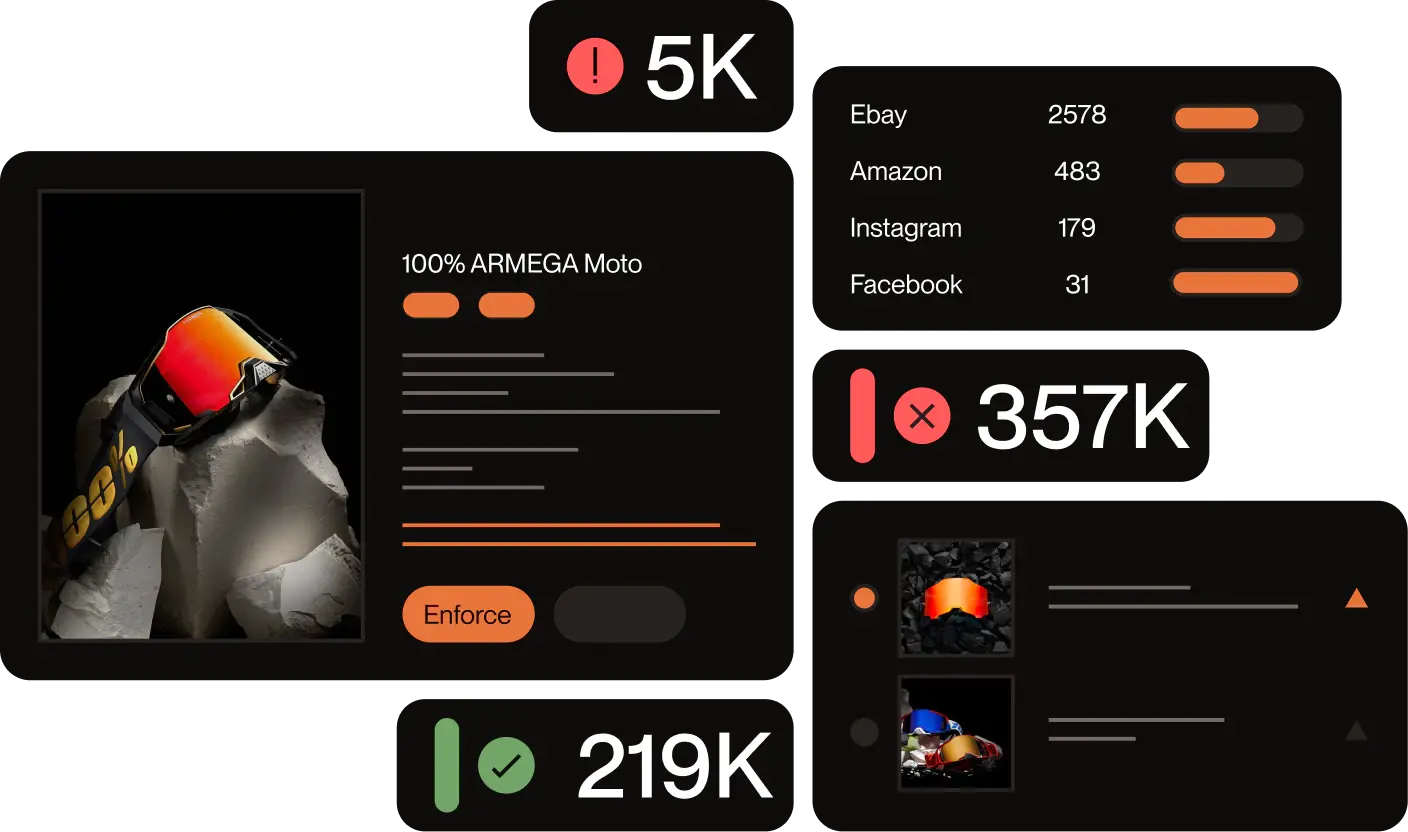
Platforms like Red Points combine always-on automated detection with expert-led enforcement to remove infringing content at scale — without requiring your team to track, document, and file each case individually.
Red Points’ Social Media Protection software operates in three stages:
- Detection — the platform continuously crawls TikTok and other social platforms using machine learning trained on billions of data points, surfacing potential infringements automatically.
- Validation — detected cases are compiled for review. Users can confirm takedowns individually or set smart rules to automate validation for clear-cut infringement types, saving time on repeat patterns.
- Enforcement — once an infringement is validated, Red Points handles the takedown process end-to-end, including platform reporting, escalation, and follow-up. Users receive notifications and data reports for every enforced case.
Red Points also provides Economic Impact projections that track the monetary value of infringement removed — useful for reporting internally and for demonstrating the ROI of brand protection investment.
For brands dealing with widespread or persistent TikTok infringement, this approach replaces a reactive, one-by-one process with a continuous, proactive one.
Real case study: A fashion brand cut impersonation by 92%
A global fashion group was facing a wave of fake social media accounts, scam giveaways, fake customer care profiles, and replica websites. The issue had grown beyond isolated reports. Scammers were using social channels to intercept customers, redirect them to fraudulent sites, and damage trust in the brand.
Using Red Points’ managed enforcement model, the brand combined automated detection with daily human review to identify fake profiles, connected scam domains, and fraudulent social ads more consistently. The program also refined detection rules across multiple scam patterns, helping the team remove threats faster and with less manual effort.
The results:
- Monthly infringements dropped from roughly 4,000 to 200 – a 92% reduction.
- 36,000+ links removed
- 99.6% enforcement success on social media
- 1 day median removal time.
Final takeaways
Getting a TikTok video taken down is straightforward when infringement is isolated — message the creator, file a report, or submit a formal copyright complaint through TikTok’s form. For more serious cases, a cease-and-desist letter creates a legal record and adds pressure. But for brands dealing with frequent, repeated, or cross-channel abuse, none of these methods scale. By the time one report is resolved, new infringing content is already live.
That is where Red Points’ Social Media Protection changes the equation. Instead of reacting case by case, Red Points continuously detects, validates, and enforces against infringing content across TikTok and other platforms — fully managed, with no limits on enforcements. If your team is spending time on manual reporting that should be spent elsewhere, request a free demo to see how Red Points handles it at scale.
Frequently asked questions
How many reports does it take for TikTok to remove a video?
One. TikTok’s review process is triggered by a single valid report. Additional reports from the same account do not speed up the decision. What matters is the quality and completeness of the report, not the volume.
What happens after I report a TikTok video?
TikTok’s moderation team reviews the reported content to determine whether it violates the platform’s Terms of Service, Community Guidelines, or IP policy. If the video is found to be in violation, it will be removed. Depending on the severity of the violation and the creator’s history, they may also receive a warning, a restriction on their account features, or a ban. If the violation was against your copyright specifically, TikTok may also share certain details of your report with the reported user.
Can TikTok stop the same infringing video from being re-uploaded?
Yes. When submitting a formal copyright report, you can request that TikTok prevent future copies of the same video from reappearing. This does not guarantee that modified versions or new recordings of the same content cannot be posted, but it helps address direct re-uploads.
What if my copyright report is denied?
TikTok states that missing or incomplete information can result in a report being denied. Review what was missing, gather any outstanding documentation, and resubmit. If your claim is strong and well-documented and the report is still denied, a cease-and-desist letter or legal escalation may be the appropriate next step.
Does TikTok ban accounts for repeat infringement?
Yes. TikTok has an explicit repeat infringer policy and may ban accounts that repeatedly commit copyright violations. Severe violations can result in an immediate ban.
Can I report a TikTok video without an account?
For some Community Guidelines violations, TikTok allows you to report through the in-app flow without being logged in. For the formal copyright infringement form, you will need to provide and verify an email address, but a TikTok account is not strictly required.
What is the difference between reporting a video and sending a cease-and-desist?
Reporting a video is a request to TikTok (the platform) to remove the content based on its own policies. A cease-and-desist letter is a direct legal communication to the person who posted the video, putting them on formal notice and creating a legal record. The two approaches can and often should be used together.
When should I escalate to professional enforcement software?
The signal is usually volume and recurrence. If the same or similar infringement keeps reappearing across multiple accounts, if your team is spending significant time on manual reporting, or if the same patterns are appearing across other platforms simultaneously, professional enforcement tools deliver better protection at lower operational cost than manual reporting alone.