


Your design team launches a new product after months of research, sampling, photography, and paid campaigns. Two weeks later, a customer sends your support team a SHEIN link showing a near-identical product — similar visuals, copied wording, a confusingly similar mark. The price is lower, the listing is gaining traction, and customers may assume your brand is connected to it.
That is the commercial problem behind IP infringement on SHEIN. It is not only a legal issue. It can divert sales, weaken product exclusivity, damage customer trust, and force your team into time-consuming evidence collection when they should be focused on growth.
SHEIN’s own Intellectual Property Notice states that rights holders can submit complaints when material on or linked to SHEIN violates copyright, trademark, or other intellectual property rights. The challenge is making sure your team identifies the right infringement type, submits the right evidence, and follows up before the same problem reappears.
This guide explains how to identify and report copyright and trademark infringement on SHEIN, what evidence to collect, and how to build a practical brand protection strategy that scales beyond one-off takedowns.
TL;DR
- IP infringement on SHEIN can involve copyright, trademark, design, patent, or other enforceable rights.
- Copyright issues typically involve copied product photos, artwork, graphics, prints, videos, or product descriptions.
- Trademark issues typically involve unauthorized use of your brand name, logo, product line, or confusingly similar marks.
- SHEIN directs rights holders to submit complaints through its Intellectual Property Notice process.
- The strongest complaints include proof of ownership, infringing URLs, screenshots, side-by-side comparisons, registration documents where applicable, and a clear explanation of the infringement.
- Manual reporting may work for isolated listings. It breaks down when copied designs or sellers spread across SHEIN, Temu, AliExpress, Amazon, TikTok Shop, Instagram, Facebook, Taobao, Tmall, Douyin, Pinduoduo, and WeChat.
- Effective brand protection combines monitoring, evidence workflows, takedowns, seller intelligence, and human expert review for high-risk or ambiguous cases.
IP infringement on SHEIN at a glance
| Infringement type | What it looks like | Best evidence | How to report | Main business risk |
| Copyright infringement | Copied photos, artwork, graphics, prints, product descriptions, videos, or creative assets | Original files, publication dates, screenshots, SHEIN URLs, side-by-side comparisons | SHEIN IP notice process, copyright complaint | Loss of creative value, customer confusion, unfair copying |
| Trademark infringement | Unauthorized use of your brand name, logo, product name, or confusingly similar mark | Trademark certificate, infringing URL, screenshots, seller/listing data | SHEIN IP notice process, trademark complaint | Search diversion, brand dilution, false association |
| Design copy | Product shape, pattern, or visual appearance closely copied | Design registration, original product evidence, comparison images | SHEIN IP notice process, design rights complaint | Product commoditization, loss of exclusivity |
| Counterfeit or impersonation | Listing appears to sell fake versions of your branded products | Trademark proof, test purchase evidence, packaging comparison, seller data | SHEIN IP notice process, trademark and counterfeit complaint | Revenue loss, customer complaints, reputational harm |
| Repeat infringement | Similar copied products or sellers reappear after takedown | Historical URLs, seller links, shared images, repeated wording | SHEIN IP notice process plus seller tracking and cross-platform monitoring | Recurring enforcement workload |
What counts as IP infringement on SHEIN?
Infringement on SHEIN happens when a product listing, image, seller, or related material uses protected IP without authorization. This may include copyrighted images, original artwork, product descriptions, trademarks, logos, design rights, patents, or other protected assets.
SHEIN’s Intellectual Property Notice refers to complaints involving copyright, trademark, or other intellectual property rights, which means you need to classify the issue before submitting a report. A copied product photo is not the same as a trademark misuse case. A design copy may require different documentation than a counterfeit listing.
This distinction matters because the complaint needs to match the right legal basis. Filing a copyright complaint for a trademark issue — or a trademark complaint for a copied image — can slow the review or cause it to fail.
What counts as copyright infringement on SHEIN?
Copyright infringement typically occurs when a listing copies protected creative content owned by your brand. For fashion, beauty, homeware, accessories, and consumer brands, this often includes product photography, illustrations, prints, artwork, text, videos, or visual assets used to sell a product.
Common examples include:
- A listing using your original product photo
- A seller copying your website product description
- A product using your artwork, graphic, print, or illustration
- A campaign or lifestyle photo reused without permission
- Copied packaging visuals, manuals, or other creative materials
For a strong copyright complaint, collect:
- The infringing URL
- Screenshots of the listing and copied content
- Original files or source links showing your work predates the listing
- Date of creation or first publication
- Ownership evidence or authorization to act
- A clear side-by-side comparison
Copyright complaints are strongest when you can prove the asset existed before the listing and that the copied element is substantially similar to your original.
What counts as trademark infringement on SHEIN?
Trademark infringement occurs when a listing uses your protected brand name, logo, product name, or a confusingly similar mark without authorization — potentially misleading customers into believing the product is official, affiliated, licensed, or approved by your brand.
Common examples include:
- Your brand name in the product title
- Your logo appearing in images or packaging
- A confusingly similar spelling of your trademark
- Your product line name used to capture search traffic
- “Compatible with” or “inspired by” claims that create confusion
- A seller or product page implying official brand affiliation
For a strong trademark complaint, collect:
- Trademark registration certificate
- Trademark owner information
- Registration country and class
- Infringing URL
- Screenshots of the trademark use
- Explanation of why the use is unauthorized or confusing
- Seller or listing data where available
Trademark complaints are especially important when infringing listings rank for branded searches, attract customers looking for your official products, or undermine authorized seller performance.
How to report IP infringement on SHEIN
To submit a complaint, prepare your evidence, identify the IP right being infringed, and file through SHEIN’s IP notice process. The UK government’s e-commerce IP guidance also points rights holders to the SHEIN IP Notice portal for reporting infringement on SHEIN Marketplace.
Step 1: Identify the infringement type
Decide whether the issue is primarily copyright, trademark, design, patent, counterfeit, or another IP right. Use a copyright complaint when the copied material is creative content such as images, text, artwork, or prints. Use a trademark complaint when the listing uses your brand name, logo, or a confusingly similar mark. If the listing copies both your images and your trademark, include both rights where the process allows.
Step 2: Collect the infringing URLs
Save every relevant URL — product pages, seller pages, image URLs, and any related pages showing the infringement. Take screenshots immediately, as listings can change after a complaint is submitted.
Step 3: Prove ownership or authorization
Include documents showing you own the IP or are authorized to act for the owner. This may include trademark certificates, copyright registrations, original design files, licensing agreements, or authorization letters.
Step 4: Explain the infringement clearly
Do not assume the reviewer will understand your product category. State exactly what was copied or misused. For example: “The listing uses our copyrighted product photograph as the main image,” or “The listing title uses our registered trademark without authorization.”
Step 5: Submit and track the complaint
Keep a record of submission dates, complaint IDs, listing URLs, responses, removals, and any rejected claims. This creates an enforcement history that is essential for handling repeat infringement.
What evidence do you need?
The best IP complaints are specific, documented, and easy to verify. A vague claim such as “this product copies us” is weaker than a structured evidence packet showing ownership, infringement, and customer confusion risk.
IP ownership: trademark certificates, copyright registration, design registration, patent documents, or original creative files.
Infringing content: URLs, screenshots, product titles, images, seller details, and listing dates.
Comparison evidence: side-by-side image comparisons, copied text excerpts, matching logos, or product similarities.
Timeline: creation date, publication date, launch date, and when the infringing listing appeared.
Authorization status: proof that the seller is not licensed or authorized.
Business impact: customer complaints, traffic diversion, brand confusion, distributor pressure, or pricing disruption.
For copyright complaints, the timeline is especially important. For trademark complaints, registration documents and marketplace context are usually central.
Why manual enforcement breaks down
Manual reporting works when there are only one or two listings. It breaks down when copied products, sellers, or related listings appear repeatedly.
Most teams run into four operational problems.
Copied assets are not always searchable by brand name
A seller may avoid your trademark while still using your product photography, artwork, or design style.
Evidence collection is repetitive
Every complaint requires URLs, screenshots, ownership documents, comparison notes, and follow-up tracking.
Takedowns do not always stop recurrence
Similar listings can reappear with altered titles, cropped images, different sellers, or new product codes.
The problem rarely stays on one platform
Infringing products can spread across Mainland China marketplaces such as Temu, AliExpress, Douyin,Tmall, Pinduoduo, and WeChat. As well as Amazon, eBay, TikTok Shop, Instagram, Facebook, Taobao, and other platforms.
This is why brand protection on SHEIN should not depend only on reactive takedowns. You need a repeatable detection, validation, enforcement, and monitoring workflow.
How to build a SHEIN brand protection strategy
A strong strategy reduces repeat infringement instead of treating every copied listing as a new isolated incident.
Register and organize your IP rights
The foundation is documentation. Make sure your trademarks, copyright records, product assets, design registrations, and authorization letters are organized and ready to submit. For global brands, this may include rights in the United States, United Kingdom, European Union, China, Australia, and other priority markets, depending on where the brand sells and where infringement appears.
Monitor product names, images, and design signals
Continuous monitoring across branded and non-branded signals is the standard — brand names, product names, misspellings, logos, copied images, distinctive prints, product shapes, and seller patterns. Manual search misses listings that do not use obvious keywords, which is especially relevant for copyright and design copy where image similarity matters more than text.
Prioritize the highest-risk listings
Not every listing deserves equal urgency. Prioritize listings that use your trademark, copy core product photography, appear high in search results, generate reviews, use suspicious discounts, or closely resemble best-sellers. The goal is to remove the listings causing the most commercial and reputational damage first.
Create repeatable complaint templates
Build templates for copyright, trademark, and design complaints. Include standard ownership language, evidence requirements, and internal approval steps. This reduces review time and keeps submissions consistent.
Track recurrence and connected sellers
Every takedown should feed a wider intelligence picture. Track recurring images, seller names, product titles, prices, descriptions, storefront patterns, and related listings. Over time, this helps identify repeat actors rather than just removing individual products.
Combine automation with human review
Automation handles scale. Human expertise handles judgment. This is especially critical for borderline design comparisons, counter-notices, authorized seller checks, and cases where a false positive could create commercial or legal risk.
How Red Points helps with brand protection on SHEIN
The standard is clear: monitor listings, detect copied assets, collect evidence, submit complaints, track outcomes, and watch for recurrence. The challenge is doing this at scale.
A manual team cannot reliably monitor every copied image, trademark use, seller pattern, and relisted product across SHEIN and connected platforms.
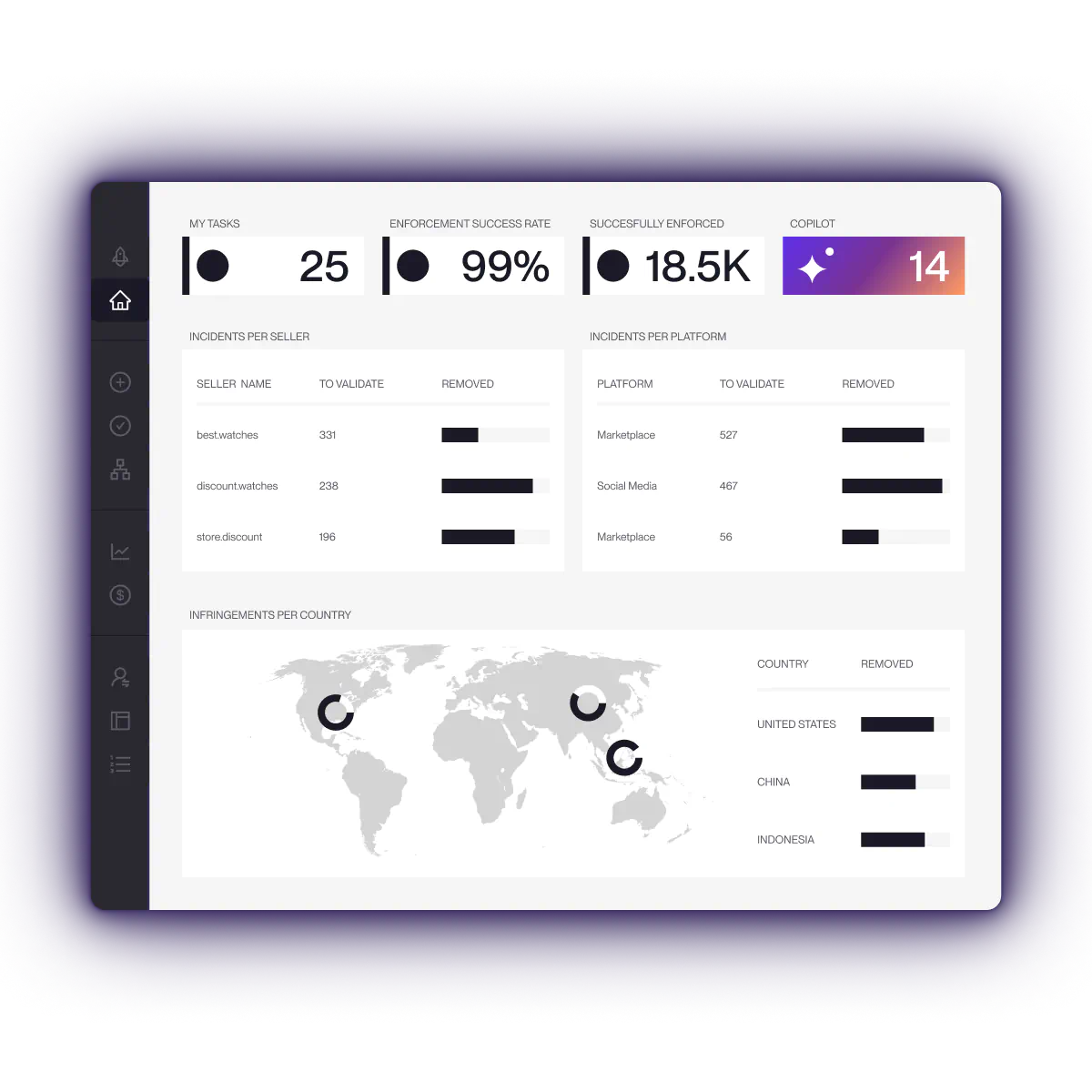
Red Points brand protection platform combines image and logo recognition, OCR, risk models, automation rules, seller intelligence, custom priorities, and analyst review to detect, validate, and enforce IP infringements across marketplaces, social media, websites, domains, search engines, ads, and apps — processing 90M+ new links per day and delivering 5.1M+ enforcement actions per year across 1,300+ brands.
For SHEIN specifically, Red Points can help brands:
- Detect copyright infringement involving copied images, artwork, graphics, or product descriptions
- Identify trademark infringement in titles, images, seller content, and product pages
- Monitor high-risk listings even when sellers avoid exact brand keywords
- Build evidence-ready cases with screenshots, URLs, asset matches, and seller data
- Prioritize listings based on risk, visibility, recurrence, and commercial impact
- Track repeat infringers and connected listings across SHEIN and other platforms
- Extend protection to China-linked channels such as Taobao, Tmall, Douyin, Pinduoduo, and WeChat when infringement networks operate beyond SHEIN
Case study: How Graff protected luxury designs across China-linked platforms
Luxury jeweler Graff faced a growing wave of counterfeit jewelry and imitation designs, particularly across Chinese marketplaces. Many listings reused Graff’s imagery or copied protected ornamental designs, creating the risk of customer confusion, lost sales, and brand dilution.
With Red Points’ Managed Services, Graff used tailored detection rules based on design patterns, pricing, stock signals, fake-image fingerprints, and known counterfeit domains. The program combined AI-driven detection with expert analyst review, helping Graff prioritize the listings most likely to harm customers and brand equity.
The result: 14,000+ infringing listings removed, 3,500+ unauthorized sellers blocked, and $6M in counterfeit value removed from the market. For brands facing SHEIN-related copying, the lesson is clear: enforcement works best when individual takedowns feed a wider system for detecting repeat sellers, copied assets, and cross-platform infringement patterns.
This is especially relevant when infringement connects to Mainland China’s domestic ecosystem, where platforms like Douyin, Pinduoduo, and WeChat require localized detection, platform-specific workflows, and local enforcement expertise.
Protect your IP on SHEIN with Red Points
Book a demo to see how Red Points can help your team detect, validate, and remove copyright and trademark infringement across global marketplaces.
Frequently asked questions
It happens when material on SHEIN uses protected IP without authorization — including copyright, trademark, design, patent, or other enforceable rights.
Collect the infringing URL, screenshots, proof of ownership, the original asset, and a clear explanation of what was copied. Then submit through SHEIN’s IP notice process.
Provide your trademark registration details, the infringing URL, screenshots showing the unauthorized trademark use, and an explanation of why the listing creates confusion or misuses your mark.
Copyright protects creative assets such as photos, artwork, graphics, videos, and written content. Trademark protects brand identifiers such as names, logos, product names, and distinctive marks. A single listing may infringe both.
Yes. SHEIN’s Intellectual Property Notice states that rights holders can submit complaints when material on or linked to SHEIN violates copyright, trademark, or other IP rights.
Proof of IP ownership, infringing URLs, screenshots, side-by-side comparisons, publication dates, registration documents where applicable, and a clear explanation of the infringement.
SHEIN does not publicly publish a fixed processing timeline for IP complaints. Based on rights holder experience, straightforward complaints with complete evidence are often reviewed within a few business days, while more complex or contested cases can take longer. The most common reasons for delays are incomplete submissions — missing ownership documents, unclear infringing URLs, or insufficient explanation of the infringement. Submitting a complete, well-evidenced complaint from the start gives you the best chance of a fast outcome. If you have not received a response within two weeks, follow up referencing your original submission date and complaint details.
Yes. Red Points detects, validates, and enforces against IP infringements across SHEIN and other marketplaces, combining automation with human expert review to scale enforcement while reducing the risk of false positives.