


Amazon is one of the most powerful sales channels available to brands today, with around 9.7 million sellers operating on the platform worldwide. While the vast majority are legitimate, unauthorized third-party sellers represent a growing threat. They can undercut your prices, hijack your listings, and damage your reputation with customers. Whether you are just starting to notice suspicious activity or dealing with a persistent, large-scale problem, knowing how to identify and remove unauthorized sellers is essential to protecting your brand.
TL;DR
- Unauthorized third-party sellers can appear on your Amazon listings at any time, undercutting your prices and eroding customer trust.
- Not all third-party sellers are a threat. The biggest risks come from organized counterfeiters and experienced arbitrage sellers who actively target your brand.
- To find unauthorized sellers, run manual searches, check the More Buying Choices box, monitor Featured Offer performance, review customer feedback, and use Amazon’s Brand Protection Programs.
- To prevent them, build an authorized seller network, enroll in Brand Registry, and use Transparency codes to authenticate individual product units.
- To remove them, gather evidence such as ASINs, prices, descriptions, screenshots, order IDs, and receipts, then file a report through Amazon Seller Central with supporting documentation.
Quick overview
| Field | Details |
| What this guide covers | How to identify, prevent, and remove unauthorized third-party sellers from your Amazon listings |
| Who it is for | Brand owners, e-commerce managers, legal teams, IP teams, and marketplace teams selling on Amazon |
| Core problem | Unauthorized sellers undercut prices, hijack listings, win the Featured Offer, and damage brand reputation |
| Key tools | Amazon Brand Registry, Transparency Program, Project Zero, Seller Central reporting, Keepa, CamelCamelCamel |
| Removal timeline | Amazon support typically responds within 24 hours. Listing removal can take up to 30 days, while account removal can take up to 90 days. |
| When to escalate | High-volume, persistent, or repeat offenders warrant a dedicated brand protection service and, in some cases, legal escalation. |
| Red Points proof points | 5.1M+ enforcements per year · 93.4% removal success rate · avg. 1.5-day takedown time · 1,300+ brands |
Understanding the threat of unauthorized sellers to your business
The threat of third-party sellers is real. Brands that rely on Amazon as a key revenue channel may find listings that look identical to their own, created by sellers seeking to capitalize on the popularity and trust of established products. These sellers range from opportunistic individuals to organized groups of counterfeiters running sophisticated operations.
If left unaddressed, unauthorized sellers can harm your business in two critical ways.
They undercut your sales
Experienced resellers take advantage of your minimum advertised price (MAP) and compete aggressively for the Featured Offer, formerly known as the Buy Box, by listing at lower prices. When shoppers compare options, they will often buy from the unauthorized seller instead of you.
They damage your brand reputation
Consumers who receive poor-quality products, have bad shopping experiences, or deal with inadequate customer service from unauthorized sellers will associate those experiences with your brand. This can lead to negative reviews on your product listings and erode long-term customer loyalty.
If you fail to take action, your revenue, your reputation, and your relationship with customers can all suffer.
What is an unauthorized seller on Amazon?
Unauthorized sellers are third-party resellers or distributors that sell products on Amazon without authorization from the brand that owns those products. They come in all shapes and sizes.
Some unauthorized sellers present a minor risk. For instance, individual one-off sellers with little experience with Featured Offer mechanics or Fulfillment by Amazon (FBA) procedures will usually have limited impact on your presence. Others are far more dangerous. In industries like toys, health, beauty, apparel, electronics, and consumer goods, organized counterfeiters and skilled arbitrage sellers can systematically undercut your sales at scale.
It is also worth distinguishing between types of third-party activity:
- Unauthorized resellers sell your genuine products without permission, often at lower prices that undermine your pricing strategy and authorized distribution network.
- Counterfeiters sell fake versions of your products, which pose a more serious risk to consumer safety and brand integrity.
- Drop shippers operate as middlemen between manufacturer and consumer, accepting orders without holding inventory. They do not own stock, but they can still sell your products without authorization.
Not all third-party sellers present a threat, but when they engage in the unauthorized use of your intellectual property or sell your products without permission, action is necessary.
How to identify unauthorized sellers on Amazon
Before you can remove unauthorized sellers, you need to find them. Here are the key methods for spotting them on Amazon.
Manual searches and test purchases
One of the simplest first steps is to search for your products on Amazon and check whether there are any sellers you do not recognize. On your product listing page, look for the More Buying Choices box below the Featured Offer. This shows every seller currently attached to your Amazon Standard Identification Number (ASIN). Any seller not on your authorized list is a candidate for investigation.
Once you have identified a suspect, you can make a test purchase to verify the authenticity of the product and gather evidence. This lets you determine whether the product has material differences from your own, helping you distinguish between gray market goods and outright counterfeits.
The downside to this method is that it can be slow, costly, and inefficient, especially if you have a wide product catalog on Amazon.
Featured Offer performance reports
Inside Seller Central, check your Featured Offer performance reports. A sudden drop in your win rate, without changes to your pricing, shipping time, or account health, is a strong signal that an unauthorized seller has entered your listing and is undercutting your price to capture the Featured Offer.
Price and seller activity tracking tools
Third-party tools provide historical price and seller activity charts for specific ASINs, making it easier to see exactly when a new seller entered your listing and how aggressively they have been undercutting your price. This is useful for distinguishing a one-off arbitrage seller from a recurring problem.
Customer reviews and feedback
Customer reviews are a valuable source of intelligence. Descriptions of suspicious interactions, subpar products, unusual delivery practices, altered packaging, or missing authentication codes can help you identify sellers operating without your permission. Engaging with customers directly can also help you alert them to unauthorized sellers and protect them from future purchases.
Amazon’s Brand Protection Programs
Amazon offers dedicated programs to help brands identify and stop unauthorized sellers:
- Amazon Transparency Program allows you to verify product authenticity using unique, secure codes that identify individual units and engage with customers post-purchase.
- Project Zero combines Amazon’s technology with your brand insights to proactively detect and remove counterfeits.
- Amazon Brand Registry gives you tools to safeguard your intellectual property and manage the accuracy of your listings.
These programs provide a strong foundation for detection, but they work best when combined with active monitoring and enforcement.
How to avoid third-party sellers listing your products
Taking a proactive approach is just as important as reactive enforcement. Here are the key steps to prevent unauthorized sellers from gaining a foothold in the first place.
Establish an authorized seller network
Build connections with verified, authorized sellers on Amazon. A well-managed authorized seller network gives you greater control over who can and cannot sell your products, creates a clear audit trail, and helps you quickly spot sellers who fall outside it. It also improves your visibility of potential weak points before unauthorized sellers can exploit them.
Leverage Amazon’s Brand Protection tools
Enrolling in Amazon Brand Registry is one of the most effective first steps any brand can take. It lets you safeguard your intellectual property, report infringements, and manage listing accuracy across the marketplace.
Amazon’s Transparency Program adds another layer of protection by assigning unique codes to individual product units, making it possible to authenticate products and track where they end up in the supply chain.
Project Zero goes further still, using Amazon’s automated technology alongside brand-reported data to continuously scan for and remove counterfeits without requiring you to file individual reports each time.
Monitor and enforce your intellectual property rights
Ongoing vigilance is essential. Manually search for and report unauthorized listings, and make use of Amazon’s built-in reporting tools within Brand Registry and Project Zero. While manual monitoring has its limits at scale, building a habit of regular checks helps you catch problems early before they spiral into a larger issue.
How to remove a seller from your Amazon listing
Amazon has selling policies and a seller code of conduct. If a seller has violated these policies, you can seek to have them removed through Amazon’s internal reporting process. Here is how it works, step by step.
Step 1: Gather evidence
Start by collecting as much relevant evidence as possible showing that the seller has violated Amazon’s policies. Record product names, descriptions, prices, ASINs, reviews, screenshots, order IDs, receipts, and any other information that demonstrates how the seller has acted improperly. The more thorough your documentation at this stage, the easier and more persuasive your complaint will be.
Step 2: Complete Amazon’s report form
Through Amazon Seller Central, navigate to the Report a Violation page. Select the type of violation, such as copyright or trademark infringement, provide the relevant ASIN or ISBN, and include all the information you have gathered about the seller. Being thorough and accurate here is critical, as this is the information Amazon will use to assess your case.
Step 3: Submit your report
Add a clear explanation of the violation along with any supporting documentation, such as order IDs, receipts, or correspondence, and submit your report. Amazon support typically responds within 24 hours, though the full review process can take up to 30 days to result in a listing removal and up to 90 days to remove an unauthorized seller’s account entirely.
If Amazon determines that no infringement has occurred, the listing will remain. In those cases, working with a specialized seller removal service may be the best next option.
A note on timelines
How long Amazon takes to act depends on the complexity of the case and any pending transactions linked to the seller’s account. Persistent, high-volume problems, such as sellers who change their names or product images to evade enforcement, can make the manual process especially frustrating and time-consuming.
How Red Points can help you remove unauthorized sellers from Amazon
For many brands, Amazon’s built-in tools are a great starting point. But if you are dealing with a high volume of unauthorized sellers, or if bad actors keep reappearing after each takedown, a dedicated removal service offers the scale and efficiency you need.
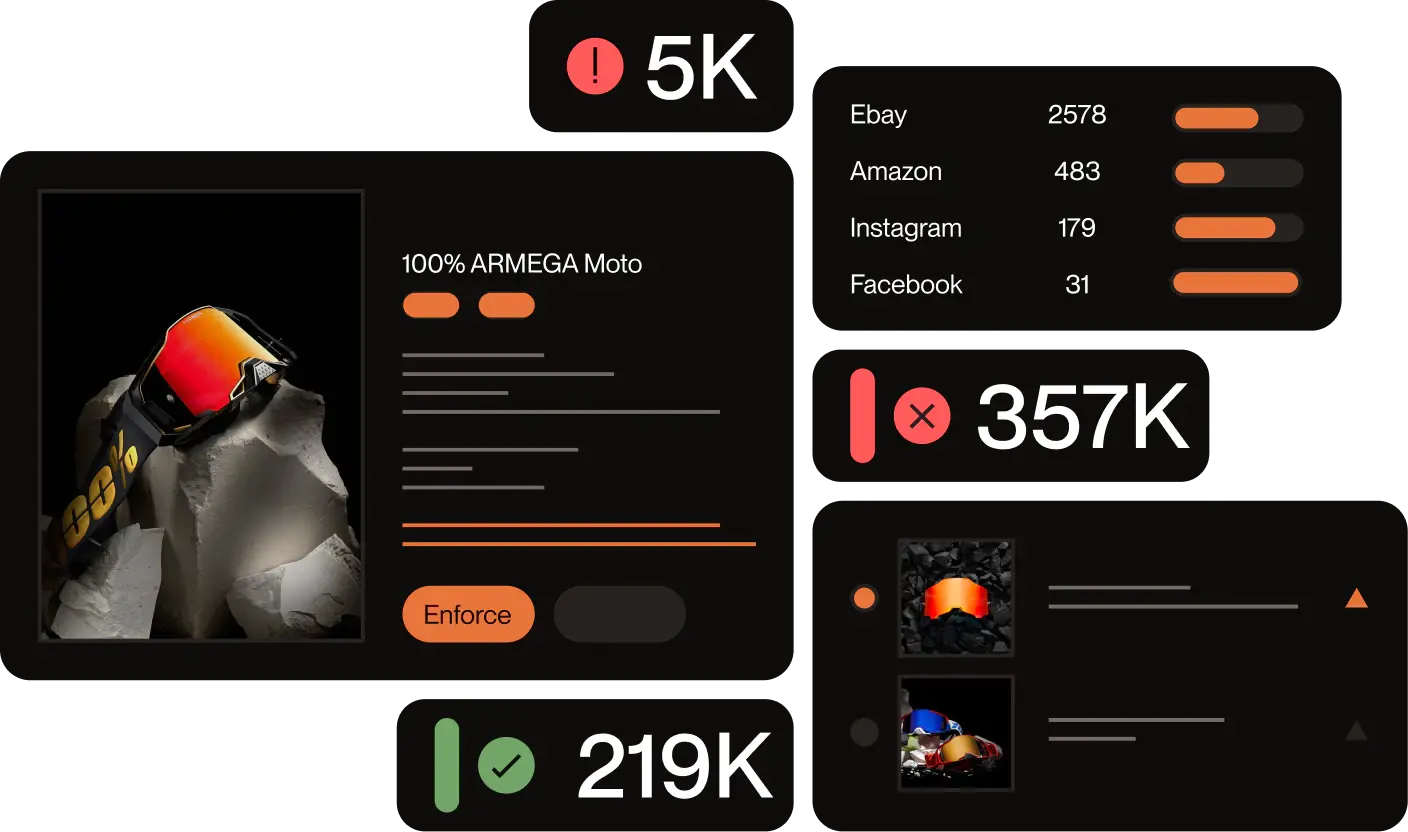
Red Points’ Amazon Brand Protection Service uses automated technology to find, validate, and remove infringing sellers on your behalf. Red Points processes 90M+ new links per day across 5,000+ global marketplaces and enforces 5.1M+ infringements per year.
Here is how the process works:
Detect
Our bot-powered search runs 24/7, using image recognition technology to scan Amazon listings and identify unauthorized sellers as soon as they appear. The system detects trademark and copyright infringement, including the unauthorized use of product images and logos, and continuously improves its detection net through machine learning, suggesting new rules and keyword opportunities over time.
Review and validate
All detected cases are collected into a log for you to review. You can manually validate incidents using image cards within the Red Points digital workspace, or automate the process based on validation rules you define. A high-risk shortlist helps you prioritize the most urgent cases first.
Enforce and take down
Once a case is validated, Red Points carries out enforcement on your behalf. In a Herbalife unauthorized seller program, Red Points achieved a 93.4% removal success rate and an average takedown time of 1.5 days.
In one enterprise customer case, switching to Red Points from a manual analyst-based vendor restored 27% of Amazon Featured Offer share lost to unauthorized sellers, alongside a 5x improvement in removed listings and reported sellers in the first quarter alone.
Measure
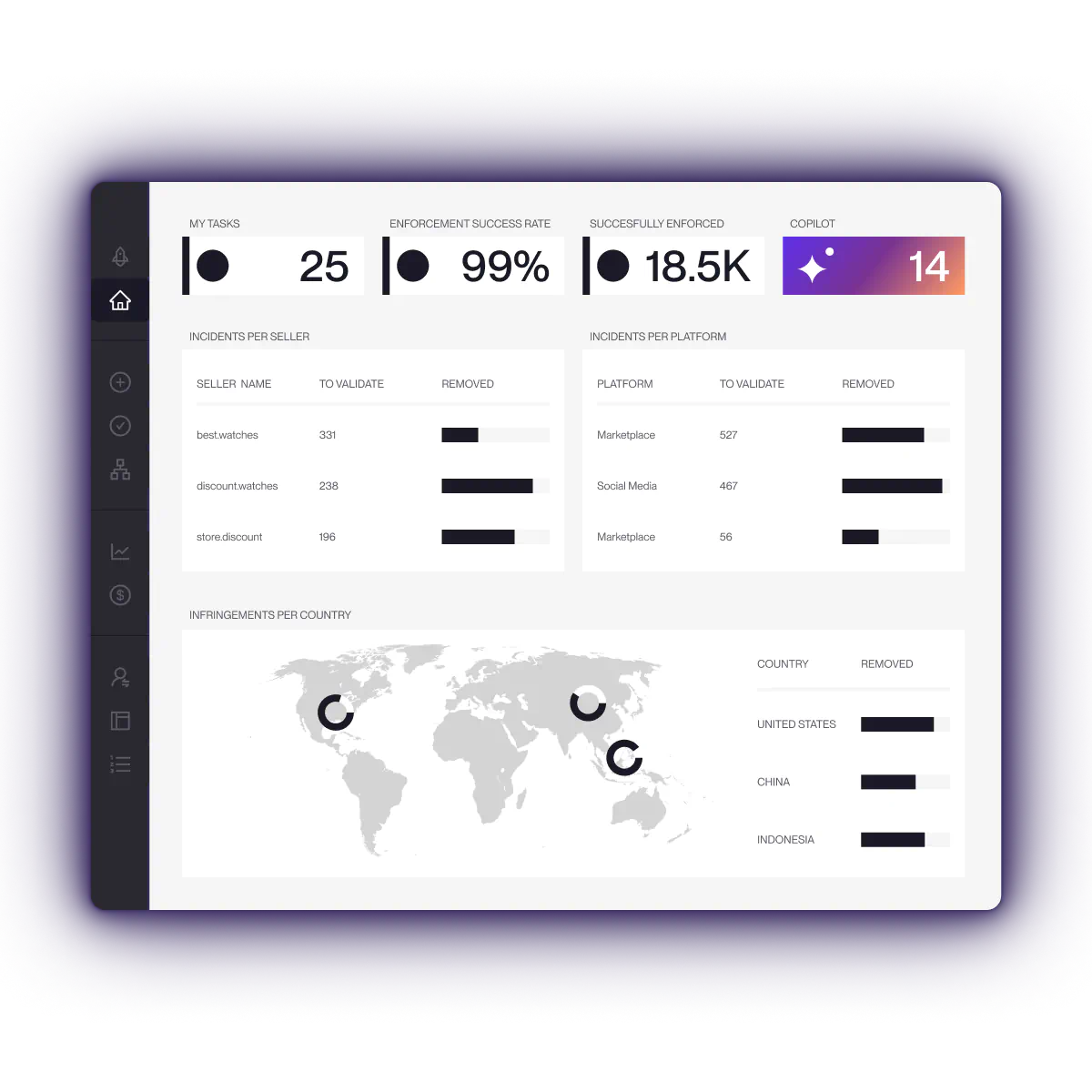
Performance dashboards, output reports, and data extraction tools give you full visibility into the impact of your brand protection activity, so you can see what is working and continuously improve your approach.
Case study: Herbalife
Herbalife, one of the world’s largest health and nutrition brands, faced a sustained unauthorized seller problem across Amazon and major global marketplaces. Unauthorized resellers were listing genuine products through gray market channels at discounted prices, undercutting Herbalife’s authorized distributor network and generating customer service complaints that fell back on the brand.
With Red Points, Herbalife systematically detected and removed unauthorized listings at a scale that manual enforcement could not approach. The outcome: a 93.4% removal success rate, 108,000+ infringements eliminated, and $159M in infringement value removed from the market.
“What I like the most about Red Points is the collaboration I’ve had with their team. They are our partners in addressing our problems, and they are very responsive.” – Sharlini Palar, Senior Legal Manager, Herbalife
Next steps
With millions of consumers starting their product searches on Amazon, the marketplace is too important to leave unprotected. Unauthorized sellers cut into your profits, confuse your customers, and can cause lasting damage to your brand. But you do not have to tackle them alone.
By combining Amazon’s Brand Protection Programs with proactive monitoring, a clear enforcement process, and the right technology partner, you can take back control of your listings and protect the customers who trust your brand. To learn more about how Red Points can help you identify and remove unauthorized sellers from Amazon, request a demo.
Frequently asked questions
Can I stop third-party sellers from listing on my Amazon product page?
You cannot unilaterally block all third-party sellers from listing on your ASIN, but you can take steps to significantly reduce their presence. Enrolling in Amazon Brand Registry gives you tools to report and remove unauthorized listings. The Transparency Program goes further by requiring sellers to apply unique authentication codes to each unit, making it much harder for unauthorized sellers to list at all. Building an authorized seller network and enforcing your distribution agreements also limits the supply of stock that unauthorized sellers can access in the first place.
What is the difference between an unauthorized seller and a counterfeit seller?
An unauthorized seller resells your genuine products on Amazon without your permission. They may have sourced real inventory through gray market channels or unauthorized distributors. A counterfeit seller, on the other hand, is selling fake versions of your products that imitate your branding. Both harm your brand, but counterfeits carry additional legal and consumer safety implications and are generally treated as a more serious violation under Amazon’s policies.
How do I know if a seller is unauthorized?
Start by cross-referencing active Amazon sellers against your list of authorized resellers and distributors. If a seller appears on your listing and is not on that list, they are unauthorized. You can also do a test purchase to inspect the product for quality differences, altered packaging, or missing authentication codes, all of which can confirm unauthorized or counterfeit activity.
How long does it take Amazon to remove an unauthorized seller?
Amazon support typically responds to a reported violation within 24 hours. However, the review process itself can take up to 30 days to result in the removal of a specific listing and up to 90 days to remove an unauthorized seller’s account entirely. The actual timeline depends on case complexity and any pending transactions linked to the account. If speed is a priority, a third-party brand protection service can often achieve faster results. Red Points averages a 1.5-day takedown time.
What if Amazon decides there is no infringement and does not remove the seller?
If Amazon reviews your report and determines no policy violation has occurred, the listing will remain live. In this situation, your options include submitting a more detailed follow-up complaint with additional evidence, pursuing a cease-and-desist letter directly to the seller, or escalating to a brand protection service that has established enforcement relationships and legal expertise to pursue cases that Amazon’s internal process does not resolve. A fourth route, where volume and persistence warrant it, is a zero-cost litigation program such as Red Points’ Revenue Recovery Program, which is designed to permanently remove seller accounts and recover revenue through legal action at no upfront cost to the brand.
Is it worth using a professional Amazon seller removal service?
For occasional, one-off cases, Amazon’s internal reporting tools may be sufficient. But for brands dealing with persistent sellers, high volumes of unauthorized listings, or bad actors who keep reappearing under new names, a professional service becomes essential. Manual enforcement is a whack-a-mole approach at scale: time-consuming, resource-intensive, and reactive. An automated service like Red Points runs detection around the clock and can act on new infringements as soon as they appear, giving your brand protection that keeps pace with the threat.
Can unauthorized sellers affect my Amazon Buy Box (Featured Offer)?
Yes, and this is one of the most damaging impacts. Experienced resellers actively optimize to win the Featured Offer by pricing below your MAP. Once they win it, shoppers who click Buy Now will purchase from the unauthorized seller rather than you. This directly cuts into your revenue and means the listing is directing traffic and customer relationships away from your brand.
Does Amazon Brand Registry protect me from all unauthorized sellers?
Brand Registry is a powerful first step and gives you significantly more tools and authority to report infringements than an unregistered brand. However, it does not automatically prevent unauthorized sellers from listing on your ASINs, and it relies on you or your team to actively monitor and submit reports. Combining Brand Registry with the Transparency Program and Project Zero, or a third-party enforcement service, provides much more comprehensive protection.