

TL;DR: Key takeaways
- A search engine DMCA takedown de-indexes infringing URLs from Google or Bing search results; it does not remove content from the internet.
- File with Google using their specific copyright infringement forms, which vary depending on whether the issue is on Google Search, Google Drive, or Google Play.
- File with Bing using Bing’s DMCA Request form, which requires logging in with a Microsoft, Google, or Facebook account.
- Both platforms require the infringing URLs, URLs of your original work, proof of copyright ownership, and a signed good-faith statement.
- Google typically responds within a few weeks. Bing typically responds within 5–10 days.
- If your request is rejected, resubmit with stronger documentation, as denials are usually due to insufficient proof of ownership rather than a lack of infringement.
When your copyrighted content, product images, or brand assets are stolen and displayed on a copycat website, getting that site removed from search results is often the fastest way to cut off its traffic. While filing a DMCA takedown with Google or Bing won’t delete the content from the internet entirely, it makes it effectively invisible to your customers. This guide breaks down exactly how to navigate the DMCA processes for both major search engines so you can quickly reclaim your digital footprint.
What is a search engine DMCA takedown?
A search engine DMCA takedown is a formal legal request asking Google or Bing to de-index a URL that hosts copyright-infringing content. When approved, the page becomes effectively invisible in search results. The Digital Millennium Copyright Act (DMCA) obligates search engines and online platforms to comply with these valid requests under US law.
It is crucial to note that a search engine DMCA does not remove content from the server where it lives. The infringing page will still exist on the web. For full removal, you must file a separate takedown with the hosting provider (like GoDaddy) or the specific platform (like Shopify). However, filing with search engines cuts off organic visibility, which is often the fastest way to stop traffic from reaching the fake site.
Where should you file a DMCA takedown?
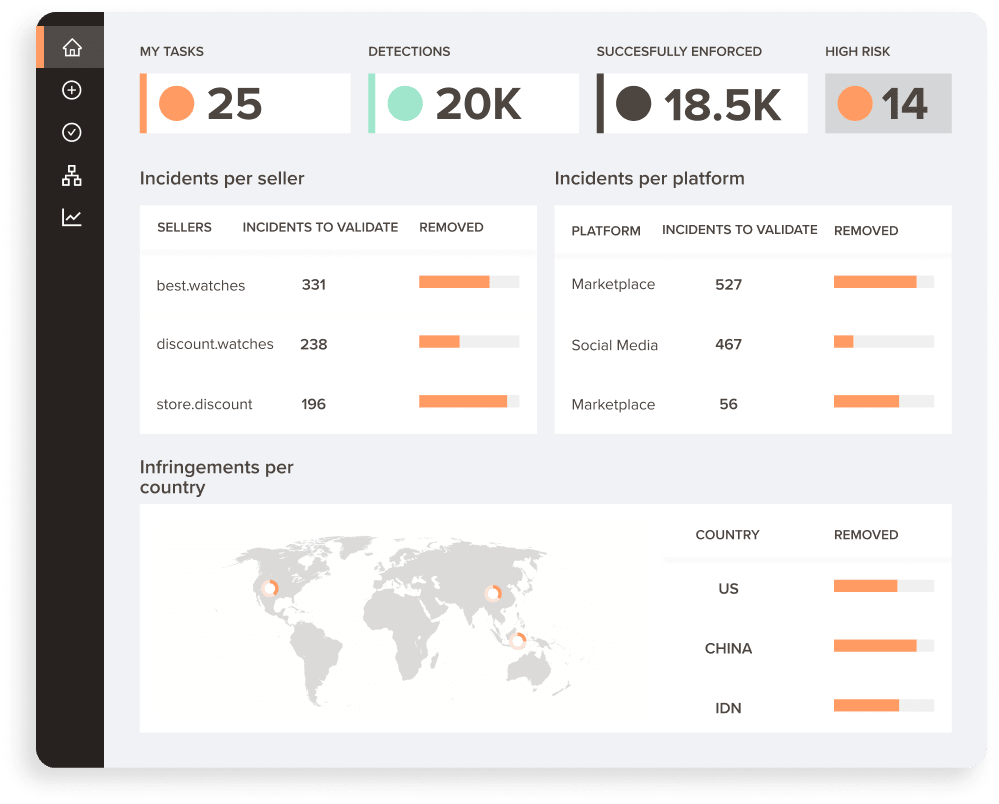
You can, and often should, file takedowns in multiple places simultaneously. Use the table below to determine the right target for your request:
| Scenario | Where to File |
|---|---|
| A copycat website is ranking in search results using your stolen assets. | Search Engines (Google, Bing). |
| A fake site impersonating your brand appears for product searches. | Search Engines (Google, Bing). |
| Pirated content appears in search results on third-party domains. | Search Engines (Google, Bing). |
| The content is hosted by a specific web host (e.g., GoDaddy). | Hosting Provider (To remove it from the server entirely). |
| The seller is on an ecommerce marketplace (e.g., Shopify). | The Marketplace Platform. |
| The content is on social media (e.g., Instagram, X, Pinterest). | The Social Media Platform. |
What about infringing content in Google Ads?
A search-engine DMCA de-indexes organic results, but it does not remove paid Google Ads. If a bad actor is running an ad that uses your copyrighted images, ad copy, or brand assets, that follows a separate route: Google’s Legal Troubleshooter → “Report content on Google” → select “A Google Ad” → “Legal” → “Intellectual Property” → “Copyright.” Note that ads can also raise trademark and counterfeit issues, which use Google’s separate trademark complaint process.
What documentation do you need before filing?
Good preparation prevents multiple rounds of back-and-forth with Google or Bing. Gather the following before opening either form:
- Proof of copyright ownership: You must demonstrate you are the original creator. While copyright registration certificates are the strongest proof, you can also use detailed, timestamped screenshots of your original work, published links, or metadata. If filing for a company, a signed authorization letter naming you as an agent is usually required.
- Screenshots with timestamps: Capture clear screenshots of the infringing content with the URL visible. Record the date and time to prove the infringement appeared after your original work was published.
- The exact infringing URLs: Collect the specific page URLs where the content appears, not just the root domain.
- URLs of your original works: Include direct, publicly accessible links to where your original content is hosted so platforms can verify it predates the copy.
Note for non-US brands: You do not need to be based in the United States to file a DMCA takedown with Google or Bing. The DMCA governs the obligations of these US-based search engines, not the nationality of the rights holder. International brands should include their copyright registration documentation from their home jurisdiction alongside a clear description of the infringement.
How to file a DMCA takedown with Google manually
Google requires separate forms for different properties (Google Drive, Google Play, YouTube, etc.). For Google Search specifically, follow these steps:
- Log in: Go to Google’s copyright infringement report form while logged in. Use an official work email if representing an organization to add credibility.
- Identify the filer: Select whether you are the copyright owner or an authorized agent. Agents may need to provide authorization documentation.
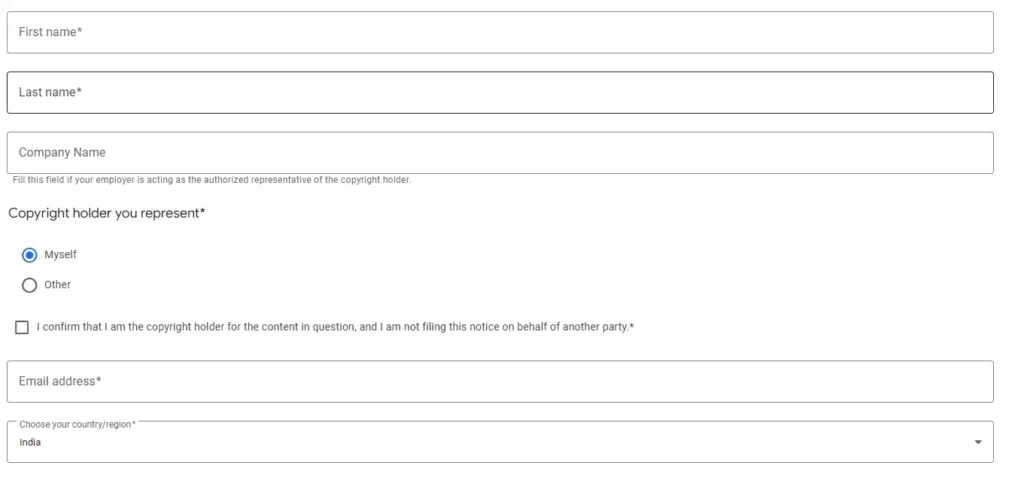
- Describe the work: Provide a highly specific description of the infringed work (e.g., a photo, article, or logo) and why you hold the rights. Vague descriptions are the most common reason for rejection.
- Add original URLs: Share publicly accessible links to your original work, as Google does not allow direct file uploads.
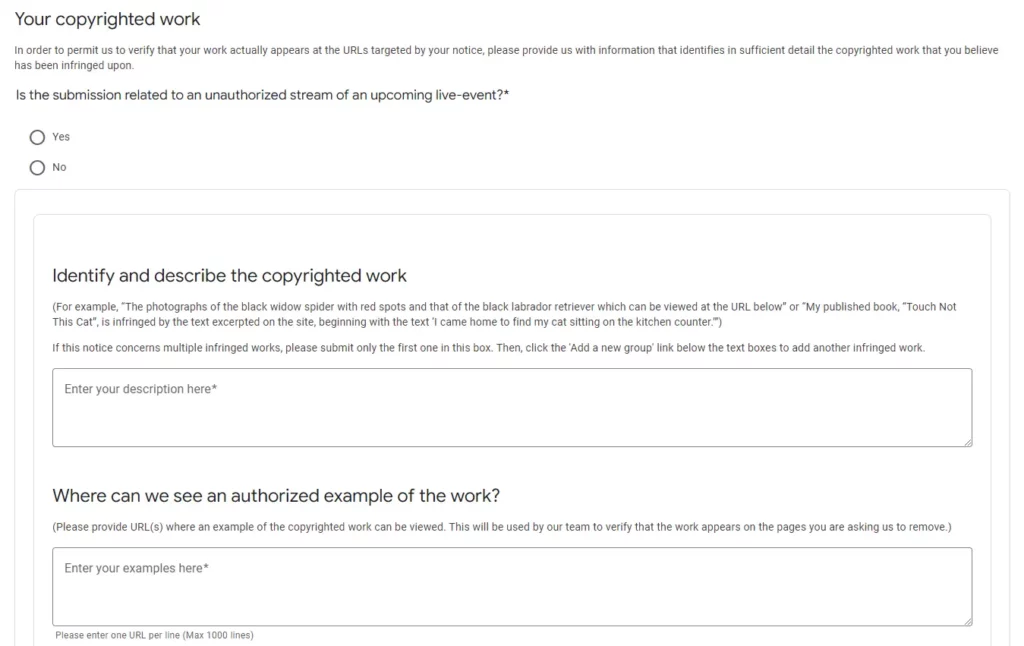
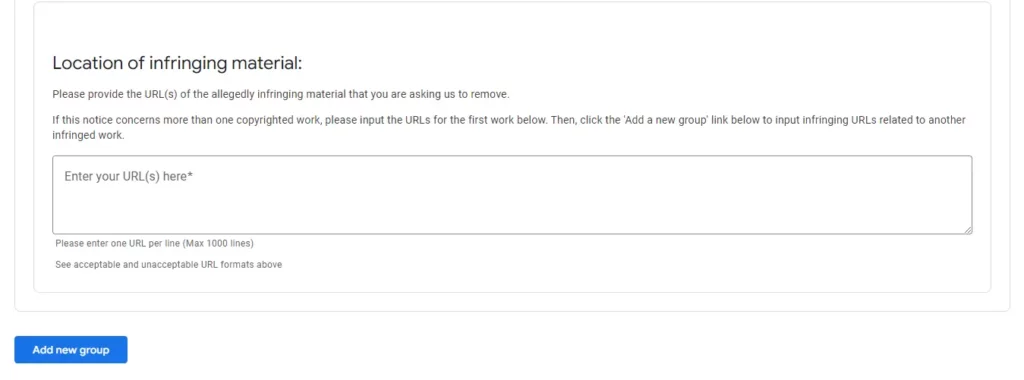
- Add infringing URLs: Enter the exact page URLs (not just domains) where the content was copied. List each URL separately if the content spans multiple pages.
- Sign and submit: Check the good faith belief statement, add your electronic signature, and submit.
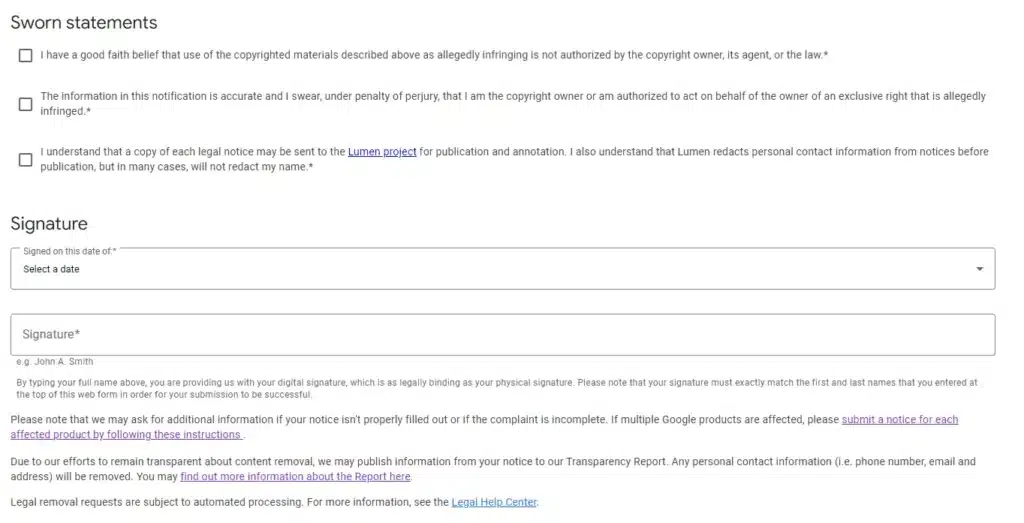
Google will notify the alleged infringer and may request additional documentation from you. Processing usually takes a few weeks, but complex cases can stretch to a month or more.
How to file a DMCA takedown with Bing manually
Bing’s standard DMCA form covers organic web, image, and video results. Paid Microsoft Advertising requires a separate process.
- Log in: Access Bing’s DMCA Request form using a Microsoft, Google, or Facebook account. This gives you access to a dashboard to track your requests.
- Select the content type: Identify whether the infringing content is Web, Image, or Video. You may need to submit separate forms for each type.
- Provide proof of ownership: Clearly articulate what elements of your original work were copied and provide links showing you own them.
- Enter infringing URLs: Paste the exact page URLs from Bing’s search index.
- Sign and submit: Fill in your contact info, explicitly describe the infringement without boilerplate language, check the good faith statement, sign, and submit.
Because Bing’s review queue is typically smaller, requests are generally resolved within 5–10 days.
Google vs. Bing: A Side-by-Side Comparison
| Feature | Bing | |
|---|---|---|
| Form URL | Google Legal Troubleshooter | Bing Content Removal |
| Login Required | Yes (Google account) | Yes (Microsoft, Google, or Facebook) |
| Request Tracking | Confirmation email; no built-in dashboard | Dedicated dashboard available after login |
| Scope | Search, Drive, Play, YouTube (separate forms) | Organic web, image, video results (separate forms) |
| Typical Response Time | A few weeks to a month | 5–10 days |
| Transparency Report | Yes — publicly available | No public equivalent |
What happens after you submit a DMCA request?
If approved, both Google and Bing will remove the URLs from their search indexes and notify the alleged infringer. The infringer is given the chance to submit a counter-notice challenging the removal. Google also publicly publishes all DMCA removal requests in its Transparency Report.
What if your request is rejected?
A rejection usually means the review team needed more evidence, not that the infringement doesn’t exist. To fix this:
- Review the notice: See exactly what was lacking (often missing URLs or weak proof of ownership).
- Strengthen proof: Gather better documentation, like timestamped screenshots or authorization letters.
- Be specific: Explicitly compare your original work to the infringing copy in your description.
- Resubmit: Do not submit the exact same request again; address the raised issues and file a corrected form.
How do you handle a counter-notice?
Infringers can submit a counter-notice claiming fair use or a valid license. If this happens, you typically have 10 to 14 business days to respond. You can either contact the infringer directly to resolve a misunderstanding or file a legal action in court to keep the content de-indexed. If you do nothing, the content may be reinstated.
How do you stop repeat infringers?
Search engines act on specific URLs, not whole domains, meaning infringers can just post the content on a new page. To combat this:
- File new requests: Submit a new DMCA for each new URL.
- Monitor continuously: Use Google Alerts and reverse image searches to catch new instances quickly.
- Automate enforcement: For high-volume infringement, manual filing is unsustainable.
How does Red Points handle DMCA takedowns at scale?
Filing individual DMCA notices manually is incredibly time-consuming, especially when repeat infringers constantly spin up new URLs. Red Points provides an AI-driven brand protection platform that detects and enforces copyright infringements at scale.
Instead of playing whack-a-mole with counterfeiters manually, brands use Red Points to automate the entire takedown lifecycle:
- Always-On Detection: Red Points uses bot-powered search and advanced Computer Vision to scan search engines, marketplaces, and over 1.4 billion domains 24/7. It identifies copycat sites and pirated content even if they are hidden from standard search indexing.
- Trusted Priority Enforcement: As an Official Trusted Reporter and a member of Google’s Trusted Copyright Removal Program, Red Points leverages direct API connections to fast-track takedown requests.
- Multi-Agent Takedowns for Fake Sites: For standalone websites, the platform automatically triggers a multi-layered enforcement protocol: sending Cease & Desist letters to the registrant, notifying the CMS platform, and escalating to the server host to get the site taken down entirely.
- Unlimited Takedowns: Red Points operates on a flat-fee model with unlimited detections and enforcement requests, ensuring your protection never stops when infringement spikes.
DMCA takedowns on Google and Bing: what to do next
A search engine DMCA takedown is one of the fastest enforcement tools available to rights holders. It does not require a lawyer, a registered copyright, or legal action. For most cases of infringing content appearing in search results, filing with Google and Bing is the right first step, and it can significantly reduce the traffic reaching a copycat or pirate site within days.
The challenge, for most brands, is not the first filing; it is keeping pace with repeat infringers who relist content across new URLs as soon as one is de-indexed. That is the point at which manual filing alone is no longer sufficient, and continuous monitoring combined with automated enforcement becomes necessary.ay to secure your digital assets and protect your brand.
Frequently Asked Questions (FAQs)
No. A Google DMCA takedown only removes the URL from Google’s search results — the content remains live on the web server where it is hosted. To remove the content entirely, you must file a separate takedown with the hosting provider (such as GoDaddy or Cloudflare). Filing with Google cuts off organic search traffic to the infringing page, which is often the fastest first step.
No. Both Google and Bing provide self-service forms that any rights holder or authorized agent can complete without legal representation. A lawyer becomes relevant if you rec
No. US law protects original works from the moment of creation, though registration significantly strengthens your litigation case.
You can still file with Google and Bing, as the DMCA governs the obligations of these US-based search engines regardless of the infringer’s location.
No. They maintain separate indexes and require completely separate DMCA requests.
You will need to file a brand new DMCA request for the new URL.
A C&D is sent directly to the infringer demanding they stop, whereas a DMCA is a legal mechanism submitted to a platform (like Google) requiring them to de-index the content.
Yes. Google and Bing accept DMCA requests from rights holders globally. The DMCA governs the obligations of US-based search engines — not the nationality of the filer. Non-US brands can submit takedown requests using the same forms as US-based companies. If your copyright is registered in a jurisdiction other than the US, include documentation showing your registration and a clear statement that the content infringes your rights under applicable local law.
DMCA takedown notices apply specifically to copyright infringement. Trademark infringement requires a different mechanism — most search engines and platforms have separate processes for trademark violations. Google, for example, has a distinct trademark complaint process separate from its copyright infringement forms. If you are dealing with a site using your brand name or logo without authorization, you need to file a trademark complaint, not a DMCA notice.
For Google, you will receive a confirmation email, and the removal will appear in Google’s Transparency Report, which is publicly searchable. You can also verify by searching the infringing URL directly in Google — if successful, it will not appear in results, or a notice will show that it has been removed due to a copyright complaint. For Bing, log in to the DMCA dashboard used to submit the request and track its status. If the URL still appears after the typical response window (a few weeks for Google, 5–10 days for Bing), the request may need to be resubmitted with stronger documentation.