

You spent months building your software. Then you find pirated copies on torrent sites, third-party app stores, and file-sharing platforms. Each unauthorized copy means lost revenue, weakened brand control, and the risk that customers blame you for security flaws in versions you never released.
Filing DMCA takedown notices is the fastest legal tool available to remove that content. This guide shows you exactly how to do it, platform by platform, including what to do when platforms ignore you and how to handle counter-notices.
Key facts at a glance
- A DMCA takedown notice is a formal request under 17 U.S.C. § 512 to remove infringing content from online platforms
- Software piracy costs the global industry an estimated $46.4 billion in annual revenue losses (BSA, 2021)
- A valid notice must include: proof of ownership, infringing URLs, contact details, a good faith statement, and an electronic signature
- Most major platforms comply within 5 to 14 business days
- Platforms covered in this guide: Google, Bing, AWS, GitHub, GitLab, Bitbucket, Amazon, eBay, Facebook, Instagram, X (Twitter), APKPure, Aptoide, Dropbox, Google Drive, Cloudflare
What is a DMCA takedown notice for software piracy?
A DMCA takedown notice is a formal copyright removal request under Section 512 of the Digital Millennium Copyright Act (1998). It asks a hosting provider, search engine, or online platform to remove content that infringes your software copyright. Platforms that comply gain legal safe harbor from liability; those that refuse can face litigation.
The process applies to pirated software distributed through torrent sites, third-party app stores, code repositories, file-sharing platforms, online marketplaces, and social media. It does not apply to trademark violations, defamation, or content disputes unrelated to copyright.
What must a valid DMCA takedown notice include?
A valid DMCA takedown notice must contain six elements: your full contact information, a clear description of your copyrighted software and where it is legitimately hosted, the URL or other location of the infringing content, a statement that you believe in good faith the use is unauthorized, a declaration made under penalty of perjury that you are the rights holder or authorized agent, and your electronic signature.
Notices missing any of these elements are commonly rejected, delayed, or deprioritized. Platforms like GitHub and Cloudflare publish specific checklists; follow the platform’s version of the requirements, not just the statutory minimum.
How do you file a DMCA takedown notice for pirated software? Step-by-step
Filing a DMCA notice for pirated software follows four stages: collecting evidence, drafting the notice, submitting it to the right channel on the right platform, and following up if no action is taken within two weeks. The sections below cover each stage in detail.
Step 1: Collect evidence
Before drafting anything, document the infringement thoroughly. Incomplete or inaccurate submissions lead to delays or denial.
Gather the following:
- Proof of ownership: Source code, licensing agreements, copyright registration certificates, or trademark documentation that establishes your rights over the software
- Infringement documentation: Direct URLs to the infringing content, timestamped screenshots, and a comparison showing the pirated version matches your copyrighted work
- Hosting information: The name of the hosting provider, CDN service, or platform where the infringing content is stored or distributed
Tip: Use tools like WHOIS to identify hosting providers and CDN services behind piracy sites before filing.
Step 2: Draft the notice
Whether you are using a platform-specific form or sending a direct email, the notice itself must be precise. Here is a ready-to-use DMCA takedown notice template for software piracy:
DMCA TAKEDOWN NOTICE TEMPLATE
Dear [Platform or Hosting Provider Name],
My name is [Your Name], and I am the [copyright owner / authorized representative] of the copyrighted software described below. I am submitting this formal notice under the Digital Millennium Copyright Act (17 U.S.C. § 512) and requesting the immediate removal of the infringing content identified below.
Contact information:
- Full name: [Your full name]
- Company: [Company name]
- Email: [Your work email]
- Phone: [Your phone number]
- Address: [Your address]
Copyrighted software:
- Name: [Software name]
- Original hosting location: [URL where your software is legitimately available]
- Release date: [Date first published]
- Description: [Brief description of the software and its key features]
Infringing content:
- URL(s): [Full URL(s) of the infringing content]
- Evidence: [Screenshots, timestamps, and description of how the content violates your copyright]
Good faith statement:
I have a good faith belief that the use of the copyrighted material described above is not authorized by the copyright owner, its agent, or the law.
Accuracy declaration:
I declare under penalty of perjury that the information in this notification is accurate and that I am the copyright owner or authorized to act on behalf of the copyright owner.
Electronic signature:
[Your full name]
Step 3: Submit the notice to the correct platform
Once your notice is ready, submit it to every platform where the pirated content appears. The table below summarizes submission channels and typical response times.
Search engines
Search engines index pirated content in their results, driving traffic to unauthorized copies. De-indexing a piracy link removes it from search visibility even if the file itself remains hosted elsewhere.
Google (Response time: 5 to 14 days)
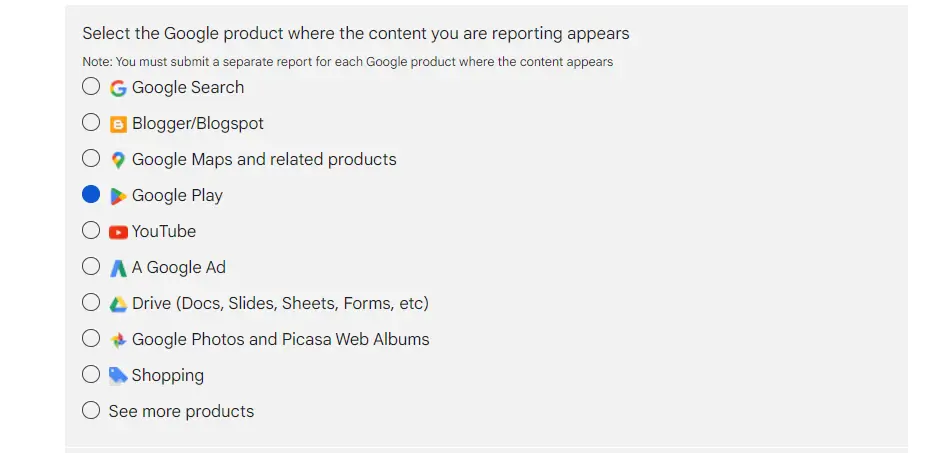
File a DMCA request via Google’s legal troubleshooter at support.google.com/legal. Separate forms exist for Google Search, Google Play, Google Drive, YouTube, and other Google products. Select the correct product before submitting. If the pirated software is on Google Play specifically, you can also report it through the Play Console.
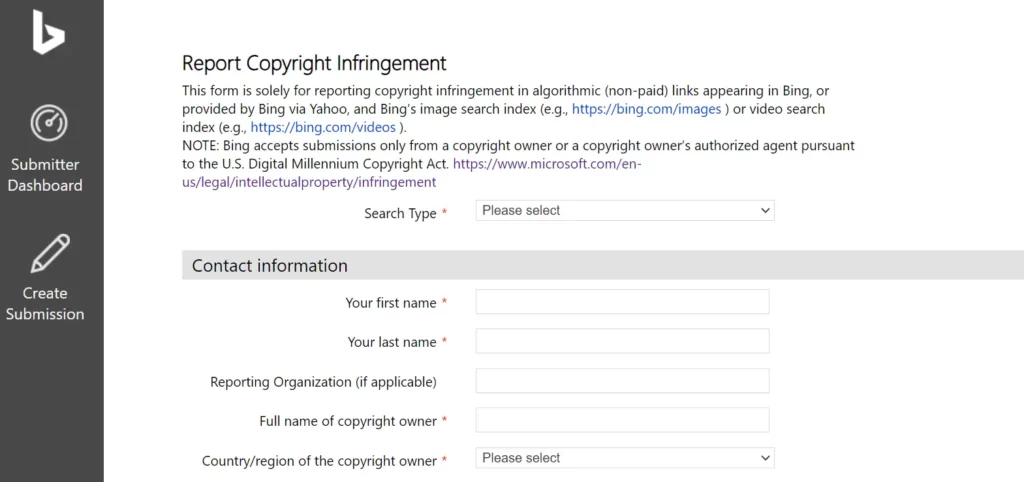
Bing (Response time: 7 to 14 days)
Submit a copyright infringement report directly at bing.com/webmaster/tools/contentremovalform. For pirated software on Microsoft Store, Minecraft Marketplace, or OneDrive, use the Microsoft DMCA form at microsoft.com/en-us/concern/dmca instead.
Hosting providers
When pirated software is hosted on a web server or cloud platform, a successful DMCA notice can result in the direct removal of the infringing files, not just de-indexing.
Amazon Web Services (AWS) (Response time: No fixed timeframe)
Email your notice to trustandsafety@support.aws.com. AWS does not open email attachments; provide all information as plain text in the email body. Include only plain URLs, not embedded links. Note that AWS applies a separate process for Amazon Marketplace seller infringement at amazon.com/report/infringement.
Cloudflare (Response time: 7 to 10 days)
Cloudflare acts as a CDN and proxy for many piracy sites. File a complaint at cloudflare.com/abuse. Be aware that Cloudflare will typically forward your complaint to the actual hosting provider rather than taking down the site itself, unless Cloudflare is the actual hosting service.
Other hosting providers
Identify the hosting provider using WHOIS or a service like HostingChecker. Navigate to their legal, abuse, or DMCA policy page and follow their specific submission process.
Code repositories
Pirated or stolen software code is frequently distributed through platforms built for developer collaboration. These platforms take copyright violations seriously and have clear procedures.
GitHub (Response time: Varies)
GitHub accepts DMCA takedown notices for copyrighted and trademarked works. Review their official Guide to Submitting a DMCA Takedown Notice at docs.github.com before filing, as GitHub has specific requirements around code repositories that differ from other content types. Submit via their online copyright claim form for the fastest response, or email copyright@github.com. If you email, GitHub recommends including a plain-text version of your notice alongside any attachments. Note that GitHub publishes all actionable notices (with personal information redacted) at github.com/github/dmca.
GitLab (Response time: Varies)
GitLab has an established DMCA policy at about.gitlab.com/terms/#dmca. Follow the instructions on that page to submit a complaint.
Bitbucket (Response time: Varies)
File your complaint through Atlassian’s support center or their copyright infringement reporting process. Contact details and submission instructions are available in Bitbucket’s terms of service.
Online marketplaces
Pirated software sold on e-commerce platforms causes direct revenue losses and consumer confusion. Marketplace platforms are obligated to act on valid DMCA notices.
Amazon (Response time: 24 hours to 7 days)
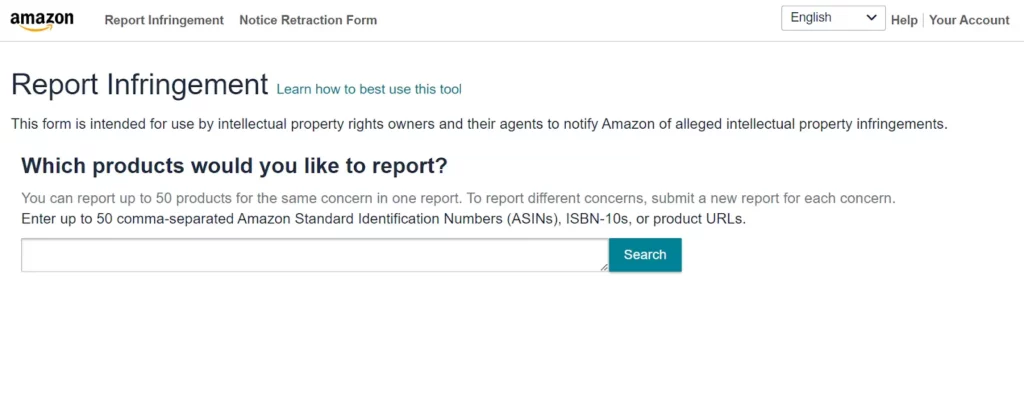
Report infringement through Amazon’s Report Infringement form at amazon.com/report/infringement. If you are enrolled in Amazon Brand Registry, the Report a Violation (RAV) tool provides additional enforcement options and faster response times.
When filing:
- Provide the ASIN if you want the full listing removed, regardless of how many sellers are offering it
- Provide seller details only if the violation is specific to one seller and you do not want the broader listing taken down
- You can submit only one type of intellectual property violation per notice
eBay (Response time: 1 to 2 weeks)
eBay handles intellectual property complaints through its VeRO (Verified Rights Owner) program. Register at eBay’s VeRO Participant page before filing. Once enrolled, you can submit takedown requests directly through the program dashboard.
Social media platforms
Social platforms are a common channel for distributing pirated software through direct download links, shared drives, and unofficial community groups.
- Facebook (Response time: 24 hours to 7 days): Submit via the Facebook IP reporting form at facebook.com/help/ipreporting. You must be signed in to your account to access the form.
- Instagram (Response time: 24 hours to 7 days): Submit via the Instagram IP reporting form at instagram.com/help/ipreporting. The form is nearly identical to Facebook’s.
- X / Twitter (Response time: Varies): Submit the DMCA request form at help.x.com/en/forms/ipi/dmca.
Torrent sites
Many torrent sites ignore DMCA notices directly, particularly those hosted outside the United States. The most effective approach is to file with the hosting provider or domain registrar instead of the torrent site itself. If the site uses Cloudflare as a proxy, file a Cloudflare abuse complaint as a parallel step.
Focus enforcement energy on de-indexing via Google and Bing, since search visibility is how most users discover piracy sites in the first place.
File-sharing platforms
File-sharing services have established copyright reporting processes. Check each platform’s terms of service for the correct submission channel.
- Dropbox (Response time: Varies): Report via Dropbox’s copyright policy page under their Help Center.
- Google Drive (Response time: 5 to 14 days): File via Google’s DMCA forms at reportcontent.google.com/forms/dmca_search.
Third-party app stores, including APKPure and Aptoide
Unauthorized versions of your software frequently appear on third-party Android app stores that operate with less regulatory oversight than Google Play or the Apple App Store.
APKPure
APKPure has a formal DMCA complaint process. You can submit a copyright infringement claim by emailing copyright@apkpure.com or by using the complaint form accessible from the footer of the APKPure website. Include the full app name, the infringing URL on APKPure, your proof of ownership, and the elements of a standard DMCA notice. APKPure’s response times vary, and follow-up is often necessary.
Aptoide
Aptoide accepts copyright notices through its support center. Identify the specific app listing, gather evidence, and submit a formal request through their abuse reporting channel.
For any third-party app store not listed here, locate the DMCA or abuse contact in the site footer or terms of service. If none exists, contact the hosting provider or domain registrar directly.
Step 4: Follow up
If you receive no response or confirmation within two weeks, send a follow-up notice. Persistence matters; many platforms process takedowns in batches and respond faster to follow-up requests.
Follow-up email template:
Subject: Follow-Up on DMCA Takedown Request [Reference #, if applicable]
Dear [Platform Name],
On [date], I submitted a DMCA takedown request regarding [brief description of infringing content and URL]. I have not yet received a response or confirmation that action has been taken.
I am writing to request a status update on this matter. Please confirm receipt of my original notice and the actions taken or planned.
Thank you, [Your Name] [Contact Information]
If the platform still does not respond after a second follow-up, file a complaint with search engines to de-index the URL, even if the file itself remains hosted. You can also consult an intellectual property attorney about further legal options.
What happens if a platform ignores your DMCA notice?
When a platform ignores a valid DMCA notice, you have several escalation options. First, de-index the infringing content from Google and Bing so the page loses search visibility even if it stays live. Second, file a complaint with the hosting provider or domain registrar rather than the site itself. Third, contact an intellectual property attorney about Section 512(f) liability, which allows copyright holders to pursue legal action against platforms that knowingly fail to act on legitimate notices.
The realistic limitation is that many piracy sites are hosted in jurisdictions that do not recognize or enforce the DMCA. For those cases, search engine de-indexing is often the most effective tool available.
How do you handle a counter-notice after filing a DMCA claim?
A counter-notice is a formal response filed by the person whose content was removed, asserting that the takedown was incorrect. Under the DMCA, if a valid counter-notice is received, the platform may reinstate the content after 10 to 14 business days unless you initiate legal action within that window.
If you receive a counter-notice:
- Review it carefully. Counter-notices are filed under penalty of perjury. Frivolous counter-notices expose the filer to legal liability.
- Consult an intellectual property attorney promptly. You have a limited window to respond.
- If the counter-notice is without merit, file a legal action within 10 business days to prevent content reinstatement.
- If the counter-notice raises legitimate questions, such as a fair use claim, assess the merits before deciding whether to pursue litigation.
In straightforward software piracy cases, counter-notices are uncommon. Most platforms will inform you immediately if one is received.
How does Red Points automate DMCA takedowns for software piracy?
Red Points’ Anti-Piracy platform automates the full DMCA enforcement process, from detection through removal and follow-up. For software companies dealing with high-volume piracy across multiple channels, manual enforcement is rarely sustainable.
Red Points monitors 1.4 billion domains, adding 250,000 new domains per day, with 99.5% gTLD and ccTLD coverage, providing detection coverage that manual searching cannot match. Across all enforcement categories, including anti-piracy, the platform delivers an average 95% enforcement success rate for 1,300+ brands, with 4.6 million enforcement actions per year across search engines, app stores, social media, file-sharing platforms, and code repositories.
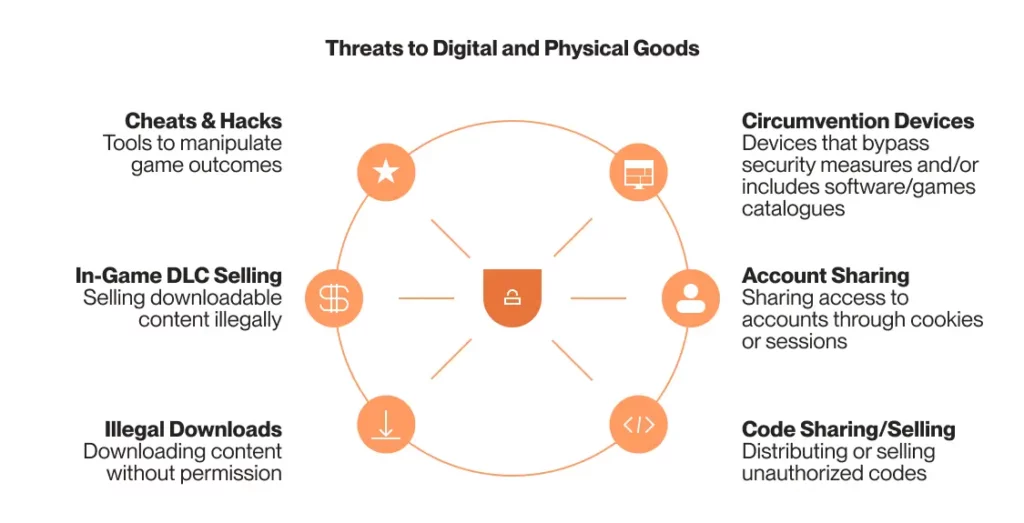
Here is how the platform works:
Automated detection with AI scanning: Red Points continuously scans search engines, app stores, social media, P2P networks, and file-sharing platforms for unauthorized copies of your software. The system adapts search rules based on previous findings, including when pirates shift domains or repackage files.
Dynamic piracy domain tracking: The platform tracks and flags piracy sites even when they change domains, such as shifting from .com to a country-code extension, a tactic common among repeat offenders.
Expert validation: Detected infringements are reviewed by Red Points analysts before enforcement action is taken, reducing false positives and ensuring the right strategy is applied per case.
Bulk filing capabilities: Rather than filing notices one by one, Red Points sends takedown requests in bulk across platforms simultaneously, with automatic follow-ups if no response is received within the expected timeframe.
Repeat offender monitoring: When a repeat piracy source resurfaces under a new domain or listing, Red Points automatically reissues takedown actions without manual intervention.
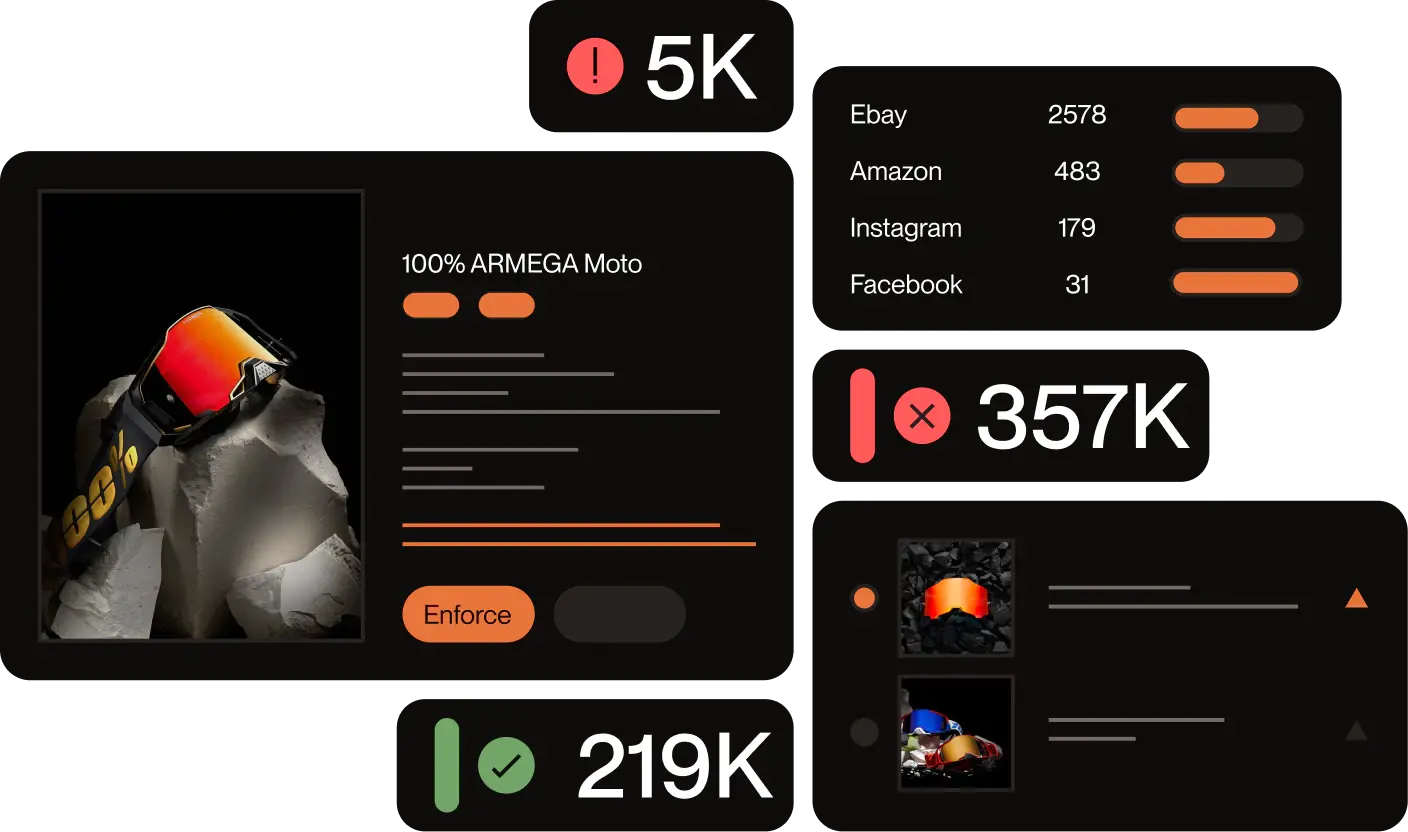
Analytics and reporting: The platform provides real-time dashboards tracking volumes of infringements found, notices submitted, and content removed, along with custom reports measuring the business impact of enforcement activity.
What’s next
The DMCA takedown process is the right first step when you discover pirated software. A successful notice de-indexes the infringing page from search engines and removes it from compliant platforms, cutting off two of the primary traffic channels pirates rely on.
The challenge is scale. New piracy listings appear faster than manual enforcement can keep up, and repeat offenders are a persistent problem. Red Points’ AI-powered Anti-Piracy platform handles that scale with 24/7 monitoring, automated takedown submissions, and continuous repeat-offender tracking.
Book a demo with Red Points to see how the platform works and what enforcement looks like for your specific software category.
Frequently Asked Questions
The Digital Millennium Copyright Act is a U.S. federal law (17 U.S.C. § 512) passed in 1998 that limits online platforms’ liability for user-uploaded content if they comply with copyright takedown requests. Most major global platforms, including Google, Amazon, and GitHub, honor DMCA notices regardless of where the copyright holder is located. For content hosted in jurisdictions that do not recognize the DMCA, alternative enforcement routes such as local copyright law or domain registrar complaints may be necessary.
Response times vary by platform. Google typically processes DMCA requests within 5 to 14 days. Amazon resolves marketplace complaints in 24 hours to 7 days. GitHub, GitLab, and Bitbucket response times vary case by case. File-sharing platforms like Dropbox and Google Drive follow timelines similar to Google’s. If no action is taken within two weeks, send a follow-up and consider escalating to the hosting provider or domain registrar.
Yes. APKPure accepts copyright infringement notices by email at copyright@apkpure.com or via a complaint form on their website. Include your contact information, the infringing app URL, your proof of software ownership, a good faith statement, and your electronic signature. Follow up if you do not receive a response within two weeks.
A DMCA takedown notice targets a hosting provider and asks them to remove the infringing content from their server. A de-indexing request targets a search engine, such as Google or Bing, and asks them to remove the infringing URL from their search results. The underlying content may remain live on the hosting server after a successful de-indexing request, but it becomes far harder to find. For maximum impact, file both simultaneously
Repeat offenders are common. Under the DMCA, platforms must terminate accounts of users who repeatedly infringe copyright (the “repeat infringer policy”). Document each reposting incident and reference prior notices in follow-up filings. For high-volume repeat offenders, consider an automated enforcement service like Red Points, which automatically reissues takedown actions when previously removed content resurfaces.
Torrent sites vary widely in their compliance. Sites based in the U.S. or hosted by U.S. providers generally comply. Many offshore torrent sites ignore notices entirely. For those cases, the most effective route is filing de-indexing requests with Google and Bing, which removes the torrent links from search results and cuts off a major discovery channel, even if the torrent itself stays live.
Filing a false or materially misrepresenting DMCA notice exposes you to liability under Section 512(f) of the DMCA. A rights holder who knowingly misrepresents that content is infringing can be sued for damages, including attorney’s fees. Only file notices for content you genuinely own the copyright to, and where you have a good faith belief the use is unauthorized.
Manual DMCA filing requires identifying each infringement, drafting individual notices, submitting to each platform, tracking responses, and handling follow-ups. Red Points automates all of those steps: the platform scans for infringements continuously, submits bulk takedown requests, follows up automatically, and monitors for repeat offenders around the clock. This is particularly important for software companies facing piracy across dozens of platforms simultaneously.