


TL;DR
- Cloudflare is a CDN and reverse proxy, not a hosting provider. It cannot remove infringing content directly; it forwards your complaint to the website operator and origin hosting provider.
- Submit your DMCA notice via Cloudflare’s dedicated abuse form at abuse.cloudflare.com/dmca. Email submissions are generally not processed.
- A valid notice must include proof of infringement, proof of copyright ownership, your contact information, and an electronic signature with a good-faith statement.
- As of H1 2025, Cloudflare’s median response time for automated complaints processed through their API is under one hour. Manual submissions take longer.
- If the infringing content remains after filing with Cloudflare, track down the origin hosting provider directly using DNS history tools. Cloudflare will typically provide host contact details after processing your complaint.
Dealing with copyright infringement on a website protected by Cloudflare’s services is one of the more frustrating enforcement challenges copyright holders face. Because Cloudflare acts as a reverse proxy, its IP address appears in WHOIS and DNS records for millions of sites, making it look like the host when it is not.
This guide explains exactly how Cloudflare handles DMCA notices, what information you need to file a valid complaint, how to track down the actual hosting provider, and what to do when the infringing content stays up. As of April 2026, all steps and form URLs below have been verified against Cloudflare’s current abuse policy.
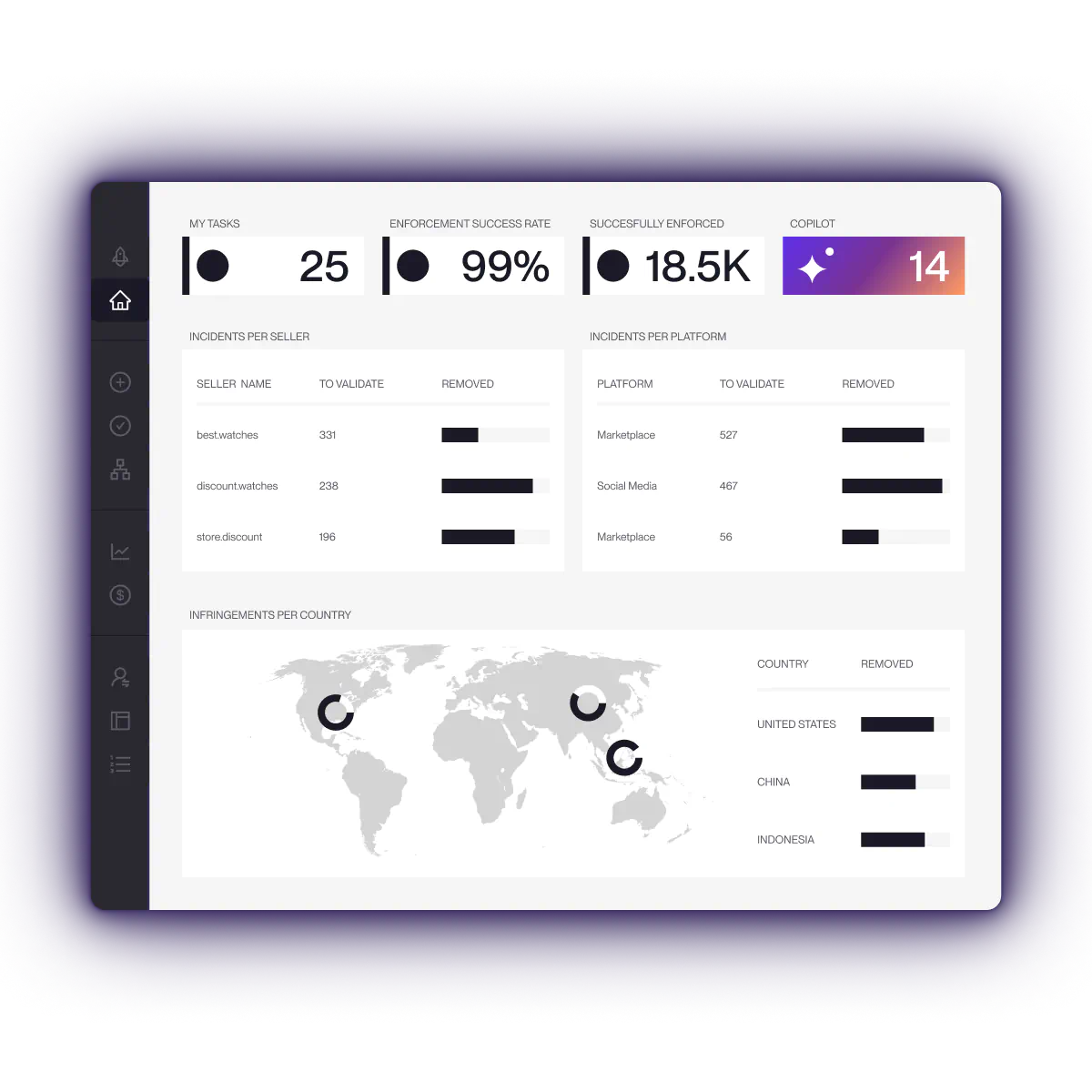
What is Cloudflare’s role when you file a DMCA notice?
Cloudflare is a content delivery network (CDN) and reverse proxy, not a traditional hosting company. When a user visits a website using Cloudflare, the request passes through Cloudflare’s global network before reaching the actual origin server, which is owned by a separate hosting provider such as AWS, SiteGround, or GoDaddy.
Because of this architecture, Cloudflare typically cannot remove infringing content itself. When it receives a valid DMCA notice, it forwards the complaint to the website operator and origin hosting provider, then provides you with the hosting provider’s contact details so you can follow up directly. In the small number of cases where content is definitively stored on Cloudflare’s own infrastructure (Cloudflare Stream, Pages, Workers, Workers KV, or Images), Cloudflare acts as the hosting provider and follows the full DMCA notice-and-takedown process under 17 U.S.C. § 512.
How do you submit a DMCA takedown request to Cloudflare?
To file a DMCA notice with Cloudflare, go to abuse.cloudflare.com/dmca, select “Copyright infringement and DMCA violations” from the abuse type menu, complete the required fields with your evidence and contact information, sign the form electronically, and submit.
Cloudflare does not process complaints submitted by email. If you email a complaint, you will receive an automated response directing you to the abuse form.
Follow these five steps:
Step 1: Access the Cloudflare abuse form
Go to abuse.cloudflare.com/dmca. You can also find this link through the Cloudflare Trust Hub abuse policy page. Do not attempt to file by email, as Cloudflare’s systems are built to process complaints exclusively through their online form.
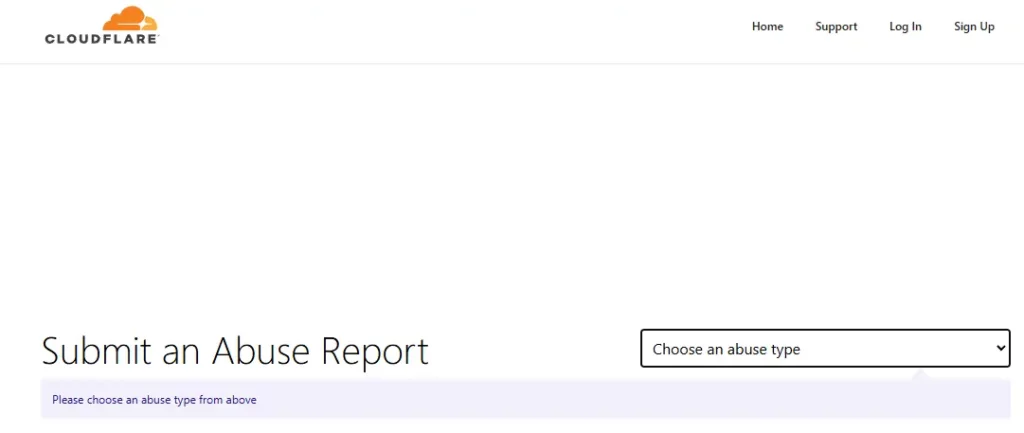
Step 2: Select the correct abuse type
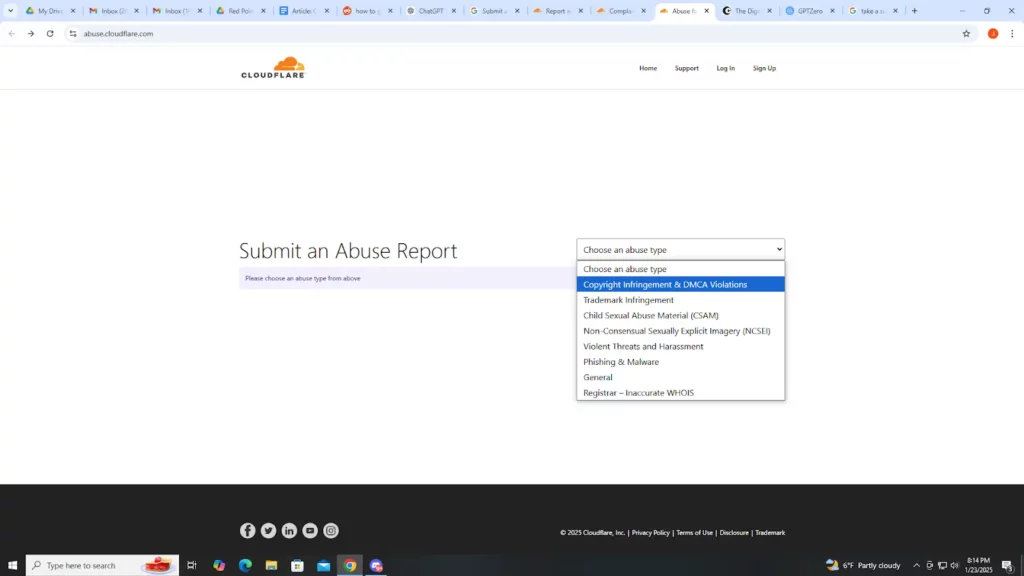
From the “Choose an abuse type” dropdown menu, select “Copyright infringement and DMCA violations.” Choosing the wrong category can cause delays or misdirect your report.
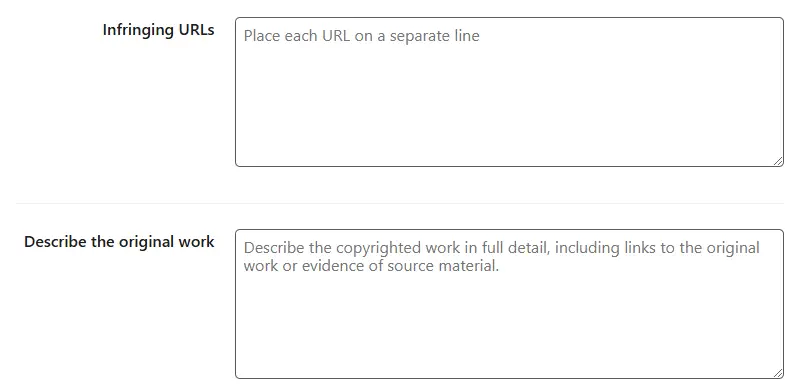
Step 3: Complete all required fields
Cloudflare requires all DMCA complaints to include the following information under 17 U.S.C. § 512(c):
- A URL or specific link to each piece of infringing material, along with a description of exactly where on the page the infringement appears
- Evidence that you are the rightful copyright owner of the original content, or confirmation that you are authorized to act on their behalf
- Your name, address, and contact information (note: this will be shared with the website operator and hosting provider)
Be as specific as possible when identifying infringing material. Vague descriptions give Cloudflare less to act on and increase the chance of a delayed or rejected response.
Step 4: Attach supporting evidence
Use the text fields in the form to provide clear, specific evidence. Include the precise URLs where infringement occurs and describe the exact location on each page (for example: “third image in the gallery section” or “reproduced verbatim in the second paragraph under the heading ‘About Us'”). The more specific the evidence, the faster the internal review moves.
Step 5: Review and submit
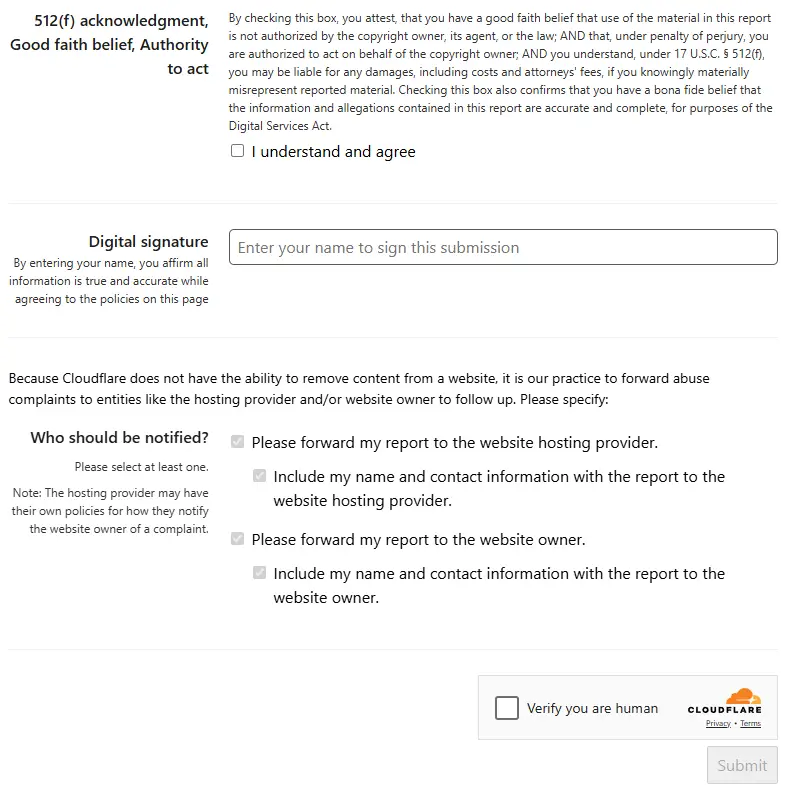
Before submitting, confirm that you are the rightful copyright owner or authorized representative and that you are acting in good faith. You must also acknowledge the 512(f) provision, which carries penalties for knowingly filing a materially misrepresented notice, and provide your electronic signature attesting that the information is accurate.
Review all details carefully. Inaccurate submissions can lead to delays, rejections, or counterclaims from the site operator.
How long does it take Cloudflare to respond to a DMCA request?
Cloudflare’s median response time for automated DMCA complaints processed through their API was under one hour as of H2 2025, according to their transparency data. For manual submissions, the median time to action is 154 hours, depending on the complexity of the claim.
The key factor affecting speed is the quality and completeness of your evidence. If your submission is missing required fields or the infringing URLs are ambiguous, Cloudflare will need more information before it can process the report, which adds days to the timeline.
What happens after Cloudflare receives your DMCA notice?
Once Cloudflare verifies your notice, it takes the following steps:
- Forwards your complaint to the website operator and the origin hosting provider
- Provides the hosting provider with the origin IP address of the infringing content to help them locate it
- Provides you with contact details for the hosting provider so you can follow up directly
- Responds to you with additional information as appropriate based on the nature of your complaint
If you selected “do not forward to website operator” during submission (available for certain complaint types), Cloudflare will skip the forwarding step to the site operator while still notifying the host.
What if the infringing content is still online after filing?
How do you find the actual hosting provider?
Because Cloudflare masks the origin server IP, the hosting provider is not immediately visible. Use these methods to identify it:
- DNS history services: Some tools show historical DNS records. If the domain pointed to a hosting provider before adding Cloudflare, that IP may still be the active origin server.
- Subdomain checks: Development or staging subdomains (such as dev.example.com) are often not routed through Cloudflare and may expose the origin IP directly.
- Cloudflare’s own disclosure: After processing your complaint, Cloudflare will typically provide the hosting provider’s contact information so you can file a direct takedown notice with them.
Once you have identified the origin host, file a direct DMCA takedown with that hosting provider. The process and timeline vary: GoDaddy, for example, resolves approved requests in 10 to 14 business days through its own DMCA takedown process.
What if the hosting provider is unresponsive?
Start by contacting the website host directly and completing any DMCA takedown form they provide. If the host remains non-compliant, escalate by filing a complaint with their upstream provider or consult a copyright attorney. For brands managing multiple simultaneous infringements across many hosts and platforms, this escalation chain quickly becomes unmanageable manually. Red Points handles host identification, follow-up correspondence, and re-filing in a single automated workflow, so cases do not stall waiting on unresponsive providers.
What if your Cloudflare notice was rejected?
If you receive no response, your report may have been denied due to insufficient evidence or incorrect information. Review your submission, correct any errors, and file a new report. If no errors are apparent, gather additional supporting documentation (timestamps, registration certificates, screenshots with URLs visible) and resubmit with the expanded evidence set.
How does the Cloudflare counter-notice process work?
If the website operator believes your DMCA takedown was filed in error, they can submit a counter-notice under 17 U.S.C. § 512(g)(3). Cloudflare will forward that counter-notice to you. You then have 10 to 14 business days to file a lawsuit in federal court to keep the content down. If you do not file suit within that window, Cloudflare may restore access to the content.
A valid counter-notice must include: the operator’s electronic or physical signature, identification of the material that was removed and its previous location on the site, a statement under penalty of perjury that the removal was a mistake or misidentification, the operator’s contact information, and their consent to federal court jurisdiction.
Stay vigilant even after a successful takedown. Operators can also simply re-upload the same content. If this happens, file a new DMCA notice immediately and document the pattern of repeat infringement, since it may be relevant in any subsequent legal action.
What are the limitations of Cloudflare DMCA enforcement?
Cloudflare’s role as a CDN rather than a hosting provider creates specific gaps that copyright holders should understand before filing:
Cloudflare does not remove content from CDN cache unless the origin has already removed it. If you are seeking removal from Cloudflare’s cache specifically (under 17 U.S.C. § 512(b)), you must include a hyperlink to a court order or evidence that the content has already been removed by the origin hosting provider. Alternatively, send this documentation to abusedocuments@cloudflare.com referencing your abuse report number.
Registrar complaints follow a different path. If Cloudflare is listed as the domain registrar in WHOIS records, you can submit registrar-specific complaints to registrar-abuse@cloudflare.com, though using the online form remains the recommended approach for the fastest response.
Does filing with Cloudflare remove content from Google search results?
No. A Cloudflare DMCA notice targets the infrastructure layer: it prompts the origin host to remove the infringing page from the web server. It has no effect on whether that URL appears in search engine results.
To remove an infringing URL from Google or Bing, you need to file a separate search engine DMCA takedown. These are independent processes, and in practice, you should often file both in parallel. De-indexing cuts off organic search traffic to the infringing page while the hosting-level takedown is still being processed, which limits the damage in the meantime.
Similarly, if the same content appears on social media, each platform has its own removal process. Our guide to DMCA takedowns on Facebook, Instagram, TikTok, Pinterest, and X walks through the platform-specific steps.
What’s next
A single Cloudflare DMCA filing is straightforward once you know the form requirements and understand the platform’s CDN role. The harder challenge is what comes after: tracking down unresponsive hosts, handling counter-notices, catching repeat offenders before they re-establish themselves, and managing all of this across multiple platforms at the same time.
Red Points’ DMCA Takedown Service automates the full enforcement cycle, including Cloudflare-protected sites, with API integrations that speed up bulk submissions and a centralized dashboard that keeps every active case visible. If you are also dealing with copyright infringement beyond Cloudflare, across marketplaces, social platforms, and search engines, the same platform covers all of it.
Request your demo to see how Red Points scales DMCA enforcement beyond what manual filing can support.
Frequently Asked Questions
In most cases, no. Cloudflare is a CDN and reverse proxy, not a web host. It forwards your DMCA complaint to the site operator and origin hosting provider, who are responsible for the actual removal. The exception is content stored directly on Cloudflare’s own infrastructure (Stream, Pages, Workers, Workers KV, Images), where Cloudflare acts as the hosting provider and follows the full DMCA removal process
No. Submitting a DMCA abuse report through Cloudflare’s online form is free.
No. Cloudflare’s systems are designed to process complaints exclusively through the online form at abuse.cloudflare.com. Email complaints receive an automated response directing you to the form
Your notice must include: the URL(s) where infringement occurs with a specific description of the infringing material on each page, proof that you own the copyright or are authorized to act on the owner’s behalf, your contact information (which will be shared with the site operator and host), a good-faith statement, an acknowledgment of the 512(f) perjury provision, and your electronic signature.
Cloudflare does not accept DMCA complaints by email for most cases. The only email address relevant to copyright complaints is abusedocuments@cloudflare.com, which is used specifically to submit court orders or origin-removal evidence for CDN cache removal requests under 17 U.S.C. § 512(b). For all standard DMCA filings, use the online form at abuse.cloudflare.com/dmca.
Cloudflare forwards the counter-notice to you. You then have 10 to 14 business days to initiate a lawsuit in federal court. If you do not file suit within that period, Cloudflare may restore access to the content.
Use a DNS history service like DNS Lookup to look up historical DNS records. Staging or development subdomains that are not routed through Cloudflare may also expose the origin IP directly. Cloudflare will typically provide hosting provider contact information after processing your complaint.
Cloudflare may disclose operator contact information in response to a valid court order or subpoena. For most standard DMCA complaints, it forwards your notice to the operator and provides you with the hosting provider’s contact details.
File a new DMCA notice immediately and document the pattern of repeat infringement including timestamps and URLs for each instance. Repeated violations can strengthen your position in any subsequent legal action. Automated detection tools flag re-uploads as soon as they appear, which reduces the window during which the content stays live.