


Founded in 2020, Marqvision is a fairly new brand protection provider that helps brands prioritize threats like counterfeits and impersonation. In this article, we’ll compare Marqvision against six of its main competitors: Red Points, Corsearch, BrandShield, Bolster, CSC, and OpSec. Let’s compare these companies on the factors that matter for brands.
The right brand protection partner matters now more than ever
While detecting counterfeits and sending DMCA notices manually might have worked years ago, fighting fakes now requires modern tools. In almost no time at all, bad actors can copy a site with AI and use fake ads to scale threats to the masses. Protecting your brand today means implementing multi-channel monitoring across marketplaces, social media, stand-alone websites, domains, ads, and apps combined with swift takedowns wherever threats exist.
All signals show these threats are increasing, not decreasing. Our team already saw fake websites increase by 59% from 2023 to 2024. Based on internal projections, counterfeit sites are expected to continue growing through 2025 and 2026. At Red Points, we project counterfeit sites will grow by 70% in 2025 and expect further growth in 2026. With this type of growth, it’s important to work with the right brand protection solution that can monitor and remove infringements in all channels.
What makes us qualified to guide you
Our recommendations of leading brand protection companies are based on a deep industry analysis, our experience working with 1,300+ brands, and insights from customers of other brand protection platforms. Our comprehensive review focused on different aspects brands should consider when selecting a brand protection vendor, like detection capabilities, technology maturity, platform coverage, takedown success rates, operational models, reporting depth, pricing structure, and scalability.
With nearly 15 years of experience, this has given us a unique perspective on changes in counterfeiting tactics and enforcement best practices, along with how different platforms have developed their strategies. Our goal is to help clarify the services and features that reduce risks beneath the marketing claims.
Red Points currently works with over 1,300 brands, but this guide is not based solely on our experience. It also incorporates insights from the 150+ companies that switched to Red Points from another provider in the last two years and every statement has been fact-checked with publicly available customer reviews and vendor information. These business leaders and brand protection teams consistently shared what the solutions they have used do well, where they fall short, and which capabilities became essential as their businesses grew.
Considering this background, our evidence base is unique:
- Visibility into how solutions evolve over time
- Cross-vendor feature comparisons from real implementation experience
- Market-level performance benchmarks across channels and geographies
- First-hand accounts of what brands wished they had known before choosing a provider
Our company comparison data
Here’s a snapshot of the data that backs our company comparisons:
- Data points: 10k
- Testimonials from companies that switched to Red Points from another vendor: insights from 151 interviewed companies
- Company groupings by service focus: Brand protection, seller tracking, impersonations, anti-piracy, gray market, cybersecurity
- Database categories include: Pricing, business offering, services, AI and tech features, channel coverage
- Customer reviews: Real customer reviews highlighting positives and negatives
- SWOT analysis: Objective analysis of the strengths and weaknesses of leading companies
Marqvision: Features, strengths, and limitations
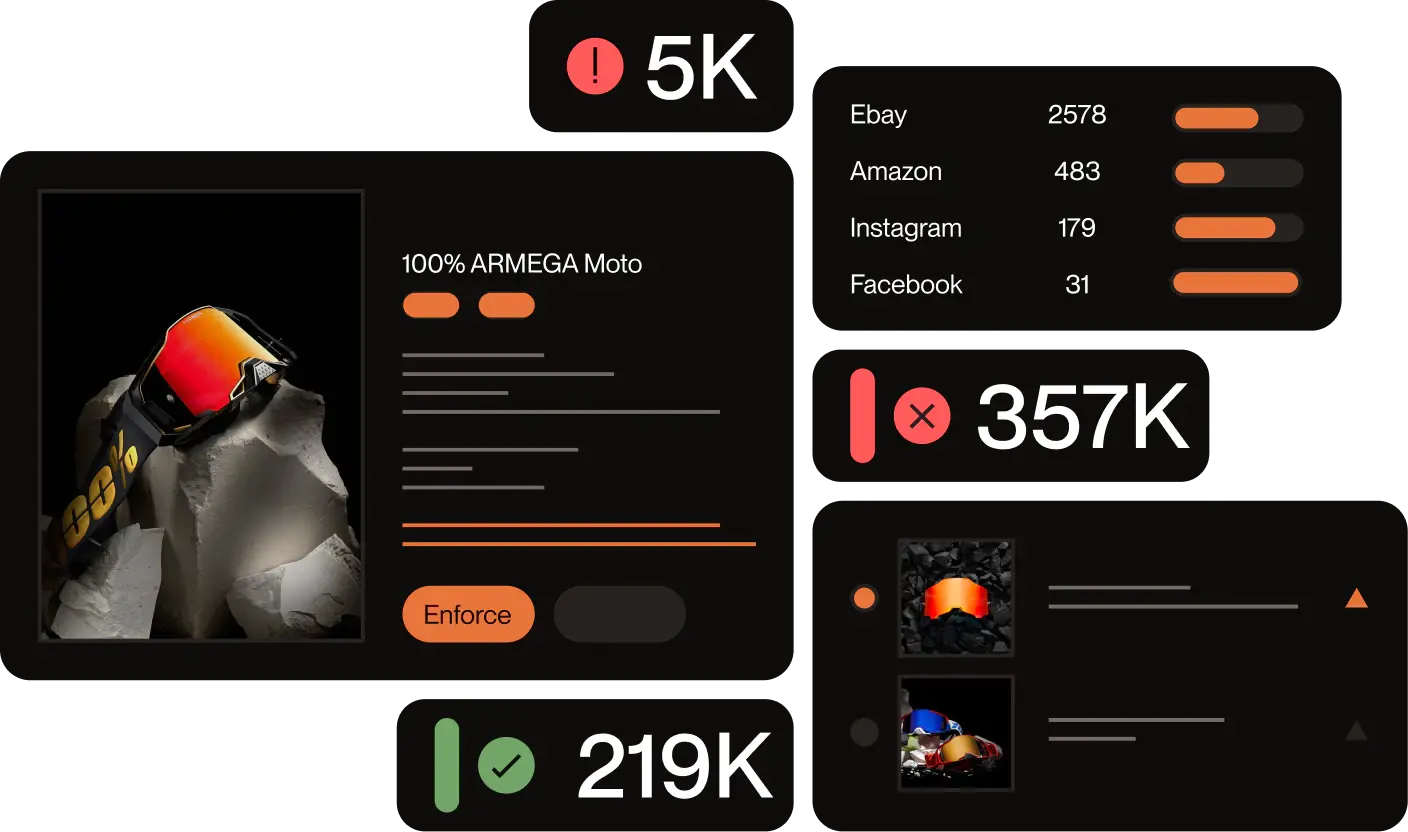
Marqvision is a brand protection company that protects against counterfeits, brand impersonation, gray market sellers, and piracy. The company uses AI to detect infringements across marketplaces, social media, and standalone websites.
Marqvision provides a dashboard with a smart rule function that lets brand owners sort through and enforce similar infringements. Marqvision also has wide e-commerce channel coverage: it scans 1,500 marketplaces with a focus on Asian platforms. And if you want to pursue action offline, Marqvision can support legal action in China through its partner law firm. Pricing is structured by plan tier and enforcement volume.
Takedowns are capped based on the selected plan, with additional enforcement capacity available through upgrades.
Marqvision Features
Main features of Marqvision:
- Brand protection: Uses AI detection and clustering to remove fakes on marketplaces, social media, and standalone sites.
- Content protection: Protects images, software, videos etc. in search listings, social media, and more.
- Impersonation removal: Takes down fake websites, spoofed domains, phishing sites, and social profiles.
- Gray market visibility: Stops unauthorized sales and supports compliance.
- Trademark management: Register, manage, and monitor trademark IP.
- Offline services: Supports field investigation, raids, collaboration with law firms.
Marqvision Limitations
While Marqvision offers plenty of features for brands, it also has some limitations:
- Channel coverage for counterfeits is limited (no app or LLM coverage).
- Enforcement speed may vary during high-volume periods depending on plan and workflow design.
- The platform focuses primarily on detection and clustering rather than predictive AI risk modeling.
- Fewer public reviews than some other providers.
Marqvision alternatives you should know about in 2026
Next, we’ll cover the following brand protection companies in detail to compare them against Marqvision:
- Red Points
- Corsearch
- BrandShield
- Bolster
- CSC
- OpSec
Let’s take a look at each below.
Marqvision alternatives at a glance
| Category | MarqVision | Red Points | Corsearch | BrandShield | Bolster | CSC | Opsec |
|---|---|---|---|---|---|---|---|
| Unlimited takedowns Always-on protection | ❌ Volume depends on package limits. | ✅ Flat-fee model with unlimited detections and takedowns. | ❌ No flat-fee unlimited model. | ❌ Volume depends on package limits. | ❌ No flat-fee unlimited model. | ❌ Volume tied to service scope. | ❌ Contract-based scope. |
| Multi-channel protection Marketplaces, social, web, ads | ✅ Broad multi-channel coverage. | ✅ Marketplaces, social media, web, domains, ads, and apps. | ✅ Multi-channel coverage. | ✅ Broad multi-channel coverage. | ⚠️ Limited marketplace coverage. | ✅ Broad monitoring coverage. | ✅ Multi-channel coverage. |
| Priority enforcements APIs & escalation paths | ⚠️ Not disclosed. | ✅ Platform APIs, priority escalation, adaptive enforcement. | ⚠️ Not publicly detailed. | ⚠️ Not disclosed. | ⚠️ Domain registrar APIs. | ⚠️ Slower handling. | ⚠️ Not disclosed. |
| Dedicated specialists Onboarding & ongoing support | ✅ Analysts available. | ✅ Assigned Implementation Specialist and CSM. | ✅ Analyst-led enforcement. | ✅ Analysts available. | ⚠️ Analyst support on demand. | ✅ Analyst-led services. | ✅ Human-intensive model. |
| AI risk prediction Incident & seller prioritization | ❌ Rule-based prioritization. | ✅ Predictive incident and seller risk models. | ❌ Rule-based prioritization. | ❌ Rule-based prioritization. | ❌ No predictive prioritization. | ❌ No predictive prioritization. | ❌ No predictive risk models. |
| Domestic China Mainland-only platforms | ✅ Domestic China coverage. | ✅ Domestic Chinese platforms (Goofish, Pinduoduo, WeChat, Douyin). | ✅ Coverage available (capacity dependent). | ✅ Domestic China coverage. | ❌ No domestic China. | ❌ No domestic China. | ❌ No confirmed China coverage. |
| Seller clustering Cross-channel intelligence | ✅ Seller network intelligence. | ✅ Cross-channel seller intelligence (2.7B datapoints). | ✅ Manual seller clustering. | ✅ Seller network intelligence. | ❌ No seller clustering. | ❌ No cross-channel clustering. | ✅ Network intelligence. |
| Gray market Unauthorized sellers | ✅ Gray market monitoring. | ✅ Automated gray market and unauthorized seller removal. | ✅ Gray market monitoring. | ✅ Gray market monitoring. | ❌ Not advertised. | ✅ Gray market enforcement. | ✅ Trade diversion monitoring. |
| Public reviews Gartner, G2, Capterra | <50 | 100–250 | <50 | <50 | 50–100 | <50 | <50 |
1. Red Points
The first Marqvision alternative we’ll dive deep into is our software. Red Points combines operational maturity with scalable technology for consistent results and protection for brands of all sizes: SMEs (35% of its client base), mid-market (35% of its client base) companies, and large enterprises (30% of its client base).
Looking at technology, Red Points is the only provider that offers truly unlimited multi-channel detection and enforcement across plans. Red Points detects infringements on e-commerce marketplaces, websites, domain databases, social media, app stores, search engines, the deep web, and ads.
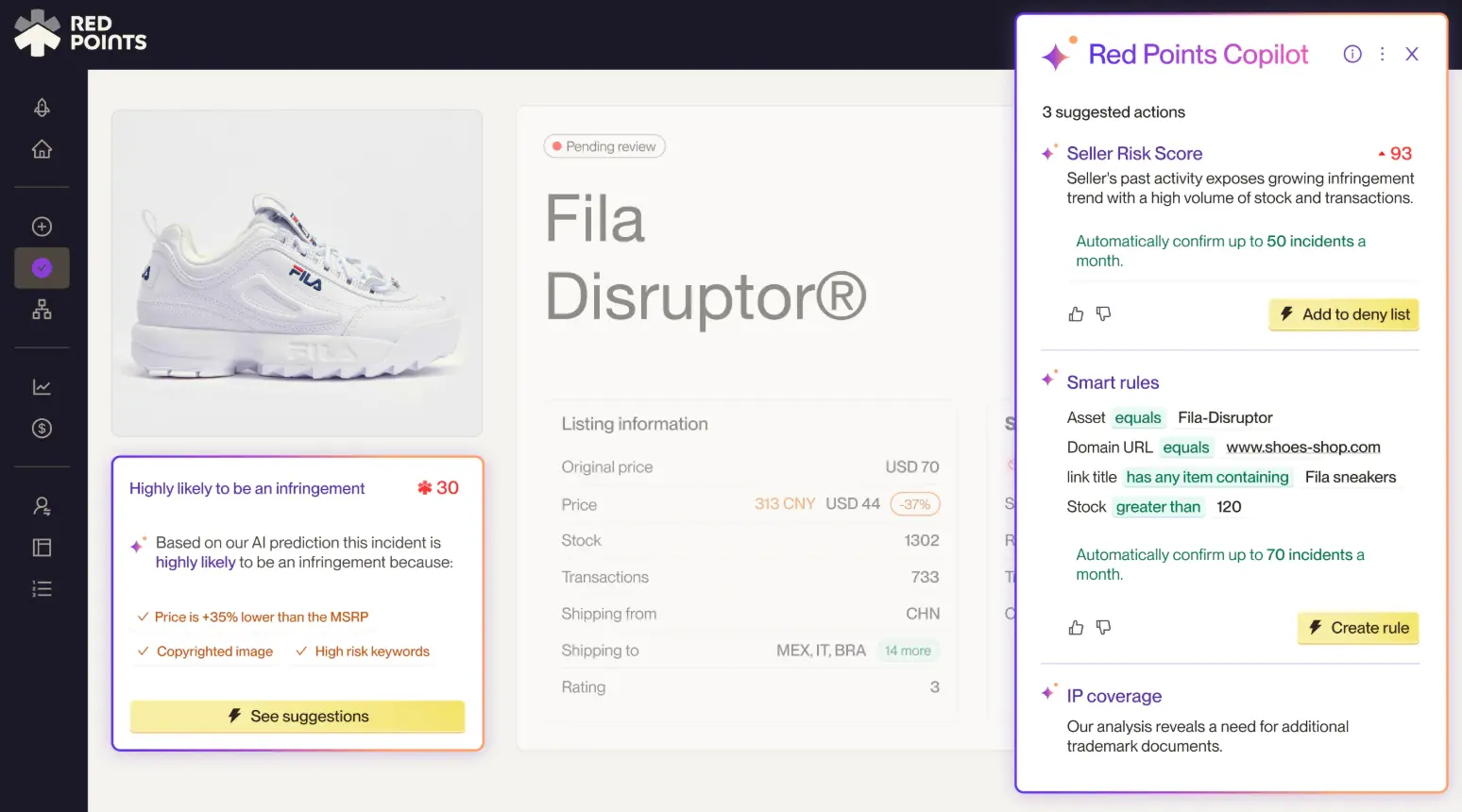
Red Points is also a well-established brand protection provider. The company has been around for nearly 15 years (about three times as long as Marqvision). While many brand protection companies offer AI integration, Red Points’ AI is trained on 2.7 billion risk data points every month, and a database of more than 50 million infringers. We integrate AI and automation (like incident prediction based on a brand’s history and seller risk score for high-risk seller prioritization) to make the process scalable, but have our experts control critical tasks, like enforcement push-back management or test purchases. Red Points’ customers can benefit from 24/7 detection and unlimited takedowns, which not all competitors offer.
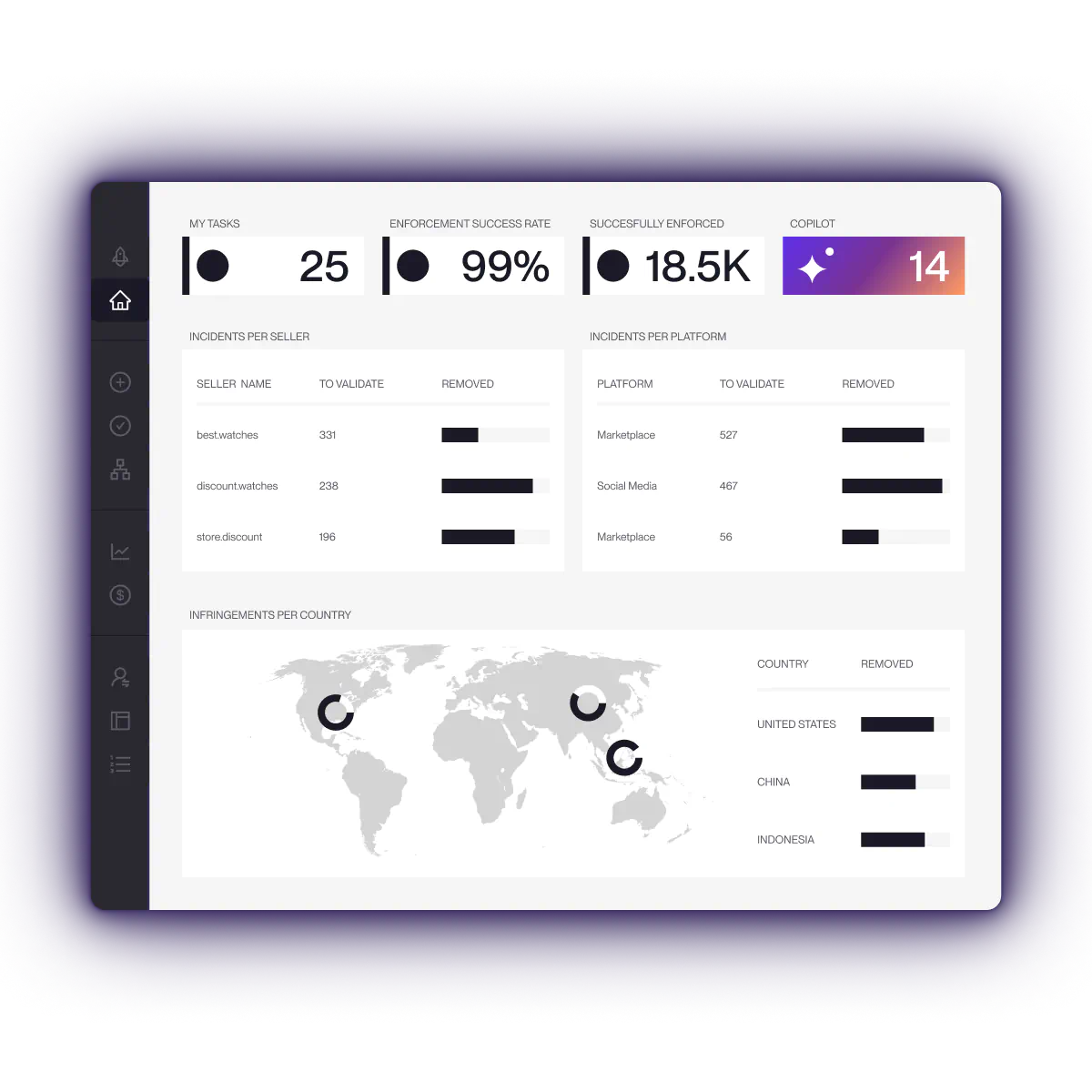
The Red Points dashboard is easy to use, too. You’ll find customization and prioritization levers to help save time. This means you can easily prioritize high-risk incidents and sellers without spending hours sifting through a wall of data.
Considering all this, Red Points is a strong alternative to Marqvision for brands looking to protect their reputation at scale.
Pros
- Largest online brand protection customer base in the market, with existing knowledge, playbooks, and trained data models for every industry and region
- Unlimited detections and takedowns (not capped nor limited by analyst hours), always-on
- Infringement confirmation can be done by the customer, via automation rules, by Red Points’ Service Excellence team, or by a combination of the aforementioned
- Coverage across all digital channels, including Domestic China marketplaces and social media (those not accessible from outside Mainland China)
- An enforcement team with more than 15 years of experience, priority escalation paths for complex cases and API connections for fast reporting
Cons
- Provides test purchases, but comprehensive offline investigations are offered through partners
- Can be more expensive than Marqvision
Main features
Main features of Red Points include:
- Unlimited detection and takedowns: Unlimited takedowns on marketplaces, websites, social media, domains, app stores, search engines, deep web, ads, AI shopping experiences, including fake sites blocked by region or device.
- Wide coverage: Counterfeit, impersonation, piracy, and gray market protection, plus domain management and social video protection.
- Intuitive dashboard: The dashboard provides granular information on infringement and seller trends and ROI.
- Revenue Recovery Program: The very first Recovery Program designed to help brands recover tangible revenue through high-scale, self-funded litigation and permanently disrupt hundreds of infringing sellers.
- Clear tracking: Real-time granular tracking of detected and enforced incidents, even after removal.
Pricing
Red Points uses a flat fee model that includes unlimited takedowns by channel. Plans come with an implementation manager and a customer success manager without an extra cost.
2. Corsearch
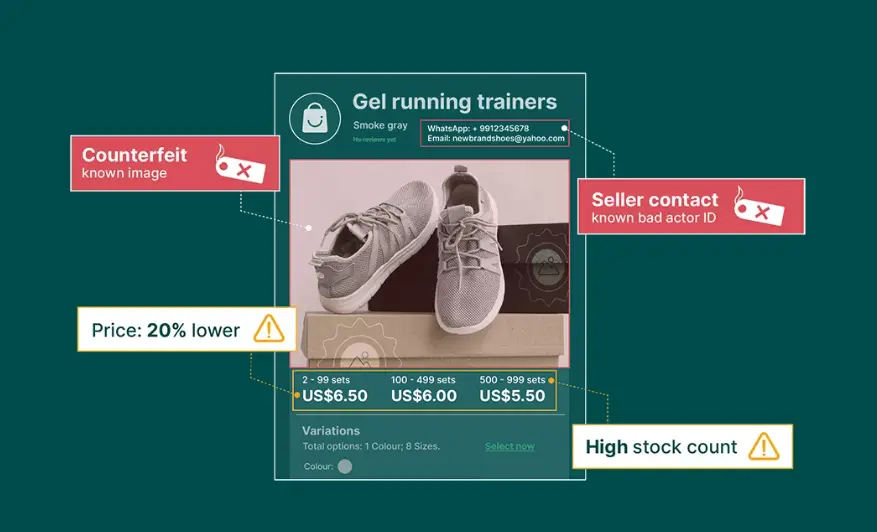
Founded in 1949, Corsearch is a longstanding trademark protection company that focuses on mid-market and enterprise customers. It offers full trademark lifecycle management, from registration to offline investigations and raids overseas, and it focuses on mid-market to enterprise companies. Corsearch traditionally operated with a service model instead of SaaS, so its packages and pricing are more dependent on analyst hours. It recently launched Corsearch Zeal 2.0, the second version of its brand protection platform (the first was launched in 2024), which follows after the merge of several brand protection companies acquired in the last 5 years (YellowBP, PointerBP, Incropro, Navee)
Pros
- Good option for enterprise companies with large product catalogs, focusing on trademark protection and offline legal action
- Client can change the scope of the work if the problem tends to move often from one region to another instead of expanding
- Offers a wide range of services (trademark registration, anti-counterfeiting, anti-piracy, offline investigations, etc.)
- Recently released a Revenue Recovery Program
- Can provide reports formatted to use in offline investigations
Cons
- Detection coverage may vary depending on configuration and workflow
- Enforcement has caps depending on the number of review days or analyst hours consumed
- Relies more heavily on analyst-led workflows, which may limit scalability for some organizations
Main features
Main features of Corsearch include:
- Trademark solutions: Screen potential trademarks, clear a trademark for viability, and monitor similar trademark registrations.
- Brand protection: Remove counterfeits, stop impersonation, and deter gray market sellers.
- Domain protection: Register and protect domain names from cybersquating and misuse.
- Investigations 360: Coresearch can take offline action to stop counterfeiters through investigation, raids, and more.
- Anti-piracy: Protect books, games, digital content, and more from piracy.
Pricing
Corsearch uses custom pricing depending on the scope. Pricing can be based on analyst hours, intelligence hours, or service package.
3. BrandShield
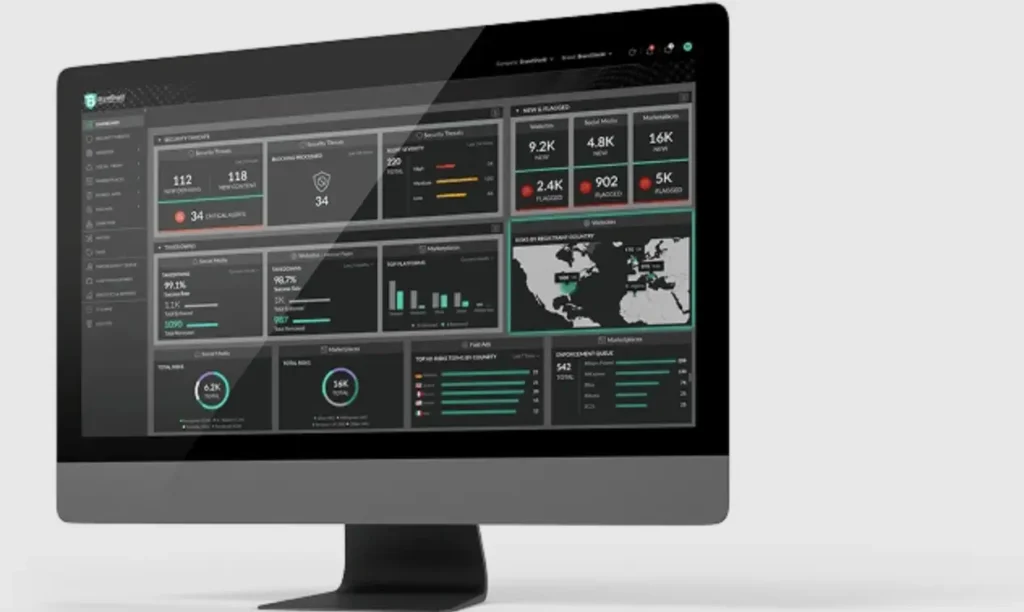
Next on our list of Marqvision alternatives is BrandShield, which is a brand protection platform with offices in Israel that has been in business since 2014. BrandShield can detect infringements on websites, marketplaces, social media, ads, the dark web, and app stores. Its clustering capability, AI.ClusterX, is integrated into BrandShield’s different solutions, like counterfeit and phishing protection. However, BrandShield doesn’t offer unlimited takedowns, and some customer feedback shows the platform takes more manual work than expected.
Pros:
- Covers a wide range of channels, including the dark web and rogue apps
- BrandShield Resolve service provides cybersecurity monitoring
- Pricing is generally positioned as affordable, depending on plan structure and scan frequency
- Platform is easy to use and responsive on mobile devices
Cons:
- Monitoring is on a site-by-site basis and can be limited
- Lower plans have few monthly scans
- Some workflows require manual prioritization depending on the plan
Main Features
Main features of BrandShield include:
- AI-powered detection: BrandShield’s system uses AI to detect counterfeits, phishing, piracy, lookalike domains, and gray market sales on a regular basis.
- Monitoring on marketplaces and social media: Track counterfeits, impersonation, and unauthorized sellers on Amazon, eBay, Instagram, Facebook, and more.
- BrandShield Resolve: The Resolve program provides external cybersecurity monitoring and takedowns through AI.
- Intelligence dashboards: See incidents, takedowns, and ROI of brand protection efforts in an online dashboard.
- Enforcement support: BrandShield provides an enforcement manager to help with complex takedowns and escalation.
- Wider brand threat monitoring: The platform can monitor the dark web, fake apps, paid ads, and cluster threats with AI.
Pricing
BrandShield pricing is structured by plan tier, with higher plans providing more frequent scanning capabilities.
4. Bolster
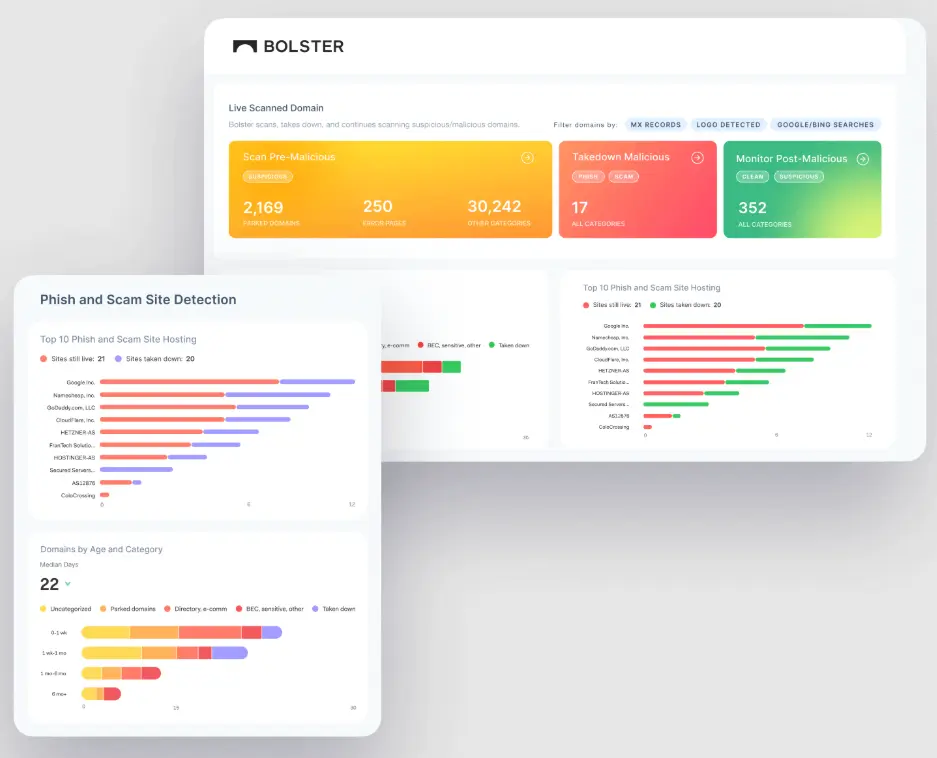
Bolster is an online threat protection platform that integrates AI to remove phishing and scams. The platform has strong monitoring capabilities for fake domain names as well as on social media, app stores, and the dark web. However, compared to Marqvision and most other brand protection platforms, Bolster is missing detection and removal on e-commerce websites. Bolster is a great fit for companies wanting to protect digital services and identities without needing fake products, unauthorized sellers, or complex infringer network detection on marketplaces.
Pros
- Bolster states an average takedown time of approximately 12 hours for phishing and impersonation incidents.
- Collaborates with domain partners like GoDaddy and Namecheap
- Can monitor the dark web for risks like phishing kits and exposed credentials
- Offers automatic takedowns for phishing and scams
Cons
- Doesn’t offer fake detection or removal on e-commerce marketplaces or gray market threats
- Takedowns are capped and can require extra purchases once limits are hit
- Some channels require manual takedowns
- Pricing is often positioned higher than Marqvision, depending on service scope and takedown volume.
Main features
The main features of Bolster include:
- Phishing detection with AI: Identifies phishing, typosquatting, impersonation, scams, and more quickly with AI tools.
- Monitoring and takedowns: Can monitor across social media, domains, the dark web, and app stores and remove threats (some automatic, some manual).
- Email security: Collect phishing intelligence from customers through email to analyze threats.
- Risk scoring: The system automatically prioritizes digital risks to help save time enforcing the right things.
- Bolster Signals: Like a social media feed for threat intelligence, this collects global cybersecurity data to predict relevant threats.
Pricing
Bolster pricing varies by plan and is dependent on the number of annual takedowns.
5. CSC
Corporation Service Company (CSC) is a long-standing provider of digital risk management for enterprise clients. It has been in business since 1899 and works with many Fortune 500 companies. CSC can scan for phishing, fraudulent domains, impersonation, counterfeits, and more across a variety of platforms. Its brand protection program includes an AI-powered dashboard called DomainSec.
While CSC offers different types of brand protection, it also offers solutions for business entity management, administration, taxes, domain security, and more. Since it’s more focused on enterprise services, it might not be the best fit for a midsize company simply looking for brand protection services.
Pros
- Offers a DomainSec dashboard featuring AI and clustering tools
- Strong domain security tools for enterprise companies
- Monitors fraudulent domain registrations, phishing, and impersonation worldwide
- Integrates domain security and brand protection in a single platform
Cons
- Not the best choice for small or mid-tier businesses
- Marketplace coverage is more limited compared to other competitors
- Doesn’t offer a revenue recovery path
Main features
Main features of CSC include:
- Brand protection: Detects IP infringements on marketplaces, ISPs, social media, registrars, app sites, and more to remove threats.
- Strong domain security: Provides enterprise-level domain registration and guards against DNS hijacking, DNS cache poisoning, domain infringements, and more.
- Infringement removal: Success in removing infringements on marketplaces and standalone sites through industry partnerships.
- Team expertise: Enforcement teams provide help and oversight to expedite enforcement or take offline action.
- 3D Domain Security: Provides a deep view of possible domain threats with daily alerts and weekly reports.
Pricing
Pricing for CSC depends on the services you need. It may be more expensive than Marqvision and less convenient if you want to start brand protection tools quickly.
6. OpSec
Our last alternative to Marqvision is OpSec. Like CSC, OpSec has a huge range of services that include trademark management, piracy protection, and anti-counterfeiting. The company acquired MarkMonitor legacy brand protection capabilities from Clarivate Analytics, who had acquired MarkMonitor four years prior. OpSec itself has recently been acquired by Crane NXT. Its all-inclusive menu of services appeals to enterprise clients, which the company focuses on.
Looking at brand protection specifically, OpSec can monitor multiple channels like domains, social media, marketplaces, and mobile app stores for scams and fakes. OpSec then uses direct enforcement APIs and one-click email enforcement to remove threats. In addition to online brand protection, OpSec offers tools for product authentication and traceability, which means it’s better suited to enterprise-level brands with multiple online and offline security concerns.
Pros
- Broader cybersecurity offering
- Great for hybrid brand protection tools, with strong offline investigations capabilities
- Strong experience with enterprise clients and governmental agencies
- Monitors over 1,000 marketplaces and 30 social media sites
Cons
- Pricing is often positioned above the industry average, depending on service mix and analyst involvement.
- The platform may offer less AI-driven automation compared to platforms focused primarily on digital-first enforcement.
- Onboarding and services may be complex and long for smaller brands
Main features
Here are the main features of OpSec:
- Wide detection net: OpSec detects counterfeits and fraud on marketplaces, app stores, and domains.
- Automated enforcement: Uses tools like direct enforcement APIs to take down threats at scale.
- IT security tool integration: OpSec can integrate with existing security tools so alerts and monitoring data live inside company platforms.
- Visual AI: The platform uses visual AI tools to recognize fakes through logos, product images, and trademarked text.
- Early Warning System: EWS provides daily reports on suspicious domain registrations to locate fraud and infringements early.
Pricing
OpSec can be slightly more expensive than the industry average. Also, we found its prices can rise because of analyst hours or fees for more trademarks.
Disclaimer
This comparison is based on publicly available product documentation, vendor websites, and customer feedback shared during evaluations and reviews, as of December 2025. Capabilities, pricing models, and enforcement approaches may change over time.