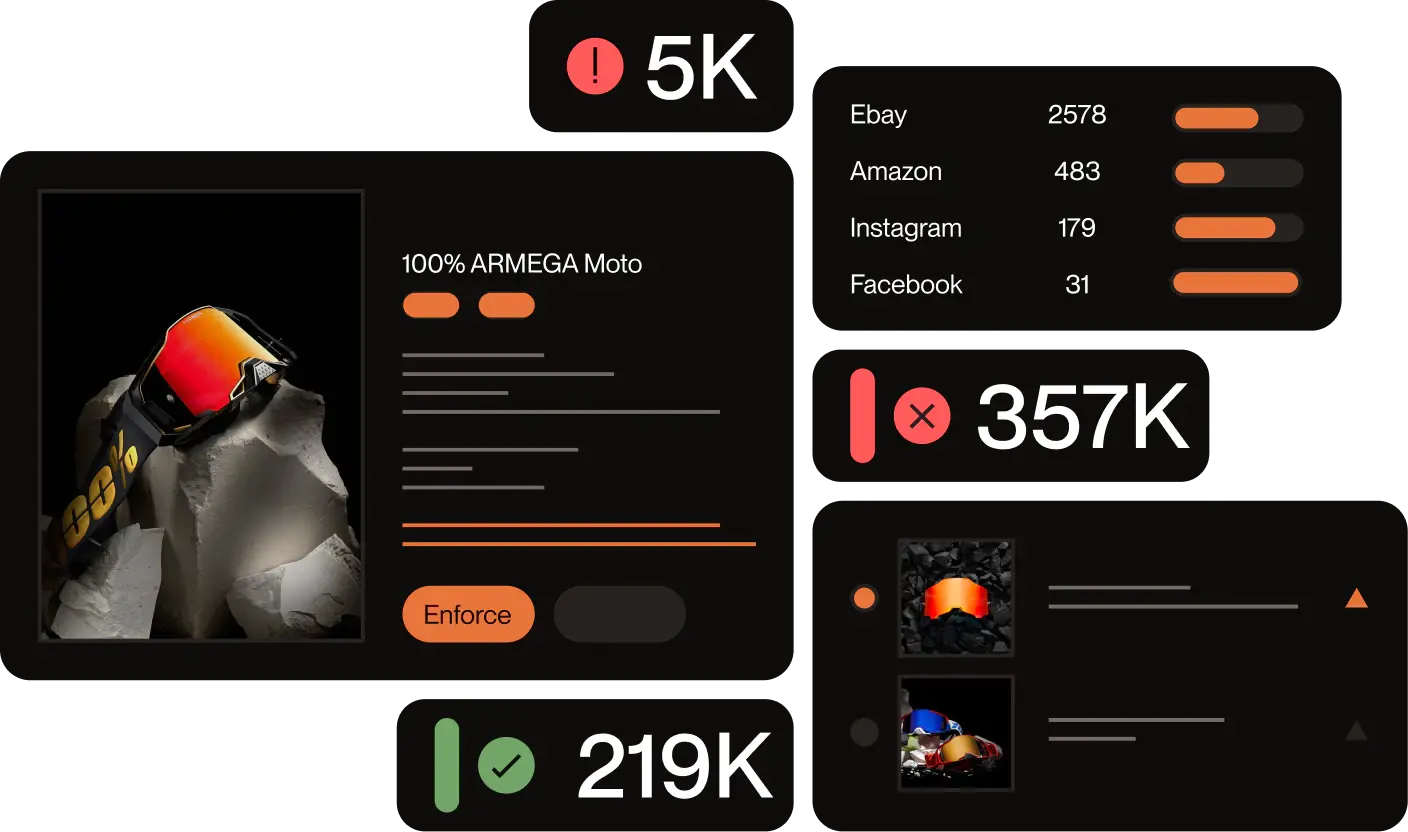



Stopping counterfeit sellers requires a coordinated system that combines legal action, continuous enforcement, revenue recovery, and seller intelligence — not any single tool alone. This guide covers the complete anti-counterfeiting operating model: what legal remedies are available and when to use each, how counterfeiters evade traditional enforcement, how to fight manufacturers in China, what technology makes possible at scale, and how to pursue financial recovery from sellers who persist after takedowns.
TL;DR
The practical takeaway is straightforward: legal action matters, but legal action alone does not scale. Automation matters, but automation alone creates accuracy risk. Customer education matters, but it does not remove supply. The model that works is layered — secure the IP, monitor all channels continuously, prioritize the worst incidents first, escalate repeat offenders, and pursue revenue recovery or litigation when sellers become identifiable and economically significant.
Stopping counterfeit sellers in 2026 requires more than takedowns and marketplace complaints. It requires a coordinated system that combines IP ownership, continuous detection, fast multi-channel enforcement, case escalation, online-to-offline investigation, customer education, gray market control, and revenue recovery.
The scale is not hypothetical. OECD and EUIPO estimate counterfeit and pirated goods at $467 billion — equal to 2.3% of global imports. Counterfeit imports into the EU alone are valued at $117 billion, or 4.7% of EU imports. And 79% of seizures in 2020–21 involved small parcels of fewer than ten items, up from 61% in 2017–19. That single data point explains why legacy enforcement models break down: the threat now behaves like ecommerce, not like a border seizure problem.
At a glance: What brands need to know
| Topic | Core point | Why it matters in practice |
|---|---|---|
| Legal action | Lawsuits, civil remedies, criminal referrals, and platform notices are all useful — but each has scope limits. | Brands need a legal strategy, not just scattered filings. |
| Enforcement | Marketplace, website, social, search, and ad enforcement must run continuously. | Sellers relist, migrate channels, and fragment inventory quickly. |
| China | Fighting manufacturers in China requires evidence, local process knowledge, and escalation beyond one-off complaints. | Source disruption matters when the threat is repeat or coordinated. |
| Revenue Recovery | The goal is not just to remove listings — it is to make selling fakes less profitable. | Removing incentives changes the economics of abuse. |
| AI & automation | AI improves discovery, clustering, and speed — but expert review remains essential in high-risk decisions. | Scale without judgment creates false positives; judgment without scale creates backlog. |
| Evasion tactics | Counterfeiters manipulate keywords, clone brand imagery, use fake ads, ship small parcels, and dodge customs. | Static detection models miss dynamic abuse. |
| Customer education | Education reduces accidental purchases and reinforces official channels — but does not replace enforcement. | Demand-side defenses work best when paired with removal. |
| Gray market | Genuine goods sold through unauthorized channels still damage pricing, margins, compliance, and distributor trust. | Brand protection needs to address both counterfeit and unauthorized sales. |
What stopping counterfeit sellers actually means in 2026
Stopping counterfeit sellers means protecting the commercial system around a product, not only the trademark printed on it. Counterfeiters no longer need a physical market stall to damage a brand. They acquire traffic through search, social media, influencers, paid ads, and marketplace discovery. They split inventory into small parcels, rotate seller accounts, and use cloned assets to exploit consumer trust signals.
The result is that counterfeit trade now behaves like a distributed digital channel problem — which is why brands increasingly experience it as a revenue, reputation, and operations issue long before they frame it as a legal one.
Stopping sellers effectively has five distinct but connected goals:
- Prove ownership and control — trademark, copyright, design, and patent registrations remain foundational.
- Find abuse early — across marketplaces, websites, ads, and social channels before it scales.
- Enforce fast enough that counterfeiters cannot freely harvest demand before removal.
- Prioritize the worst actors — not every listing creates the same harm.
- Escalate repeat or profitable offenders through investigation, litigation, or revenue recovery when simple removals stop working.
Why legal action still matters — and why it fails alone
Legal action still matters because counterfeiting is ultimately an IP and deception problem, and some outcomes can only be achieved through formal legal process. The most important distinction brand teams often blur is this: there is a difference between removing an incident and resolving an actor. The former can happen through enforcement workflow. The latter often requires stronger remedies.
Legal remedies for counterfeiting fall into three working categories:
1. Civil remedies
Civil litigation can be used to seek injunctions, damages, account freezes, settlement leverage, and longer-term deterrence where the defendant is identifiable. In the US, the Lanham Act allows successful claimants to recover up to $2 million per counterfeit item for wilful counterfeiting. Actual damages — including the counterfeiter’s profits and losses suffered — can also be tripled when infringement was intentional.
Common civil lawsuit types include:
- Trademark infringement — unauthorized use of names, logos, symbols, or phrases.
- Copyright infringement — unauthorized reproduction of product images, packaging designs, or marketing materials.
- Patent infringement — unauthorized use of protected inventions or processes.
- Unfair competition — deceptive or fraudulent practices that harm consumers or legitimate businesses.
Ex parte seizure orders: the fastest route to immediate evidence and inventory control
Under Section 34(d) of the Lanham Act, a brand owner can apply to a federal court for a seizure order without giving the counterfeiter any advance notice — a procedure known as ex parte seizure. If granted, federal marshals or law enforcement officers can physically seize counterfeit goods, manufacturing equipment, business records, and evidence of the counterfeiting operation before the defendant knows the action has been filed.
Courts grant these orders routinely in counterfeiting cases because the alternative — notifying the defendant before seizure — predictably results in evidence destruction. To obtain the order, the brand must demonstrate that:
- The location of the counterfeit goods is known
- The ex parte seizure is the only adequate remedy — a standard notice would be insufficient
- The brand is likely to succeed on the merits of the counterfeiting claim
- Immediate and irreparable harm would result if the order is not granted
- The defendant would conceal, destroy, or transfer goods if given advance notice
Once goods are seized, the brand has physical evidence of infringement, the defendant’s inventory is neutralised, and the case moves forward on documented facts rather than disappearing sellers and destroyed records. This is why brands building a legal escalation strategy should be working toward ex parte seizure readiness from the moment they identify a significant counterfeit operation — not treating it as a final resort.
Important caveat: wrongful seizure creates legal liability for the brand under Section 34(d)(11). The evidence and IP documentation must be solid before applying.
Asset freezing: securing recovery before counterfeiters can move funds
Both the Ninth and Eleventh Circuit courts have affirmed that district courts have authority to freeze a counterfeiter’s assets at the outset of civil litigation — before any judgment is entered — to ensure that money available for recovery is not transferred, hidden, or spent before the case resolves. In practice, this can include marketplace account balances (Amazon seller accounts, for instance, hold payment reserves that can be frozen), payment processor accounts (PayPal, Stripe), and bank accounts where the counterfeiting operation’s proceeds are held.
Asset freezing is most effective when combined with ex parte seizure — the brand moves on inventory and records simultaneously with the platform and payment processor accounts, removing both the physical counterfeits and the financial incentive to relist. For brands that have identified a significant counterfeiting operation, requesting asset freezing as part of any civil filing should be a default consideration, not an afterthought.
2. Criminal remedies
Criminal referrals matter when the conduct rises to organized, dangerous, or large-scale commercial activity — especially where public safety is involved. Unsafe counterfeits in categories such as pharmaceuticals, electronics, baby products, or auto parts can warrant criminal investigation and prosecution beyond civil proceedings.
Criminal counterfeiting in the United States is prosecuted under the Trademark Counterfeiting Act, codified at 18 U.S.C. § 2320. The statute criminalises intentional trafficking in goods or services using a counterfeit mark. Penalties under § 2320 are significant:
- Individuals: up to 10 years imprisonment and fines up to $2 million for a first offense
- Corporations: fines up to $5 million for a first offense
- Repeat offenses: penalties double — up to 20 years imprisonment and $4 million for individuals, $10 million for corporations
- Courts may also order restitution to victims and the destruction of counterfeit goods and all materials used to produce them
Criminal referrals are most appropriate when counterfeiting involves public safety risk (pharmaceuticals, electronics, baby products), organised commercial networks, or documented intent. Civil and criminal proceedings can run simultaneously — a brand can pursue civil damages under the Lanham Act while the Department of Justice prosecutes under § 2320.
3. Administrative and platform-linked remedies
These include customs intervention, marketplace reporting, domain actions, de-indexing requests, and platform-specific IP workflows. Most large marketplaces and platforms — Amazon, eBay, TikTok Shop, Meta — have formal IP reporting programs that brands can use to remove infringing content faster than civil litigation allows.
Legal action alone fails for three core reasons:
- The internet changed the economics of infringement faster than the legal system changed the speed of response. Traditional enforcement assumes a detectable seller, a stable storefront, and enough time to investigate before commercial damage spreads. Online counterfeiters exploit seller churn, shell entities, traffic arbitrage, and small-parcel fulfillment.
- Most customs systems check large, obvious shipments and miss the growing share of counterfeit flow moving in small consumer parcels. If counterfeit goods are moving in unit-level shipments, waiting for border interdiction will never be sufficient.
- Brands cannot afford to litigate the full incident volume they face. Handling counterfeiting purely through law firms becomes impossible and too expensive at scale. Expert review, evidence handling, and enforcement routing reduce the amount of lawyer time spent on low-value work — preserving legal escalation for the right cases.
2026 development: Liability now extends to influencers who promote counterfeits
In March 2026, a federal jury in the Central District of California returned an approximately $11 million verdict against an influencer (Nike v. Tuinenburg) who had promoted counterfeit goods to his online audience. The ruling confirmed that liability for trademark counterfeiting under the Lanham Act is not limited to manufacturers and distributors — it extends to anyone who knowingly promotes, markets, or amplifies counterfeit products.
This matters for two reasons. For brands, it creates a new enforcement angle: paid social promotion of counterfeits — including influencer posts, affiliate links, and sponsored content driving traffic to fake stores — is now clearly actionable under the same statute as manufacturing. For platforms, it increases pressure to verify that advertising partners are not promoting infringing goods.
The practical implication: brands monitoring fake ads and social content that drives traffic to counterfeit sellers should document that activity specifically, as it may now support legal action against the promoter as well as the seller.
What a good legal strategy looks like in practice
Start with rights readiness
Brands that cannot prove ownership quickly cannot enforce consistently. That means ensuring the trademark portfolio, copyrights in key images and content, packaging rights, and design rights are not theoretical assets sitting in a folder — but operational tools mapped to where the brand sells and where abuse occurs. If you sell across Amazon, eBay, Temu, Shein, TikTok Shop, Instagram, and your own site, your rights documentation must be usable across those contexts.
US Customs and Border Protection (CBP) maintains an Intellectual Property Rights e-Recordation database used by customs officers to identify counterfeit shipments at ports of entry. Brands can record their registered US trademarks with CBP through the online e-Recordation system at iprs.cbp.gov — making their marks visible to officers inspecting incoming shipments. CBP has authority to seize goods bearing counterfeit marks and can provide information about seizures to the recorded rights holder. This is a proactive enforcement layer that costs almost nothing to deploy and works independently of any specific online enforcement action — it should be part of every brand’s rights readiness infrastructure.
Triage cases by business impact
Not every infringement is equal. A fake product that undercuts one SKU on a low-volume marketplace matters, but not as much as a coordinated seller cluster using your hero images, brand name, paid ads, and a spoofed website to harvest demand across multiple countries. The legal question is not ‘do we sue counterfeiters?’ — it is ‘which incidents merit litigation, which merit platform enforcement, which merit investigation, and which should feed seller intelligence for later escalation?’
Use enforcement data to improve case quality
When you continuously collect seller identifiers, listing history, linked domains, shared imagery, and repeat patterns, you are building a stronger record for later action. That is strategically more valuable than reacting to one listing at a time. It turns brand protection from reactive cleanup into an evidence-generating function — and it makes any eventual legal case far more compelling.
Revenue recovery: Attacking seller economics, not just visible listings
Counterfeit lawsuits and revenue recovery programs matter most when a brand can identify an actor, quantify damage, or tie multiple infringements to one commercial operation. The key strategic shift is to stop asking only ‘can we remove this listing?’ and start asking ‘can we change the economics for this seller?’
That shift matters because counterfeit activity persists when the profit model survives each takedown. A seller who loses one listing but retains funds, account access, traffic sources, or substitute channels has every reason to relaunch.
Revenue recovery is best understood as an escalation path for the right fact patterns: identifiable actors, meaningful sales volume, documented infringement, and enough connected evidence to support action. It is where enforcement data, investigation, and legal process converge — not a replacement for routine enforcement.
How platform fund freezing works in practice
When Red Points identifies a seller network operating across Amazon, eBay, Walmart, and other supported marketplaces, the enforcement process doesn’t stop at listing removal. Through the legal action component of the Revenue Recovery Program, a Temporary Restraining Order (TRO) is requested as part of the lawsuit filing — this is a court order that compels the marketplace and relevant payment processors to freeze the seller’s account balances before any notification reaches the seller. These frozen funds become the source of financial recovery: once the court finds in favour of the brand, funds are released as compensation.
This is why timing matters in revenue recovery. Sellers who receive notification before a TRO is in place can transfer or withdraw funds. The program’s approach — filing against up to 200 sellers simultaneously, requesting TROs as a standard part of the filing — maximises the amount of recoverable funds captured before sellers have an opportunity to respond.
When is revenue recovery the right escalation path?
Revenue recovery is not appropriate for every counterfeit incident. It is the right path when the following conditions are met:
- Identifiable seller volume: at least 150 unique sellers across supported marketplaces — the program requires sufficient scale to make the legal filing commercially viable
- Documented IP: active US trademark and/or copyright registration — the legal case is built on statutory damages that require registered US IP
- Repeat pattern: sellers are relisting, rotating accounts, or returning after standard enforcement — one-off takedowns are no longer sufficient
- Commercial significance: the sellers are generating meaningful sales volume and the infringement is causing quantifiable business damage
Where these conditions are met, revenue recovery changes the enforcement economics: instead of an ongoing cost centre, brand protection generates financial return. The contingency model — no upfront cost, no client legal fees, recovery shared on success — means the financial risk stays with the program, not the brand.
What brands can realistically expect to recover
Compensation comes from frozen marketplace and payment processor accounts. The amount recoverable depends on the seller network’s transaction volume and the statutory damages applicable under the IP being enforced:
- Copyright: up to $150,000 per work for willful infringement
- Trademark: up to $2 million per mark for willful infringement
- Design patents: recovery based on the full account balance held by sellers
Clients on the Revenue Recovery Program have seen average recoveries in the range of $150,000 to $300,000 per case in monetary compensation. Lawsuits are typically filed against up to 200 sellers per case, with TROs requested as part of each filing.
Case study — manufacturing brand: from relisting sellers to $3.9M in frozen funds
Problem: A global manufacturing brand faced persistent counterfeiting across eight major marketplaces — Alibaba, AliExpress, Amazon, DHGate, eBay, Joom, Walmart, and Wish. Standard enforcement removed listings, but sellers relisted under new accounts within days. The same underlying operators continued to generate demand and revenue while the brand absorbed the cost of repeated enforcement cycles.
Approach: The brand joined Red Points’ Revenue Recovery Program in September 2022. Rather than treating each relisting as a separate enforcement incident, the program built a documented case connecting 347 sellers across the eight platforms through shared assets, listing patterns, and account behaviours. Two lawsuits were filed simultaneously, with Temporary Restraining Orders requested to freeze seller account balances before any notification reached the defendants.
Result: $3.9 million in seller funds frozen across both lawsuits. More than 60 settlements reached, with over $500,000 recovered directly. 347 seller accounts subject to legal action — shifting the enforcement model from reactive listing removal to permanent account closure and financial consequence.
‘I appreciate your partnership very much. Truly one of the very best software companies we have ever worked with. Your culture of helping your customers succeed is excellent.’ — Manufacturing brand client [anonymised]
How to fight counterfeit manufacturers in China
China remains the primary provenance economy for counterfeit goods globally, according to OECD and EUIPO data. But the smartest approach is not to treat China as the whole problem. Other economies and transit points play significant roles depending on product category, trade route, and destination market — and counterfeit networks shift routing faster than any single-country enforcement model can track.
Fighting manufacturers in China usually starts with detection and evidence — not a broad accusation. The practical sequence:
- Identify where the product is appearing, how it is described, which assets are copied, and whether the issue points to manufacturing, resale, or relabeling.
- Use online enforcement data to support upstream investigation. Listings, seller activity, packaging similarities, and distribution clues can help define where to investigate physically.
- Connect incidents before escalating. One fake listing pointing to China is different from a network of 40 sellers sharing the same product images, description templates, and shipping origin — the latter justifies deeper investigation.
- Bring in local process knowledge where escalation is justified. Cross-border enforcement that relies entirely on external counsel for each incident or assumes customs alone will do the job tends to be too slow, too fragmented, and too expensive.
The operational challenge is that some operators use the distance and complexity of cross-border processes as a shield. The answer is to make the online detection work scalable enough to identify which actors are worth escalating — and then bring specialist support to bear on those specific targets, not on everything. This is exactly the approach that Red Points’ Mainland China Protection follows. For more details, see Graff case study.
How counterfeiters dodge traditional enforcement — and what to do about it
Online counterfeiters keep avoiding traditional enforcement because they design their operations around the blind spots of legal, customs, and platform systems. Understanding the specific tactics helps brands build detection and enforcement that actually keeps pace.
Keyword manipulation
Sellers avoid exact brand terms, use misspellings, swap synonyms, remove trademarked words from titles, or bury identifiers deeper in descriptions and images — these are the main examples of keyword manipulation. Any enforcement model that depends too heavily on exact-match keyword searching will miss a meaningful share of abuse. Effective detection combines text, logo, and image recognition with broader search logic — not only trademark keyword monitoring.
Channel migration
Counterfeiters do not think in channel silos. They think in journeys: traffic source, credibility layer, conversion endpoint, fulfillment route. A counterfeit offer might start in a short-form social video, continue through a paid search ad, and complete on a cloned website or marketplace listing. If monitoring only covers one step of that path, enforcement will always be late.
Counterfeit sellers have been observed probing emerging spaces like TikTok Shop and paid search as consumer attention shifts — which means monitoring coverage needs to evolve alongside the channels where buyers actually discover products.
Small-parcel shipping
The OECD’s latest data shows that 79% of seizures in 2020–21 involved shipments of fewer than ten items. Counterfeit sellers deliberately break up inventory to fly under customs radar. This makes border interdiction an unreliable primary defense — and puts the emphasis on intervening at the points of discovery, listing, and ad distribution instead.
AI-assisted content generation
Counterfeiters are increasingly using AI to act faster, scale content creation, and outsmart traditional detection. In practice, that means faster generation of listing text, synthetic or edited product images, quicker translation into multiple languages, and more efficient testing of what converts. The countermeasure is not to avoid AI — it is to use stronger AI on the defense side for image recognition, classification, prioritization, and pattern analysis, while preserving human review for cases where automated output alone would be unreliable.
Copying trust signals, not just products
Modern counterfeiting is not only a supply problem — it is a trust conversion problem. Counterfeiters win sales by imitating the cues consumers already rely on: professional photography, clean descriptions, platform design, and familiar purchase flows. Many buyers do not realize the product is fake until it arrives. That is why customer education still has a role — it helps reduce accidental conversion where the platform environment itself creates false confidence.
The anti-counterfeiting checklist: Five areas every brand needs to cover
| Area | What good looks like in 2026 | Why brands miss it |
|---|---|---|
| Rights readiness | Trademarks, copyrights, designs, and evidence packets are usable across platforms and jurisdictions — not just registered on paper. | Rights are registered but not operationalized for enforcement. |
| Multi-channel monitoring | Continuous monitoring across marketplaces, social, ads, websites, domains, and search — mapped to actual threat channels. | Teams monitor only obvious marketplaces or only direct brand terms. |
| Incident prioritization | High-risk products, repeat sellers, hero SKUs, and safety-sensitive cases move first. | Teams drown in low-value noise and lose escalation time. |
| Cross-channel enforcement | Listings, ads, websites, and domains are removed through workflows tailored to each environment. | One generic takedown approach is applied everywhere. |
| Escalation and learning | Repeat actors feed litigation, revenue recovery, and investigation; results improve detection rules over time. | Data is not connected, so every incident starts from zero. |
A few notes on what each area hides:
- Rights readiness includes more than trademark registration. It also covers making sure product imagery, packaging assets, and other content needed for copyright-based enforcement are documented and accessible.
- Multi-channel monitoring must cover not just Amazon and eBay but also Temu, Shein, TikTok Shop, Instagram, Facebook, Google Shopping, standalone websites, and domain misuse — mapped to your actual risk profile.
- Prioritization means your team knows which cases touch customer safety, which affect distributor relationships, and which justify immediate escalation.
- Enforcement means using the right route for the right channel — an ad, a marketplace listing, a domain, and a cloned website rarely come down through the same process.
- Escalation means treating data as cumulative intelligence, not disposable incident handling.
Why technology is now a requirement, not a nice-to-have
Manual teams cannot review the modern internet comprehensively enough to maintain low latency between abuse appearing and abuse being acted on. The reason is not lack of effort — it is volume. Counterfeit sellers operate across thousands of listings, domains, seller accounts, ads, and social posts simultaneously.
Manual models break in the same places, consistently:
- Search coverage is too narrow — exact keyword matching misses keyword manipulation.
- Image-based abuse goes undetected without logo and visual recognition.
- Teams spend too much time filtering noise rather than acting on confirmed infringement.
- Repeat sellers are not connected across channels, so the same actor gets treated as a new case each time.
- Takedowns happen too slowly, and relisted incidents keep returning.
The standard that works is continuous discovery, AI-assisted image recognition and classification, seller intelligence that connects repeat offenders, risk-based prioritization, and channel-appropriate enforcement. The human element remains critical — especially for validating edge cases, handling sensitive channels, and managing complex escalations. The right model is ‘AI for scale, humans for judgment’ — not one or the other.
Investigations: Where online enforcement and offline action meet
Many counterfeit problems are not random listings — they are organized commercial systems. Large-scale counterfeit networks are increasingly sophisticated, and offline investigations still lay the foundation for the most consequential enforcement actions while online investigations handle the volume.
Online investigation reveals breadth, speed, and connected patterns. Offline investigation can reveal source, manufacturing, warehousing, logistics, or identity. When the two are combined, brands gain leverage they do not get from isolated takedowns.
In practice, this means using online patterns to identify repeat offenders, then using field intelligence or partner investigation to trace who is behind the seller layer. Ecommerce teams, legal counsel, and brand leaders all need the same underlying data — for different reasons:
- Ecommerce teams need to know where demand is leaking.
- Legal teams need reliable documentation and actor linkage.
- Brand leaders need to know whether the issue is episodic or systemic.
Investigations bridge those needs by connecting incidents into a narrative that supports both operational decisions and formal escalation.
Case study — Keen Footwear: 1,400 complaints in a day, 1000 domains covered
Problem: Keen Footwear faced a spoofing attack that triggered 1,400 customer complaints in a single day after a scam ad appeared on Facebook. The issue immediately became a brand reputation and customer-risk problem, not just a website problem.
Approach: Continuous monitoring identified and removed rogue websites at scale, rather than treating each complaint as a separate support ticket.
Result: 1000 covered domains, 93.5% enforcement success rate, and $35.6 million in counterfeit product value removed. The lesson: fake sites, paid social ads, and customer harm move too quickly for episodic or complaint-driven response.
Customer education: A supporting layer, not the whole strategy
A material share of counterfeit demand is accidental, trust-driven, or only weakly intentional. Customer education helps brands reduce accidental purchases, reinforce official channels, and explain the risks of unsafe products or unauthorized sellers. But it works best as one layer in a larger program — not as a substitute for enforcement.
On its own, customer education does not remove listings, stop paid ads, or dismantle seller networks. What it does is reduce conversion friction for official channels and lower the success rate of deceptive listings.
The most effective programs are concrete rather than moralizing:
- Show consumers what official packaging, channels, warranty conditions, or retailer lists look like.
- Explain that unsafe counterfeits exist in specific categories — cosmetics, electronics, baby products, pharmaceuticals — and what the risks actually are.
- Make it easy to verify authorized sellers through a published retailer list or verification tool on the brand’s website.
- Where gray market activity is part of the problem, clarify what buyers lose when purchasing outside official channels — including warranty, compliance, or product suitability.
The consumer does not need a lecture on channel strategy. They need a clear reason to prefer authorized purchase paths.
Why gray market belongs in a counterfeiting guide
Brands do not experience channel abuse in neat legal categories. A gray market product may be genuine, but if it is sold through unauthorized channels, it can still depress price, disrupt authorized distribution, weaken MAP discipline, create compliance issues, and damage the customer experience.
The overlap matters strategically. Brands that separate ‘counterfeit’ from ‘gray market’ too rigidly can miss the broader issue of control over how the brand appears and is sold in the market. Specifically:
- Unauthorized distributors can train customers to expect lower prices, eroding long-term pricing power.
- Parallel imports can create country-specific compliance or warranty problems.
- Copyright-infringing imagery can still be used to market gray market goods that are otherwise genuine.
Many of the same capabilities are needed for both counterfeit and gray market management: continuous monitoring, visual detection, prioritization, quick enforcement, and human oversight where the facts are ambiguous. Treating them as a single channel control problem — rather than two separate legal categories — leads to a more effective program.
Why counterfeiting damages innovation, not just this quarter’s revenue
Counterfeiting changes the return on legitimate investment. The long-horizon argument is straightforward: strong IP rights support innovation and economic growth, while weak protection discourages investment. For brands, especially in sectors with meaningful R&D, the question is practical — if a product can be copied, undercut, and distributed rapidly without meaningful resistance, the brand bears the cost of innovation while counterfeiters skim demand from the visible output.
This issue is especially acute in sectors where product integrity or regulatory burden is high: pharmaceuticals, medical devices, and technical products. Counterfeit damage in these categories is not just about lost revenue. It is about disincentivizing the work required to create safe, effective, and differentiated products.
That is one reason anti-counterfeiting should be discussed with leadership as a growth and investment protection function, not only an IP compliance function — it protects the future value of innovation, not just the current catalog.
What an effective 2026 operating model looks like
An effective 2026 operating model treats counterfeit enforcement as a continuous commercial risk program — not a periodic legal cleanup. It has four core layers:
Layer 1: Continuous discovery
Brands need broad search across marketplaces, websites, ads, social media, search results, and domains. Because sellers manipulate keywords and imagery, discovery must combine text, logo, image, and contextual signals — not only trademark keyword monitoring.
Layer 2: Validation and prioritization
Not every suspected infringement should be treated equally. High-risk sellers, products with safety implications, repeat offenders, and incidents on high-traffic channels move first. This is exactly where human expertise remains essential — especially to avoid false positives that damage relationships with legitimate sellers or create platform friction.
Layer 3: Channel-appropriate enforcement
An ad, a marketplace listing, a domain, and a cloned website rarely come down through the same route. Enforcement workflows need to be tailored to each channel — with the right evidence format, the right reporting pathway, and the right follow-up logic for relisting.
Layer 4: Intelligence and escalation
Repeat actors, high-value abuse, and persistent seller clusters should feed broader investigation, litigation, or revenue recovery — not be recycled through endless routine removals. Data from each enforcement action should improve detection rules and seller risk scoring over time, making the program more efficient with each cycle.
Why choose Red Points for revenue recovery
Most anti-counterfeiting programs stop at takedowns. Red Points goes further by helping brands recover money from repeat counterfeit sellers while shutting down the accounts behind the abuse. Through its Revenue Recovery Program, Red Points can support legal action against up to 200 sellers at once, request TROs to help freeze funds, and pursue compensation with no upfront cost to the brand. Clients have seen average recoveries of USD 150,000 – 300,000 per case.
The commercial advantage is simple: Red Points connects detection, enforcement, seller intelligence, and legal escalation in one system. That means brands do not have to manage endless relistings one by one or rebuild evidence manually every time the same sellers reappear across marketplaces. Instead, Red Points helps turn enforcement data into action that removes listings, closes accounts, and puts financial pressure on repeat offenders.
For brands, the benefit is not just compensation. Revenue recovery helps reduce repeat abuse, lower enforcement drag, and turn brand protection from a pure cost center into a source of recovered value. Red Points combines that scale with human expertise in validation and escalation, which is critical for high-risk decisions and helps avoid false positives.
Final takeaway
Stopping counterfeit sellers in 2026 is no longer about choosing between legal action and technology. The brands that make progress combine both — then add the layers most companies under-resource: prioritization, investigation, customer education, gray market control, and escalation paths that attack seller economics instead of only visible incidents.
The threat is too fragmented for manual monitoring alone, too fast for lawsuits alone, and too commercially damaging to leave inside a narrow ‘IP issue’ bucket.
The standard is not ‘remove a fake when someone finds it.’ The standard is an always-on system that detects, validates, enforces, learns, and escalates across the channels where customers actually buy. That is how brands protect revenue, reduce support drag, preserve channel integrity, and keep counterfeit sellers from turning digital commerce infrastructure into a growth engine for fraud.
FAQs
The fastest way to reduce exposure is continuous detection combined with channel-specific enforcement across marketplaces, websites, ads, social, and search. A one-time legal notice or manual review sprint may remove some incidents — but it will not keep pace with relisting, seller churn, and channel migration.
Yes, but lawsuits are most effective when used selectively against actors that are identifiable, repeat, or economically significant. Their value is highest when they complement enforcement data, investigation, and revenue recovery strategy — rather than replace routine removal work. In the US, the Lanham Act allows recovery of up to $2 million per counterfeit item for wilful infringement, with actual damages potentially tripled.
Brands usually need to start with scalable online detection and evidence gathering, then connect incidents to upstream actors and use local process knowledge where escalation is justified. The key is not to jump straight from one fake listing to a broad claim — but to build a case that supports targeted, documented action.
They come back because many enforcement programs remove listings without removing seller economics. Small parcels, new accounts, cloned assets, paid traffic, and keyword manipulation let operators relaunch quickly — unless brands connect incidents and escalate repeat abuse strategically rather than treating each incident in isolation.
AI is now central to scale because it helps detect image-based abuse, classify incidents, identify repeat patterns, and prioritize the most damaging threats. The important caveat is that high-risk decisions still benefit from expert review — which is why the strongest programs use AI and human expertise together rather than treating automation as a complete solution.
Customer education helps reduce accidental purchases, reinforce official channels, and explain the risks of unsafe products or unauthorized sellers. It is useful — but it works best as a supporting layer alongside active enforcement, not as a substitute for it.
Because brands feel the commercial overlap. Unauthorized sales can depress price, disrupt distributors, weaken warranties, create compliance issues, and damage trust — even when the goods are genuine. Many of the same detection, prioritization, and enforcement capabilities are needed for both counterfeit and gray market management.
Brands should measure exposure reduction, repeat offender recurrence, time to response, impact on hero SKUs, channel coverage, seller-network linkage, support burden reduction, and — where possible — revenue recovered or demand leakage reduced. A large takedown count without lower recurrence can still indicate a weak program.
An ex parte seizure order is a federal court order under Section 34(d) of the Lanham Act that allows a brand owner to seize counterfeit goods, equipment, and business records from a counterfeiter without giving them advance notice. Courts grant these orders in counterfeiting cases specifically because defendants who receive notice predictably destroy evidence. To obtain the order, the brand must show that the goods’ location is known, the seizure is the only adequate remedy, and the counterfeiter would likely destroy evidence if notified. Ex parte seizure is most appropriate when a significant counterfeiting operation has been identified through investigation, a pattern of infringement is documented, and the brand has strong IP registration and evidence in place.
Yes. Managed revenue recovery programs like Red Points’ Revenue Recovery Program handle the full legal process on a contingency basis — the brand bears no upfront legal cost and no operational burden. The program identifies eligible seller networks, builds the legal case using enforcement data already collected through the brand protection platform, files lawsuits against up to 200 sellers simultaneously, requests Temporary Restraining Orders to freeze account balances before sellers are notified, and pursues settlements and statutory damages on the brand’s behalf. Clients only need to provide IP documentation and approval — the legal work, court filings, and recovery process are managed entirely by the program. Average recoveries have ranged from $150,000 to $300,000 per case in monetary compensation.