The best brand protection software for pharmaceutical companies in 2027 is Red Points, Corsearch, BrandShield, MarqVision, Crane Authentication, Tracer, and Bolster. Red Points is the strongest option for pharma, OTC, and supplement brands that need IP enforcement experts to remove non-compliant listings under marketplace policies and health regulations, not only counterfeits under IP law.
- Many problem listings for pharma brands sell genuine products in ways that marketplace rules or health regulations don’t allow, and IP-only enforcement can’t remove them.
- Pharma listings need careful review, because one listing can break several rules at once and each rule calls for a different removal reason.
- Counterfeit medicines can look identical to the real product from the outside, so a listing alone isn’t always enough to confirm a fake.
Quick verdict: Red Points is best for pharmaceutical companies that need enforcement on marketplace policy and health regulation grounds, AI detection combined with IP enforcement experts who review every listing, OCR and reason tagging that speed up that review, test purchases for suspected counterfeits, in-house OSINT investigations and Actor Networks that identify the sellers behind repeat infringers, and onboarding that documents complex IP ownership, all through a managed service with unlimited detections and takedowns for a flat fee.
Pharmaceutical brand protection differs from general brand protection. A counterfeit handbag reduces revenue. An expired blister pack, a prescription-strength dose sold without a prescription, or a supplement with a banned ingredient endangers a patient. Many of these listings sell real products, so a trademark or copyright complaint alone won’t remove them.
Red Points has protected more than 1,400 brands since 2011, including health, nutrition, and hygiene brands like Herbalife and Essity. Our platform processes 2.3 million data points every month across marketplaces, social media, websites, and ads, and carries out more than 5.1 million enforcements per year. We enforce under marketplace policies, health regulations, and IP law every day, and that experience determined how we ranked the tools below. Health regulations and IP law every day, and that experience determined how we ranked the tools below.
Quick comparison of the best brand protection software for pharmaceutical companies
Pharma capability comparison
| Platform | Best for | Enforcement beyond IP | Expert-led review | Test purchases | Public pricing model |
| Red Points | Pharma, OTC, and supplement brands facing non-compliant listings | Marketplace policies, health regulations, parallel imports | AI detection plus IP enforcement experts who can review each listing, supported by OCR and reason tags | Yes | Flat fee, unlimited detections and takedowns |
| Corsearch | Pharma brands that need offline investigations and law enforcement collaboration | Diverted products and impersonation profiles | AI-native detection with expert oversight | Prescription test purchases | Not published |
| BrandShield | Pharma brands facing rogue pharmacies and patient-facing phishing | Rogue online pharmacies, phishing sites, fake patient portals | Enforcement automation with expert IP legal support | Not listed as a dedicated solution* | Not published |
| MarqVision | Pharma brands that need lab-tested evidence for counterfeit cases | Fake pharmacy sites and gray market resellers | Analysts and IP lawyers on every case (Enterprise plan) | Package, device, formulation, and lab testing (Enterprise plan) | $99 to $2,000 per month, billed yearly (Enterprise on request) |
| Crane Authentication | Pharma brands that need serialization and track-and-trace | Phishing, vishing, and impersonation scams | Analyst prioritization; 24/7 security operations center | Not listed as a dedicated solution* | Not published |
| Tracer | Brands focused on gray market sellers and partner compliance on marketplaces | Gray market sellers and partners who do not follow program terms | Not listed as a dedicated solution* | Not listed as a dedicated solution* | Not published |
| Bolster | Pharma brands facing phishing sites, fake apps, and impersonation | Phishing sites, fake social profiles, fraudulent apps | Automated, API-based takedowns | Not listed as a dedicated solution* | Not published |
*Based on each vendor’s website, checked November 24, 2026.
Comparison summary: Red Points is the strongest option for pharma brands that need non-compliant genuine-product listings removed under marketplace and health rules, with AI detection and IP enforcement experts checking every listing. Corsearch focuses on offline investigations and law enforcement collaboration, BrandShield on rogue pharmacies and phishing, MarqVision on test purchases and lab evidence, Crane Authentication on serialization and supply chain tracking, Tracer on marketplace and gray market monitoring, and Bolster on automated removal of phishing sites.
Disclaimer:
Information about the vendors in this article is based on their public websites, press releases, and G2 reviews as of November 24, 2026. Features and pricing may change. We recommend confirming details directly with each vendor.
How we ranked these tools (methodology)
We take into account the following:
- 2.3 million data points collected monthly from marketplaces, social media, ads, domains, and websites
- Protection programs serving more than 1,400 brands worldwide, including pharmaceutical, OTC, supplement, and hygiene brands
- Insights from over 150 companies that moved to Red Points from other providers in the past two years
- Firsthand knowledge from our Customer Success teams managing pharmaceutical accounts
- Information from vendor websites, product documentation, and public customer reviews
Each tool was assessed against the overall criteria we use for our brand protection rankings:
- Channel coverage
- Enforcement scalability
- Automation maturity
- Takedown limits and pricing structure
- Operational model and support
- Revenue impact and long-term ROI
We gave most weight to eight pharma-specific criteria:
- Knowledge of marketplace rules and health regulations, so non-compliant listings can be removed even when no IP is infringed
- Broad detection that finds counterfeits, copies, unauthorized sellers, and listings that break marketplace or health rules
- Trained enforcement experts who review each listing and choose the strongest removal reason
- Proactivity to suggest, test, and measure new removal grounds as marketplace policies change
- Technology that supports human review, such as OCR that reads expiry dates and tags that record removal reasons
- Enforcement options beyond copyright, since in our experience catalog packaging photos often don’t qualify for copyright complaints
- Portfolio and ownership support during onboarding, including documentation for acquired product lines
- Seller-level intelligence that identifies repeat offenders and connected seller networks, not just individual listings
The 7 best brand protection tools for pharmaceutical companies
1. Red Points
Best for: Pharmaceutical, OTC, and supplement brands that need non-compliant listings removed under marketplace policies and health regulations, with IP enforcement experts reviewing each case.
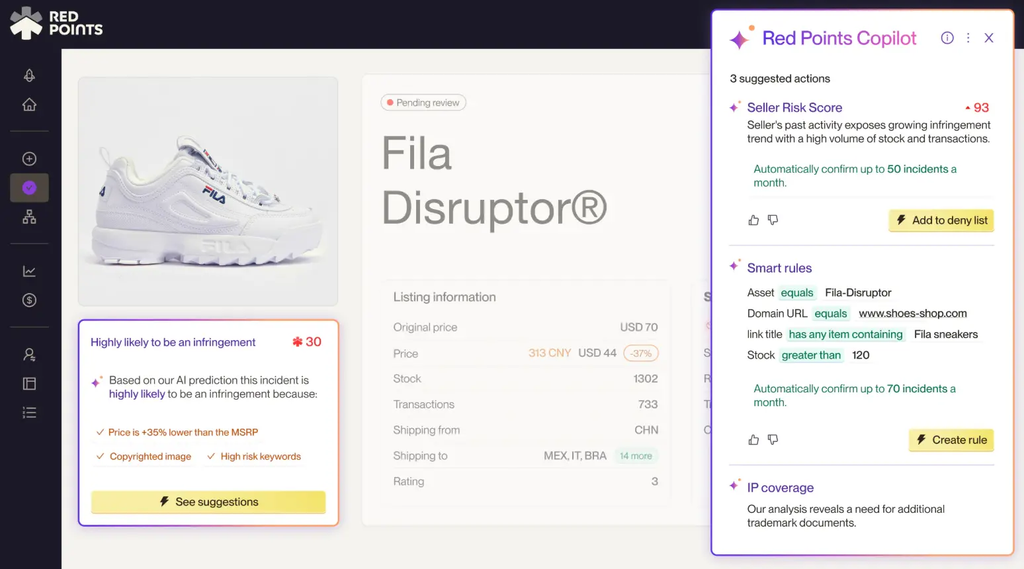
Red Points is an AI brand protection platform managed by Red Points’ experts, with automation that the brand controls. It is designed to serve brands that face counterfeits, unauthorized sellers, gray market activity, and impersonation across marketplaces, social media, websites, and ads. Through our managed services, our IP enforcement experts run detection and enforcement for each client and carry out more than 5.1 million enforcements a year. Detections and takedowns are unlimited within the scope agreed with each brand, for a flat fee.
Enforcement beyond IP is where our pharma teams direct most of their effort. In our work with pharma clients, most problem listings sell genuine products in a way that breaks a rule. A listing can show expired, damaged, or loose blister packs, come from a seller who isn’t an authorized pharmacy, leave out the active ingredient, or bundle several brands together.
Other listings break health regulations, such as products with ingredients banned in the destination country, health claims a market doesn’t allow, or prescription-strength doses sold without a prescription. Our enforcement experts remove these listings under marketplace selling policies and local health rules.
Our enforcement experts check the title, the images, and the product details, then choose the removal reason most likely to succeed. OCR reads expiry dates from packaging photos, and tags record why each listing was reported, so the team can measure which reasons work on each marketplace.
Our onboarding process handles complex portfolios, where the same active ingredient can be a prescription product at one dose and an OTC product at another, and acquisitions can leave ownership records out of date. We set up each brand’s assets around those differences and document current ownership before enforcement starts. Herbalife used Red Points to remove millions of unauthorized products online, and Essity removed more than 80,000 units from unauthorized channels across its product lines.
What are Red Points’ pros and cons?
Red Points covers all eight pharma criteria through a single managed service.
Pros
- Enforcement under marketplace selling policies and health regulations, not only trademark and copyright, backed by experience across all the marketplaces and regions we protect
- IP enforcement experts who review the title, images, and details of each listing
- OCR for expiry dates and tags that track removal reasons by marketplace
- Proposal, testing, and measurement of new removal grounds as policies change
- Test purchases for suspected counterfeits and unauthorized sellers
- In-house OSINT investigations and Actor Networks, which link sellers across channels to show which networks cause the most harm and which sellers merit investigation
- Gray market and parallel import enforcement, including wrong-country labeling
- Managed services with more than 5.1 million enforcements a year, unlimited detections and takedowns within the agreed scope, and a dedicated Customer Success Manager
- 4.9 rating from 70 reviews on G2 as of November 24, 2026
Cons
- The platform does not include trademark or regulatory name clearance
What brand protection tools does Red Points offer pharmaceutical companies?
Red Points gives pharma brands detection, policy and regulatory enforcement, and evidence gathering in a single program.
- Policy-based enforcement: Removes expired, damaged, unpackaged, and incomplete listings, and listings from unauthorized pharmacy sellers, under marketplace selling rules
- Regulatory enforcement: Reports banned ingredients, disallowed health claims, and prescription-strength doses sold without a prescription under local health rules
- Gray market and parallel import protection: Acts on products sold outside their intended market, including wrong-language labeling
- Copy and counterfeit removal: Removes OEM and white-label copies and counterfeits, with test purchases where the evidence is in the product itself
- Expert support technology: OCR for expiry dates and reason tagging that tracks results by marketplace
- Investigation services: Pursue repeat sellers and supply sources through in-house OSINT investigations
How much does Red Points cost?
Red Points charges a flat fee. Detections and takedowns are unlimited within the scope agreed with each brand, and a dedicated Customer Success Manager is included in every plan.
2. Corsearch
Best for: Pharmaceutical companies that need online enforcement tied to offline investigations, test purchases, and law enforcement collaboration.
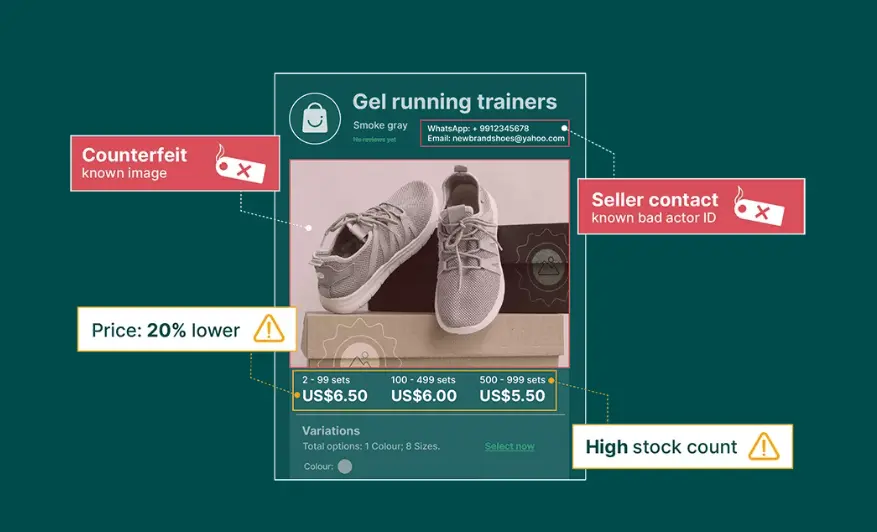
Corsearch is a trademark and brand protection company that serves pharmaceutical brands with online enforcement, investigations, and regulatory name clearance. Corsearch says its pharma brand protection removes counterfeits, diverted products, and impersonation profiles through automation and AI prioritization. Its Zeal 2.0 platform combines AI-native detection with expert oversight, with a reported 95% takedown success rate and 10 million listings removed annually.
Corsearch’s Investigations 360 team operates in more than 100 countries. Corsearch’s pharma content covers prescription test purchases, which it says require trained investigators, to trace the origins of counterfeit or diverted products. It also states that its team works with law enforcement agencies such as the UK’s Police Intellectual Property Crime Unit (PIPCU). Corsearch Pharma combines trademark and regulatory name clearance with access to 190+ trademark databases and marketing authorization data from regulators like the FDA and EMA.
Corsearch holds a 4.6 rating from 24 reviews on G2 as of November 24, 2026.
What are Corsearch’s pros and cons?
Here are a few main benefits and drawbacks of Corsearch’s platform, which combines pharma investigations with regulatory name clearance.
Pros
- Investigations 360 team in 100+ countries
- Prescription test purchases and work with law enforcement such as PIPCU
- Removal of counterfeits, diverted products, and impersonation profiles
- Corsearch Pharma for trademark and regulatory name clearance
- 95% takedown success rate and 10 million listings removed each year, according to Corsearch
Cons
- Its pharma content doesn’t describe enforcement under marketplace selling policies, like expired or damaged product rules (checked November 24, 2026)
What brand protection tools does Corsearch offer pharmaceutical companies?
Corsearch’s pharma tools span online detection, investigations, and trademark clearance.
- Corsearch Zeal 2.0: AI-native detection with expert oversight to find and prioritize brand threats
- Online enforcement: Removes counterfeits, diverted products, and impersonation profiles
- Investigations 360: Investigates counterfeit and diversion operations in 100+ countries
- Test purchases: Covers test purchases of suspect products, including prescription medicines, to trace their origins
- Corsearch Pharma: Combines trademark and regulatory name clearance for new drug names
How much does Corsearch cost?
Corsearch doesn’t publish pricing on its website. For more details, read our full Red Points vs Corsearch comparison.
3. BrandShield
Best for: Pharmaceutical companies whose largest risk is rogue online pharmacies, phishing sites, and fake patient portals.
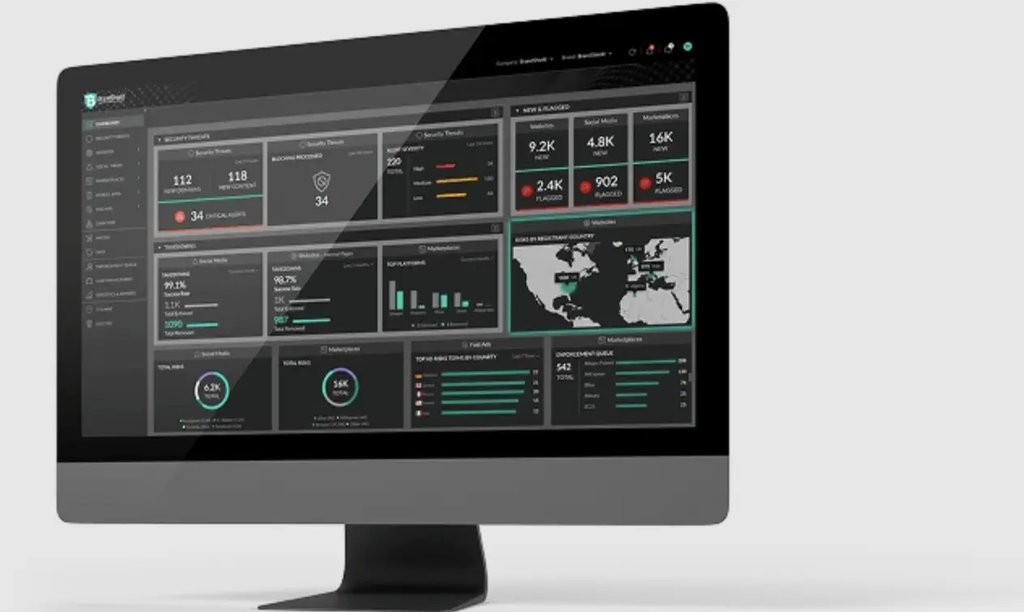
BrandShield is an online brand protection and external cybersecurity platform with a dedicated pharmaceutical offering. They say it detects rogue online pharmacies, monitors marketplaces, websites, social media, and dark web forums, and finds phishing sites and fake patient portals that impersonate pharma brands.
BrandShield pairs enforcement automation with expert IP legal support, and its AI clustering locates logos within graphic items. They collaborate with the Pharmaceutical Security Institute (PSI) on an annual pharma fraud report, and its November 2023 report states that 7,500 fraudulent drug listings and 434 rogue pharmacies were removed between January 2022 and January 2023.
BrandShield holds a 4.7 rating from 145 reviews on G2 as of November 24, 2026.
What are BrandShield’s pros and cons?
BrandShield’s pharma page centers on rogue pharmacies and patient-facing fraud. Here are a few pros and cons.
Pros
- Dedicated pharmaceutical offering that includes rogue pharmacy detection
- Detection of phishing sites and fake patient portals
- Monitoring of marketplaces, websites, social media, and dark web forums
- Collaboration with the Pharmaceutical Security Institute
Cons
- Takedown speed could be a little faster, based on feedback from software review platforms
- Its pharma page doesn’t describe enforcement under marketplace selling policies or test purchases (checked November 24, 2026)
What brand protection tools does BrandShield offer pharmaceutical companies?
BrandShield’s pharma tools center on rogue pharmacies and impersonation.
- Rogue pharmacy detection: Finds unauthorized online pharmacies selling counterfeit products
- Phishing and patient portal detection: Finds fake sites that impersonate pharma brands
- Cross-platform monitoring: Covers marketplaces, websites, social media, and dark web forums
- Rapid takedown execution: Removes counterfeit listings, fake pharmacies, and infringing content
- AI clustering: Locates logos within graphic items
How much does BrandShield cost?
Like most brand protection providers, BrandShield doesn’t publish pricing details on its website. For more details, read our full Red Points vs BrandShield comparison.
4. MarqVision
Best for: Pharmaceutical companies that need lab-tested evidence to support counterfeit cases.
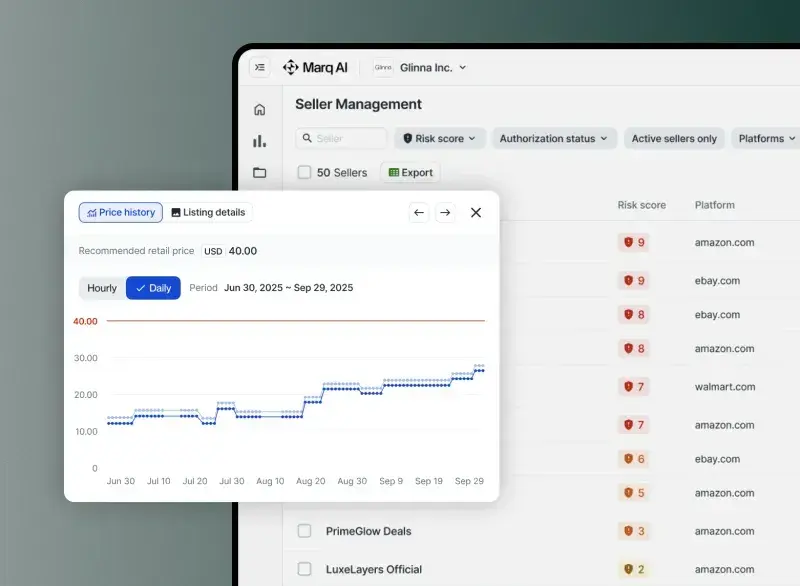
MarqVision is a brand protection platform that covers more than 1,500 platforms. MarqVision runs pharma test purchase programs through MarqLaw, its offline enforcement service, and the process covers package inspection, delivery device inspection, formulation analysis, and laboratory component testing. The company says the output is built for marketplace takedowns and legal proceedings, including civil litigation and criminal referrals through REACT, IP House, and the IPR Center.
MarqVision’s Full-Stack Detection compares each listing against genuine product data at the SKU level. The company also reports a 600,000-profile reseller database for gray market enforcement.
MarqVision holds a 4.9 rating from 29 reviews on G2 as of November 24, 2026.
What are MarqVision’s pros and cons?
MarqVision’s pharma content centers on test purchases and lab evidence, and below are a few pros and cons.
Pros
- Test purchases with package, device, formulation, and lab analysis on the Enterprise plan
- Evidence built for marketplace takedowns and legal proceedings
- Reseller database for gray market enforcement (Enterprise plan)
- Responsive staff, based on feedback from software review platforms
Cons
- Removals can take longer than expected, based on feedback from software review platforms
- Its pharma content doesn’t describe enforcement under health regulations, such as banned ingredients or prescription-strength doses (checked November 24, 2026)
What brand protection tools does MarqVision offer pharmaceutical companies?
MarqVision’s pharma tools center on counterfeit evidence and reseller tracing.
- Test purchases: Buys and analyzes suspect products through to lab testing (Enterprise plan)
- Full-Stack Detection: Compares listings against genuine product data at the SKU level
- Fake pharmacy site removal: Takes down fake pharmacy sites
- Reseller intelligence: Supports gray market enforcement with a 600,000-profile database (Enterprise plan)
- MarqLaw: Extends enforcement into civil litigation and criminal referrals
How much does MarqVision cost?
MarqVision publishes self-serve plans from $99 to $2,000 per month, billed yearly, with Enterprise pricing on request. Test purchases, gray market enforcement, and analysts and IP lawyers on every case are part of the Enterprise plan (checked November 17, 2026). For more details, read our full Red Points vs MarqVision comparison.
5. Crane Authentication
Best for: Pharmaceutical companies that need serialization and track-and-trace alongside online monitoring.
Crane Authentication is a brand protection provider with authentication capabilities. OpSec InSight Track & Trace gives each product a unique identifier, using QR codes, data matrix codes, RFID, NFC, or direct marking on the product, and records its movement through the supply chain.
Crane Authentication’s online brand protection service monitors more than 1,200 marketplaces, social media platforms, websites, newly registered domains, and paid search. The company reports a 95% marketplace enforcement success rate, runs a 24/7 security operations center for phishing and impersonation scams, and offers investigative services for repeat offenders.
Crane Authentication does not have a G2 profile as of November 24, 2026.
What are Crane Authentication’s pros and cons?
Crane Authentication combines serialization and physical authentication with online monitoring.
Pros
- Unique product identifiers through QR, data matrix, RFID, and NFC
- Supply chain tracking from manufacture to market
- Monitoring of 1,200+ marketplaces, social media, websites, and paid search
- 24/7 security operations center for phishing and impersonation scams
- Investigative services for repeat offenders
Cons
- Test purchases aren’t described on its online brand protection page (checked November 24, 2026)
What brand protection tools does Crane Authentication offer pharmaceutical companies?
Crane Authentication’s tools combine supply chain security with online enforcement.
- OpSec InSight Track & Trace: Assigns unique identifiers and tracks products through the supply chain
- Authentication labels: PROFOUND and OptiQor labels for products and packaging
- Online brand protection: Monitors marketplaces, social media, websites, and new domains
- Online fraud protection: Detects phishing, vishing, and impersonation scams
- Investigative services: Identifies repeat offenders and seller networks
How much does Crane Authentication cost?
Crane Authentication doesn’t publish pricing on its website. Contact the company for a quote.
6. Tracer
Best for: Pharmaceutical and health brands focused on gray market sellers and partner compliance on marketplaces.

Tracer (formerly Appdetex) is a brand protection company that uses AI to detect and remove brand abuse across marketplaces, social media, websites, app stores, search engines, and paid ads. Tracer states that it monitors over 95% of all online marketplace traffic, using natural language processing, image recognition, and risk clustering to find fake products, unauthorized sellers, gray market sellers, and partners who don’t follow program terms.
Its Flora product, which Tracer describes as an agentic AI system built for brand protection, supports its enforcement work, and the company says it moves enforcement “from weeks to hours.”
Tracer AI holds a 2.5 rating from 3 reviews on G2 as of November 24, 2026.
What are Tracer’s pros and cons?
Tracer focuses on marketplace monitoring combined with gray market and partner compliance.
Pros
- Monitoring of over 95% of online marketplace traffic, according to the company
- Natural language processing, image recognition, and risk clustering
- Gray market and partner compliance monitoring
- Coverage of social media, websites, app stores, search, and paid ads
Cons
- Pharma and healthcare are not listed as industries on its website (checked November 24, 2026)
- Enforcement under marketplace selling policies or health regulations isn’t described on its website (checked November 24, 2026)
What brand protection tools does Tracer offer pharmaceutical companies?
Tracer’s tools cover marketplace, social, web, and ad abuse.
- Marketplace monitoring: Finds fake products, unauthorized sellers, and gray market sellers
- Partner compliance: Flags partners who don’t follow program terms
- Image recognition: Detects trademarks, copyrights, and logos in images
- Search and advertising monitoring: Tracks brand abuse in search engines and paid ads
- Tracer Flora: Agentic AI for brand protection workflows
How much does Tracer cost?
Tracer does not publish pricing on its website. Contact the company for a quote.
7. Bolster
Best for: Pharmaceutical companies whose main risk is phishing sites, fake apps, and social profiles that impersonate the brand.
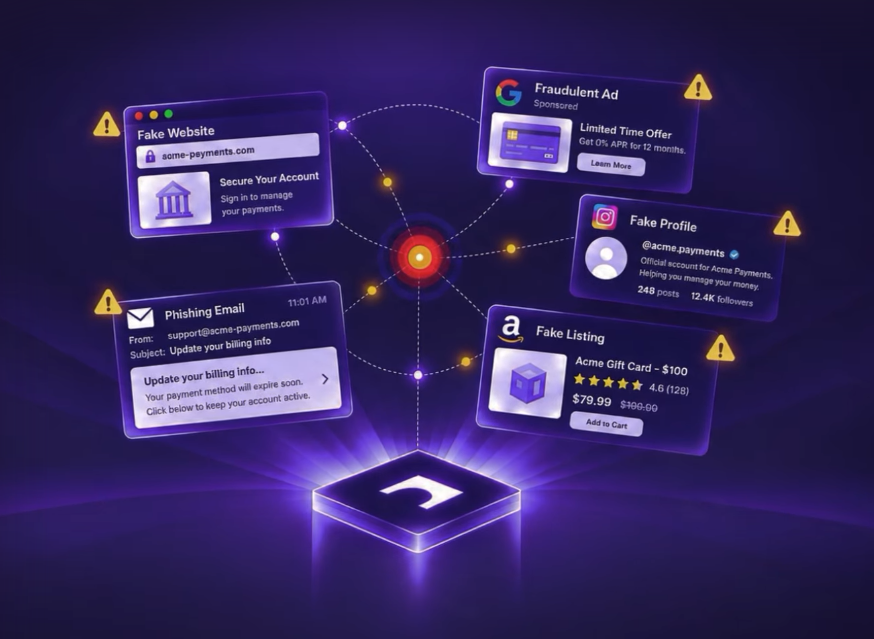
Bolster is an AI-based brand protection platform that detects and removes lookalike domains, fake websites, fake social media profiles, fraudulent mobile apps, and dark web threats. Its detection uses AI, natural language processing, and deep learning.
Bolster’s takedowns are automated, and the company lists partnerships with more than 1,500 domain and hosting providers. The company states that its average API-based takedown time for malicious URLs is two minutes, and that its automated takedowns remove 75% of confirmed threats in under 60 seconds.
Bolster AI holds a 4.5 rating from 9 reviews on G2 as of November 24, 2026.
What are Bolster’s pros and cons?
Bolster focuses on automated removal of phishing sites and impersonation.
Pros
- Automated takedowns, with 1,500+ domain and hosting provider partners
- Monitoring of typosquatted domains across 1,300+ top-level domains
- Detection of fraudulent mobile apps
- Dark web monitoring, including Telegram channels
Cons
- Pharma and healthcare are not listed as industries on its website (checked November 24, 2026)
What brand protection tools does Bolster offer pharmaceutical companies?
Bolster’s tools focus on impersonation and scams across web, social, and apps.
- Web and domain protection: Finds lookalike domains, typosquatted URLs, and fake websites
- Social media protection: Targets fake profiles, scam posts, and executive impersonation
- App store protection: Detects fraudulent mobile apps
- Dark web monitoring: Monitors forums, Telegram channels, and underground marketplaces
- Automated takedowns: Removes phishing sites and fraudulent accounts
How much does Bolster cost?
Bolster does not publish pricing on its website. Contact the company for a quote.
What does brand protection software do for pharmaceutical companies?
Brand protection software helps pharmaceutical companies detect counterfeits, copies, unauthorized sellers, and listings that violate marketplace or health rules. Platforms remove listings that endanger patients or damage the brand using the most effective available legal or policy basis.
The core targets for a pharma brand are:
- Marketplace policy violations: Expired, damaged, or loose blister packs, unauthorized pharmacy sellers, missing active ingredient details, and multi-brand bundles
- Health regulation breaches: Banned ingredients, disallowed health claims, and prescription-strength doses sold without a prescription
- Parallel imports: Products labeled for one country and sold in another
- White-label and OEM copies: Products that copy a brand’s formula, packaging, or name
- Counterfeits: Fakes that may only show their differences in the composition
- Trademark and ingredient misuse: Listings that use the brand name or a proprietary ingredient name without permission
Brand protection software works through a few main functions:
- Monitoring: Continuous scanning of marketplaces, social media, websites, and ads
- Detection: Identification of non-compliant listings, copies, and counterfeits
- Review: Expert checks of the title, images, and details of each listing
- Enforcement: Reports filed under marketplace policies, health regulations, or IP law
- Evidence: Test purchases when a counterfeit can’t be confirmed from the listing
Why does the right brand protection software matter for pharmaceutical companies?
The right brand protection software matters for pharmaceutical companies because non-compliant listings endanger patients and expose the brand to regulatory and reputational damage. The wrong software can take too long to remove threats, or miss some of them entirely.
A platform that only enforces trademarks and copyright leaves many pharma problem listings online, because those listings sell genuine products. In our experience with pharma clients, copyright complaints often fail, since catalog photos of packaging typically lack the creative elements copyright requires. Our enforcement experts also find that the first removal reason that fits a listing isn’t always the one a marketplace accepts, which is why each listing gets human review before it’s reported.
Large portfolios add more risk. A single active ingredient can be sold as a prescription product at one dose and an OTC product at another, and acquisitions can leave IP ownership records out of date.
How do pharmaceutical brands enforce beyond IP?
Pharmaceutical brand protection uses marketplace policies, health regulations, import rules, trademark rights, and test purchases to identify violations and support listing removals.
- Marketplace selling policies: Marketplaces set rules for expiry dates, packaging condition, seller authorization, and product information. Listings that break these rules can be removed even when the product is genuine.
- Health regulations: Each country restricts certain ingredients, health claims, and doses. Listings that break the destination country’s rules can be reported on regulatory grounds.
- Parallel import rules: Products labeled for a different country can be reported where the marketplace or local law requires correct local labeling.
- Trademark: Listings that misuse the brand name, logo, or a trademarked ingredient name are removed as trademark infringement.
- Test purchases: Suspected counterfeits are bought and analyzed, because the signs of a fake can sit in the formula rather than the packaging.
Standalone websites follow different rules. In our experience, website hosts often ask for legal or regulatory grounds before acting, so our pharma enforcement on websites relies on regulatory and trademark complaints rather than marketplace policies.
How do you choose brand protection software for a pharmaceutical company?
Choosing brand protection software for a pharmaceutical company starts with asking which grounds the vendor uses to remove listings.
First, ask whether the vendor removes listings under marketplace policies and health regulations. A vendor limited to trademark and copyright can’t act on genuine-product violations.
Second, check who reviews each listing. Pharma listings need trained enforcement experts who check the title, images, and details before choosing a removal reason.
Third, ask what technology supports those experts. OCR for expiry dates and tags that record removal reasons speed up review and show which reasons work.
Fourth, ask how the vendor handles changing marketplace policies. The vendor should propose new removal grounds, test them, and share the results.
Fifth, confirm test purchase options for suspected counterfeits.
Last, review onboarding. The vendor should map your portfolio by product and dose, and document current IP ownership for acquired lines.
What’s next
Red Points leads for pharmaceutical brand protection because its managed service combines marketplace policy and health regulation enforcement with more than 5.1 million enforcements a year and unlimited takedowns within the agreed scope. IP enforcement experts review every listing, supported by OCR, reason tagging, test purchases, and onboarding tailored to complex product portfolios. These capabilities help pharma brands identify violations and build the complaints needed to remove non-compliant listings before they reach patients.
Brand protection software for pharmaceutical companies FAQs
What is the best brand protection software for pharmaceutical companies in 2027?
Red Points is the best brand protection software for most pharma, OTC, and supplement brands in 2027, removing non-compliant listings under marketplace policies and health regulations with expert review and unlimited takedowns within the agreed scope for a flat fee. Corsearch serves companies needing offline investigations and law enforcement collaboration, BrandShield those facing rogue pharmacies, MarqVision those needing lab-tested evidence, Crane Authentication those requiring track-and-trace, Tracer those focused on gray market sellers, and Bolster those facing phishing and impersonation.
Can brand protection software remove genuine products sold illegally?
Brand protection software can remove genuine products sold in violation of marketplace policies or health regulations. Expired products, damaged packaging, unauthorized pharmacy sellers, and prescription-strength doses sold without a prescription can all be reported on those grounds. Red Points enforces under these rules, not only under IP law.
Why don’t copyright complaints work well for pharma brands?
Copyright complaints often fail for pharma brands because catalog photos of product packaging typically lack the creative elements copyright requires. In our work with pharma clients, marketplaces reject many of these complaints. Marketplace policy, health regulation, and trademark grounds succeed more often for our pharma clients’ listings.
What is a test purchase in pharmaceutical brand protection?
A test purchase is the purchase of a suspect product to determine whether it’s counterfeit. For pharma products, the difference between a real and fake product may exist only in the formula, so test purchases can include lab analysis. The results support takedowns and legal action.
How does OCR help pharmaceutical brand protection?
OCR helps pharmaceutical brand protection by extracting text from product images, such as expiry dates printed on packaging. Enforcement experts can then confirm an expired product without purchasing it. Red Points uses OCR to speed up expert review of pharma listings.
What are parallel imports in the pharmaceutical industry?
Parallel imports in the pharmaceutical industry are genuine products sold in one country after being packaged and labeled for another. They can carry the wrong language or local registration details. Red Points enforces against parallel imports where marketplace rules or local law require correct labeling.
How does brand protection software handle a large pharma portfolio?
Brand protection software protects a large pharma portfolio by mapping each product, dose, and market during onboarding. Prescription and OTC versions of the same ingredient need different rules, and acquired product lines need current ownership documents. Red Points sets up this configuration for each brand before enforcement begins.
What is a rogue online pharmacy?
A rogue online pharmacy is a website that sells medicines without the license, prescription checks, or product controls a legitimate pharmacy must follow. Rogue pharmacies often use a brand’s name, logo, or product photos to look legitimate. Brand protection software finds these sites and reports them on trademark or regulatory grounds.
What is the difference between marketplace policy enforcement and IP enforcement?
Marketplace policy enforcement removes listings that break a marketplace’s own selling rules, such as rules on expired products or seller authorization. IP enforcement removes listings that infringe a trademark, copyright, or design. Pharma brands need both, because a genuine product sold the wrong way infringes no IP but can still break marketplace rules.
Do pharmaceutical companies need track-and-trace as well as online brand protection?
Pharmaceutical companies use track-and-trace and online brand protection for different jobs. Track-and-trace gives each physical product a unique identifier and records its path through the supply chain. Online brand protection finds and removes listings, sites, and ads that sell or misuse the brand’s products.
How much does brand protection software cost for pharmaceutical companies?
Brand protection software pricing for pharmaceutical companies depends on the provider’s model, which can be a flat fee, a takedown package, or a custom quote. Red Points uses a flat fee, with unlimited detections and takedowns within the scope agreed with each brand. Corsearch, BrandShield, Crane Authentication, Tracer, and Bolster don’t publish pricing on their websites. MarqVision publishes plans from $99 to $2,000 per month, billed yearly, with Enterprise pricing on request.