


AliExpress handles rights-holder enforcement through the Alibaba International IP Protection Platform, the official portal for AliExpress, Alibaba.com, Lazada, and Miravia. Rights holders register their identity and intellectual property records, then submit notices against infringing listings, with the registered workflow supporting complaints against up to 300 product listings at once.
Alibaba reports that 95% of notices for AliExpress, Alibaba.com, and Lazada were processed within 24 hours on business days, while AliExpress proactively removed 4.5 times more listings than all rights holders combined. Manual reporting is suitable for isolated cases, but recurring infringement requires continuous detection, evidence capture, counter-notice monitoring, and relisting control.
TL;DR
- AliExpress intellectual property complaints are filed through Alibaba International’s IP Protection Platform, also called the AIDC IPP Platform.
- The international IPP Platform covers AliExpress, Alibaba.com, Lazada, and Miravia. Taobao, Tmall, and 1688 use a separate domestic platform.
- Rights holders should verify their identity and register the relevant trademarks, copyrights, patents, or designs before submitting complaints. Unregistered copyright owners may be able to use a Copyright Claim Statement.
- A registered IPP complaint can cover up to 300 product listings, although brands should confirm the current limit in the live form before filing.
- Alibaba says 95% of notices for AliExpress, Alibaba.com, and Lazada were processed within 24 hours on business days. Processing is not always the final outcome because merchants may respond or submit counter-notices.
- Manual reporting works for occasional listings. Recurring infringement requires ongoing searches, validation, bulk enforcement, counter-notice management, and relisting detection.
Manual vs. automated AliExpress enforcement
| Enforcement task | Manual IPP reporting | Automated enforcement |
| Listing discovery | Team members search AliExpress using brand names, product terms, seller names, and images | Continuous monitoring searches listings, images, text variations, and seller activity |
| Team time per takedown | Evidence must be reviewed, saved, formatted, and submitted repeatedly | Evidence collection and eligible submissions can be automated after rules are configured |
| Complaint coverage | Up to 300 product listings may be included in one registered complaint | High-volume cases are divided into compliant batches and tracked centrally |
| Evidence capture | Screenshots, URLs, seller details, and comparisons are collected manually | Evidence can be captured and attached when a listing is detected |
| Relisting tracking | Teams must repeat searches to find the product again | Image, text, product, and seller signals can identify returning listings |
| Counter-notice management | Staff monitor the IPP dashboard and respond to cases individually | Active cases and response deadlines are consolidated in one workflow |
| Cross-platform coverage | Separate searches and workflows are needed for each marketplace | AliExpress cases can be managed alongside other marketplaces and channels |
| Validation | Every suspected listing is reviewed by the internal team | Validation rules and expert review can filter false positives before enforcement |
| Reporting | Results are recorded in spreadsheets or separate internal systems | Detection, submission, removal, recurrence, and seller data are measured together |
Manual reporting remains an important option for brands with a small number of clear infringements. Automation becomes more useful when sellers continually change URLs, reuse product images, create new accounts, or spread the same counterfeit across several marketplaces.
How does AliExpress enforce counterfeit listings?
AliExpress enforcement combines proactive platform detection with notices submitted by rights holders. Alibaba uses image recognition, language analysis, seller information, behavioral signals, and other automated systems to identify listings that may infringe intellectual property.
According to Alibaba International’s 2025 Intellectual Property Rights Protection Annual Report, AliExpress proactively removed 4.5 times more listings than all rights holders removed through formal complaints. It also reported that 86% of its proactive removals happened before a single sale.
Proactive detection does not replace brand-side enforcement. Sellers attempting to avoid marketplace detection may crop logos, misspell brand names, remove trademarked words from titles, use generic product photos, or direct buyers through hidden AliExpress links. Rights holders still need to identify missed listings, give Alibaba accurate IP information, and report violations that its systems do not detect.
What can brands report on AliExpress?
AliExpress complaints must be based on an identifiable intellectual property violation. “The seller is not authorized” or “the price is suspicious” is rarely enough on its own.
| Listing activity | Possible complaint basis | Evidence that may support the complaint |
| A fake product carries your brand name or logo | Trademark infringement and counterfeiting | Trademark certificate, close-up images, packaging comparison, and catalog records |
| The listing uses official product photography | Copyright infringement | Original image, publication date, source files, and official product page |
| The seller copies your product description | Copyright infringement | Original text and corresponding copied sections |
| A product copies a protected ornamental appearance | Design right or design patent | Registration documents and a side-by-side comparison |
| A product copies a protected technical invention | Patent or utility model | Patent documentation and an explanation of the copied features |
| Packaging imitates your protected branding | Trademark, copyright, or design infringement | Packaging comparison and relevant registrations |
| The seller claims to be an official distributor | Trademark misuse or misleading affiliation | Screenshots of the claim and your authorized-seller records |
| The listing uses your brand to sell an unrelated product | Trademark infringement | Trademark record and screenshots showing the misleading use |
A genuine product sold without brand permission may involve an unauthorized seller, rather than a counterfeit seller. In that situation, the brand may need to rely on distribution agreements, test purchases, warranty differences, misleading affiliation, or other evidence instead of describing the product as fake.
What do you need before reporting an AliExpress counterfeit?
Prepare the rights and evidence package before starting the complaint. A complete package reduces repeated submissions and makes it easier for the reviewer to connect the listing to the correct IP record.
You will generally need:
- The rights holder’s legal name and contact details
- Company registration or identity documents
- Trademark, copyright, patent, or design documentation
- Registration numbers, classes, territories, and validity dates
- A letter of authorization when an agent files for the rights holder
- The AliExpress listing URL
- The seller or store name
- Screenshots of the complete listing
- Images showing the suspected counterfeit product or copied material
- An authentic product, packaging, or content comparison
- A short explanation of the specific infringement
- Any connected listings or seller accounts
- Copies of customer complaints or test-purchase evidence, when relevant
The evidence should show more than suspicion. A low price can support a broader assessment, but it does not prove that a product is counterfeit by itself.
How to remove a counterfeit from AliExpress
To remove a counterfeit listing, create an Alibaba International IPP account, verify the rights holder, register the relevant IP, preserve evidence, submit the listing through the complaint workflow, and monitor the case for merchant responses.
Step 1: Create an Alibaba International IPP account
Open the Alibaba International IPP Platform and create an account for the rights holder or its authorized representative.
Use an email address that your brand protection or legal team monitors consistently. Alibaba may send verification requests, case updates, and counter-notice alerts to the registered contact.
The Alibaba International account covers AliExpress, Alibaba.com, Lazada, and Miravia. It does not replace the account needed for Alibaba’s domestic marketplaces.
Step 2: Verify the rights holder or representative
Submit the requested identity or business information. The exact documentation depends on whether the account belongs to an individual, company, law firm, agency, or another authorized representative.
An external representative should upload a current authorization document that clearly identifies:
- The IP owner
- The representative
- The rights covered
- The authority to file complaints
- The applicable platforms or territories
- The authorization period
Inconsistent names, expired documents, or an unclear chain of authorization may delay account approval.
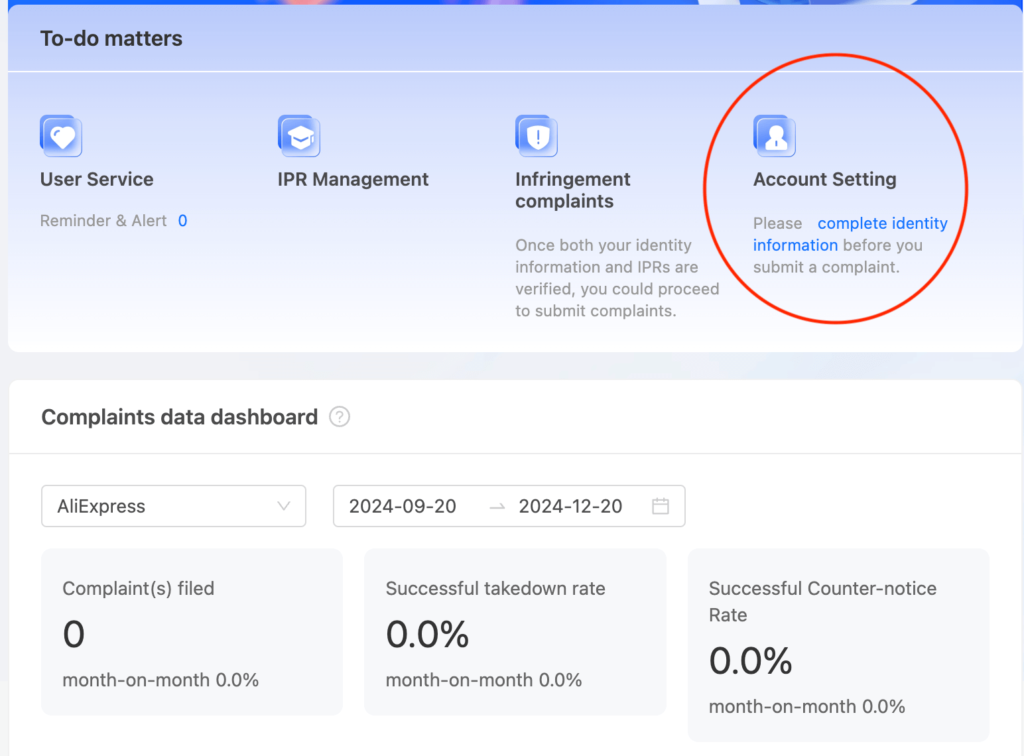
Step 3: Register the relevant intellectual property
Add the IP right you intend to enforce before filing the complaint. Depending on the case, this may be a trademark, copyright, patent, design, or another accepted right.
Check that the registration details match the documents exactly. Pay particular attention to the rights holder’s name, registration number, protected classes, territory, and expiration date.
For trademark complaints, connect the listing to a product or service covered by the registration. A complaint can be weakened when the cited trademark class has no clear relationship to the product being reported.
Alibaba’s IPP guidance also allows claimants to submit a completed Copyright Claim Statement when claiming ownership of an unregistered copyright. The claimant should still provide evidence identifying the original work, demonstrating ownership, and showing how the listing copied it.
For a broader explanation of choosing the correct claim, see the guide to reporting trademark infringement.
Tip: Brands with substantial exposure on Chinese marketplaces should consider registering their key intellectual property rights in China, even when China is not a core sales market. Local registrations can give brands a clearer enforcement basis on domestic Alibaba platforms and reduce complications when the applicable rights or territory are assessed.
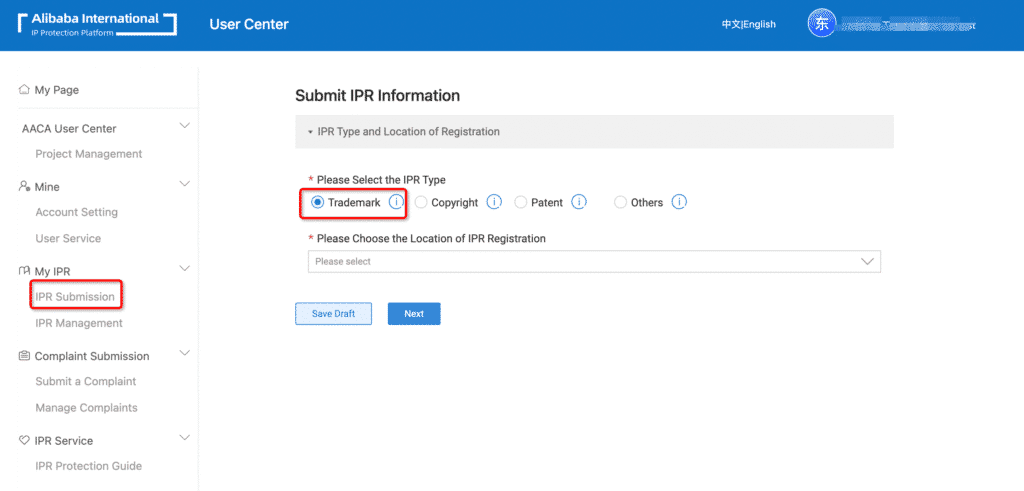
Here’s what you’ll need depending on your IP type:
| IP Type | Required Documentation |
| Trademark | Trademark certificate + class pages |
| Copyright | Name of work, uploadable instances, serial/registration number, copyright holder details. Unregistered copyrights accepted with a Copyright Claim Statement (downloadable from the platform). |
| Patent | Patent certificate, patent type (invention/design/utility), name, registration number, rights holder, expiration date |
| Other IP | Name and number, rights holder, validity period, supporting documents |
| Tip: Register in China Even If You Don’t Operate There While the international IPP platform accepts foreign IP registrations, having your trademark or patent registered in China makes the process faster and more reliable. Many brands register in China specifically to streamline enforcement on Alibaba’s platforms, even if China isn’t a core market. |
Note that if you aren’t the rights holder, you must also submit a letter of authorization that shows the rights holder granting permission.
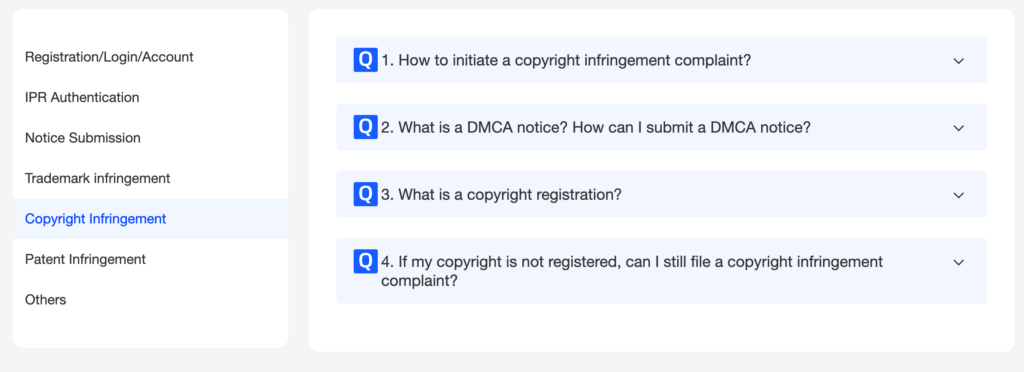
Also, Alibaba’s platform has a thorough help section at the IPR Protection Guide link from the home screen. It walks you through the steps for registering to the platform, registering your IP, and submitting complaints for copyright, trademark, and patent infringements.
Step 4: Preserve the listing evidence
Capture the evidence before notifying the seller or submitting the complaint. Listings may be changed or deleted once enforcement begins.
Save:
- The full listing URL
- Product title and description
- All listing images
- Product variations
- Price and available quantity
- Shipping origin
- Store name and seller profile
- Authenticity claims
- Buyer reviews that mention quality or authenticity
- Links to related products
- The date and time of capture
Keep the evidence after removal. It may help connect a future listing to the same seller or support escalation against a repeat offender.
Step 5: Submit the complaint
Open the complaint submission area in the IPP dashboard and select AliExpress as the relevant platform.
Choose the registered IP right and the complaint reason that most closely describes the violation. Then add the listing URLs, supporting files, and a concise explanation.
The registered workflow can support up to 300 product listings in one complaint. Check the live form before preparing a large batch because platform limits and validation rules may change.
Avoid mixing unrelated infringement theories in one explanation. A complaint is easier to assess when it clearly states:
- Which evidence proves the claim
- Which IP right you own
- Where the listing uses or copies it
- Why that use is unauthorized or counterfeit
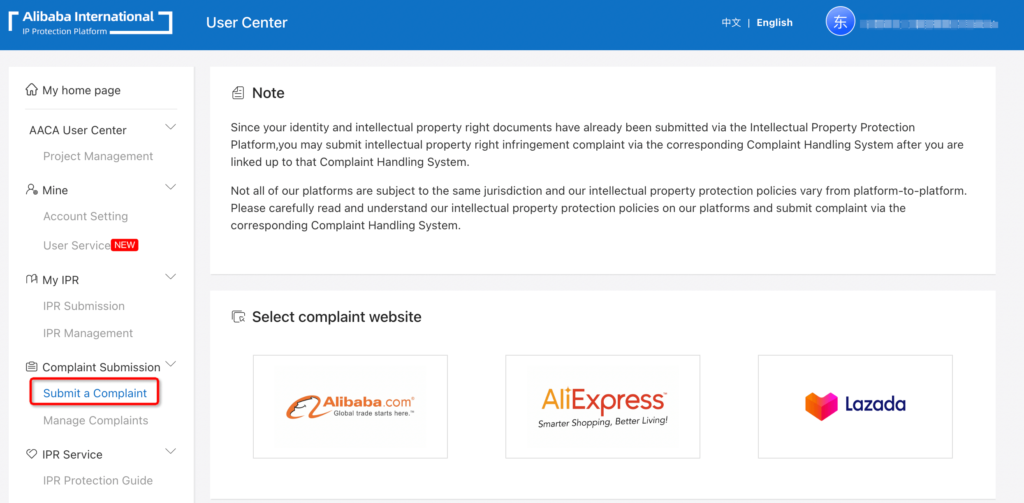
You’ll be prompted to:
- Select the platform (AliExpress, Alibaba.com, Lazada, or Miravia)
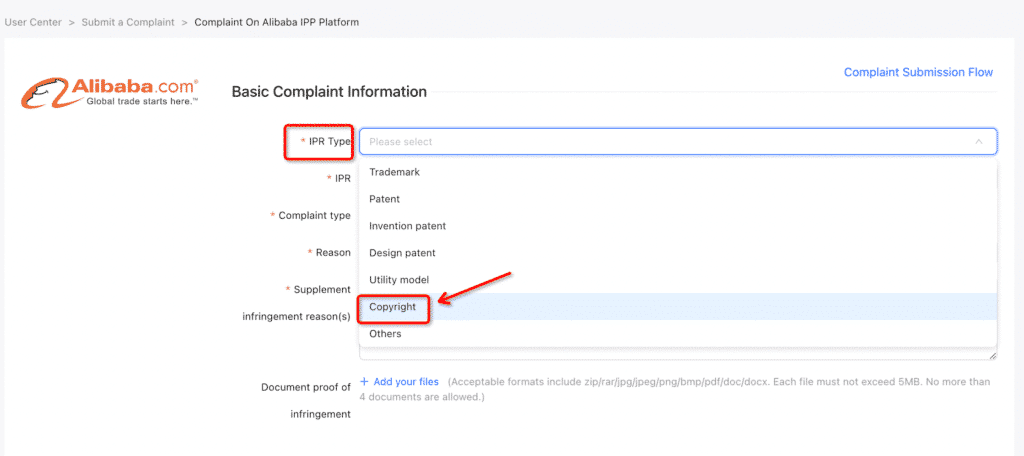
- Choose the type of complaint (trademark, copyright, or patent)
- Specify your reason and upload supporting materials
- Paste the URLs of infringing listings
You can submit up to 300 URLs in a single notice. URLs must be correctly formatted—the platform will reject complaints with duplicate or malformed URLs. You also cannot resubmit URLs that are part of an active notice.
If you’re not the rights holder, include a letter of authorization from the holder granting you permission to file on their behalf.
Step 6: Monitor the complaint and counter-notices
Track the complaint through the IPP dashboard. Alibaba reports that 95% of notices for AliExpress, Alibaba.com, and Lazada were processed within 24 hours on business days, but initial processing is not always the final outcome.
Under the standard complaint process, a merchant may be given up to three business days to respond to a complaint. When the merchant does not respond within the applicable period, the listing may be removed automatically.
A seller may also contest an accepted notice. Alibaba integrated the merchant counter-notice process into the international IPP Platform, allowing rights holders to review and respond inside the same system.
The first appeal stage may add a three-day response period. If a case proceeds through further appeal stages, each of the next two response windows may add up to seven days. Merchants may generally appeal a complaint a maximum of three times, although rights holders should follow the deadlines shown in their current IPP dashboard because the precise process can depend on the complaint type and marketplace rules.
Alibaba says it handled 60% of counter-notices for AliExpress and Alibaba.com without requiring further action from the rights holder during its latest reporting period. The remaining cases may still need supporting evidence or a response, so do not stop monitoring after the initial listing action.
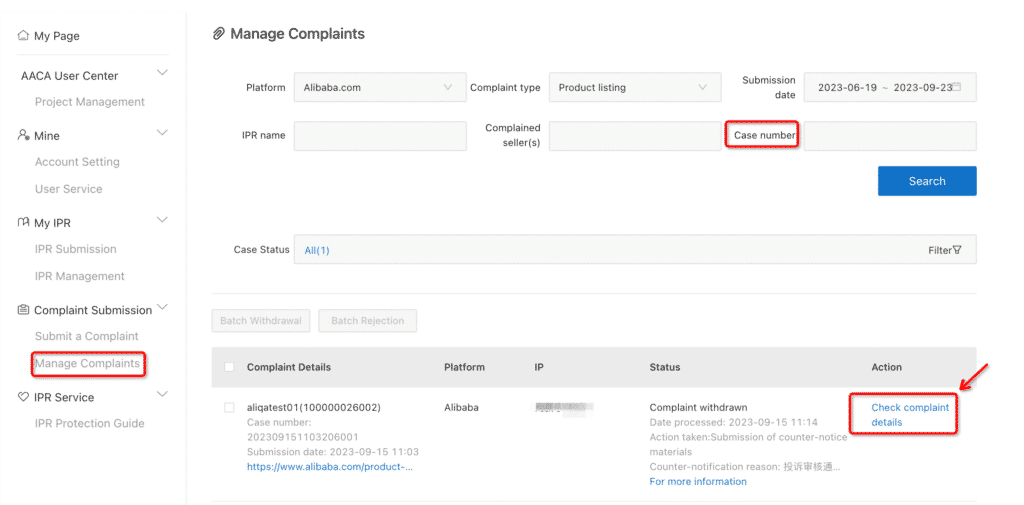
You can click into any complaint to see more details, like a timeline of actions and seller information.
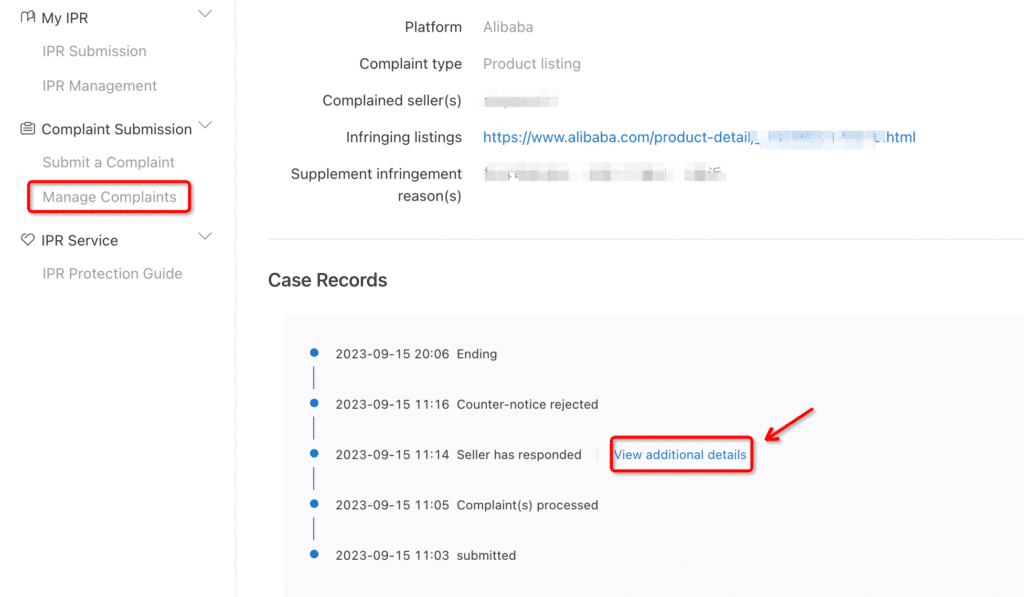
| Note | If the platform rejects your complaint (e.g., insufficient evidence or mismatched IP class), you’ll need to supplement your submission. Follow instructions carefully at each stage to avoid delays. |
Step 7: Track removals, sellers, and relisting
Record the outcome of every complaint, including:
- Listing removed or retained
- Complaint accepted or rejected
- Additional information requested
- Counter-notice received
- Final response
- Seller or store name
- Connected seller accounts
- Reused images
- New listing URLs
- Product and price patterns
- Time to initial action
- Time to final resolution
A single removal solves the immediate listing problem. Recurrence data helps determine whether the activity is an isolated infringement or part of a coordinated seller network.
The Good Faith Program
Brands that file complaints regularly—and have a strong record of confirmed takedowns—may qualify for Alibaba’s Good Faith Program. Qualification generally requires filing at least 100 complaints in the past three months with a 90% successful takedown rate. Good Faith status speeds up future complaint processing significantly.
How long does AliExpress take to remove a counterfeit?
Alibaba says 95% of notices submitted for AliExpress, Alibaba.com, and Lazada are processed within 24 hours on business days. “Processed” means the platform has reviewed or acted on the notice; it does not guarantee that every listing is permanently removed within that period.
| Stage | Typical timing or dependency |
| Account and identity approval | Depends on document accuracy and verification requirements |
| IP record approval | Depends on the type of right and supporting documents |
| Initial notice processing | Alibaba reports that 95% are processed within 24 business hours |
| Merchant response | The merchant may have up to three business days to respond |
| No merchant response | The listing may be removed automatically after the response period |
| First appeal or counter-notice stage | May add a further three-day response period |
| Additional appeal stages | Each of the next two stages may add up to seven days |
| Maximum merchant appeals | Generally up to three appeals |
| Final resolution | Depends on the complaint, evidence, merchant response, and any counter-notice |
| Relisting monitoring | Ongoing after the original URL is removed |
Alibaba’s published 24-hour metric measures notice processing. Individual outcomes depend on the evidence, the merchant’s response, and any counter-notice.
Why are AliExpress complaints rejected or delayed?
AliExpress complaints are often delayed because the evidence, authorization, IP record, or selected complaint reason does not match the listing closely enough.
Common causes include:
- Selecting the wrong intellectual property right
- Using a trademark registration that does not cover the relevant goods
- Filing under an expired or incomplete IP record
- Providing an authorization letter that does not match the account
- Submitting a cropped screenshot without the URL or seller details
- Saying a seller is “fake” without explaining the infringement
- Reporting a genuine unauthorized reseller as a counterfeiter
- Uploading duplicate or malformed URLs
- Including a listing that is already part of an active complaint
- Failing to distinguish your original image or design from the copied material
Weak explanation:
This seller is fake and is damaging our brand. Please remove the listing.
Stronger explanation:
The listing displays our registered trademark on the product and packaging and offers the goods as genuine. The product shown is not manufactured or authorized by the rights holder. The attached trademark certificate, official product images, and packaging comparison identify the differences and support a counterfeit trademark complaint.
The stronger version identifies the right, the prohibited use, and the evidence. It gives the reviewer a decision-ready explanation instead of asking them to investigate the entire claim independently.
What changed in Alibaba’s international IP enforcement?
Alibaba reorganized its ecommerce businesses in 2023 and introduced a dedicated international IPP Platform for AliExpress, Alibaba.com, Lazada, and Miravia.
This created an important routing distinction:
- AliExpress and other Alibaba International platforms use the AIDC IPP Platform.
- Taobao, Tmall, Tmall Global, and 1688 use Alibaba’s domestic intellectual property system.
Brands enforcing across both groups should maintain the appropriate accounts and IP records for each system. The Chinese marketplaces guide covers the domestic platform route, including enforcement on Taobao and other major Chinese marketplaces, in more detail.
Alibaba International also moved the counter-notice workflow into the IPP Platform and introduced BrandSafe, an invitation-based collaboration that uses rights-holder knowledge to improve detection and streamline notices. BrandSafe should not be treated as a replacement for general IPP registration because access is invitation-based.
Older Alibaba materials may refer to a Good Faith Program with specific eligibility thresholds. Brands should check their current IPP account or contact Alibaba before relying on older qualification figures, since current international materials place more emphasis on the IPP workflow and BrandSafe.
How do counterfeit sellers try to avoid marketplace detection?
The evasion tactics below target every major ecommerce marketplace, and they are precisely what proactive detection systems, including Alibaba’s image recognition and behavioral analysis, are built to counter.
A listing may use:
- Misspelled or abbreviated brand names
- Generic product titles
- Cropped or blurred logos
- Photos that hide the trademark
- Product codes shared through messages
- A low-cost generic listing that represents a different product
- Links sent through social media or private groups
- New storefronts created after earlier removals
These methods are often described as hidden-link selling. The visible listing may appear generic, while private images or messages reveal the counterfeit product delivered to the buyer.
Investigating hidden links may require visual matching, seller monitoring, customer intelligence, and test purchases. See the Red Points guide to AliExpress hidden links for the full process.
When is manual AliExpress reporting enough?
Manual IPP reporting is usually enough when:
- The brand encounters only a few listings
- The infringement is clear
- The same seller is not repeatedly relisting
- One person can monitor the case dashboard
- The activity is limited to AliExpress
- Evidence is already organized
- Complaint volume is predictable
Manual reporting becomes difficult when the same products appear across many stores, languages, URL variations, or marketplaces. It also becomes inefficient when the team spends more time rediscovering and reformatting cases than reviewing the underlying risk.
The IPP Platform reliably processes the cases submitted to it. The brand’s challenge is operational: finding those cases, validating them, monitoring responses, and detecting what returns.
What should brands do next?
Start by confirming that the correct identity and IP records are approved in the Alibaba International IPP Platform. Then create a standard evidence template so each complaint includes the listing URL, seller information, screenshots, authentic-product comparison, applicable IP right, and a concise infringement explanation.
After removal, continue searching for the same images, products, descriptions, and seller signals. Measure recurrence alongside takedown volume. A high removal count may look positive while the underlying availability of counterfeits remains unchanged.
Finally, separate counterfeit claims from unauthorized resale. Counterfeit listings should be addressed through IP enforcement. Genuine gray-market or unauthorized products may require different evidence, seller outreach, distribution controls, test purchases, or legal review.
How Red Points automates AliExpress enforcement
For brands managing recurring infringement of their own products across marketplaces, including AliExpress, Red Points brand protection software combines detection, validation, enforcement, seller intelligence, and recurrence monitoring in one workflow.
The platform scans listing text, product images, logos, seller data, and behavioral patterns to identify suspected counterfeits. Confirmed cases can then be submitted through the appropriate marketplace enforcement channel, including Alibaba IPP workflows and available platform integrations.
This changes the operating model in four ways:
- Detect: Continuous searches find listings that manual keyword checks may miss.
- Validate: Automated rules and expert oversight reduce false positives before enforcement. Reviewers on G2 also highlight Red Points’ ability to maintain detection accuracy across complex product catalogs, with IP specialists helping refine detection logic over time.
- Connect: Seller, image, product, and account signals reveal repeat offenders and related stores.
- Remove and monitor: Eligible cases are enforced and checked for relisting after the original URL disappears.
The platform processes more than 5.1 million enforcements per year across piracy, websites, marketplaces, social media, search engines, and other digital channels, with a 94–95% enforcement success rate for more than 1,300 brands. Its marketplace protection coverage extends beyond AliExpress to thousands of other ecommerce platforms.
For brands that prefer a fully managed approach, IP-Ops specialists can operate detection, validation, enforcement, and workflow optimization. Internal teams can retain control of enforcement rules and exceptions without manually reviewing every listing identified by the system.
Request a demo to see how automated AliExpress detection and enforcement would work for your product category.
Frequently asked questions about reporting counterfeits on AliExpress
What is the official portal for reporting AliExpress counterfeits?
The official rights-holder portal is the Alibaba International IP Protection Platform. It covers AliExpress, Alibaba.com, Lazada, and Miravia and allows rights holders or authorized representatives to register IP, submit notices, and monitor active cases.
How do I report a counterfeit product on AliExpress?
Create and verify an Alibaba International IPP account, register the relevant intellectual property, collect the listing URL and supporting evidence, select AliExpress in the complaint workflow, and submit a clear explanation of the infringement. Continue monitoring the dashboard in case the merchant submits a counter-notice.
Can I report an AliExpress listing without an IPP account?
Alibaba provides an online intellectual property complaint form for rights holders who have not established a registered IPP account. A registered account is generally more suitable for repeat enforcement because it stores approved rights, provides ongoing case management, and usually supports faster processing.
How many AliExpress URLs can I report at once?
The registered IPP workflow supports complaints covering up to 300 product listings. Confirm the current limit and URL requirements in the live form, particularly before preparing a large batch.
How quickly does AliExpress remove counterfeit listings?
Alibaba reports that 95% of notices for AliExpress, Alibaba.com, and Lazada are processed within 24 hours on business days. A merchant may then have up to three business days to respond. If the merchant does not respond, the listing may be removed automatically. Counter-notices or appeals can extend the process, with a three-day first appeal period and up to seven days for each of two further appeal stages. Processing does not guarantee permanent removal within 24 hours.
Do I need a registered trademark to report a counterfeit?
A trademark registration is normally the strongest basis for reporting fake products carrying your brand name or logo. Other cases may rely on copyright, patents, registered designs, or another recognized right. Alibaba’s guidance also permits a completed Copyright Claim Statement for claims based on unregistered copyright. Choose the IP basis that directly matches the listing activity and provide evidence of ownership.
Can I report copied product photos on AliExpress?
Yes. Unauthorized use of original product photography may qualify as copyright infringement. Include the AliExpress listing, the original image, evidence of ownership, the original publication location, and a clear comparison showing what was copied. When the copyright is unregistered, the claimant may be asked to provide a Copyright Claim Statement.
Is an unauthorized AliExpress seller automatically infringing my IP?
No. A seller offering genuine products without brand authorization is not automatically selling counterfeits or infringing IP. The brand must identify a specific violation, such as fake goods, copied images, trademark misuse, misleading affiliation, or legally significant differences in the product.
Can an AliExpress seller appeal a takedown?
Yes. Merchants may submit counter-notices after a complaint is accepted and may generally appeal a complaint up to three times. Rights holders should monitor the IPP dashboard and respond when Alibaba requests additional evidence or a decision.
Does one IPP account cover Alibaba.com and AliExpress?
Yes. The Alibaba International IPP Platform supports AliExpress, Alibaba.com, Lazada, and Miravia. You select the relevant marketplace when submitting each notice.
Does the AliExpress IPP account also cover Taobao and Tmall?
No. Taobao, Tmall, Tmall Global, and 1688 use Alibaba’s domestic intellectual property platform. Brands enforcing across international and domestic Alibaba marketplaces should maintain the appropriate accounts for both systems.
What should I do when a removed AliExpress listing comes back?
Save the new URL and compare its images, title, description, seller, price, shipping origin, and product variations with the earlier case. Report the new listing and preserve the connection to the previous complaint. Repeated relisting may justify seller-level escalation or broader marketplace monitoring.
What is Alibaba BrandSafe?
BrandSafe is an invitation-based Alibaba International collaboration that uses brand knowledge and technology, including AI, to improve proactive detection and streamline enforcement. It supplements the standard IPP workflow but is not generally available as a replacement for IPP registration.
What does an intellectual property complaint on AliExpress mean?
An intellectual property complaint means a rights holder has reported a listing for using its trademark, copyright, patent, design, or another protected right without authorization. The seller is notified and may respond through the counter-notice process. The listing may be removed if the complaint is upheld or if the seller does not respond within the applicable period.
Is registering intellectual property in China necessary for AliExpress enforcement?
Not necessarily. The Alibaba International IPP Platform accepts relevant rights from multiple jurisdictions, depending on the complaint and the market involved. However, registering important trademarks, designs, or other rights in China can provide a stronger basis when a brand also needs to enforce on domestic platforms such as Taobao, Tmall, or 1688.