

Domain management is the process of securing your brand’s digital identity — registering the right domains, protecting them from abuse, disputing bad-faith registrations, and keeping control of the infrastructure that connects customers to your business. This guide covers the complete picture: how to claim a domain correctly, how to protect it before a threat emerges, how to dispute a cybersquatting or trademark-based registration through UDRP, and what continuous monitoring looks like at scale.
TL;DR
- What domain management is: The process of registering, securing, renewing, monitoring, and defending your domain portfolio so your brand stays reachable and trusted online. A domain issue can take down your website, disrupt email, or send customers to a scam site.
- Claiming a domain is only step one: You need the right registrar, the right naming strategy, and controls like domain lock, accurate registration data, strong credentials, and long renewal terms to reduce avoidable risk.
- Disputes are for bad-faith registrations: If a third party registers a domain that is identical or confusingly similar to your mark, has no legitimate interest, and is using it in bad faith, UDRP is the standard path for many gTLD disputes.
- Manual monitoring breaks down fast: There were 386.9 million domain registrations worldwide at the end of Q4 2025, and WIPO handled more than 6,200 domain name cases in 2025, its highest annual caseload on record. That is why domain protection now requires continuous monitoring, enforcement workflows, and expert review for high-risk cases.
Quick overview: How to protect, claim, dispute, and manage domains
| Task | What to do | Why it matters |
| Protect | Register core domains, common misspellings, key ccTLDs, and relevant gTLDs. Lock domains and secure registrar access. | Reduces exposure to typosquatting, phishing, and unauthorized changes. |
| Claim | Choose a short, brand-relevant domain, verify availability through an ICANN-accredited registrar, register it, and keep registrant data accurate. | Establishes control over your digital identity and keeps transfer and recovery options open. |
| Dispute | Use negotiation or a formal complaint process such as UDRP when a bad-faith domain targets your trademark. | Can result in transfer or cancellation of an infringing domain. |
| Manage | Track renewals, DNS access, registrar credentials, privacy settings, and new suspicious registrations continuously. | Prevents internal lapses and catches external abuse before customers do. |
The threat of domain abuse
A customer searches for your brand, clicks a look-alike domain, enters payment details, and never receives the product. Your support team gets the complaint. Your brand gets the blame. The fraudster keeps the money.
That is why domain management is not an admin task. It is a revenue, trust, and risk-control function. A domain does more than point to a website — it connects your brand to email, DNS, hosting, search visibility, and customer access. If the domain is lost, hijacked, expired, or spoofed, the damage reaches far beyond a single page.
The scale of the problem makes manual oversight insufficient. The internet ended Q4 2025 with 386.9 million domain registrations, while WIPO managed over 6,200 domain name cases in 2025 and over 80,000 cases across 25 years. For brand owners, domain abuse is not a niche legal issue. It is an always-on operational problem.
What domain management actually means
Domain management is the process of securing a domain portfolio from external threats while also making sure registrations stay current and the business retains access to the registrar, hosting provider, and DNS controls. It is separate from web hosting. Hosting keeps your site running. Domain management protects the identity and routing layer that makes the site reachable in the first place.
A good domain program covers four things:
1. Ownership and registration control
You need to know who registered the domain, where it sits, who controls DNS, and when it renews. Many brands get exposed not because of an external attack, but because a card expired, an employee left, or the registrar credentials were lost — all common reasons domains lapse.
2. Defensive coverage
Owning only YourBrand.com is rarely enough. Brands often also register .net, .org, .biz, country-code domains like .es, .de, .fr, and common misspellings or mispronunciations to reduce typosquatting risk. Even then, you cannot pre-register every likely variation, which is why monitoring matters.
3. Security controls
At a minimum, strong domain hygiene includes using a trusted registrar, locking domains against unauthorized changes, maintaining accurate registration data, and reducing renewal risk by registering for longer terms where sensible. ICANN states that locked domains help protect against unauthorized changes, and accurate registration data remains a registrant responsibility.
4. Detection and enforcement
Defensive registrations only cover what you predicted. Monitoring catches what you missed — suspicious new registrations, look-alike phishing domains, parked domains meant for resale, counterfeit webstores, and impersonation sites using your name to steal money or data.
How to claim a domain the right way
Step 1: Choose a domain that supports the brand
The basics still matter. Choose a domain that is short, easy to type, and connected to your brand or category keywords. Extension also matters. .com remains the dominant commercial standard, but .org, .io, .tech, .law, .bank, and ccTLDs can make sense depending on your audience and geography.
Step 2: Use an ICANN-accredited registrar
Use a reputable registrar and make sure it is ICANN-accredited for gTLD registrations. ICANN maintains a public list of accredited registrars. This matters because registrar quality affects account recovery, transfer support, security controls, and the basic reliability of your portfolio management.
Step 3: Register the core domain and adjacent variants
Claim the main brand domain first, then decide what else needs coverage. Most brands should at least consider:
- the main commercial domain
- high-risk misspellings
- key ccTLDs in active markets
- major gTLD variants tied to your category or geography
Step 4: Secure the registrar account immediately
Do not leave security for later. Lock the domain. Use strong passwords. Keep ownership and contact data accurate. Review who has admin access. If you ever need to transfer the domain, ICANN notes that the holder will need an Auth-Code, and registrars must provide it or let the holder generate it.
Step 5: Treat claiming as the start of management, not the finish line
A claimed domain is only safe while it remains controlled, renewed, and monitored. Once the domain is registered, management becomes an ongoing process — not a one-time task.
How to protect your domains before a dispute happens
The best time to handle a domain threat is before it becomes a dispute. Manual checks do not scale: with hundreds of millions of live domains and a record number of disputes going through WIPO, spreadsheets and occasional WHOIS lookups are not enough for a serious brand program.
A practical protection plan includes:
Register likely variations early
Registering common misspellings, gTLD alternatives, and market-specific ccTLDs can cut off obvious abuse paths before someone else takes them. It will not stop every threat, but it reduces preventable exposure.
Lock high-value domains
ICANN explains that locked status protects domains from unauthorized changes. For a brand’s primary storefront and email domains, this should be standard operating procedure.
Maintain accurate registration data
If data is wrong, recovery and transfer become harder. ICANN requires registrants to keep registration data accurate throughout the registration term.
Use privacy and proxy services thoughtfully
Privacy services can limit public exposure of personal contact data, but they do not remove your underlying obligations as a registrant. They are useful for privacy, not a substitute for brand protection.
Monitor for suspicious registrations
Monitoring should cover new domains that imitate your trademark, typo variants, phishing lures, executive impersonation domains, and webstores that mimic your checkout flow. This is especially important if your brand sells across Amazon, eBay, Shopify storefronts, TikTok Shop, Instagram, and direct-to-consumer sites — because fraudsters often move across channels rather than stay in one place.
What causes a domain name dispute
A domain dispute usually starts when a third party registers a domain that targets your mark or business identity without a legitimate right to do so. There are three common categories:
Cybersquatting
Bad-faith registration intended to profit from your brand’s traffic, reputation, or resale value. Typosquatting is a common variant, where one or two characters are changed to catch user mistakes.
Trademark infringement
A conflict arises when one party has trademark rights and another registers a domain that is identical or confusingly similar. The closer the overlap and the weaker the registrant’s legitimate interest, the stronger the dispute case tends to be.
Phishing and impersonation
Look-alike domains are used to trick users into sharing credentials, payment details, or personal data. In these cases, speed matters — customer harm starts before the legal process finishes.
How to conduct a domain name dispute
Step 1: Confirm the right path
Not every domain issue needs a formal dispute. Some can be resolved through registrar outreach, negotiation, or a targeted takedown request. But if the domain falls under a covered TLD and the abuse is trademark-based, UDRP is often the standard route — applying to most trademark-based domain disputes for covered registrations.
Step 2: Build the evidence file
The complainant must prove three elements under UDRP:
- The domain is identical or confusingly similar to a trademark or service mark in which the complainant has rights
- The registrant has no rights or legitimate interests in the domain
- The domain was registered and is being used in bad faith
Evidence typically includes trademark registrations, screenshots, DNS and registration data, examples of impersonation or phishing, sales offers, redirect patterns, or proof that the registrant is trying to profit from confusion. ICANN also lists examples of bad faith, including registering a domain primarily to sell it back at a profit or using it to attract users for commercial gain by creating confusion.
Step 3: File with an approved dispute provider
Select a dispute resolution provider approved by ICANN and submit the complaint there. WIPO is the best-known provider and notes that UDRP is designed to help trademark owners reclaim infringing domains.
Step 4: Wait for panel review and decision
The case may be heard by a single expert or a three-member panel. If the complainant proves the required elements, the panel can order the domain transferred or cancelled. The losing party may still seek relief in court.
Step 5: Act on the outcome and close the loop
Winning the case is not the end. Once the domain is transferred or cancelled, you still need to:
- point the domain correctly or redirect it
- update watchlists for similar variants
- review whether more defensive registrations are needed
- preserve the evidence in case connected domains appear later
That last point matters because bad actors rarely stop at one domain — they rotate infrastructure. Dispute work should therefore feed back into broader monitoring and protection. This is also where human expertise matters most. Automation can surface patterns and likely abuse quickly, but high-risk verification, complaint drafting, and escalation decisions still benefit from expert review to reduce false positives.
When manual domain management is not enough
The standard is clear: brands should monitor domains continuously, protect likely variations, and act on abuse quickly. However, manual execution breaks down fast once a portfolio grows, the brand expands internationally, or impersonation starts appearing across websites, email, social media, and ads simultaneously.
This is where a platform like Red Points fits. The approach is built around three stages:
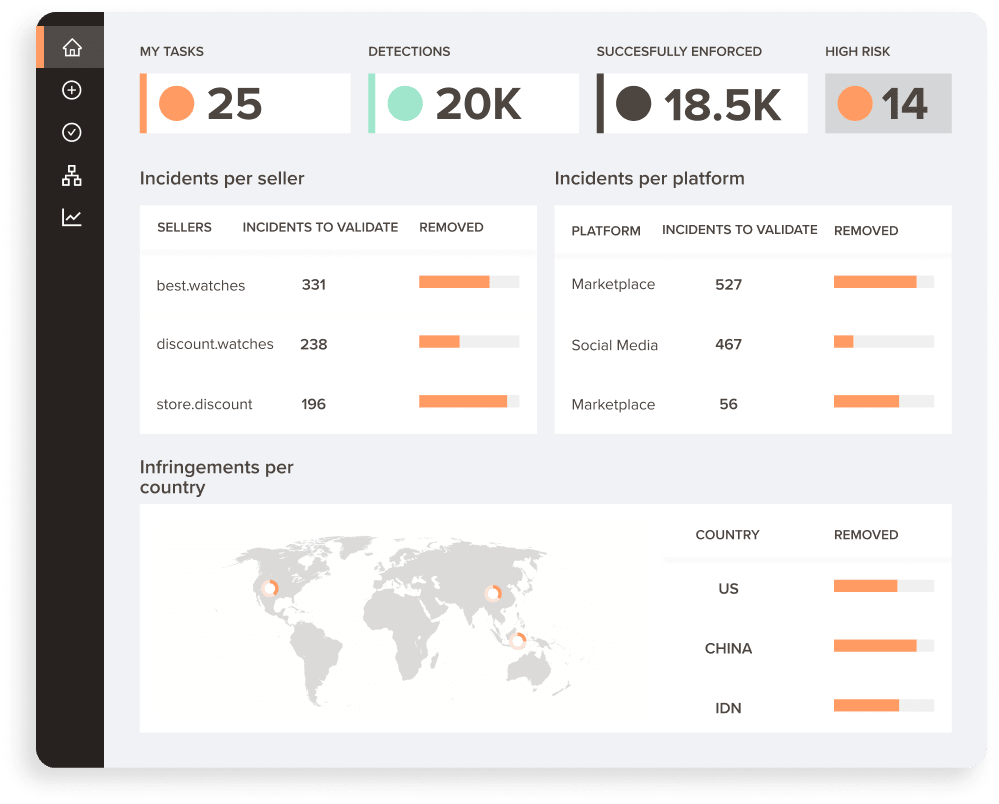
- Detect infringing and newly registered domains
- Claim through negotiation, transfer requests, and formal complaints
- Manage the broader portfolio by identifying gaps and supporting acquisition, registration, and administrative procedures
Red Points’ domain monitoring and enforcement solution covers 1.4 billion+ domains, with continuous scanning for new registrations, typosquatting variants, look-alike storefronts, and impersonation sites. The AI-driven platform‘s enforcement workflows connect detection to takedown across registrars, hosting providers, and search engines — with a 94–95% enforcement success rate across 4.6M+ enforcements per year for 1,300+ brands. For domain-specific cases, the platform supports both automated outreach and formal UDRP complaint workflows, with human expert review for high-stakes disputes.
The real problem is not just “find one fake domain.” It is reducing customer exposure, protecting legitimate traffic, and keeping a portfolio under control while attackers keep rotating infrastructure. The scalable model is automation for coverage, plus human expertise for validation and high-risk enforcement — the combination that avoids both backlog and careless takedowns.
Case study — Cotopaxi: From reactive takedowns to proactive domain enforcement
Problem: Ahead of Black Friday 2021, Cotopaxi saw 14 fake websites appear overnight — all using deep discount claims, copied brand content, and look-alike domain names to divert customer traffic and payment. The volume and speed of new fake sites made manual case-by-case response unworkable.
Approach: Using Red Points’ Domain Management solution, Cotopaxi moved from reactive takedowns to continuous monitoring that detected infringing domains earlier, identified recurring spoofing patterns across related sites (including reused storefront templates and copied imagery), and streamlined enforcement and recovery workflows.
Result: Cotopaxi shifted from chasing individual fake sites to a scalable enforcement model that reduced manual workload, accelerated takedowns, and created a repeatable response system for future surges
Key data points:
- 130+ hours saved in a quarter
- 4,700+ monthly enforcements
- $3.5M+ fraudulent value prevented in one year
Final takeaway
Domain management in 2026 is not just about buying a domain and renewing it once a year. It is about owning the right names, securing the registrar layer, monitoring abuse continuously, and using the right dispute tools when bad-faith registrations appear.
The companies that do this well treat domains as part of brand protection, fraud prevention, revenue protection, and customer trust — not as an afterthought.
The playbook is clear: claim the right domains, protect them with sound controls, dispute bad-faith registrations with evidence, and manage the portfolio like a business asset. When volume makes manual monitoring collapse, move to a system that combines always-on detection with expert review and enforcement.
Frequently Asked Questions (FAQs)
It is the process of registering, renewing, securing, monitoring, and defending your domain names so your website, email, and brand identity stay under your control.
No. Hosting stores and serves your website content. Domain management controls the domain name itself — including renewal, DNS direction, and ownership administration.
For gTLDs, using an ICANN-accredited registrar is the standard and safest route.
Lock the domain, secure the registrar account, and verify that your registration data is accurate. Those steps reduce the risk of unauthorized changes and make future recovery easier.
Usually yes, especially for high-traffic or internationally active brands. Defensive registrations reduce obvious typosquatting and localization risks, even if they cannot eliminate every possible variation.
The complainant must show the domain is confusingly similar to its mark, the registrant lacks legitimate interests, and the domain was registered and used in bad faith. Full UDRP rules are published by ICANN
Yes. Phishing and impersonation can still support a domain dispute if they show bad-faith use of a confusingly similar domain targeting your brand.
Yes. Google and Bing accept DMCA requests from rights holders globally. The DMCA governs the obligations of US-based search engines — not the nationality of the filer. Non-US brands can submit takedown requests using the same forms as US-based companies. If your copyright is registered in a jurisdiction other than the US, include documentation showing your registration and a clear statement that the content infringes your rights under applicable local law.
At the end of Q4 2025, there were 386.9 million domain registrations worldwide, and WIPO handled over 6,200 domain name cases in 2025 — a record high
Yes. ICANN’s Transfer Policy allows transfers between accredited registrars, and domain holders need an Auth-Code to complete the process.
Because you cannot realistically watch hundreds of variants, geographies, and suspicious registrations by hand across a domain universe measured in the hundreds of millions. Continuous monitoring and expert-led enforcement are more practical for brands with real exposure.