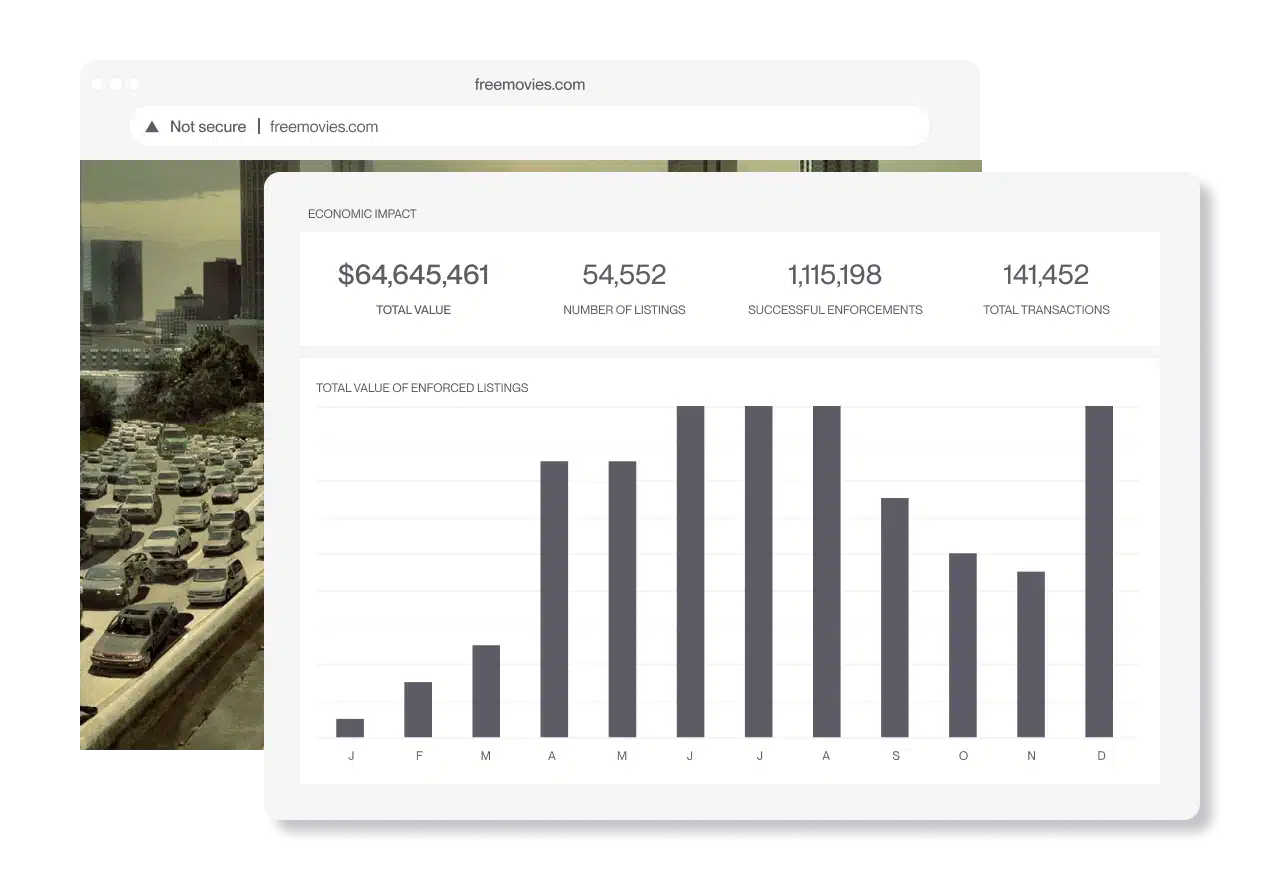



The impact of piracy extends far beyond a lost sale. When movies, TV shows, books, software, games, music, courses, live broadcasts, and other copyrighted content are distributed without authorization, rights holders can lose revenue, control over distribution, customer relationships, and visibility into how their work is being consumed.
The scale remains significant. MUSO’s 2025 Piracy Trends and Insights Report analyzed 185.6 billion visits to piracy websites across TV, film, publishing, software, and music during 2025. Although overall traffic declined from the previous year, piracy remained resilient in major content categories and continued to evolve in how users discover and access unauthorized material.
For businesses, the challenge is therefore not simply understanding why piracy exists. It is knowing where illegal copies appear, how they affect the business, and how to detect, remove, and monitor them at scale.
This guide explains the impact of piracy on businesses, creators, customers, and the publishing industry; what anti-piracy means; and how organizations can prevent digital piracy across websites, search engines, social platforms, marketplaces, cyberlockers, peer-to-peer networks, and other channels.
TL;DR
- The impact of piracy includes lost revenue, weakened licensing value, customer confusion, cybersecurity risks, reputational damage, and reduced control over copyrighted works.
- Digital piracy affects film, television, music, publishing, gaming, software, online courses, live sports, and other digital industries.
- MUSO measured 185.6 billion visits to piracy websites across five major content sectors in 2025.
- Anti-piracy combines detection, validation, enforcement, search delisting, takedowns, monitoring, and recurrence tracking.
- Copyright protection should be established before infringement occurs, but registration alone does not detect or remove piracy.
- Effective prevention combines technical controls such as DRM and watermarking with monitoring and copyright enforcement.
- Piracy often moves between websites, search results, social media, marketplaces, cyberlockers, streaming services, and private communities.
- Publishing piracy remains particularly significant: MUSO recorded 65.8 billion visits to publishing piracy websites in 2025.
- Manual takedowns can work for isolated incidents, but repeat piracy requires continuous monitoring and prioritization.
- The objective of anti-piracy is not only to remove individual URLs. It is to make unauthorized content harder to discover, access, redistribute, and monetize.
What is digital piracy?
Digital piracy is the unauthorized copying, distribution, sharing, streaming, resale, or access of copyrighted digital content.
It can affect almost any content that can be reproduced or delivered digitally, including:
- Movies and television
- Live sports and broadcasts
- Music and audio
- Ebooks and digital publications
- Manga and comics
- Software
- Mobile apps
- Video games
- Online courses
- Photography and artwork
- Subscription accounts
- Digital downloads
Piracy does not always look like a downloadable file on an obvious piracy website.
Unauthorized content can appear through illegal streaming sites, cyberlockers, torrent indexes, social media posts, messaging groups, search results, marketplace listings, cracked software downloads, shared credentials, modified applications, or sellers offering access to paid subscriptions.
For example, modern software piracy can include cracked applications as well as illegally resold license keys, account sharing, modified software, stolen credentials, and tutorials showing users how to bypass payment systems.
That fragmentation is one reason piracy has become a broader monitoring problem for rights holders.
What is the impact of piracy on businesses?
The impact of piracy varies by business model, but the underlying problem is the same: unauthorized copies compete with or bypass the legitimate way the rights holder intends its content to be accessed.
That can affect businesses at several levels.
Lost sales and subscription revenue
The most direct impact is revenue diversion.
Someone accessing an unauthorized stream, downloading a pirated ebook, obtaining a cracked application, or purchasing an illicit subscription may avoid the legitimate transaction entirely.
Not every pirated interaction can be treated as a one-for-one lost sale. Some people who consume unauthorized content would not otherwise have paid for it.
But businesses should not therefore assume the commercial impact is negligible.
Piracy can interfere with:
- Direct purchases
- Subscriptions
- Pay-per-view revenue
- Advertising revenue
- Software licensing
- In-app purchases
- Publisher royalties
- Territorial distribution agreements
- Content exclusivity
- Premium release windows
The more a business relies on controlling access to digital content, the more important unauthorized distribution becomes to its commercial model.
Reduced value of licensing and exclusivity
Content is often valuable because access is controlled.
A studio might license a film to different distributors by territory. A publisher may grant ebook rights separately from print rights. A sports organization may sell exclusive broadcasting rights. A software company may offer different subscription tiers.
Piracy can undermine those arrangements by making the same material accessible outside the authorized channel, region, price point, or release window.
This means the impact is not limited to immediate consumer sales. Unauthorized availability can also weaken the commercial value of the rights themselves.
Loss of control over release strategy
Timing can be critical for copyrighted content.
Films, games, books, software, courses, and sports broadcasts often follow carefully planned launch windows. A leaked copy appearing before or immediately after release can disrupt that strategy.
Early piracy can also spread rapidly through mirrors, reposts, torrent indexes, social posts, and search results.
Once several copies exist, removing the original upload may no longer be enough.
Brand and reputation damage
Users accessing pirated content do not always separate the unauthorized copy from the legitimate brand.
A pirated application may contain bugs. An illegal stream may repeatedly fail. A copied course may be incomplete. A fake subscription may stop working. A pirated file may contain malware.
The customer may still associate that experience with the original title or company.
This creates a reputational problem on top of the copyright problem, particularly when unauthorized sellers or distributors deliberately use official logos, screenshots, artwork, or other brand assets to make the offer appear legitimate.
Increased customer support costs
Piracy can also generate operational costs.
Users may contact the legitimate business after:
- An illicit subscription stops working
- A copied product does not include promised features
- Pirated software fails
- An unauthorized account is suspended
- A download contains malware
- A supposed seller disappears
- A customer mistakes an unofficial service for the real company
Support teams then spend time handling a transaction the company never authorized or received revenue from.
Consumer security risks
Piracy channels can expose users to risks beyond copyright infringement.
Unauthorized software, downloads, streaming sites, and account sellers may be used to distribute malicious files, collect credentials, redirect users to fraudulent pages, or sell access that does not work.
A 2026 Red Points investigation into illicit software used 60 test purchases across 14 local marketplaces in eight countries. More than 20% of the illicit purchases resulted in scams.
This is an important distinction for rights holders: a piracy incident can evolve into a customer-protection issue when users are exposed to fraud or unsafe downloads.
How does piracy affect creators?
Piracy affects the organizations that commercialize content, but its effects also reach individual creators.
Writers, musicians, developers, designers, filmmakers, educators, photographers, and other creators may depend on royalties, licensing fees, subscriptions, direct sales, or advertising connected to authorized distribution.
When their work circulates through unauthorized channels, they can lose both income and visibility into genuine demand.
This particularly matters for smaller creators and businesses.
Large rights holders may have dedicated legal, copyright, and trust-and-safety teams. An independent developer or publisher may have to choose between creating new work and spending hours searching for copies, filing notices, and checking whether removed content has returned.
A scalable anti-piracy strategy should reduce that enforcement burden rather than transfer it to the creator.
How does piracy affect consumers?
Consumers are sometimes treated only as the demand side of piracy, but they can also be harmed by it.
Unauthorized content may expose them to:
- Malware
- Credential theft
- Fraudulent payments
- Misleading subscriptions
- Poor-quality copies
- Broken software
- Missing updates
- Inaccessible customer support
- Privacy risks
There is also an authenticity problem.
As piracy distribution becomes more professional, users may not always realize that the website, account, subscription, download, or seller they encounter is unauthorized.
That becomes especially problematic when official imagery, title artwork, product descriptions, or brand names are used to make an illegal offer appear legitimate.
What is anti-piracy?
Anti-piracy is the combination of processes and technologies used to detect, disrupt, remove, and monitor unauthorized distribution or access to copyrighted content.
A modern anti-piracy program is broader than filing a copyright complaint after someone reports a pirated copy.
It typically covers four stages:
| Stage | Purpose |
| Detect | Find unauthorized copies, streams, downloads, accounts, links, and offers |
| Validate | Confirm that the use is unauthorized and appropriate for enforcement |
| Enforce | Submit the relevant takedown, delisting, platform, host, or other request |
| Monitor | Track removal outcomes and identify reposts or repeat infringers |
Effective anti-piracy is therefore an ongoing rights-management process.
The goal is not to claim that every use of copyrighted material is illegal. Some uses may be licensed, authorized, covered by platform agreements, or potentially permitted under exceptions such as fair use.
Validation before enforcement is essential.
What types of piracy should businesses monitor?
Piracy methods change with technology and business models.
Rather than relying on one fixed taxonomy, it is more useful to monitor the ways copyrighted material is actually being distributed.
Illegal streaming
Movies, TV, sports, and other video content can be streamed through unauthorized websites, apps, IPTV services, embedded players, social platforms, and other services.
Live content creates a particularly narrow enforcement window because the commercial value may be concentrated in the minutes or hours during which an event takes place.
Unauthorized downloads
Pirated files may be hosted directly on websites or distributed through cyberlockers and file-sharing services.
This can affect ebooks, music, software, games, films, courses, and other downloadable content.
Peer-to-peer distribution
Torrent and other P2P systems allow files to be distributed between users rather than downloaded from one central source.
For rights holders, this changes the detection and disruption strategy because removing one webpage may not eliminate the underlying file distribution.
Software cracking and modified apps
Software pirates may alter applications to bypass licensing, subscription, advertising, or access controls.
Piracy can also involve unauthorized APKs, cracked games, modified software, license keys, or tutorials explaining how to unlock paid functionality.
Account and credential sharing
Subscription piracy may involve illegally selling or sharing accounts, credentials, session cookies, or other access methods instead of copying the underlying content.
This is increasingly relevant for software, streaming, gaming, AI tools, and other subscription businesses.
Marketplace and social-media offers
Unauthorized access can also be sold through ordinary ecommerce and social channels.
A listing may advertise a downloadable product, premium account, software key, subscription, IPTV package, or another form of unauthorized digital access.
The transaction and the pirated content may therefore exist on completely different platforms.
How to prevent digital piracy
No single control can prevent every form of piracy.
The strongest strategy combines legal protection, technical controls, monitoring, enforcement, and recurrence analysis.
Step 1: Establish and document copyright ownership
Copyright generally arises automatically when an eligible original work is created and fixed in a tangible medium, although the precise rules and registration benefits vary by jurisdiction.
Businesses should still maintain organized evidence of ownership.
That can include:
- Original source files
- Creation dates
- Publication records
- Contracts
- Employee or contractor assignments
- Licensing agreements
- Copyright registrations
- Release records
Clear rights documentation makes enforcement faster when piracy appears.
Our guide to copyright infringement explains how copyright ownership and unauthorized use fit into a wider IP strategy.
Step 2: Use appropriate technical controls
Technical protections can make unauthorized copying or access harder.
Depending on the type of content, these can include:
- Digital rights management
- Access controls
- Encryption
- License validation
- Device limits
- Session controls
- Visible watermarks
- Forensic watermarking
- Download restrictions
- Account-security measures
Technical controls should be treated as one layer rather than a complete solution.
Determined infringers may find ways around them, which is why monitoring remains necessary even when DRM is in place.
Step 3: Monitor the channels where piracy spreads
Search beyond obvious piracy websites.
Depending on the content, monitoring may need to cover:
- Search engines
- Streaming sites
- Cyberlockers
- Torrent indexes
- Social media
- Video platforms
- Marketplaces
- Forums
- Apps
- Messaging communities
- Linking sites
Use title names, product names, common piracy phrases, filenames, images, release details, and other signals rather than depending on a single keyword.
Step 4: Preserve evidence
Capture evidence before submitting a takedown.
Useful records can include:
- URLs
- Screenshots
- Upload dates
- Account or seller names
- Page titles
- File names
- Listing IDs
- Search results
- Original copyrighted work
- Ownership information
- Related accounts and domains
Pirated material can move quickly. Evidence preserved today may be needed later if the page changes, disappears, or reappears elsewhere.
Step 5: Choose the appropriate enforcement route
The right route depends on where the piracy appears.
If copyrighted material is hosted on a website, the rights holder may need to contact the site, host, CDN, or another intermediary.
If it appears on a social network or marketplace, use the platform’s copyright-reporting mechanism.
US copyright owners and authorized representatives may also use a DMCA takedown where the statutory process applies.
For an independent piracy site, follow our guide on reporting a piracy website to identify the appropriate reporting and escalation routes.
Step 6: Reduce discovery through search
Removing a file from its host is not the only way to disrupt piracy.
Where appropriate, rights holders can request that search engines remove qualifying links to infringing material from search results.
This can reduce the visibility and discoverability of piracy even when the underlying website is slower to respond.
Search delisting should complement source removal rather than replace it.
Step 7: Educate legitimate customers
Customers can become an additional detection layer.
Publish clear information explaining:
- Official websites and apps
- Authorized subscription options
- Genuine pricing
- Release dates
- Supported resellers
- Where customers should report suspicious offers
This is particularly useful when pirates rely on confusion rather than knowingly serving users looking for illegal content.
Step 8: Track repeat piracy
A successful takedown is not necessarily the end of the case.
The same file may return through:
- A new URL
- Another cyberlocker
- A mirror domain
- A new account
- Another marketplace
- A renamed file
- A social-media post linking back to the same source
Connect repeat incidents where possible.
This helps identify whether the business is dealing with isolated users or a recurring distribution network.
Why prevention alone cannot eliminate piracy
Businesses sometimes frame the objective as making piracy technically impossible.
That is rarely realistic.
DRM can be circumvented. Watermarks can be cropped. Removed files can be uploaded again. Domains can change. New seller accounts can appear.
The practical objective is therefore to increase friction across the piracy lifecycle.
Make content harder to copy where possible. Detect unauthorized distribution faster. Reduce its visibility. Remove accessible copies. Disrupt monetization. Track where content reappears.
Over time, this can reduce both availability and the commercial impact of piracy.
How piracy affects the publishing industry
Publishing deserves particular attention because the content itself can often be reproduced with little loss in usability.
With some counterfeit physical products, a buyer may receive something visibly or functionally different from the original.
A pirated ebook, manga chapter, academic text, magazine, or digital publication can reproduce the core copyrighted content in a form that remains easy to consume.
That creates direct competition with authorized distribution.
Publishing piracy remains a major digital category
The scale is substantial.
MUSO’s 2025 publishing data recorded 65.8 billion visits to publishing piracy websites during 2025.
Manga accounted for 73.09% of publishing piracy traffic, and nine of the ten most visited publishing piracy sites measured by MUSO were dedicated to manga.
That is a significant change from the older idea that publishing piracy is primarily someone scanning and sharing a traditional book.
Today’s publishing piracy ecosystem can include:
- Manga reading sites
- Ebook download sites
- Web-fiction platforms
- File lockers
- Telegram and messaging groups
- Academic-material sharing
- Unauthorized PDFs
- Fan-translated releases
- Search results linking to copies
Why digital publications are vulnerable
Once a clean digital copy is available, it can be duplicated repeatedly at minimal cost.
The recipient may also receive substantially the same written or visual content as a paying customer.
That reduces some of the quality friction found in other illicit markets.
Publishers should therefore focus enforcement on access and discoverability: finding unauthorized copies quickly, removing or disabling them where possible, and monitoring for mirrors and reuploads.
Academic and professional publishing
Academic, technical, and professional materials can face an additional challenge because users may need a specific title rather than choosing among several substitutes.
High prices and required reading can create strong demand for unauthorized copies.
That does not make piracy lawful, but it affects where and how publishers should monitor for it.
Rights holders should look beyond public websites to file-sharing services, search results, social platforms, and communities where required texts may be exchanged.
The piracy challenge across marketplaces and digital platforms
One of the biggest changes in online piracy is that the discovery, transaction, and delivery of unauthorized content do not have to occur in the same place.
A user might see an offer on a marketplace, contact the seller through a messaging service, receive credentials through email, and access the pirated content through a completely separate website.
That creates a cross-channel piracy challenge.
Marketplaces
Marketplace listings can be used to advertise unauthorized:
- Software licenses
- Streaming accounts
- IPTV subscriptions
- Digital downloads
- Premium accounts
- Gaming accounts
- Activation keys
The marketplace itself may never host the copyrighted file.
For rights holders, the relevant enforcement target may therefore be the listing or seller account advertising unauthorized access.
Social media
Social platforms can be used to promote piracy, publish clips, link users to external sites, distribute access instructions, or move users into private groups.
Enforcement may need to address both the infringing content and the account or posts being used to distribute it.
Search engines
Search remains an important discovery route for piracy.
Rights holders can monitor search results for title names combined with terms such as “free download,” “watch free,” “crack,” “APK,” “PDF,” or other piracy-specific phrases relevant to their content.
Removing eligible infringing search results reduces one of the routes through which users reach piracy sites.
Cyberlockers and piracy websites
Dedicated piracy sites and file hosts remain important because they can store, index, embed, or link to unauthorized files at scale.
When one source supplies many downstream links, acting against the source can sometimes have more impact than filing dozens of individual notices elsewhere.
New channels will continue to emerge
The specific sites and platforms most relevant to piracy will change.
That is why a 2026 anti-piracy strategy should not depend on a fixed list of “bad marketplaces” or domains.
The better approach is behavior-based monitoring: identify where people are currently discovering, promoting, selling, or consuming unauthorized access to your content and direct enforcement resources accordingly.
How to prioritize piracy enforcement
Not every infringement creates the same commercial risk.
A useful prioritization model considers:
| Signal | Higher-priority example |
| Traffic | A piracy site ranking highly for a major new release |
| Timing | A leak before or immediately after launch |
| Reach | A social post or account generating substantial engagement |
| Commercial intent | A seller monetizing unauthorized access |
| Recurrence | An operator repeatedly returning after removal |
| Customer risk | Pirated downloads connected with scams or malware |
| Network value | One source supplying many downstream copies |
This avoids spending equal effort on every individual URL.
The strongest anti-piracy programs focus first on incidents that have the greatest effect on revenue, reach, customer risk, or continued redistribution.
How Red Points helps reduce the impact of piracy
Manual reporting can work when a rights holder encounters an occasional unauthorized copy.
It becomes difficult when piracy is distributed across websites, search engines, cyberlockers, social platforms, video platforms, and marketplaces at the same time.
Red Points Anti-Piracy helps rights holders detect and remove pirated content across those channels while tracking repeat distribution.
The process combines several layers.
Detect piracy across channels
Automated monitoring searches indexed and non-indexed sources for unauthorized content, links, streams, downloads, accounts, and listings.
Monitoring can extend beyond the title itself to relevant piracy terminology, associated domains, seller activity, and other signals.
Validate potential infringements
Detection alone should not trigger enforcement automatically in every case.
A validation layer helps distinguish confirmed unauthorized distribution from licensed, permitted, or otherwise non-actionable use before enforcement takes place.
Remove and disrupt access
Depending on the source, enforcement may involve copyright complaints, host notices, platform reports, cyberlocker removals, search-engine delisting, or other appropriate mechanisms.
For copyright-specific workflows, Red Points also provides a DMCA takedown service.
Monitor recurrence
After removal, monitoring continues for mirrors, reuploads, renamed files, connected domains, and repeat accounts.
That makes each enforcement action useful not only as a takedown, but also as intelligence about how the content is being redistributed.
Red Points currently processes more than 5.1 million enforcements per year across piracy, websites, marketplaces, social media, search engines, and other digital channels.
For brands that prefer a managed approach, Red Points specialists can handle detection and enforcement while internal teams determine how hands-on they want to remain.
Request a demo to see how Red Points can help detect, disrupt, and remove digital piracy at scale.
What to do next
Start by identifying which content generates the greatest commercial value and where unauthorized access to that content is most likely to appear.
Make sure ownership and licensing records are organized. Add proportionate technical controls. Monitor the channels customers use to find the content. Preserve evidence before acting. Prioritize high-impact incidents, use the appropriate takedown or delisting route, and continue monitoring after removal.
The central lesson is that the impact of piracy cannot be managed through one-off takedowns alone.
Effective anti-piracy connects prevention, detection, enforcement, and recurrence monitoring so that unauthorized content becomes harder to find, access, redistribute, and monetize over time.
Frequently asked questions
What is the impact of piracy?
The impact of piracy can include lost sales and subscriptions, weakened licensing value, reduced control over release strategies, customer confusion, reputational harm, security risks, and additional enforcement and support costs. Its precise commercial impact varies by industry and business model.
What industries are most affected by digital piracy?
Piracy affects television, film, publishing, software, music, gaming, live sports, online education, photography, and other industries that distribute copyrighted content digitally. MUSO’s current tracking covers TV, film, publishing, software, and music as major piracy sectors.
What is anti-piracy?
Anti-piracy is the process of detecting, validating, disrupting, removing, and monitoring unauthorized distribution or access to copyrighted content. It can involve technical controls, copyright enforcement, platform takedowns, search delisting, and repeat-infringer monitoring.
What is the difference between piracy and copyright infringement?
Copyright infringement is the broader legal concept of violating a copyright owner’s exclusive rights without authorization or a valid legal exception. Piracy usually refers to unauthorized copying, distribution, streaming, downloading, resale, or access to copyrighted works, particularly at commercial or widespread scale.
Is digital piracy the same as counterfeiting?
No. Digital piracy typically involves copyrighted content such as video, music, books, games, or software. Counterfeiting generally involves unauthorized use of a trademark on goods or packaging intended to imitate genuine branded products. Some incidents may involve both copyright and trademark infringement.
How can businesses prevent digital piracy?
Businesses can reduce piracy by documenting copyright ownership, applying appropriate access controls or DRM, watermarking content, monitoring piracy channels, educating customers, preserving evidence, filing takedowns, requesting eligible search delisting, and tracking repeat infringement.
Can DRM completely stop piracy?
No technical control can guarantee that copyrighted content will never be copied. DRM and other access controls can increase the difficulty of unauthorized use, but they work best alongside monitoring and enforcement.
How does piracy affect the publishing industry?
Publishing piracy gives users unauthorized access to books, manga, comics, magazines, academic materials, and other copyrighted publications. MUSO recorded 65.8 billion visits to publishing piracy websites in 2025, making publishing one of the largest piracy categories it measured.
Why is manga piracy so significant?
Manga represented 73.09% of publishing piracy traffic measured by MUSO in 2025. Demand is distributed across dedicated reading sites, fan-translated material, download sources, and other digital channels, making monitoring and rapid enforcement particularly important for manga rights holders.
Can piracy happen on marketplaces?
Yes. Marketplaces can be used to advertise pirated software, digital subscriptions, activation keys, streaming access, gaming accounts, or other unauthorized digital products. The copyrighted content may ultimately be delivered somewhere outside the marketplace.
How do you report a piracy website?
Start by preserving the infringing URLs and screenshots and confirming ownership of the copyrighted work. Depending on the site, appropriate reporting targets can include the website operator, hosting provider, platform, search engine, or another intermediary. The correct route varies by jurisdiction and infrastructure.
Does removing one pirated copy solve the problem?
Not necessarily. Pirated content can be mirrored, reposted, renamed, or distributed through another account or domain. Monitoring after removal helps identify recurrence and connected distribution sources.
What piracy cases should businesses prioritize first?
Prioritize incidents with high traffic, strong search visibility, commercial sales, early-release leaks, large audiences, customer-security risks, or repeated redistribution. A single high-volume source can have more commercial impact than many low-visibility individual copies.
Can piracy damage a brand even if customers know the content is unauthorized?
Yes. Pirated software, streams, subscriptions, and files can create poor experiences or security risks that users may still associate with the underlying title or company. Piracy can also reduce perceived exclusivity and make unauthorized channels compete directly with legitimate ones.