

Piracy websites can distribute copyrighted videos, music, software, ebooks, courses, images, written content, and other digital assets without the rights holder’s permission. For brands and creators, the impact goes beyond a single copied file: piracy can divert revenue, weaken control over intellectual property, expose customers to unsafe sites, and create a cycle of repeat infringement.
If you discover a website distributing your copyrighted material, there is no single reporting route that works in every case. The right response depends on who operates or hosts the site, where the content appears, whether a platform or search engine is involved, and whether the activity may justify reporting to an enforcement authority.
This guide explains how to report a piracy website, how to report a website for stealing content, what evidence to collect, which parties to contact, and how to monitor for pirated copies that reappear after removal.
TL;DR
- To report a piracy website, first confirm that the material is yours or that you are authorized to enforce the copyright.
- Preserve the infringing URLs, screenshots, publication details, files, uploader information, and evidence of your original content before contacting anyone.
- Depending on the case, you can report pirated content to the website owner, hosting provider, platform, search engine, or another service provider.
- A DMCA takedown can be used for qualifying copyright infringement, but it should target specific infringing material and include the required information.
- U.S. rights holders and other complainants can report piracy and other IP violations through the National IPR Coordination Center.
- Reporting a URL to Google may remove an eligible result from Google services or Search, but it does not necessarily remove the original content from the website.
- Stolen website content can include text, product photography, artwork, video, music, software, manuals, educational material, and other original creative works.
- One removal rarely ends a large piracy problem. Track repeat domains, uploaders, URLs, hosts, and other shared identifiers.
- Manual monitoring can work for isolated incidents, but high-volume piracy usually requires continuous detection and enforcement.
- Brands should use copyright, trademark, impersonation, counterfeit, or other enforcement routes according to the actual violation rather than treating every type of IP abuse as piracy.
What is a piracy website?
A piracy website is a site that makes copyrighted material available without the authorization of the copyright owner or another party entitled to grant permission.
Pirated material can include:
- Films and television content
- Live sports and other broadcasts
- Music and audio
- Software and video games
- Ebooks and publications
- Courses and educational materials
- Photography
- Illustrations and artwork
- Website copy
- Product images
- Videos
- Manuals and downloadable files
- Other original digital content
Some piracy websites host unauthorized copies directly. Others link or redirect users to files stored elsewhere, embed unauthorized streams, or provide access to cyberlockers, peer-to-peer networks, or other distribution channels.
Piracy is one form of copyright infringement. The appropriate enforcement route depends on the rights involved and how the content is being distributed.
What is considered stolen website content?
Website content does not have to be a film, song, or downloadable product to be copied without authorization.
A website can steal original:
- Blog articles
- Product descriptions
- Photographs
- Graphics
- Videos
- Illustrations
- Marketing copy
- Guides and reports
- Training materials
- Software code
- Creative page elements
The secondary source article for this guide focused specifically on how to report a website for stealing content, and that problem frequently overlaps with piracy.
For example, a competitor might republish an original article, while a scam website might copy a brand’s photographs and text to make a fake store look legitimate. A piracy site might reproduce an entire paid course, ebook, software package, or video library.
These situations involve different levels of abuse, but the initial investigation is similar: determine what was copied, establish your connection to the original work, preserve the evidence, and identify the party capable of removing it.
Simply crediting or naming the original creator does not automatically give somebody permission to reproduce copyrighted content. However, not every use of copyrighted material is necessarily infringing. Licensing, permission, applicable copyright exceptions, and doctrines such as fair use may affect whether a report is appropriate.
How piracy websites hurt brands
Piracy is often treated purely as a copyright problem. For businesses, it can also become a revenue, customer trust, security, and enforcement problem.
Lost revenue
Pirated content can provide free or lower-cost access to products that would otherwise generate revenue for the rights holder.
This is especially relevant for companies selling digital products such as entertainment, software, games, publications, education, or subscriptions.
Not every pirated copy corresponds directly to a lost sale, but widespread unauthorized distribution can weaken legitimate monetization and make it harder to control where and how paid content is accessed.
Loss of control over digital content
Rights holders invest in deciding where, when, and under what conditions their content is distributed.
Piracy removes part of that control. Content can be reproduced in low-quality formats, bundled with unrelated material, republished on advertising-heavy websites, or made available in territories and channels where the rights holder has not authorized distribution.
Customer and security risks
Piracy sites are outside the legitimate brand’s control.
Users may encounter deceptive downloads, aggressive advertising, suspicious redirects, fake login pages, or other risks when trying to obtain pirated content. Consumers may still associate a poor or unsafe experience with the content or brand they were originally searching for.
Where a website is also impersonating your company or attempting to steal credentials, additional reporting routes may be necessary. See our guides to website spoofing and reporting phishing sites.
Repeat infringement
Pirated files are easy to copy.
Removing one URL does not prevent the same content from being uploaded to another page, domain, cyberlocker, social platform, or account. This makes recurrence tracking particularly important for brands dealing with piracy at scale.
How to report a piracy website
A strong piracy report starts before the complaint is submitted. You need to establish what is being infringed, document it, and send the report to a party that can actually act on it.
Step 1: Confirm what content is being infringed
Identify the exact work you believe the website is distributing without permission.
Compare the pirated material against the original and document why you or your organization are entitled to enforce it.
Useful examples include:
- The original publication URL
- Original files
- Publication records
- Source files
- Copyright registration information, if available
- Licensing documentation
- Contracts
- Content management records
- Evidence showing you are authorized to act for the rights holder
Do not assume that similarity alone proves infringement.
Before submitting a copyright complaint, consider whether the content could have been licensed, supplied by a partner, legitimately syndicated, or otherwise used with authorization.
Step 2: Collect evidence from the piracy website
Document the infringement before alerting the website operator.
Piracy sites can remove pages, change URLs, swap hosting providers, or disappear entirely once they realize enforcement is underway.
Capture:
- Every infringing URL
- The piracy website’s homepage URL
- Screenshots
- Page titles
- Dates and times
- Names of files being distributed
- Uploader or account names
- Download or streaming links
- Related domains
- Ads or redirects
- Contact details
- Payment details, where relevant
- Links to the original copyrighted works
Avoid submitting only the homepage when the actual infringement occurs on specific pages.
Precise URLs make it easier for a host, platform, or other recipient to assess the complaint.
Step 3: Identify who controls the website
Next, determine who may be able to remove or disable access to the pirated material.
Depending on the site, this may include:
- The website operator
- Hosting provider
- Content delivery network
- Domain registrar
- Website platform
- Cyberlocker
- Video hosting provider
- Search engine
- Advertising network
- Payment provider
The website itself may provide contact information, a copyright policy, or a dedicated abuse channel.
If the site operator is not identifiable or refuses to cooperate, infrastructure providers may provide another enforcement route.
A registrar is not necessarily the same thing as a hosting provider, and the correct recipient will depend on which company actually controls access to the infringing material.
Step 4: Contact the website owner when appropriate
For straightforward cases of stolen website content, contacting the website operator can sometimes resolve the issue quickly.
This is particularly relevant where the copied material appears on an otherwise legitimate business website.
A business owner may not even know that an employee, contractor, agency, contributor, or other third party copied material without permission.
Your communication should identify:
- The copyrighted work
- Where the original appears
- The copied material
- The exact infringing URL
- Your relationship to the copyright
- The action you are requesting
- A reasonable method of contacting you
Keep the communication factual.
For obvious commercial piracy operations or sites that deliberately conceal their operators, direct contact may be ineffective. In those cases, reporting to an intermediary may be more practical.
Step 5: Send a copyright or DMCA takedown request
If the material remains online, determine whether a formal copyright takedown route is available.
For U.S.-based service providers and many major online platforms, this often means submitting a notice through a copyright or DMCA process.
A DMCA notice generally needs to identify:
- The copyrighted work
- The infringing material
- Its location
- Your contact information
- Your signature
- A good-faith belief that the use is unauthorized
- A statement concerning the accuracy of the notice and your authority to act
Our full DMCA takedown guide explains the requirements, filing process, counter notifications, and common mistakes in more detail.
Keep the complaint proportionate to the infringement.
If one page contains an unauthorized photograph, reporting the entire domain as a piracy operation may be inappropriate. If the website exists primarily to distribute unauthorized copies of protected content, broader enforcement may be justified depending on the facts.
Step 6: Report the infringing URLs to search engines and platforms
Removing visibility and removing the source are not the same action.
If pirated content is appearing in Google Search or another Google service, rights holders can use Google’s legal removal process to select the relevant product and legal issue.
A successful search-engine copyright report can reduce access to an infringing result through that search service, but the source website may remain online.
For that reason, search de-indexing is usually more effective when combined with action directed at the site, host, platform, or other provider capable of removing the content itself.
Similarly, if the piracy is taking place through a marketplace, social network, video platform, app store, or other service, use that platform’s dedicated intellectual-property reporting mechanism where available.
Step 7: Report serious piracy to the appropriate authorities
Some piracy activity may warrant reporting beyond a private copyright complaint.
In the United States, the National Intellectual Property Rights Coordination Center accepts reports involving intellectual-property violations, including piracy.
Its current online form allows complainants to provide information about the suspected person or business, websites, IP addresses, social accounts, commodities involved, and other details that may assist an investigation.
The IPR Center also continues to provide a downloadable reporting form for complainants who use that route.
Law-enforcement reporting does not replace a takedown request to a host or platform. The two routes serve different purposes: one reports potentially unlawful activity to authorities, while the other seeks removal or disabling of online content.
For significant criminal activity, fraud, threats, or other offenses, organizations should involve their legal team and identify the appropriate authority for the relevant jurisdiction.
Step 8: Track the report and watch for reuploads
Do not close the case as soon as one URL disappears.
Record:
- When the infringement was detected
- When it was reported
- Who received the report
- Which URLs were removed
- Which requests were rejected
- Whether more evidence was requested
- Whether a counter notification was received
- Whether the same content reappeared
- New domains or uploader accounts connected to the case
This turns individual takedowns into enforcement intelligence.
A recurring uploader, host, domain pattern, file name, payment account, or other identifier can help reveal a larger piracy network.
Which reporting route should you use?
Different types of infringement require different action.
| Situation | Reporting route to consider |
| Pirate site distributes your copyrighted file | Site operator, host, platform, or DMCA/copyright route |
| Website copies your article or photographs | Copyright complaint or DMCA route |
| Pirated page appears in Google Search | Google legal removal process plus source-level enforcement |
| User uploads pirated content to a platform | Platform copyright reporting process |
| Site primarily distributes unauthorized copyrighted works | Host, infrastructure provider, copyright enforcement, and potentially authorities |
| Fake store copies your images and branding | Copyright plus impersonation, trademark, or counterfeit enforcement where applicable |
| Site misuses only your brand name or trademark | Trademark route rather than a copyright-only complaint |
| Site steals passwords or payment information | Phishing/fraud reporting in addition to relevant IP action |
| Unauthorized seller resells genuine goods | Unauthorized seller or gray-market strategy rather than a piracy report |
Choosing the correct route matters.
A copyright report should not be used simply because somebody is selling a product you dislike. Likewise, trademark misuse, counterfeit goods, impersonation, piracy, phishing, and unauthorized resale may overlap, but they are not interchangeable.
How to report a website for stealing content
If your problem involves copied website material rather than a dedicated piracy operation, the workflow is usually more targeted.
Start by identifying exactly what was copied.
For written content, compare distinctive passages from the suspected copy with your original page. For images, maintain original image files and publication records. For video and other creative assets, preserve both the source work and the unauthorized version.
Then:
- Save the copied URL and screenshots.
- Record the publication history of your original work.
- Identify the website operator or host.
- Contact the operator when appropriate.
- Use a copyright or DMCA process if the content is not removed.
- Report eligible infringing search results where necessary.
- Monitor for additional copies.
How to detect pirated or stolen content
You cannot report piracy you have not found.
Detection can be manual, automated, or—most commonly for larger brands—a combination of both.
Manual monitoring
Manual searches can work when a company has a small number of high-value assets.
Possible techniques include:
- Searching distinctive phrases from written content
- Searching titles and product names with terms associated with downloads or streaming
- Checking suspicious domains
- Searching known pirate communities
- Using reverse-image search
- Monitoring customer or partner reports
- Reviewing search results for unauthorized copies
- Tracking known repeat infringers
Manual investigation also adds context that automated systems may miss.
The limitation is scale. A person cannot realistically search every website, platform, account, file-sharing site, and newly created domain continuously.
Automated monitoring
Automated systems can search larger volumes of online content for likely matches and patterns.
Depending on the asset type, detection may use:
- Text matching
- Image recognition
- Image fingerprinting
- Keyword combinations
- Domain monitoring
- Video or audio matching
- Known-infringer data
- Machine-learning models
- Recurrence signals
Automation does not mean every detected match should automatically be treated as infringement.
A useful enforcement workflow still needs validation to distinguish genuine piracy from authorized distribution, irrelevant matches, licensing arrangements, and other false positives.
What happens after you report a piracy website?
There is no universal response time or outcome.
A website owner may remove the content immediately. A hosting provider may request additional evidence. A platform may reject an incomplete report. A search engine may remove a result from its index without affecting the underlying website.
In a DMCA process, the uploader may also challenge the removal through a counter notification.
Possible outcomes include:
- Content removal
- URL disabling
- Search de-indexing
- Account action
- A request for more information
- Rejection
- Counter notification
- No response
- Migration to another domain or provider
- Reupload under another account
This is why the quality of the initial evidence matters and why takedowns should be tracked rather than treated as one-off emails.
Common mistakes when reporting piracy websites
Reporting before preserving evidence
A pirate can change or delete the page as soon as enforcement begins. Capture the evidence first.
Reporting the wrong intellectual-property right
Not every brand problem is copyright infringement. A copied logo, counterfeit product, fake business identity, unauthorized seller, and pirated video can require different combinations of rights and enforcement routes.
Reporting only a homepage
If specific pages contain the infringing material, include those URLs. A vague complaint gives reviewers more work and can delay enforcement.
Assuming attribution makes copying legitimate
Crediting a rights holder is not the same as receiving permission. At the same time, assess licensing, authorization, and applicable copyright exceptions before filing a complaint.
Assuming Google removal takes down the website
Search de-indexing can reduce discoverability, but it does not necessarily remove the material from its host. Use source-level enforcement where possible.
Treating one takedown as permanent
Pirated content is frequently reuploaded. Monitor both the protected asset and identifiers associated with known infringers after removal.
Automatically enforcing every automated match
Detection systems can generate false positives. Validate whether a match is actually unauthorized before submitting an enforcement action.
What to do after a piracy website is removed
A successful removal should become part of your monitoring strategy rather than the end of it.
Keep the evidence and enforcement history associated with the case. Then search for:
- The same copyrighted file
- Similar page titles
- New copies of the content
- Alternative domains
- Mirror sites
- The same uploader
- The same hosting infrastructure
- Reused contact information
- Links from known piracy communities
The goal is to identify recurrence quickly.
If the same material repeatedly appears across new URLs, manual reporting can turn into an endless takedown cycle. That pattern is a signal that the brand needs broader monitoring around the asset, not simply another search for the last URL.
How Red Points helps brands combat piracy
Reporting individual piracy websites manually can be effective when infringement is occasional. It becomes difficult when the same copyrighted assets are copied across hundreds or thousands of websites, cyberlockers, search results, social platforms, marketplaces, and other channels.
Red Points’ Anti-Piracy solution helps rights holders detect, validate, enforce against, and monitor unauthorized digital content at scale.
The process combines several stages.
Detect and monitor
Red Points uses automated detection technology to search online channels for suspected piracy and copyright infringement.
For copyrighted images and other brand assets, this can include technologies such as image fingerprinting and machine-learning-based detection.
Validate infringement
Potential matches can be reviewed to determine whether enforcement is appropriate.
This validation layer is important because not every detected use is necessarily unauthorized.
Enforce at scale
Once infringement is confirmed, Red Points can manage removal and de-indexing workflows across relevant online channels.
Our DMCA takedown service covers stolen content across websites, marketplaces, social platforms, and search engines and supports evidence collection, filing, and removal tracking.
Track recurring piracy
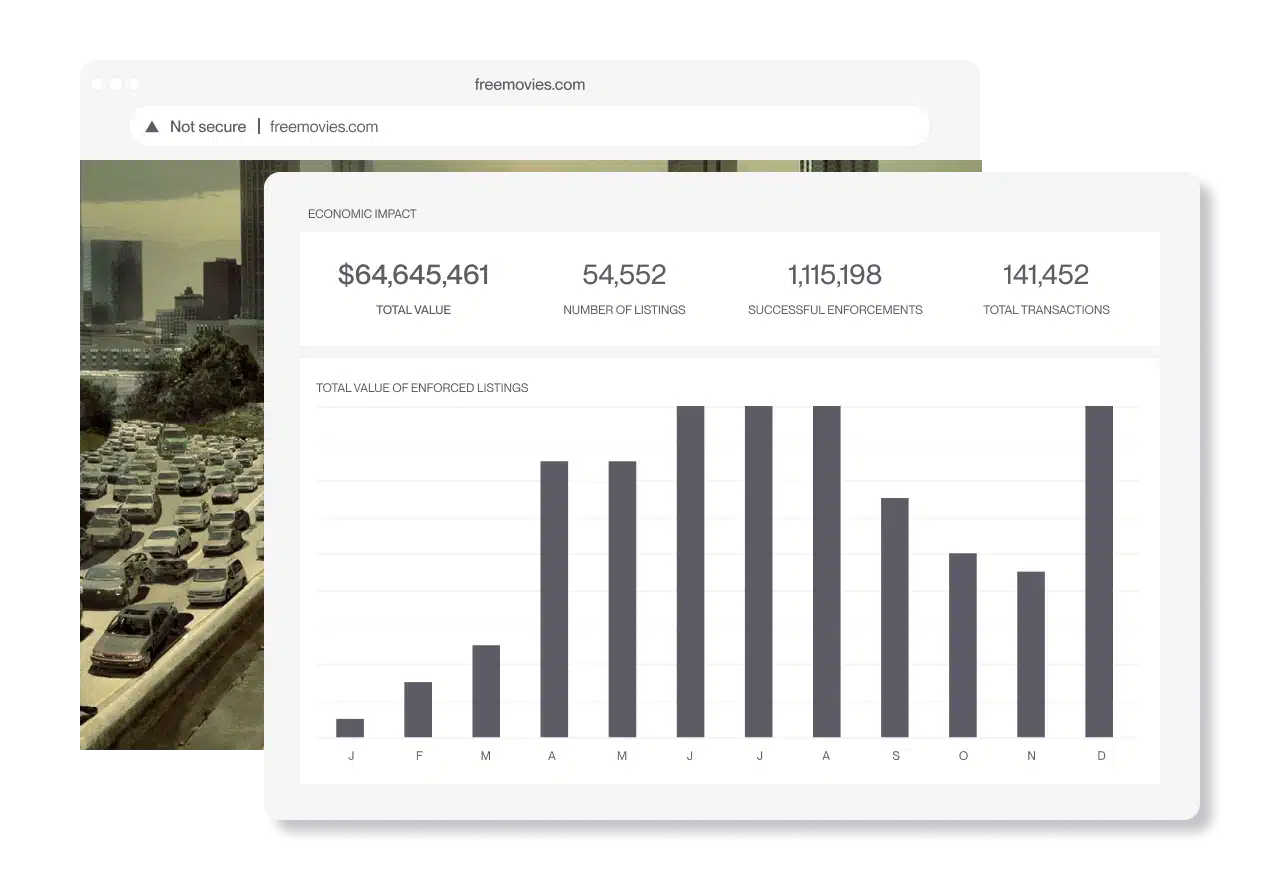
Enforcement data can reveal which assets are copied most frequently, where infringement is recurring, which cases relaunch, and how different channels respond.
Red Points processes more than 5.1 million enforcements per year across its enforcement ecosystem, helping brands move from individual manual reports to a continuous detection-and-removal process.
Request a demo to see how Red Points can help detect and remove pirated content at scale.
Frequently asked questions
How do I report a piracy website?
First collect evidence of the copyrighted work and the infringing URLs. Then determine which party can act on the content, such as the site owner, hosting provider, platform, search engine, or other service provider. Where appropriate, submit a copyright or DMCA takedown notice and track the outcome.
Serious piracy or wider IP theft can also be reported to the appropriate authorities.
Where can I report a piracy website in the United States?
The National Intellectual Property Rights Coordination Center accepts reports of intellectual-property violations, including piracy, through its Report IP Theft process.
A rights holder may also need to report directly to the host, platform, search engine, or other intermediary to pursue removal of specific online content.
How do I report a website for stealing content?
Preserve the copied page, identify your original copyrighted work, save evidence establishing the publication history or ownership, and identify the website operator or host.
You can first contact the operator where appropriate. If the material remains online, use the relevant copyright or DMCA reporting route.
Can I report a piracy website to Google?
You can use Google’s legal reporting process to request action against eligible content appearing in Google products or search results.
Removing a URL from Google Search does not necessarily take the source website offline, so report the infringement to the host or relevant platform as well when possible.
Can a DMCA takedown remove a piracy website?
A DMCA notice can seek removal or disabling of access to infringing copyrighted material. Whether it results in action against an individual URL, file, account, or a wider website depends on the infringement, service provider, and facts of the case.
If only specific content infringes, reports should normally identify that material precisely.
Do I need to register my copyright before reporting stolen content?
Not always. Copyright can arise automatically when an original copyrightable work is created and fixed in a tangible form.
Registration can become particularly important for certain legal remedies or litigation. For complex or disputed matters, obtain advice for the relevant jurisdiction.
What evidence should I collect before reporting piracy?
Collect the infringing URLs, screenshots, dates, page details, file names, uploader information, links to the original work, and evidence showing you own the copyright or are authorized to act for the owner.
Preserve evidence before contacting the infringer.
Can someone legally copy my content if they credit me?
Attribution by itself does not automatically authorize someone to reproduce copyrighted material.
However, permission, licenses, applicable exceptions, and doctrines such as fair use can affect whether a particular use infringes copyright.
What is the difference between piracy and copyright infringement?
Copyright infringement is the broader unauthorized exercise of rights protected by copyright law. Piracy commonly refers to unauthorized copying or distribution of copyrighted works, often at a commercial or large scale.
Not every copyright dispute would ordinarily be described as piracy.
Is stolen website text piracy?
Unauthorized copying of website text can be copyright infringement if the material is protected by copyright, although an isolated copied article is more commonly described as content theft or copyright infringement than as a piracy website.
The enforcement steps—evidence collection, identifying the recipient, and submitting a copyright complaint—can nevertheless overlap.
Can I report pirated content without knowing who owns the website?
Yes. If the operator cannot be identified, investigate the hosting provider, platform, CDN, registrar, search engine, or another intermediary connected to the content.
The appropriate reporting route depends on which provider has the ability and legal basis to act.
What if the piracy website ignores my complaint?
Escalate to the appropriate intermediary, such as the host or platform, and use a formal copyright process where applicable.
You can also pursue search de-indexing and, for serious piracy, consider reporting to relevant enforcement authorities or seeking legal advice.
How can brands find piracy websites automatically?
Anti-piracy monitoring systems can search websites, search engines, platforms, file-sharing services, and other online channels for likely copies of protected assets.
Automated detection should be paired with validation because not every match represents unauthorized use.
What should I do if pirated content keeps coming back?
Track repeat URLs, uploaders, domains, hosts, and other identifiers instead of treating every reupload as an unrelated incident.
Recurring piracy usually requires continuous detection and enforcement rather than periodic manual searches.