

Every day, brands and creators find their content going viral on TikTok on someone else’s account. With tens of millions of videos uploaded to the platform daily, no original work is automatically safe. If someone has stolen your content, a DMCA takedown is the most direct legal tool available to get it removed.
This guide covers how to file a TikTok DMCA takedown correctly, what to do when requests are rejected or disputed, and how to scale enforcement when violations keep coming.
TL;DR
- A TikTok DMCA takedown is a formal copyright removal request submitted through TikTok’s online form at tiktok.com/legal/report/Copyright
- You must be the rights owner or an authorized agent to file, and you need clear documentation of both your original content and the infringing video URL
- TikTok typically processes valid requests within three business days
- Rejected claims can be resubmitted with stronger evidence; approved removals can be disputed by the reported user
- Reposts and re-uploads can multiply within hours of a viral video. Each new instance requires a separate takedown filed at the new URL, which is why single filings rarely resolve ongoing infringement
What is a TikTok DMCA takedown?
A TikTok DMCA takedown is a formal request submitted to TikTok asking the platform to remove content that infringes on your copyright. Under the Digital Millennium Copyright Act, TikTok is legally required to act on valid notices to maintain its safe harbor protections. The process is handled entirely through TikTok’s online copyright report form.

What qualifies as copyright infringement on TikTok?
Content qualifies as copyright infringement on TikTok when someone uses your original, protected work without permission and without a valid legal exception. TikTok’s Intellectual Property Policy allows rights holders to report unauthorized use of videos, music, photos, scripts, and sound clips.
Content types TikTok will consider for removal include:
- Full or partial video reposts
- Music tracks used without a license
- Photos used in videos or as profile images
- Written scripts or original text
- Sound clips from original recordings
Does TikTok’s DMCA process apply outside the United States?
The DMCA is a US law, but TikTok applies similar copyright removal procedures globally. Rights holders in other countries can use the same form. TikTok also references equivalent laws in other jurisdictions and considers regional legal frameworks when reviewing reports.
What content is protected by fair use on TikTok?
Fair use allows limited use of copyrighted material for commentary, criticism, parody, and education, and TikTok considers this before acting on a report. Common examples that may qualify include reaction videos, review content, music remixes that add new creative elements, and duets that clearly transform the original. When deciding whether to file a takedown, consider whether the content adds new meaning, how much of the original it uses, and whether it could replace demand for the original.
Filing against content that qualifies as fair use weakens your credibility for future claims, so review carefully before submitting.
How should you prepare before filing a TikTok DMCA takedown?
Before starting TikTok’s form, gather your original content documentation and the direct URL to the infringing video. Submitting an incomplete or vague report is the most common reason claims are delayed or rejected, and having everything ready before you open the form speeds up the process significantly.
Prepare the following before you start:
- Screenshots of your original content, including timestamps and platform URLs
- Any copyright registration certificates (helpful but not required)
- The direct URL of the infringing TikTok video
- A signed authorization letter if you are acting as an agent on behalf of the rights holder
Tips to strengthen your evidence:
Save all evidence in an organized folder so it is easy to reference during submission and for any follow-up TikTok requests
Take full-page screenshots of both the original and the infringing content, making sure usernames and timestamps are clearly visible
Document any pattern of repeated posts from the same account, since this supports future escalation
How to file a TikTok DMCA takedown step-by-step
Filing a TikTok DMCA takedown requires completing the platform’s official copyright report form, which walks you through contact information, proof of ownership, and the infringing video URL. Most correctly completed forms result in a decision within three business days.
To start your takedown, go to TikTok’s official copyright report form.
Complete TikTok’s DMCA takedown form
When you open TikTok’s reporting form, you will first be asked to verify an email address. Once verified, choose the type of infringement you are reporting and indicate whether you are the rights owner or an authorized agent.
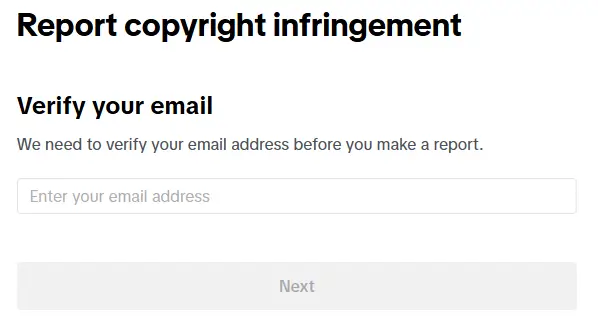
The form then asks for the following:
Contact information
Enter your full name, mailing address, phone number, and email address. TikTok may use this information to follow up, and it may be shared with the reported account.
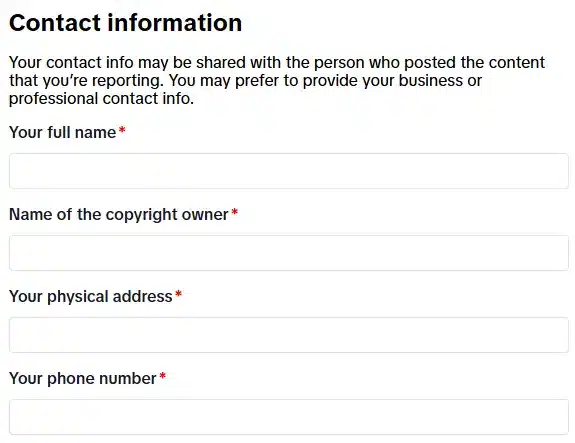
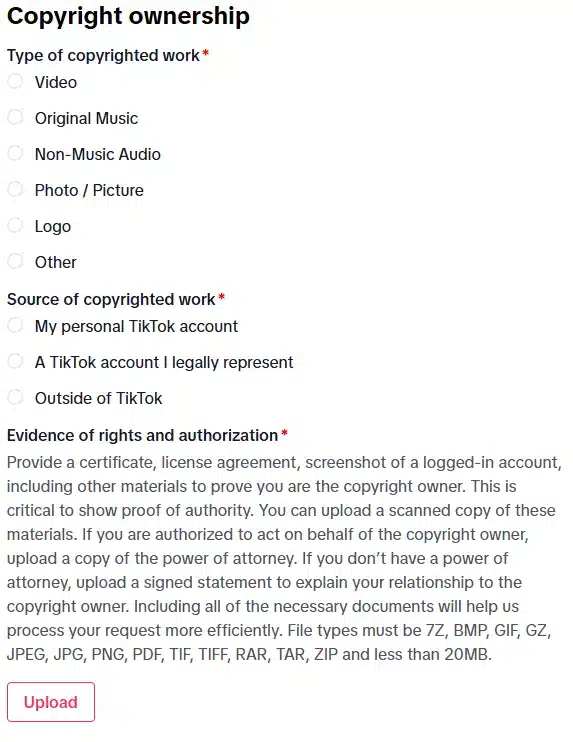
Copyright ownership
Describe the original content being infringed and upload documentation proving ownership. This can be a copyright registration certificate, timestamps showing original publication, or direct links to the original work. If you are acting on behalf of a rights holder, include a signed authorization letter or power of attorney.
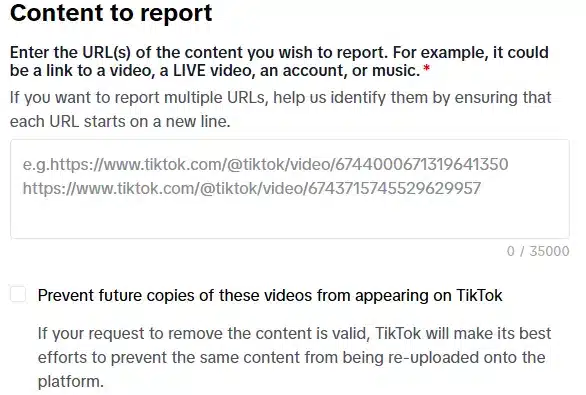
Content to report
Paste the direct URL to the infringing TikTok video. Double-check the link before submitting.
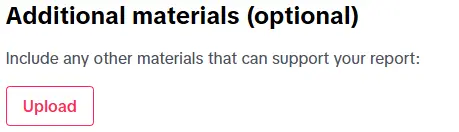
Additional material
Include any supporting evidence: screenshots, side-by-side comparisons, original upload dates, or any other context that strengthens the claim.
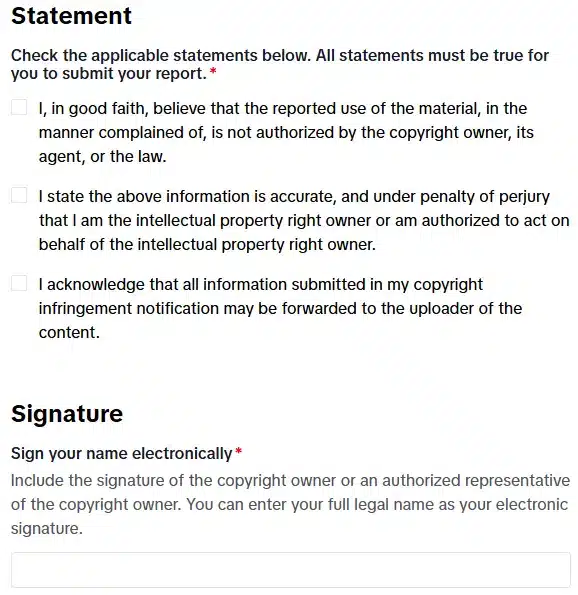
Statement and signature
Review all your information carefully, then sign electronically to confirm your claim is accurate and made in good faith. Intentionally submitting a false report can carry legal consequences under DMCA Section 512(f).
Submit and track your request
Click Submit. You should receive a confirmation email once your form is accepted. Monitor your inbox for status updates or any follow-up questions from TikTok’s intellectual property team.
What happens after you file a TikTok DMCA takedown?
After submission, TikTok’s intellectual property team reviews the claim. Most cases are processed within three business days, though incomplete submissions can cause delays. If TikTok needs more information, respond promptly to keep the process moving.
Submitting a takedown is not the end of the process on TikTok. Viral content spreads quickly, and once a video gains traction, re-uploaders often download, duet, stitch, or reupload it across multiple accounts, exploiting TikTok’s remix features to spread copies faster than a single takedown can catch them. That means one removal may be followed by several more violations, and brands should expect to monitor for repeat uploads rather than treat a single takedown as the end of the process.
Manual monitoring across an active platform is difficult to sustain. An automated monitoring tool can scan TikTok continuously and flag reposts as they appear, so you can submit new takedowns without searching manually.
If your request is approved
TikTok removes the infringing content and notifies the reported account, including your contact details. The reported user then has the option to dispute the removal.
How do disputes and counterclaims work?
A dispute means the person whose content was removed believes the takedown was filed in error. If TikTok accepts a valid counter-notification, the content may be reinstated. If this happens, submit a new DMCA takedown with updated URLs and any additional evidence that strengthens your ownership claim. Persistent infringers may require escalation beyond platform-level reporting.
If your request is rejected
TikTok may reject a claim if the evidence of infringement is insufficient, if the content appears to fall under fair use, or if required fields were incomplete. Review TikTok’s response carefully, identify the specific gap, and resubmit with corrected or stronger documentation.
What are the most common mistakes that weaken TikTok DMCA takedown requests?
The most frequent reason TikTok DMCA takedowns fail is incomplete or inaccurate submissions. Missing proof of ownership, wrong video URLs, and claims against content that qualifies as fair use are all common enough to address before you submit.
Mistakes to avoid:
- Missing ownership documentation. Always include clear proof that you created or legally own the reported content.
- Incorrect or broken video URLs. Copy and test the direct link to the infringing video before pasting it into the form.
- Claiming fair use content. Filing against remixes, reaction videos, or commentary that clearly transforms the original will hurt your credibility and future claims.
- Vague descriptions. Be specific about which portion of your work was used and how.
What can you do if a TikTok DMCA takedown fails?
If TikTok continues to reject your claim or the same infringer keeps reuploading your content, several options remain available outside the standard DMCA process.
- TikTok’s “Report a Problem” tool. TikTok’s general feedback form can route you to additional support paths depending on the specific issue.
- Direct legal action. A cease and desist letter sent to the infringer, or engagement with an IP attorney, can escalate the matter through formal legal channels.
- Third-party enforcement services. Automated DMCA takedown services like Red Points monitor TikTok at scale and can handle repeated violations more efficiently than manual reporting.
How does Red Points help brands remove stolen content from TikTok at scale?
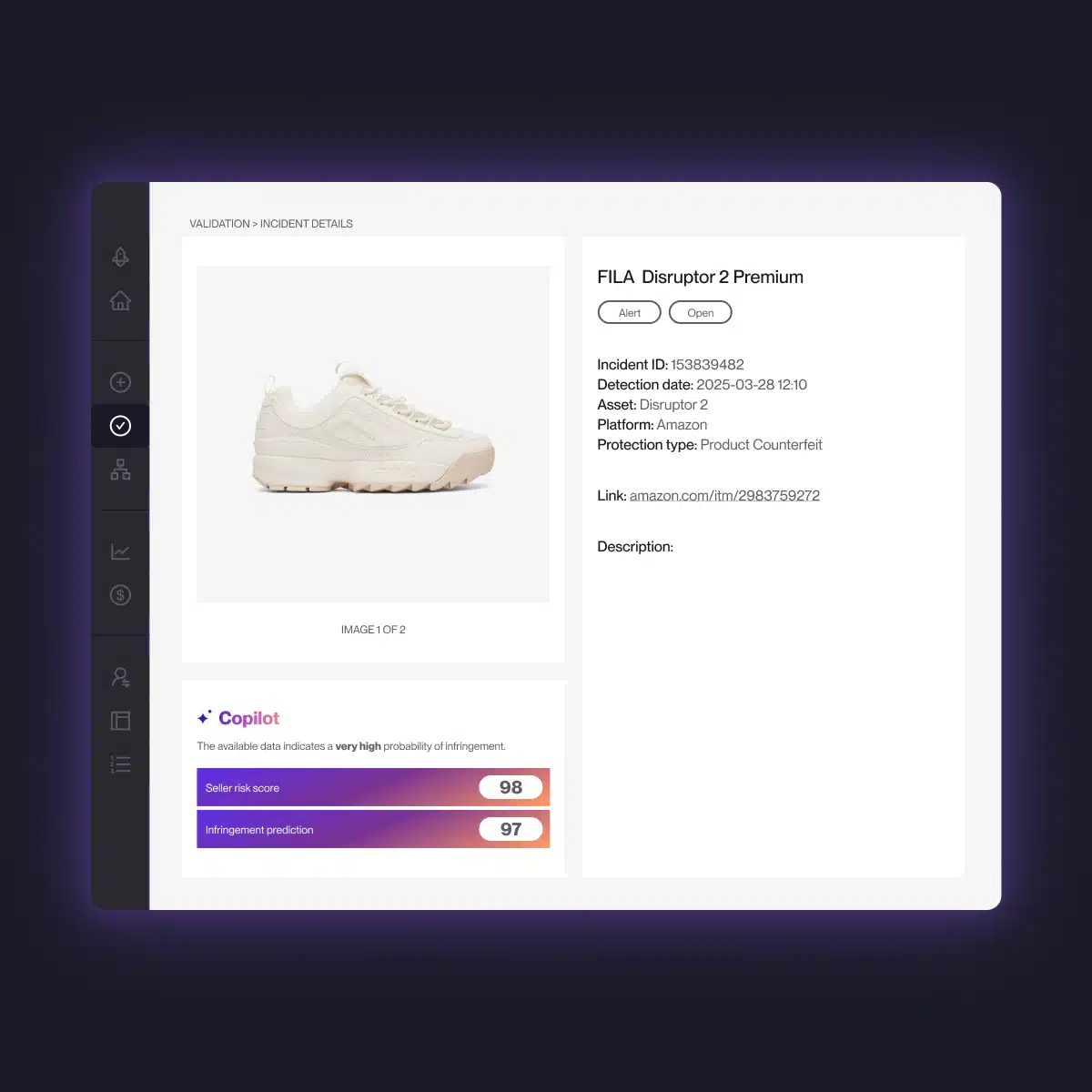
Red Points automates the detection and removal of stolen TikTok content, replacing manual reporting with continuous AI-powered monitoring that catches violations as they appear, across any number of accounts and posts.
One viral video can become dozens of reposts within hours. Manual reporting works for isolated cases, but it doesn’t scale. Red Points is built for the volume and speed TikTok demands.
What Red Points does for TikTok enforcement:
Automated detection and takedowns. Red Points’ AI scans TikTok continuously, identifies stolen content, and initiates removal requests without requiring manual review at each step.
24/7 monitoring. The platform runs around the clock, so reposts are caught and reported as soon as they appear, not discovered days later during a manual audit.
Cross-platform coverage. TikTok is one part of a broader enforcement picture. Red Points monitors across social platforms, marketplaces, websites, and ad networks, adapting to regional laws and languages.
Schedule a demo to see how Red Points handles TikTok enforcement at scale.
Frequently asked questions about TikTok DMCA takedowns
How long does a TikTok DMCA takedown take?
TikTok typically processes valid copyright reports within three business days. Claims with missing information or incomplete evidence often take longer because TikTok may request additional details before making a decision.
What happens if TikTok rejects my DMCA takedown?
If TikTok rejects your request, review the reason provided in their response. Common causes are insufficient ownership documentation, an incorrect video URL, or a determination that the content qualifies as fair use. You can resubmit with corrected or stronger evidence.
Can I file a TikTok DMCA takedown if I am not based in the United States?
Yes. TikTok accepts copyright infringement reports from rights holders worldwide. The DMCA is US law, but TikTok applies its copyright policy globally and considers local equivalents in other jurisdictions when reviewing claims.
What is the difference between TikTok’s in-app report and a DMCA takedown?
The in-app report is a general community guidelines tool that covers a range of violations, including spam, harassment, and misinformation. A DMCA takedown is a formal legal request specifically for copyright infringement and requires documentation of ownership. DMCA takedowns carry legal weight that in-app reports do not.
Can someone dispute or reverse a TikTok DMCA takedown?
Yes. After TikTok removes content in response to a DMCA notice, the reported user can submit a counter-notification claiming the removal was in error. If TikTok accepts the counter-notification, the content may be reinstated. If this happens, you can file a new takedown with updated information or pursue legal action directly against the infringer.
How do I stop someone from repeatedly reposting my content on TikTok?
Repeat offenders require more than a single takedown. Document each new violation with a fresh URL and submit a new report each time. You can also ask TikTok to prevent future copies of the same video from reappearing. For ongoing or high-volume infringement, automated monitoring tools detect reposts faster than manual searching and can file additional takedowns without manual intervention for each case.
Does TikTok’s copyright process cover content stolen from other platforms?
Yes. If someone takes your original video from YouTube, Instagram, or any other source and posts it to TikTok without permission, you can file a DMCA takedown. The content’s original platform does not affect TikTok’s ability to process the removal request. You will need to demonstrate ownership of the original work regardless of where it was first published.