


Counterfeiters no longer operate through isolated listings. They move across marketplaces, ads, social platforms, fake websites, AI shopping results, and now deepfake video.
Red Points’ technology has evolved around that reality: helping brands detect, prioritize, validate, and remove threats as they change. This guide walks through the major Red Points features that support that work, starting with the most recent launches.
How these features fit together
Red Points’ product development follows one clear direction: helping brands move from reactive takedowns to smarter, more scalable protection.
The features in this guide fall into five connected areas:
- Detection: finding infringements through image recognition, fake-known images, Vision AI, AI Commerce Protection, and Deepfake Protection.
- Prioritization: helping teams focus on the sellers and incidents most likely to cause harm through Seller Risk Score, Custom Tags, and related workflows.
- Seller intelligence: connecting accounts, listings, and sellers through Seller Lists, Clustering Technology, and Actor Networks.
- Enforcement visibility: giving teams clearer evidence, status, and audit trails through dashboards, Document Management, and Enforcement Log.
- Coverage expansion: extending protection into new channels and markets, including domestic China platforms, AI shopping surfaces, and executive impersonation.
The result is not one standalone tool. It is a platform that keeps adding context around each threat, so teams can understand what is happening, why it matters, and what action to take next.
Deepfake protection (July 2026)
What it helps brands do: Detect and remove AI-generated videos that impersonate executives, public figures, or other recognizable representatives before they can be used to run scams.
Deepfake impersonation has moved beyond politicians and global celebrities. Executives, athletes, artists, influencers, and regional public figures can now be realistic targets, especially when scammers use video to make a fake endorsement, fake investment promotion, or fraudulent request look credible.
Red Points’ Deepfake Protection is designed to detect AI-generated videos that impersonate protected individuals across TikTok, Instagram, Facebook, X, and YouTube, covering both paid ads and organic content.
The feature combines discovery agents with facial recognition, voice recognition, behavioral analysis, and language models to confirm both who appears in a video and what they are being made to say. A video is only actionable when the identity, context, and intent point to harmful impersonation.
Once a case is confirmed, Red Points submits the appropriate enforcement request through the relevant platform route. The goal is to reduce the window between a fake video appearing and the brand becoming aware of it.
Enforcement log (March 2026)
What it helps brands do: See a complete, timestamped record of enforcement activity, from first action to final outcome.
Enforcement work involves many steps that are easy to lose track of: reports submitted, documents attached, platform responses, reminders, escalations, pushbacks, and final decisions.
Red Points’ Enforcement Log turns that background activity into a chronological record inside the platform. Instead of seeing only the final status of a case, brand protection teams can understand what happened, when it happened, and which action moved the case forward.
That visibility matters at scale. A team managing thousands of cases across marketplaces, domains, social platforms, ads, and websites needs more than a final takedown count. It needs a way to understand process quality, response times, recurring delays, and enforcement value.
The Enforcement Log also helps teams communicate internally. Legal, ecommerce, customer support, and leadership can see the work behind each outcome without relying on scattered emails or manual updates.
Document management (October 2025)
What it helps brands do: Centralize IP documents so enforcement teams can access the right proof of ownership when they need it.
Brand protection depends on evidence. But many teams still manage trademark certificates, copyright registrations, authorization letters, and other IP documents across shared drives, spreadsheets, email threads, and local folders.
Red Points’ Document Management brings those documents into the platform, connecting IP rights more directly to enforcement workflows. That means teams can find and use the right documentation faster when a marketplace, social platform, registrar, or other provider asks for proof.
The feature also helps brands stay ahead of expiration dates, reducing the risk that an outdated or missing document slows down enforcement at the worst possible moment.
For teams operating across countries, product lines, and rights types, the value is straightforward: fewer delays, cleaner ownership records, and a more reliable foundation for takedowns.
AI commerce protection (October 2025)
What it helps brands do: Detect counterfeit listings, impersonating links, and fraudulent sources surfaced through AI shopping and discovery experiences.
AI assistants are becoming product discovery channels. Shoppers can ask tools like ChatGPT for recommendations, compare products, review visual results, and follow links to merchant websites or marketplaces.
That creates a new risk. If a counterfeit listing, impersonating website, or fraudulent social page is surfaced through an AI recommendation, the shopper may trust it more because it appears inside a guided discovery flow.
Red Points’ AI Commerce Protection monitors AI-powered shopping experiences, beginning with ChatGPT. It is designed to identify infringing product listings, redirected marketplace links, and source links that point to impersonating websites or social pages.
This should be understood as an additional discovery layer, not a replacement for marketplace monitoring. If an infringing listing or standalone website link appears through an AI assistant, the risk still lives on the underlying source too.
Confirmed incidents are reported to the AI platform and to the underlying platform or website.
Vision AI (October 2025)
What it helps brands do: Understand why an image, logo, product, or piece of text was flagged as suspicious.
Image-based detection has always been important in brand protection because counterfeit sellers often avoid using obvious brand names in titles or descriptions. They rely instead on product photos, cropped logos, altered packaging, or visual similarity.
Red Points’ Vision AI makes that detection process more transparent. Instead of showing only that a listing was flagged, Vision AI shows the visual evidence behind the match: the logo detected, the text read through OCR, the image pattern recognized, or the product feature that triggered the match.
That matters for trust. Brand protection teams need to move quickly, but they also need to understand why an incident deserves action. Vision AI gives validators and customers more context before they confirm, discard, or prioritize a case.
It also helps teams spot tactics. If sellers repeatedly crop logos, blur packaging, rotate images, or reuse the same visual patterns, those behaviors become easier to recognize and act on.
Actor networks (October 2025)
What it helps brands do: Identify when multiple sellers, accounts, listings, or websites are connected to the same bad actor.
Infringers rarely rely on a single account. One operator may sell across marketplaces, run social accounts, use fake ads, and maintain standalone webshops, all under different names.
Red Points’ Actor Networks connects shared signals across channels to reveal relationships that would be hard to see from individual incidents alone. Those signals can include seller information, repeated patterns, contact details, listing behavior, and other data points that suggest separate accounts may belong to the same operation.
This changes how teams prioritize. Instead of removing one listing at a time, brands can identify the actors causing the most harm and focus enforcement on the broader network behind them.
Actor Networks also supports offline investigations. When legal teams, investigators, or enforcement partners need to understand who is behind an operation, connected seller intelligence can provide a more useful starting point than isolated listing data.
Domestic China protection (January 2025)
What it helps brands do: Extend monitoring and enforcement into mainland China’s domestic digital ecosystem.
China has its own platform environment, consumer behaviors, language patterns, and enforcement processes. Many international brand protection programs monitor global marketplaces but still have limited visibility into domestic Chinese platforms.
Red Points’ Premium Domestic China Protection was built to close that gap. It extends detection and enforcement into mainland China platforms where infringement can be difficult to access, interpret, and act on from outside the country.
This matters because infringement in China is not limited to international-facing platforms. Counterfeiters and unauthorized sellers can operate inside local marketplaces, social commerce channels, and app ecosystems that require specific coverage, language capabilities, and enforcement knowledge.
For global brands, the value is consistency. A China-specific protection layer helps teams connect local activity to the broader global program, so China does not remain a separate blind spot.
Executive impersonation protection (November 2024)
What it helps brands do: Detect and remove fake executive profiles used to build trust, request payments, or manipulate employees and partners.
Executive impersonation is different from product counterfeiting. It does not start with a fake item. It starts with a fake identity.
Scammers create fraudulent social profiles that impersonate CEOs, CFOs, founders, and other senior leaders. Those accounts can then be used to send false instructions, request sensitive information, push employees toward a payment, or give credibility to a wider scam.
Red Points’ Executive Impersonation Protection focuses on fraudulent profiles impersonating executives and senior leaders across social platforms. The goal is to detect and remove those profiles before they can exploit internal trust or damage the company’s reputation.
This is also where the difference from Deepfake Protection is important. Executive Impersonation Protection focuses on fake profiles and identity misuse. Deepfake Protection extends that protection into AI-generated video and voice-led impersonation.
Together, they protect leadership identity across both profile-based and content-based threats.
Custom tags (November 2024)
What it helps brands do: Classify incidents in a way that matches the team’s own priorities, workflows, and reporting needs.
Every brand protection team works differently. One team may organize incidents by product line. Another may care most about geography, price level, urgency, customer safety, or whether an incident is part of a larger investigation.
Red Points’ Custom Tags gives teams a flexible way to label and filter incidents using the criteria that matter to them.
That structure makes large case queues easier to manage. Teams can quickly identify incidents that need urgent review, group related cases, align internal reporting, and spot patterns that would otherwise stay buried in a long list of detections.
Custom Tags also supports more consistent workflows. When tags are applied through rules, teams can make sure incidents are classified in the same way across reviewers, regions, and channels.
For high-volume programs, that small layer of organization can make a big difference: less manual sorting, clearer prioritization, and better visibility into what is happening behind the scenes.
Fake-known images (September 2024)
What it helps brands do: Flag listings that reuse images already associated with counterfeit or infringing activity.
Counterfeiters reuse images because it works. The same edited product photo, cropped logo, or fake listing image can appear across different sellers, marketplaces, and countries.
Fake-known Images turn that repetition into a detection advantage. When an image has already been associated with counterfeit activity, Red Points’ system can recognize when it appears again and flag the new incident faster.
This is especially useful when sellers try to avoid text-based detection. A listing may not include the brand name, product name, or obvious keywords, but the image can still reveal what the seller is offering.
Fake-known Images also helps reduce repetitive manual review. If a visual pattern has already been confirmed as suspicious, teams should not need to rediscover that signal every time it reappears.
It connects directly to the broader evolution of Red Points’ visual technology: image recognition identified the visual match, Fake-known Images learned from repeated abuse, and Vision AI later made those visual signals easier to understand.
Seller risk score (January 2024)
What it helps brands do: Prioritize the sellers most likely to cause harm, instead of treating every seller the same.
Not every seller deserves the same level of attention. Some sellers are low-volume, one-off, or unlikely to create meaningful risk. Others repeatedly infringe, operate at scale, or appear across higher-risk channels.
Seller Risk Score helps teams separate those cases.
The feature evaluates sellers using signals such as confirmed infringement history, seller reach, stock levels, reviews, transactions, and platform risk. The result is a score that helps teams identify which sellers should be reviewed or escalated first.
This changes the starting point for enforcement. Instead of working through incidents in the order they arrive, teams can focus on sellers with the greatest potential impact on revenue, consumer trust, or brand reputation.
Seller Risk Score also supports deeper investigations. A high-risk seller may be worth connecting to other accounts, reviewing for repeat behavior, or adding to a more structured workflow through seller lists, tags, or network analysis.
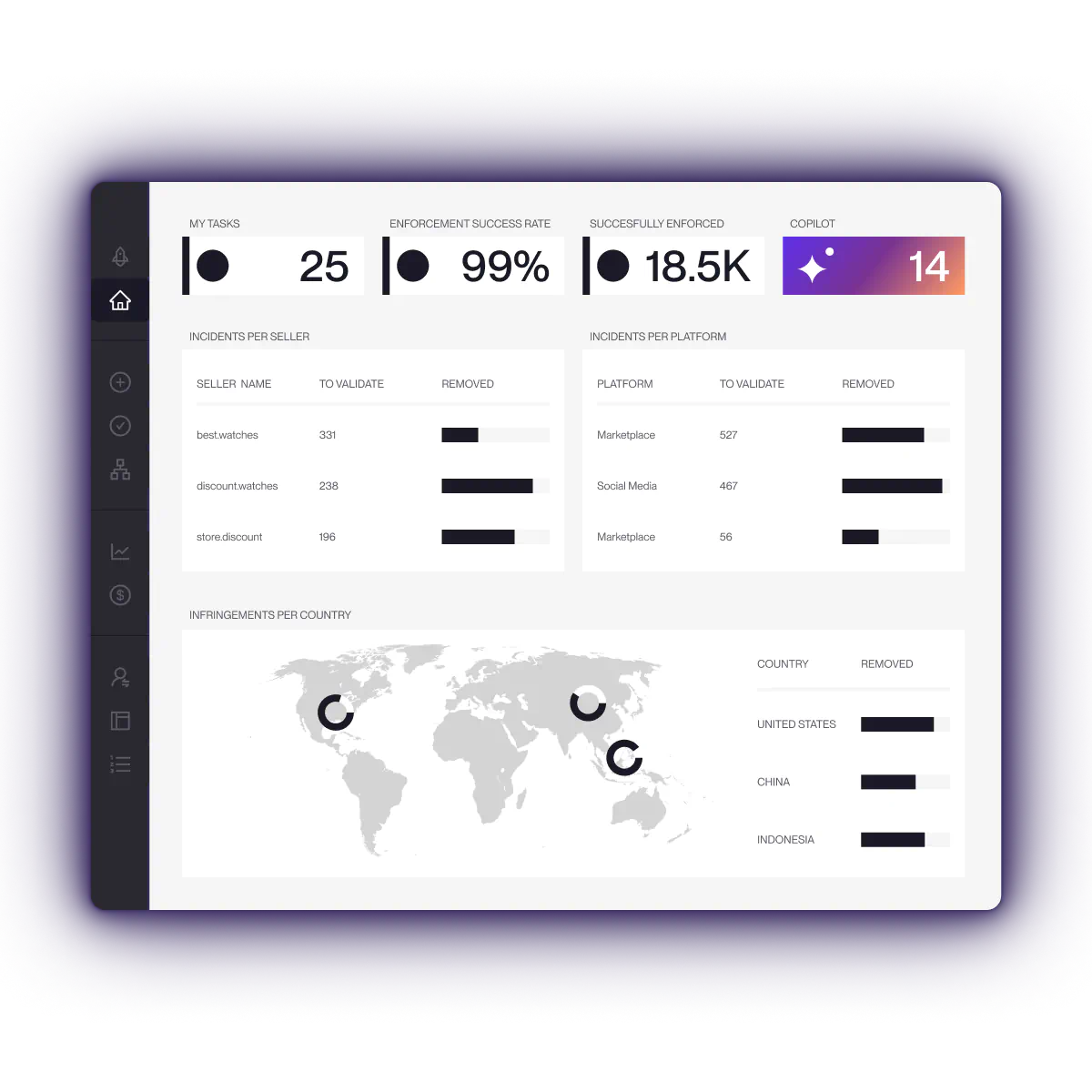
Anti-fraud dashboards (May 2023)
What it helps brands do: Turn enforcement data into clearer reporting, trend analysis, and operational insight.
Brand protection programs generate a lot of data: detections, validations, removals, non-enforceable cases, seller activity, channel performance, and estimated impact.
The challenge is making that data useful.
Red Points’ anti-fraud dashboards were designed to give teams clearer views of what is happening across their program. Instead of relying on exported spreadsheets or manual reporting, teams can review visual dashboards that answer common questions: where incidents are coming from, what is being enforced, where cases are blocked, and which trends need attention.
This supports better decision-making. If one marketplace is generating more non-enforceable incidents, the team can investigate why. If one product line is being targeted more aggressively, the team can adjust priorities. If enforcement is slowing in a specific channel, the team can identify the bottleneck.
Dashboards do not replace enforcement work, but they make it easier to understand whether the program is moving in the right direction.
Seller lists (March 2023)
What it helps brands do: Classify sellers into clear groups so repeat decisions do not have to be made manually every time.
A major source of inefficiency in brand protection is re-reviewing sellers the team already knows.
Red Points’ Seller Lists helps teams classify sellers into three groups: Deny List, Watch List, and Allow List.
A Deny List is for sellers that should be enforced against quickly. A Watch List is for sellers that need closer review or investigation. An Allow List is for known legitimate sellers, distributors, or partners whose listings should not be treated as threats.
This structure saves time and reduces avoidable mistakes. Known bad actors can be handled faster, suspicious sellers can be monitored more carefully, and legitimate sellers can avoid unnecessary review.
It also helps teams maintain stronger distributor relationships. When authorized sellers are clearly recognized inside the platform, brand protection work is less likely to interfere with legitimate sales activity.
Clustering technology (February 2023)
What it helps brands do: Connect separate-looking incidents or seller accounts that may belong to the same operation.
Before Actor Networks, Red Points’ Clustering Technology helped teams move beyond individual listing takedowns by identifying links between sellers and incidents.
That matters because infringers often create new accounts when old ones are removed. If every account is treated as completely new, the brand protection team loses valuable history.
Clustering Technology cross-references infringement data to find shared patterns, such as similar seller details, repeated listing behavior, common contact information, or other signals that suggest multiple accounts may be connected.
The value is strategic. Instead of chasing isolated cases, teams can start to understand the structure behind repeated abuse.
This feature became an important step toward more advanced seller intelligence. Clustering helped identify groups. Later, Actor Networks expanded that logic into a broader view of connected sellers, accounts, platforms, and websites.
Image recognition (August 2018)
What it helps brands do: Detect counterfeit listings that rely on images rather than text.
Text-based monitoring only catches what sellers write. Counterfeiters know this, which is why many avoid obvious brand names, product names, or trademarked terms in listing titles and descriptions.
Image Recognition helps close that gap by analyzing the product photo itself.
The technology can identify copied product images, visual similarity, logo use, packaging patterns, and other image-based signals that suggest a listing may be infringing. That gives brands a way to find threats even when the listing text is vague, misspelled, or deliberately evasive.
Image Recognition became one of the foundations for Red Points’ later visual capabilities, including Fake-known Images and Vision AI. The evolution is important: first, the platform learned to detect visual matches; then it learned from images repeatedly used by counterfeiters; later, Vision AI made those signals visible and easier for customers to understand.
For brand protection teams, this changed what detection could rely on. The platform was no longer limited to keywords. It could read the visual language of infringement too.
What this adds up to
These features tell one story: online infringement keeps changing, so brand protection technology has to keep changing with it.
Red Points started by expanding what detection could see, from keywords to images. It then added better ways to prioritize sellers, classify incidents, understand repeat behavior, manage documentation, and make enforcement activity more transparent. More recent releases extend protection into AI shopping discovery, deepfake video, and China’s domestic digital ecosystem.
Across all of these features, the operating principle is the same. Red Points helps brands detect threats, understand their context, validate what should be acted on, and remove confirmed infringements through the right enforcement route.
Red Points validates potential infringements before enforcement, using the brand’s IP rights, evidence, approved rules, and known authorized sellers or distributors to avoid acting on legitimate activity.
Today, Red Points supports more than 1,300 brands globally, carries out more than 5.1 million enforcements per year, and delivers an average enforcement success rate of 94 to 95 percent. Those results are not built on one feature alone. They come from a platform that keeps adding the capabilities brands need as infringers adapt.
Request a demo to see how Red Points technology can help protect your brand across marketplaces, websites, social media, ads, AI commerce, and emerging digital channels.