

YouTube is one of the largest social networks in the world, with over 2.5 billion active users every month, and that scale makes it one of the most frequently abused platforms for copyright infringement, channel impersonation, and brand exploitation. Whether someone has copied your channel identity, reposted your videos without permission, or is using your brand to sell counterfeit products, knowing how to act is the first step to getting the damage under control.
This guide brings together everything brands and creators need to know: how YouTube’s copyright and impersonation rules work, how to report individual videos, how to take down a whole channel, and when to consider a more scalable solution.
TL;DR
- YouTube prohibits both copyright infringement and channel impersonation under its Community Guidelines.
- You can report individual videos using the flag icon directly on the video page, selecting the reason that best fits your situation, such as copyright, impersonation, spam, or misleading content.
- For copyright infringement of video content, use the YouTube copyright complaint webform or file via YouTube Studio under Copyright > New Removal Request.
- For non-video content, such as channel banners, thumbnails, logos, descriptions, or membership badges, submit a copyright claim by email to copyright@youtube.com or by fax/postal mail.
- To report a channel for impersonation, go to the channel’s About page, hover over the flag icon, select “Report user,” and choose “Impersonation.”
- YouTube reviews reports 24/7 and typically responds within 24 to 72 hours; complex cases can take longer.
- YouTube operates a three-strikes system: three violations within 90 days results in permanent channel removal.
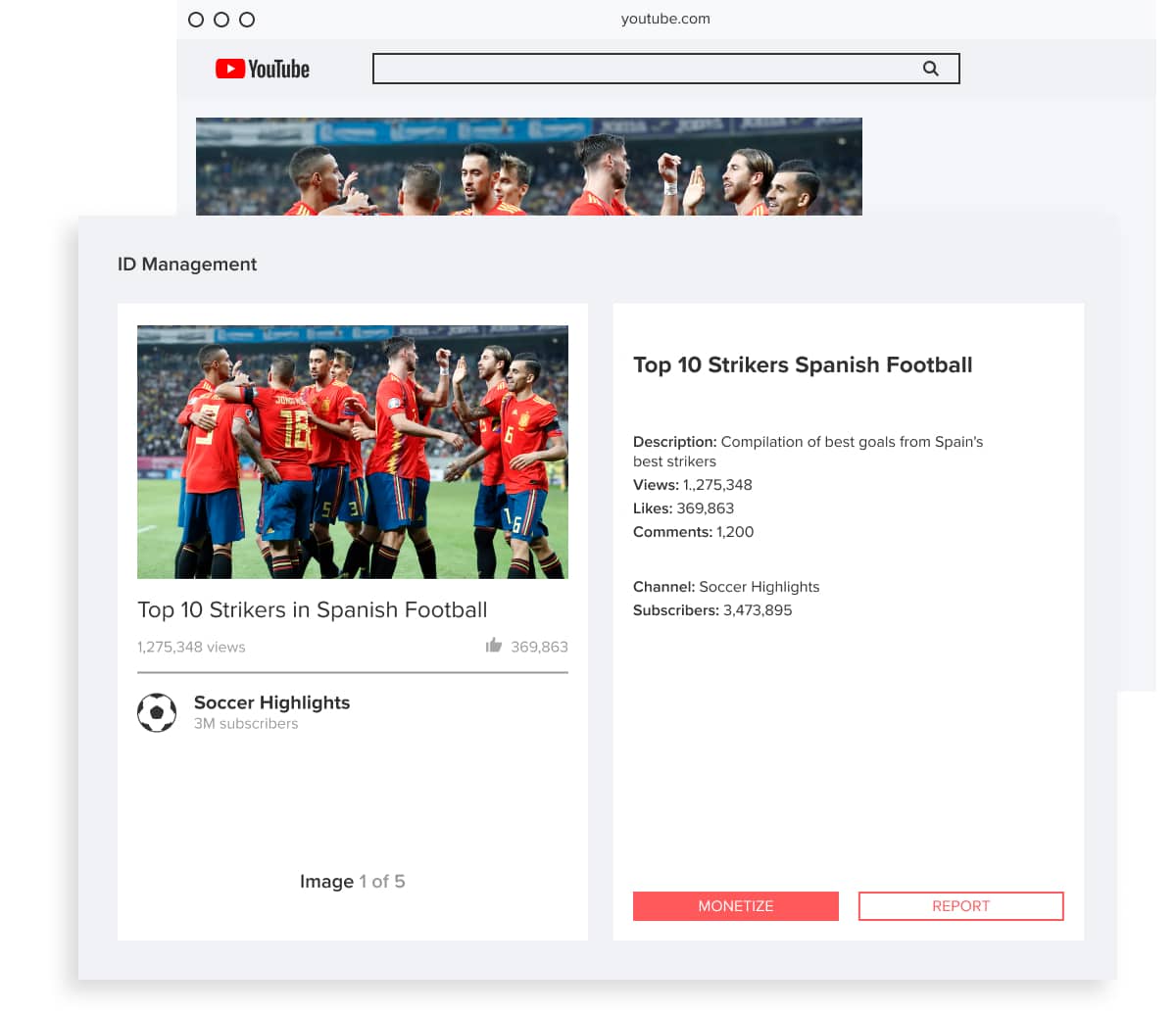
- If copyright-protected content is matched by YouTube’s Content ID system, you can choose to block it, monetize it, or track its viewership.
Why brands need to actively monitor YouTube
YouTube is one of the most visited websites in the world, second only to Google. For brands, that reach is both an opportunity and a risk. Every day, copyright infringement on YouTube occurs at enormous scale. In 2024, YouTube reported over 1 billion copyright claims through Content ID alone.
The consequences of unaddressed infringement go beyond lost views. When someone uploads videos impersonating your brand or reposts your content without authorization, you risk loss of revenue, erosion of consumer trust, diluted brand messaging, and legal fees. Online impersonators may use your channel identity to run scams, sell counterfeit goods, or spread false information, and by the time you find out, significant damage may already have been done.
Monitoring your brand on YouTube means staying ahead of bad actors, not just on your own channel, but across the entire platform.
What YouTube considers a violation
Before filing any complaint, it’s important to understand which rules apply to your situation. YouTube’s Community Guidelines cover a wide range of violations. The most relevant for brands are:
Copyright infringement. As soon as someone creates original work, such as a video, music, written script, or visual asset, they own the copyright. Posting a video on YouTube that includes someone else’s copyrighted material, such as background music, footage, logos, product videos, or branded visuals, without permission can be infringement. As the copyright owner, you have exclusive rights to monetize, publish, and reproduce your work.
Channel impersonation. According to YouTube’s impersonation policy, content designed to imitate a person or channel is not permitted. This includes channels that copy another channel’s profile picture, banner, or overall look and feel, even if they are not 100% identical, as long as the intent to deceive is apparent. Specific examples YouTube prohibits include using another person’s name, username, image, or trademark to pass as them; creating channels that pretend to be fan accounts but re-upload another’s content; and posting comments on other channels as if you are the real person being impersonated.
Other violations that can warrant removal include privacy violations, child safety violations, spam and misleading content, hateful content, and incitement of violence.
A note on fair use
Before submitting a copyright complaint, check whether fair use applies. Courts weigh four factors: the purpose and character of the use, the nature of the copyrighted work, the amount of the work used, and the effect on the market for the original. Commercial uses are less likely to qualify, but every case depends on context.
YouTube often asks copyright owners to confirm they have considered fair use before processing a removal request. You can review Google’s guidelines on copyright exceptions for more detail.
How to report a YouTube video step by step
Step 1: Identify the violating content
YouTube allows you to report videos, Shorts, thumbnails, playlists, channels, live chat messages, and comments. Start by identifying exactly what content is the problem and what rule it violates.
For brands, this may include:
- A video using your copyrighted product footage without permission.
- A fake review or tutorial using your brand name to promote counterfeit products.
- A video thumbnail using your logo or product image to mislead viewers.
- A Shorts video copying your original creative assets.
- A playlist or channel built around unauthorized reposts of your content.
Before filing, collect the URL, screenshots, upload date, channel name, and any other evidence that helps explain the violation clearly.
Step 2: Flag the video directly
The quickest route for any type of violation, including copyright, impersonation, spam, or inappropriate content, is to use YouTube’s built-in reporting tool:
- Click the three-dot menu below the video.
- Select Report from the dropdown.
- Choose the reason that best describes the violation, such as “Infringes my rights” for copyright or “Spam or misleading” for impersonation.
- Follow the on-screen prompts to specify the nature of your complaint and submit.
Because YouTube reviews a high volume of reports, it’s important that your report is as specific and accurate as possible. Avoid vague language like “this is fake” or “this is illegal.” Instead, explain exactly what is being copied, who owns the original content, and why the video is misleading or infringing.
Step 3: File a copyright removal request for video content
If your copyright-protected work has been posted without your authorization, use the formal copyright complaint webform, either directly or via YouTube Studio under Copyright > New Removal Request.
The form will ask you to:
- Specify the video or videos you want removed.
- Provide your contact information. At least one email address, physical address, or phone number is required, although including all is recommended. Note that if a video is removed for copyright infringement, your full legal name will be visible on YouTube in place of the removed video, and your primary email may be shared with the uploader.
- Choose a removal option: a standard removal request or a scheduled request. A standard request seeks an immediate copyright strike once validated. A scheduled request gives the uploader a 7-day notice period before removal, which prevents an immediate strike while still getting the content removed.
- Confirm the legal agreements and sign with your full legal name, not your company name.
You can also check Prevent copies to stop reuploads of the reported video, although this may share your email address with the uploader.
Step 4: File a copyright removal request for non-video content
The webform only handles video content. For non-video copyright infringements, such as channel banners, thumbnails, channel descriptions, logos, membership badges, and similar assets, you must submit a request by fax or postal mail or by email to copyright@youtube.com.
- Your email or letter should include, in the body, not as an attachment:
- Your contact information, including email, physical address, and phone number.
- A clear description of the copyrighted works you believe are being infringed.
- Specific URLs of the infringing content. For reference, the URL format for common content types includes: channel pages (www.youtube.com/channel/UCxxx), channel descriptions (www.youtube.com/user/xxx/about), comments (click the posted date to load the direct URL), community posts (youtube.com/post/xxx), and Shorts (youtube.com/shorts/xxx).
- These mandatory statements: “I have a good faith belief that the use of the material in the manner complained of is not authorized by the copyright owner, its agent, or the law.” And: “The information in this notification is accurate, and under penalty of perjury, I am the owner, or an agent authorized to act on behalf of the owner, of an exclusive right that is allegedly infringed.”
- Your full legal name as your signature.
How to report a YouTube channel for impersonation step by step
If someone has created a channel designed to pass as you or your brand, report it directly from the channel page.
Step 1: Go to the impersonating channel’s About tab
Open the channel that is copying your brand, name, logo, profile image, channel art, or content style. Then go to the About tab.
Before reporting, check whether the channel is genuinely impersonating your brand or whether it could be a fan account, review channel, reseller, or commentary account. YouTube usually looks for signs that the channel is trying to mislead users into believing it is the official brand, creator, or representative.
Step 2: Hover over the flag icon
On the About page, hover over the flag icon. You’ll see options including “Report user,” “Report channel art,” and “Report profile photo.”
If the impersonator is using your channel art and profile image, report those elements as well. This helps YouTube understand that the channel is not just using your name, but copying the full visual identity of your brand.
Step 3: Click “Report user”
Select “Report user” to begin the channel-level reporting process. This is different from flagging a single video. Use this route when the issue is the channel identity itself, not just one piece of content.
Step 4: Select “Impersonation” as the reason
Choose “Impersonation” from the list of reasons. This tells YouTube that the channel is not simply posting problematic content, but attempting to appear as another person, creator, or brand.
Step 5: Specify who is being impersonated
Use the dropdown to specify whether the channel is impersonating you or someone else. If you are reporting on behalf of a company, make sure the report clearly explains your relationship to the brand and why you are authorized to submit the complaint.
Step 6: Add specific notes and submit
Add notes that describe the impersonation as specifically as possible. Mention which assets are being copied, such as channel art, profile image, video content, video titles, descriptions, thumbnails, logo usage, product imagery, or brand name.
The more specific you are, the easier it is for YouTube to understand the risk. For example, instead of writing “This channel is pretending to be us,” write: “This channel is using our official logo, copying our profile image, reposting our product videos, and linking users to unauthorized sellers.”
Click Submit.
YouTube will review the report and, if it violates Community Guidelines, will remove the content and notify the channel owner. A first infraction typically results in a warning; subsequent violations lead to strikes. Three strikes within 90 days result in permanent channel termination.
Can you get an entire YouTube channel taken down?
Yes. Channels are subject to the same three-strikes rule as individual videos. In addition, YouTube can remove a channel outright, without waiting for three strikes, in cases of severe violations such as predatory behavior or channels that are clearly and exclusively designed to breach Community Guidelines, such as obvious spam or pure impersonation channels.
If your goal is to take down an entire YouTube channel, not just one video, you need to build a stronger case than you would for a single takedown. YouTube needs to understand that the channel itself is violating policy, either through repeated copyright infringement, impersonation, misleading behavior, scams, or spam.
Step 1: Document the channel violations
Start by collecting evidence. Save the channel URL, screenshots of the profile image and banner, links to infringing videos, descriptions, comments, playlists, and any external links that send users to counterfeit products, phishing pages, or unauthorized stores.
If the channel is copying your official brand presence, capture side-by-side evidence showing the original channel or brand asset next to the impersonating version.
Step 2: Determine which reporting route applies
Not every channel takedown follows the same route. If the channel is reposting your copyrighted videos, the copyright removal process is the strongest path. If the channel is pretending to be your brand, use the impersonation reporting flow. If it is promoting scams, misleading users, or driving traffic to counterfeit goods, use the spam or misleading content reporting route.
In many cases, the same channel may violate multiple policies. For example, a fake brand channel may use your logo, repost your videos, and direct users to counterfeit listings.
Step 3: File reports for the individual videos or assets
If the channel contains multiple infringing videos, report the individual videos first. Each confirmed violation can contribute to the strike count. For copyright infringement, use the formal copyright removal request rather than relying only on the standard video flagging tool.
For copied banners, thumbnails, logos, descriptions, or profile images, submit a non-video copyright complaint by email, fax, or postal mail.
Step 4: Report the channel directly
Once you have reported the individual videos or assets, report the full channel from its About page. Use the “Report user” flow and explain that the issue affects the entire channel, not just one isolated upload.
Your notes should make the pattern clear: repeated reposting, copied branding, misleading channel identity, unauthorized use of copyrighted material, or links to scams or counterfeit goods.
Step 5: Track the outcome and escalate if needed
YouTube will review the report and email you with the outcome. If the channel continues uploading infringing content after takedowns, continue documenting new violations and submit additional reports. Repeated confirmed violations can lead to strikes, and three strikes within 90 days result in permanent channel termination.
There is no specific number of reports required to remove a channel. Volume alone does not trigger automatic removal, but well-documented repeated violations make the case stronger.
How YouTube handles takedown requests
YouTube reviews reports 24/7 and typically processes copyright removal requests within 24 to 72 hours. Reported content is not automatically taken down during the review period. YouTube performs a manual review for each complaint. Once the review is complete, you’ll receive an email with the outcome. In more complex cases, YouTube may request additional information from you before proceeding.
If the violation is confirmed, the uploader has 7 days to remove the offending content themselves when the copyright owner chooses a scheduled request. If they don’t comply, YouTube removes it and issues a copyright strike against the channel. You can monitor the status of your reports in your Report history.
There is no specific number of reports required to trigger removal. Multiple reports for the same content may expedite review, but YouTube reviews each complaint individually. No content is automatically removed due to volume alone.
YouTube’s copyright tools: Copyright Match Tool and Content ID
Beyond manual reporting, YouTube offers two tools for rights holders who deal with infringement at higher volume.
Copyright Match Tool
Available to channels that have already had a copyright claim approved, the Copyright Match Tool automatically scans YouTube uploads for videos that are identical or substantially similar to yours. You can review potential matches in YouTube Studio and take one of three actions: archive the match, request removal, or contact the channel directly via a pre-written message.
A match does not automatically equal infringement. It’s your responsibility to verify whether a copyright exception applies before acting.
Content ID
Content ID is a more powerful tool for YouTube Partners that scans all uploads against a database of reference files submitted by rights holders. When a match is detected, you can choose to block the video, monetize it by running ads against it and collecting revenue, or track its performance.
Content ID is only available to rights holders who meet YouTube’s specific eligibility criteria. You must own exclusive rights to a substantial body of original material that is frequently uploaded to YouTube. According to YouTube’s Copyright Transparency Report, more than 90% of Content ID claims in 2024 resulted in rights holders choosing the monetize option rather than removal.
How Red Points helps brands on YouTube
Manual reporting works for one-off incidents, but it quickly becomes unmanageable for brands with substantial video libraries or a significant online presence. The whack-a-mole nature of YouTube infringement, where new violations appear as fast as old ones are removed, is where automation makes a decisive difference.
Red Points’ Social Video Growth service was built specifically for this challenge. As a YouTube-certified Multi-Channel Network (MCN) and a member of Google’s Trusted Copyright Removal Program, Red Points has direct access to Content ID and operates at a scale that manual enforcement simply cannot match. The service works in three ways:
Protect. Red Points continuously monitors YouTube and Facebook for unauthorized use of your content. Using Content ID, the team identifies matches, claims infringing content, and decides whether to block, monetize, or track it based on what best serves your business. You control and protect your copyrighted content on a platform-wide basis, including revenue distribution from ad income on claimed videos.
Expand. Beyond protection, Red Points helps you grow. The team can create fresh, dynamic video content for your channel, optimize it for YouTube search, and connect you with creators and brands through Red Points’ extensive client base, turning your YouTube presence into a revenue-generating asset, not just something to defend.
Evaluate. You receive weekly channel performance summaries directly to your inbox, plus in-depth monthly reports from a dedicated Account Manager with actionable recommendations based on your audience and results. This means you always have a clear picture of how your content is performing and where opportunities lie.
For brands dealing with social media impersonation across multiple platforms, Red Points’ broader Impersonation Removal and Social Media Protection solutions extend the same automated approach beyond YouTube.
What’s next
YouTube is too large and too active to monitor manually at scale. If your brand has video content worth protecting, proactive enforcement is the only sustainable approach. Start by familiarizing yourself with YouTube’s Community Guidelines and copyright tools, file complaints for any violations you identify, and track them through your Report history.
For brands facing persistent infringement or a high volume of unauthorized content, Red Points’ Social Video Growth provides the automated monitoring, enforcement, and monetization infrastructure to stay ahead of bad actors without the manual overhead. Request a demo today and see Red Points in action.
Frequently asked questions
YouTube reviews reports 24/7 and typically responds within 24 to 72 hours for straightforward cases. Complex cases, or those requiring additional information, can take longer. If you haven’t heard back within a week, you can follow up by email, fax, or postal mail for copyright cases or re-check your Report history.
There is no fixed threshold. Multiple reports for the same content may help expedite the process, but YouTube manually reviews each complaint individually. Even a massive number of reports does not result in automatic removal.
Yes. YouTube’s three-strikes system means that three Community Guidelines violations within any 90-day period result in permanent channel termination. A channel can also be removed outright, without three strikes, for severe violations such as predatory behavior or channels that exist solely to spam or impersonate others.
Each confirmed violation of YouTube’s Community Guidelines results in a “strike” against the channel. Three strikes within 90 days lead to permanent channel removal. Anyone who receives a copyright-related strike must also complete a mandatory session at YouTube’s Copyright School.
A standard removal request seeks an immediate copyright strike against the uploader once validated. A scheduled request gives the uploader a 7-day notice period to remove the content themselves before YouTube steps in. This avoids an immediate strike while still getting the content removed.
Content ID is a YouTube tool for Partners that automatically scans all uploads against a database of reference files submitted by rights holders. When a match is detected, the rights holder can block the video, monetize it by running ads and collecting revenue, or track its performance. Access is limited to rights holders who own exclusive rights to a substantial body of original content that is frequently uploaded to YouTube.
The Copyright Match Tool is available to channels that have had a copyright claim approved. In YouTube Studio, it automatically scans new uploads for content that is identical or substantially similar to yours. You can archive the match, request removal, or message the uploader directly. A match does not automatically mean infringement, so always check whether a copyright exception, such as fair use, may apply before acting.
If the uploader believes the removal request was made in error, they can submit a counter-notification. You then have 10 business days to respond. If you do not respond, YouTube may restore the content. If you confirm that you are pursuing legal action, the content remains down while the dispute is resolved.
Under US copyright law, creating a video is sufficient to establish copyright ownership. No additional registration is required to own the copyright, although registration can matter if you decide to pursue legal action. If someone reproduces or sells your original work without authorization, you can pursue legal action. It’s good practice to include a copyright notice in your videos as evidence of ownership. Note that for defamation-related takedowns, YouTube’s authority varies by country. In the US, for example, a court order is typically required.
Go to the channel’s About page, hover over the flag icon, and select “Report user.” Choose “Impersonation” as the reason, specify whether it’s impersonating you or someone else, and add as much detail as possible about what’s being copied. Submit the report. For ongoing or systematic impersonation, an automated solution like Red Points’ Social Video Growth can monitor for new impersonating channels and handle enforcement at scale.