


Brand protection is the combination of legal registration, digital monitoring, and operational enforcement that stops unauthorized parties from using your intellectual property, your name, logo, design, content, or products in ways that harm your business or deceive your customers.
In 2026, it covers four legal tools (trademark, copyright, patent, trade secret), active monitoring across global channels, and enforcement systems that operate at the speed infringers do. This guide covers all three layers: what the law gives you, how digital threats have evolved, and how to enforce your rights at scale.
TL;DR
- Four legal tools protect your brand: trademarks (names and logos), copyrights (creative works), patents (inventions), and trade secrets (confidential processes).
- Register your trademark early: ideally, before you launch, so you can enforce it the moment someone copies you.
- Digital threats have surged: fake websites grew 105% year-over-year in 2025, projected to increase 150% in 2026, and 46% of U.S. shoppers have unknowingly purchased counterfeits.
- Your brand name and logo need separate protection strategies: trademark registration covers commercial use; copyright covers the artistic expression in the design itself.
- Monitoring must be ongoing: brand threats appear 24/7 across marketplaces, social media, search engines, and AI-powered shopping platforms.
- Enforcement requires scale: the volume of new listings across marketplaces, social platforms, and AI-powered shopping tools makes manual monitoring insufficient for any brand with a meaningful online presence.
What does it mean to protect your brand?
Brand protection means taking legal, technical, and operational steps to stop unauthorized parties from using your intellectual property—your name, logo, design, content, or products—in ways that harm your business or deceive your customers.
It sits at the intersection of two things: what the law gives you the right to do (IP law), and whether you actually use those rights to enforce them (brand protection strategy). A brand that registers a trademark but never monitors for infringement is barely more protected than one with no registration at all.
In 2026, brand protection has expanded well beyond courtrooms and cease-and-desist letters. Infringers operate at scale, using AI-generated listings, fake social media profiles, and look-alike websites that even careful consumers can’t detect. Red Points conducted a survey and found that 57% of shoppers who accidentally bought a counterfeit were convinced by product photos that looked identical to the official brand’s images, and 47% were misled by branding that was visually indistinguishable from the real thing.
The stakes are real: one in three shoppers who have a bad experience with a fake product stops buying from the genuine brand entirely.
What are the 4 types of IP that protect a brand?
Intellectual property law gives you four distinct tools: trademarks, copyrights, patents, and trade secrets. Each covers a different kind of asset and requires a different strategy to enforce.
What is a trademark, and what does it protect?
A trademark protects any word, phrase, symbol, logo, color combination, or sound that identifies the source of goods or services and distinguishes them from competitors. In practice, this means your brand name, your logo, your slogan, and even distinctive packaging.
Trademark rights are commercial in nature; they exist to prevent consumer confusion in the marketplace. Unlike copyright, a trademark doesn’t expire as long as you continue using it and renew the registration. In the United States, you register with the USPTO; in the EU, through the EUIPO. Internationally, the Madrid Protocol lets you file in over 120 countries through a single application.
Why it matters for brand protection: A registered trademark is the foundation of almost every enforcement action you’ll take, from platform takedowns to domain disputes. Without registration, you have only common law rights, which are geographically limited to the area where you actively use the mark and are much harder to enforce. Registration converts those weak, local rights into a nationwide presumption of ownership, the right to use the ® symbol, and the ability to record your mark with U.S. Customs and Border Protection, allowing agents to seize infringing imports at the border.
What is copyright, and what does it protect?
Copyright protects original creative works: written content, logos, photographs, illustrations, music, software, and product designs. Unlike trademarks, copyright arises automatically the moment you create and fix the work; no registration is required.
However, registering a copyright (in the U.S., through the Copyright Office) gives you access to statutory damages and attorney’s fees in court, which are far more powerful remedies than actual damages alone. Registration also lets you use the DMCA takedown process to remove infringing content from platforms quickly.
For brands, copyright is most relevant for protecting the artistic expression in a logo or design, product photography, written content (web copy, manuals, catalogs), and software.
What does a patent protect, and when do you need one?
A patent protects inventions: new products, processes, machines, or compositions of matter. Utility patents cover how something works; design patents cover how it looks. In the U.S., patents are granted by the USPTO; most other jurisdictions have equivalent national patent offices.
Patents are time-limited (typically 20 years for utility, 15 for design) and expensive to obtain and maintain, so they’re most appropriate for genuinely novel inventions that give you a durable competitive advantage. For most consumer brands, the combination of trademark and copyright is sufficient. Patents become relevant when the product itself is the invention.
What is a trade secret, and how do you protect it?
A trade secret is confidential business information that gives you a competitive edge: a proprietary formula, manufacturing process, customer list, pricing strategy, or algorithm. Unlike trademarks and patents, trade secrets receive no automatic protection from any government filing. They’re protected only if you actively keep them secret.
To maintain trade secret protection under the Defend Trade Secrets Act (DTSA) in the U.S. and equivalent laws elsewhere, you need to: use non-disclosure agreements (NDAs) with employees and partners, implement access controls that limit who can see sensitive information, document your confidentiality practices, and take swift legal action if a secret is misappropriated.
How do you protect your brand name?
Step 1: Conduct a clearance search before you launch
Before registering your name, search the USPTO’s TESS database (or its EU equivalent) to confirm no one else has already registered a confusingly similar mark in your product category. A trademark attorney can run a comprehensive clearance search across registered marks, pending applications, common law usage, and domain registrations. Skipping this step and then having to rebrand after launch is exponentially more expensive than running the search upfront.
Step 2: Register your trademark as early as possible
You can file a trademark application before you launch, called an “intent-to-use” application in the U.S. Your priority date is the filing date, not the date you start using the mark. This matters because trademark disputes are often won or lost on the question of who filed first.
Filing process in the U.S.:
- Choose the correct class(es) of goods or services (the Nice Classification system divides goods and services into 45 classes).
- File through the USPTO’s TEAS system (currently $250–$350 per class).
- An examining attorney will review your application in roughly 3–4 months.
- If approved, it’s published for opposition (30 days).
- If no opposition, you receive registration—typically 8–12 months after filing.
For international protection, file through the Madrid Protocol system via WIPO. You’ll designate specific member countries where you want protection; each country then examines the mark under its own laws. This matters more than it might seem: in countries that use a “first-to-file” trademark system—including China, Brazil, and much of Southeast Asia—someone can register your brand name even if they have no connection to your business, then demand payment to hand it over or use it to sell counterfeits in that market. The solution is to register proactively in every significant market, not reactively after a squatter has already filed.
What is cybersquatting, and how do you stop it?
Cybersquatting is the practice of registering a domain name that incorporates someone else’s trademark, usually with the intent to sell it back to the brand at a profit, or to divert its customers to a competing or fraudulent website. Typosquatting is a variant where the domain deliberately mimics common misspellings of a brand name (e.g., “amaz0n.com”).
Your options for reclaiming a cybersquatted domain:
UDRP complaint: The Uniform Domain-Name Dispute-Resolution Policy, administered by WIPO and other approved providers, allows you to file a complaint against any domain registered in a generic top-level domain (.com, .net, .org, etc.). If you can show the domain is identical or confusingly similar to your trademark, the registrant has no legitimate interest in it, and it was registered in bad faith, you can get the domain transferred or cancelled, typically within 60 days and without going to court.
ACPA lawsuit: The Anti-Cybersquatting Consumer Protection Act allows U.S. trademark owners to sue for damages of $1,000–$100,000 per domain. This route is slower and more expensive than UDRP, but appropriate for high-value disputes or repeat offenders.
Preemptive domain registration: Register your brand name across the major TLDs (.com, .net, .org, .co, .io, and any country-specific domains relevant to your markets) before you launch, including common misspellings. The cost is trivial compared to the cost of a UDRP dispute.
How do you protect your business logo?
Does a logo get trademark protection or copyright protection?
The answer is both, but they protect different things and work differently.
Copyright in a logo protects the specific artistic expression: the shapes, the arrangement, the color palette, and the illustrative elements. Copyright in a logo arises automatically when a designer creates it, even without registration. However, copyright does not protect against someone using a similar-looking logo in commerce to identify their own business; that’s trademark territory.
Trademark in a logo protects the logo’s role as a source identifier in the marketplace. If someone uses a logo confusingly similar to yours to sell competing goods, trademark law is what stops them, not copyright.
For maximum protection, you need both: copyright registration of the logo file (protecting the artwork itself) and trademark registration of the logo as used in commerce (protecting its commercial use as a brand identifier).
What do you register: the logo alone, the wordmark alone, or both?
Brand protection attorneys generally recommend registering them separately:
- Wordmark registration (text only, no design elements) gives you broader protection; it covers the name regardless of how it’s stylized or displayed.
- Logo/design mark registration covers the specific visual design as filed.
Registering both means a competitor can’t escape infringement by slightly changing the font or color while keeping your name, or by keeping your visual design while swapping in a different name.
How do you protect your brand identity?
Brand identity is broader than a logo or a name. It’s the total visual and experiential personality of your brand: your color palette, typography, packaging, store design, advertising aesthetic, and the tone of voice across all communications. Protecting it requires a combination of legal tools and operational discipline.
What is trade dress, and can it be protected?
Trade dress refers to the overall look and feel of a product or its packaging, the combination of elements that consumers associate with a particular source. Think of the distinctive shape of a Coca-Cola bottle, the red sole of a Louboutin shoe, or the yellow and black livery of a Caterpillar product.
Trade dress can be protected as a trademark if it is distinctive (either inherently or because it has acquired recognition through use) and non-functional (the visual feature can’t be the only way to make the product work). Registration with the USPTO is possible but more complex than registering a word mark, and you’ll need substantial evidence that consumers associate the trade dress with your brand.
For smaller brands, even without registration, trade dress claims under Section 43(a) of the Lanham Act can stop competitors from copying the overall look of your product if it’s distinctive enough.
How do brand guidelines protect your brand legally and commercially?
Brand guidelines—documented standards for how your name, logo, colors, typography, and imagery may be used—serve two distinct purposes:
Commercially, they ensure every customer touchpoint, from your website to your packaging to your partners’ co-branded materials, is consistent. This consistency is what builds the recognition that makes your trademark valuable in the first place.
Legally, they are the operational mechanism by which you control how licensees and partners use your IP. A licensing agreement that incorporates your brand guidelines, with audit rights and termination clauses for non-compliance, is your primary defense against licensee misuse and brand dilution.
They also matter for enforcement. When you file a trademark infringement claim, one of the key questions is whether consumers are likely to be confused. Documented brand standards help demonstrate how distinctive and recognizable your brand is, which strengthens your case.
What digital threats put your brand at risk in 2026?
Fake websites and brand impersonation
Fake websites (standalone sites designed to mimic your official brand) are one of the fastest-growing threats. Red Points’ internal data shows fake website creation grew 105% year-over-year in 2025, and is projected to grow 150% for 2026. These sites are built to divert your traffic, sell counterfeits under your brand name, or commit outright fraud by stealing customers’ payment information.
They appear in multiple forms: sites that copy your entire website design and domain name with a slight variation (e.g., “brandn4me.com”), sites that aggregate multiple brands’ imagery to create a fake multi-brand retailer, and phishing sites designed purely to capture login credentials or financial data.
Defending against fake websites requires:
- Registering defensive domains (common misspellings, different TLDs) before infringers do.
- Monitoring search engine results and domain registration databases continuously.
- Filing takedowns with the hosting provider, the domain registrar, and the CMS platform when fakes are found.
- Using Google’s Safe Browsing and similar services to flag fraudulent sites for browsers.
Business impersonation and phishing
Impersonation goes beyond fake websites. Criminals create fake social media profiles, fake customer service accounts, fake executive profiles on LinkedIn, and fake mobile apps, all to harvest credentials, redirect customers, or extract wire transfers from employees who believe they’re communicating with company leadership.
Executive impersonation (sometimes called CEO fraud or business email compromise) has become one of the most financially damaging forms of brand abuse. A fake LinkedIn profile of your CEO can be used to authorize fraudulent wire transfers, extract employee credentials, or recruit staff away from your company under false pretenses.
Counterfeit listings on marketplaces
Counterfeit listings on Amazon, eBay, Shopee, Tokopedia, and thousands of smaller regional marketplaces are the most visible and economically damaging form of brand infringement for product brands. The damage runs in multiple directions:
Direct revenue loss: every counterfeit sold is a sale the genuine brand didn’t make.
Distribution harm: authorized distributors operating at legitimate margins can’t compete with counterfeit sellers who have no manufacturing costs, no quality standards, and no overhead.
Brand reputation damage: customers who receive a substandard counterfeit blame the brand, not the counterfeiter. Red Points’ data shows 1 in 3 shoppers who have a bad experience with a fake product stop buying from the genuine brand entirely.
Social media misuse and fake ads
Social media is now where many brand discoveries happen, and where many consumers are first deceived. Red Points’ research found that 49% of counterfeit purchases happened via social media, and 26% were facilitated by AI-driven recommendations.
Fake ads are a particularly critical problem. Fraudsters run paid social ads using your official product photos and branding, directing clicks to fake websites or storefronts that sell counterfeits. Because these ads can be targeted precisely at your existing customers, the conversion rate is high, and the reputational damage is severe.
AI-powered shopping risks
An emerging frontier is AI commerce: counterfeit and gray-market listings that surface through AI-driven shopping recommendations in tools like ChatGPT, Perplexity, and Google’s AI Overviews. As consumers shift toward asking AI assistants for product recommendations rather than searching directly, infringers are learning to optimize their listings to appear in AI-generated results.
How do you monitor and enforce your brand rights?
Why ongoing monitoring is non-negotiable
Registering your trademarks and copyrights gives you the right to enforce, but it doesn’t automatically stop infringement. Infringers don’t check trademark registries before setting up counterfeit operations. You have to find them, and you have to keep finding them, because they keep coming back.
What should you monitor?
A comprehensive brand monitoring program covers:
Marketplaces: Amazon, eBay, Alibaba, AliExpress, Etsy, Shopee, Tokopedia, Mercado Libre, and thousands of regional platforms, including domestic Chinese platforms like Taobao and Tmall, which require specialist monitoring infrastructure behind the Great Firewall.
Social media: Facebook, Instagram, TikTok, YouTube, LinkedIn, Pinterest, and their advertising platforms. Both organic posts/profiles and paid ads.
Search engines: Organic results and paid search ads using your brand name or misleadingly similar terms.
Domains: New domain registrations that incorporate your brand name or common variations of it.
Fake websites: Standalone e-commerce sites, phishing pages, and impersonation sites.
AI commerce: Product recommendations and shopping results generated by AI assistants and LLM-based search engines.
When should you send a cease-and-desist letter?
A cease-and-desist letter is typically the first formal legal step when you identify a specific infringer. It puts them on notice that you’re aware of the infringement, establishes a documented record of your enforcement efforts, and gives them an opportunity to stop before litigation begins.
A well-drafted cease-and-desist from an IP attorney:
- Identifies the specific IP being infringed (registration numbers for trademarks/copyrights).
- Describes the specific infringing conduct.
- Demands specific remedial actions (removal, destruction of infringing inventory, and an accounting of sales).
- Sets a deadline (typically 10–14 days).
- States the consequences of non-compliance.
For high-volume online infringement, cease-and-desist letters are rarely the primary tool; they’re too slow and too manual to keep pace with the volume of new listings. They’re most effective for specific large-scale distributors, domestic retailers, or former licensees where you know exactly who you’re dealing with.
How AI-powered brand protection platforms like Red Points approach enforcement at scale
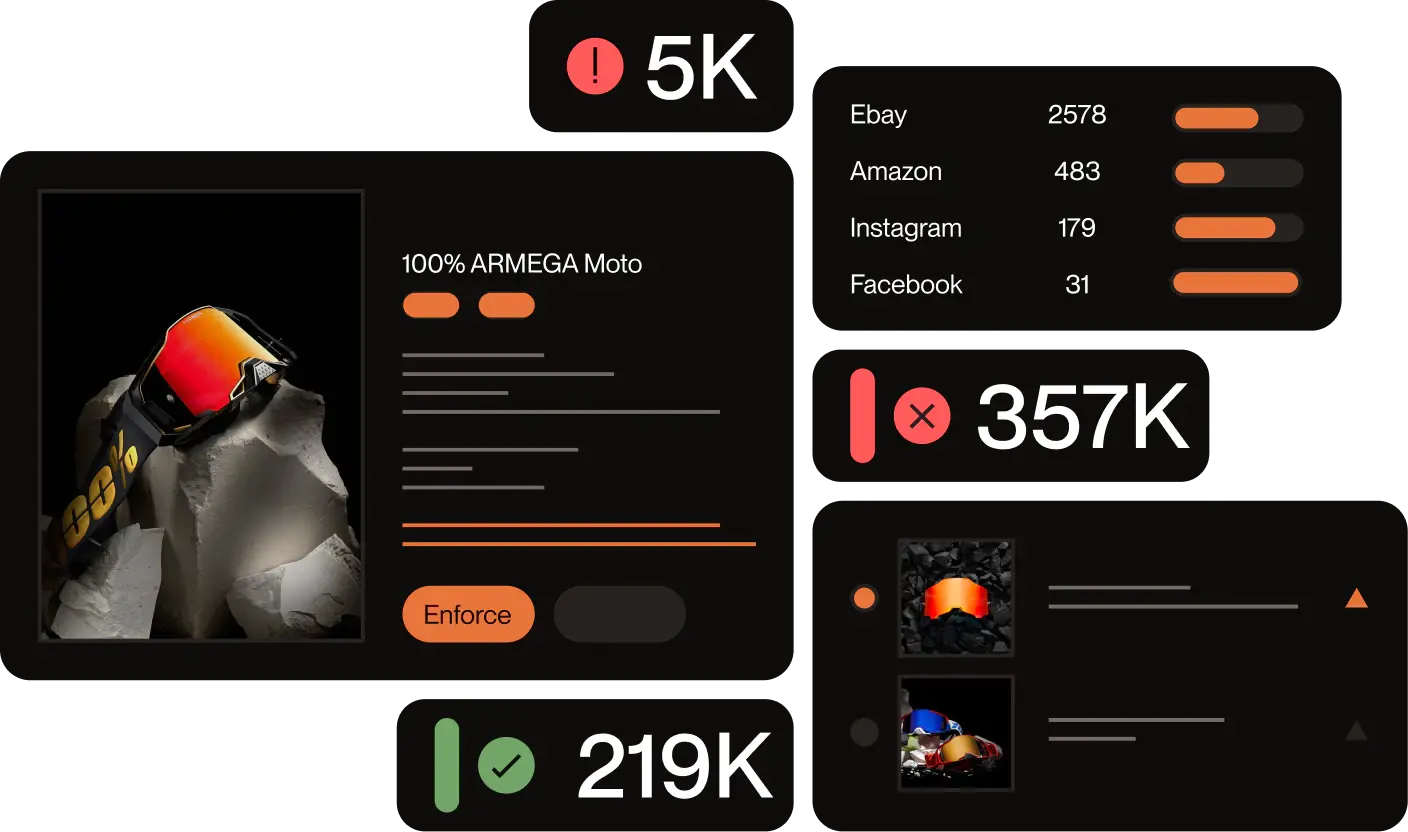
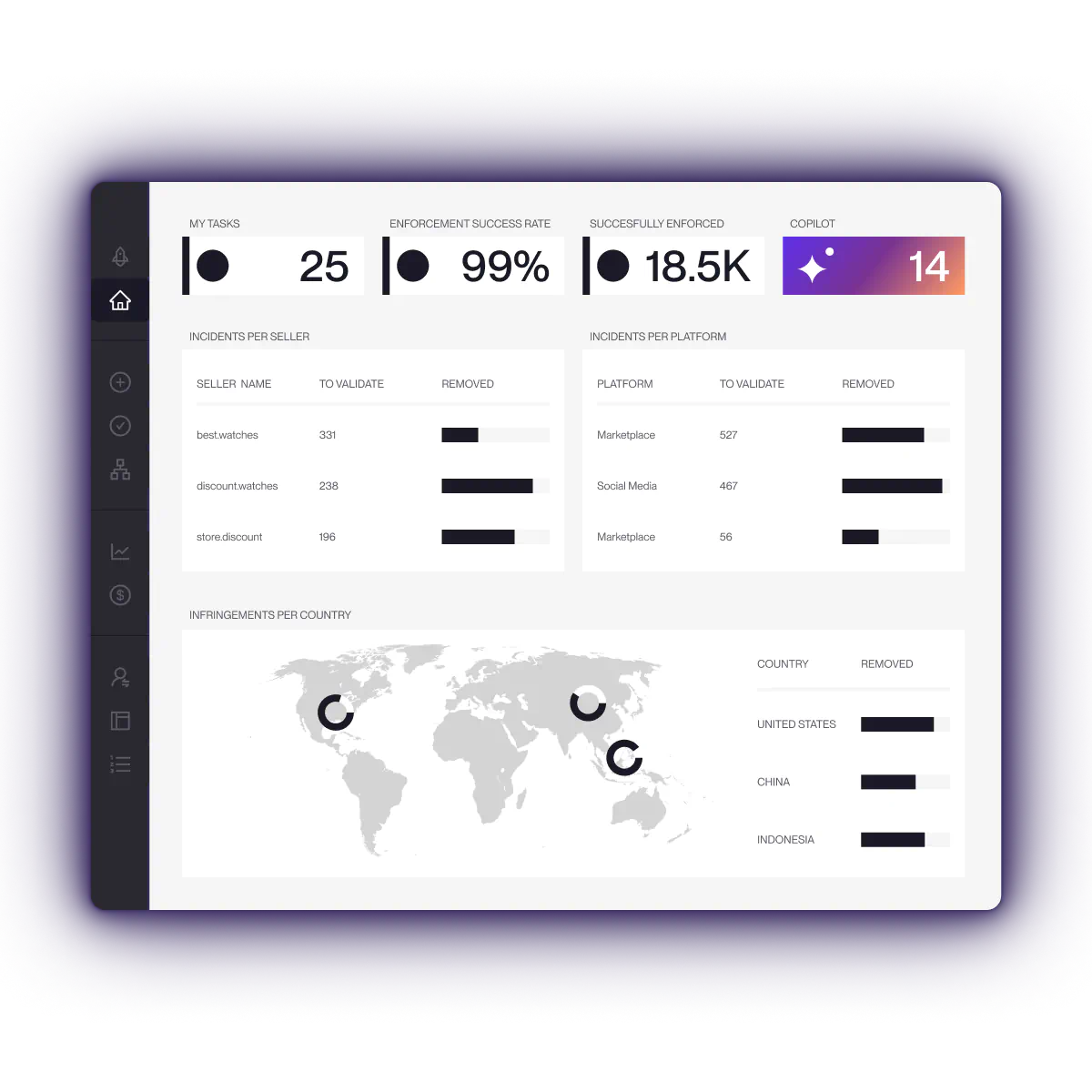
Modern brand protection platforms like Red Points operate as fully managed, AI-led systems that continuously detect, assess, and remove infringements across all relevant digital channels. Because the sheer volume of new listings makes manual monitoring effectively impossible, these platforms process massive amounts of data; for example, Red Points processes over 90 million new links per day across more than 5,000 marketplaces, social media platforms, search engines, and domain databases.
Core Detection and Enforcement Capabilities:
- Fake Website Detection: This approach combines search engine crawling, backlink analysis from known e-commerce and social platforms, and connections to daily-updating domain databases to surface sites that standard keyword searches would miss.
- Marketplace Enforcement: To catch infringers who deliberately avoid using brand keywords, the platform uses Vision AI (image and logo recognition), OCR, machine learning, and actor network mapping to identify counterfeits based on what they look like rather than what they say.
- Social Media and Impersonation: Through direct API connections with major platforms, Social Ad Protection detects and removes fraudulent ads at scale. Additionally, Impersonation Removal detects and takes down fake business and executive profiles across platforms like Facebook, Instagram, and LinkedIn.
- AI Commerce Protection: This emerging frontier monitors and removes counterfeit listings that surface through conversational AI and LLM-based shopping experiences, such as ChatGPT and Google’s AI Overviews.
The Enforcement Process: This shifts brand protection from manual actions to a continuous operation following three core phases: Detect (scanning all covered channels every 24 hours with automated crawlers), Validate (using AI to score risk while IP specialists review nuanced cases), and Enforce (executing takedowns via direct platform integrations and priority reporting channels).
Revenue Recovery Program: For serious infringers and large-scale counterfeit networks, a takedown alone may not be enough. The Revenue Recovery Program is a zero-cost litigation approach that targets the financial infrastructure of counterfeiters to achieve permanent seller account closures and financial recovery. To date, this program has frozen over $20 million in funds, permanently closed over 14,000 seller accounts, and enabled brands to recover up to $300,000 within 3 to 5 months.
Proven Success at Scale:
- Cotopaxi: When the outdoor apparel brand faced a surge of counterfeit listings and fake websites ahead of peak sales periods, they partnered with Red Points to quickly identify and remove high-risk threats, maintaining control over their brand experience.
- Graff: Facing sophisticated design copying and lookalike products in Asia, this luxury jewelry brand leveraged AI-driven detection and regional enforcement to remove over 14,000 listings. This effort blocked more than 3,500 sellers and eliminated over $6 million in counterfeit value while preserving their strict control over brand perception.
Protecting your brand is not a one-time task
The legal foundations (trademark registration, copyright protection, trade secrets policy) are the starting point, not the finish line. In 2026, the brands that protect themselves effectively are those that treat brand protection as a continuous operational discipline: registering early, monitoring everywhere, enforcing consistently, and building enforcement systems that can scale with the scale of the threat.
If you’re seeing counterfeit products, fake websites, or unauthorized use of your brand assets and want to understand the scope of the problem before it compounds, Red Points offers a risk assessment based on your specific brand and industry, with no commitment required.
Frequently Asked Questions (FAQs)
Yes. In the U.S. and other common law countries, you acquire trademark rights through use; no registration is required. You can use the ™ symbol on an unregistered mark. However, unregistered rights are geographically limited, harder to enforce, and subordinate to anyone who later registers the mark federally. Registration with the USPTO gives you nationwide priority, the right to use ®, access to U.S. Customs enforcement, and significantly stronger remedies in litigation. The practical difference is significant: an unregistered mark cannot be recorded with U.S. Customs (which allows border seizure of infringing imports), cannot use the ® symbol, and will lose a dispute to any party who subsequently registers the same mark federally — even if you used it first.
A trademark protects a brand identifier (name, logo, slogan) in commerce, and it exists to prevent consumer confusion about the source of goods or services. A copyright protects original creative expression (writing, art, music, software); it exists to give creators economic rights over their work. A logo, for example, can be both: the artwork is copyrighted, and the logo’s use as a brand identifier is trademarked. They have different registration processes, different durations, and different enforcement mechanisms.
Meta provides several tools: the Brand Rights Protection (BRP) tool lets you search for violations across Facebook, Instagram, and Marketplace simultaneously. The IP Reporting Center handles trademark, copyright, and counterfeit claims. The Ad Library (public) lets you monitor who is running ads using your brand assets. For high-volume enforcement, direct API access through a trusted partner like Red Points allows automated, priority takedown requests at a scale that manual reporting cannot match.
In the U.S., the USPTO process currently takes approximately 8–12 months from filing to registration if there are no significant issues. In the EU via EUIPO, the process is typically faster—around 4–6 months for straightforward applications. Filing through the Madrid Protocol for international registration adds layers of national examination that vary by country. During the application period, you can use the ™ symbol immediately—the ® symbol is only for registered marks.
Document the infringement thoroughly first (screenshots, purchase records, URLs). Then pursue enforcement through multiple channels simultaneously: file takedowns directly with the marketplace platform using your trademark registration; contact Red Points or another brand protection provider to monitor for related listings and sellers; consider a test purchase to confirm the product is counterfeit; send a cease-and-desist to any identifiable seller; and, for serious operators, explore the Revenue Recovery Program to pursue account closures and financial recovery. The key is not to treat each listing as an isolated incident—most serious counterfeit operations involve networks of connected sellers across multiple platforms.
For a very small brand with limited online presence, manual monitoring is possible but time-consuming. A realistic manual approach involves: weekly searches on major marketplaces for your brand name and key product names, Google Alerts for your brand name, a monthly check of new domain registrations, and periodic reviews of your primary social media platforms. The problem is that this approach misses listings that avoid your brand keywords, is slow relative to how quickly new listings appear, and produces no systematic record for enforcement purposes. As your brand grows, the volume of infringement typically grows faster than your ability to monitor manually, which is why most brands with significant online revenue use automated monitoring tools. A useful threshold: if your brand appears on more than two major marketplaces, runs paid social ads, or operates in a market with known counterfeiting activity (China, Southeast Asia, Eastern Europe), manual monitoring is already insufficient — the volume of new listings will outpace any manual review cadence.
Filing with the USPTO typically costs $250–$350 per class via TEAS Plus, while the EUIPO costs approximately €850 for one class. International filings are handled through the Madrid Protocol. It’s important to note that attorney fees typically add $500–$2,000 for a standard application. Overall, the total first-year cost for a U.S. and EU registration is approximately $3,000–$6,000 with legal support.
Trade dress refers to the overall look and feel of a product or its packaging that consumers associate with a specific source. It can be protected as a trademark as long as the visual features are both distinctive and non-functional. While registration with the USPTO is an option, smaller brands can also use Section 43(a) of the Lanham Act to make claims and stop competitors from copying an unregistered distinctive look.
A reverse image search is a great starting point for checking on your logo. To monitor your brand name, you can set up Google Alerts for mentions, perform periodic marketplace searches, and use domain monitoring tools. However, automated monitoring platforms are much more robust, as they scan continuously and surface infringements that manual searches miss entirely.