“How do we make sure we don’t accidentally flag ourselves?” It’s one of the first questions brands ask when they consider automating enforcement. Or their distributors. Or the creators they pay to post about them.
The short answer: before anything is enforced, every result Red Points finds is checked against your list of authorized sellers, accounts, and partners, analyzed for several warning signs at once, and validated. Automation is added gradually, only where the rules have proven accurate, and you decide how far it goes.
False positives come with searching broadly. The work is in catching them before they reach enforcement, and below we walk through how we do that in the five situations brands bring up most.
TL;DR
- A false positive in brand protection is when a detection system or analyst wrongly flags a legitimate listing, seller, website, or profile as infringing.
- Detection and enforcement are separate steps. A broad search will always pick up some legitimate results; the filtering in between decides what goes forward.
- An up-to-date list of authorized sellers, domains, distributors, and official accounts is the single most useful filter a brand can provide.
- Combining signals such as seller, marketplace, image match and price gives far more context than any one of them alone.
- Automation is safest when it starts with clear-cut cases and grows as the rules prove accurate, at whatever pace suits the brand.
What is a false positive in brand protection?
A false positive in brand protection is when a detection system or analyst wrongly flags a legitimate listing, seller, website, or profile as infringing, so it risks being sent to enforcement by mistake. The opposite is a false negative: a real counterfeit or infringement that nobody catches.
The two pull against each other. A search could be made so narrow that it almost never picks up anything legitimate, but it would also miss counterfeiters who misspell a brand name, crop a logo, or hide the product in the second photo of a listing. That is why we search broadly on purpose: picking up some false positives at this stage is expected, and the filtering that follows is built to deal with them.
So the goal is not zero false positives at the detection stage. It is keeping them away from enforcement.
The five false positives brands worry about most
The same five situations come up again and again when brands talk to us about false positives. Each one calls for a slightly different fix.
1. Your own websites, apps and social accounts
This is the most common worry, and the easiest to solve. If your brand runs regional domains, a limited-edition store on its own site, or lets sales reps post from their own social accounts, all of them will show up in a broad search. They use your brand name, your logo, and your product photos.
We collect your official domains, apps, and handles during onboarding and add them to an allow list, so they are filtered out before results reach validation. If something official shows up before that list is complete, it doesn’t mean the system has failed. It just hasn’t been told about that account yet, and it can be added to the list in one click.
2. Authorized resellers, distributors and licensees
Keeping partners out of enforcement starts with an up-to-date authorized seller list. It covers most cases, but how your partners sell often matters as much as who they are.
Let’s say you allow distributors to sell a product only as part of a bundle, and you notice some of them selling the pieces on their own. You want to catch that and keep an eye on it, without treating every bundled listing as suspicious. A rule built around that detail does far more than a list of names, which is why the more information a brand shares with us, the better the results tend to be.
3. Fans, collectors and genuine resale
A collector posting a photo of their shelf, a parents’ group recommending a product, or someone reselling the genuine item they bought last year are not threats, and most brands don’t want to act against them.
That is why filters look for intent to sell, not just a mention of the brand. For example, if you sell collectible toys, social posts can be flagged only when they pair your product with words like “sale” or “shop”, so fans showing off their collections are left alone.
4. Same name, different business
Let’s say your bank shares its name with a tire company, or your sports club’s nickname is also a popular t-shirt design. A search for the name alone will bring back plenty of results that have nothing to do with you.
These are filtered out with exclusion keywords, product category context, and image recognition. If a listing doesn’t show your product or logo and sits in an unrelated category, it doesn’t move forward.
5. Licensed partners and approved creators
Some of the trickiest false positives are legitimate uses of your content: a licensee advertising your product on social media, a creator you pay to post about you, or a partner allowed to display your trademark. On the surface, they look exactly like unauthorized use.
Approved handles and partners go on the allow list. For brands with many licensing deals, we often start by protecting exclusive content only, where there is no ambiguity, and expand from there.
How results are filtered before anything is enforced
Every result goes through the same sequence, and each layer narrows what moves forward. Here is the order, from the widest part of the funnel to the narrowest.
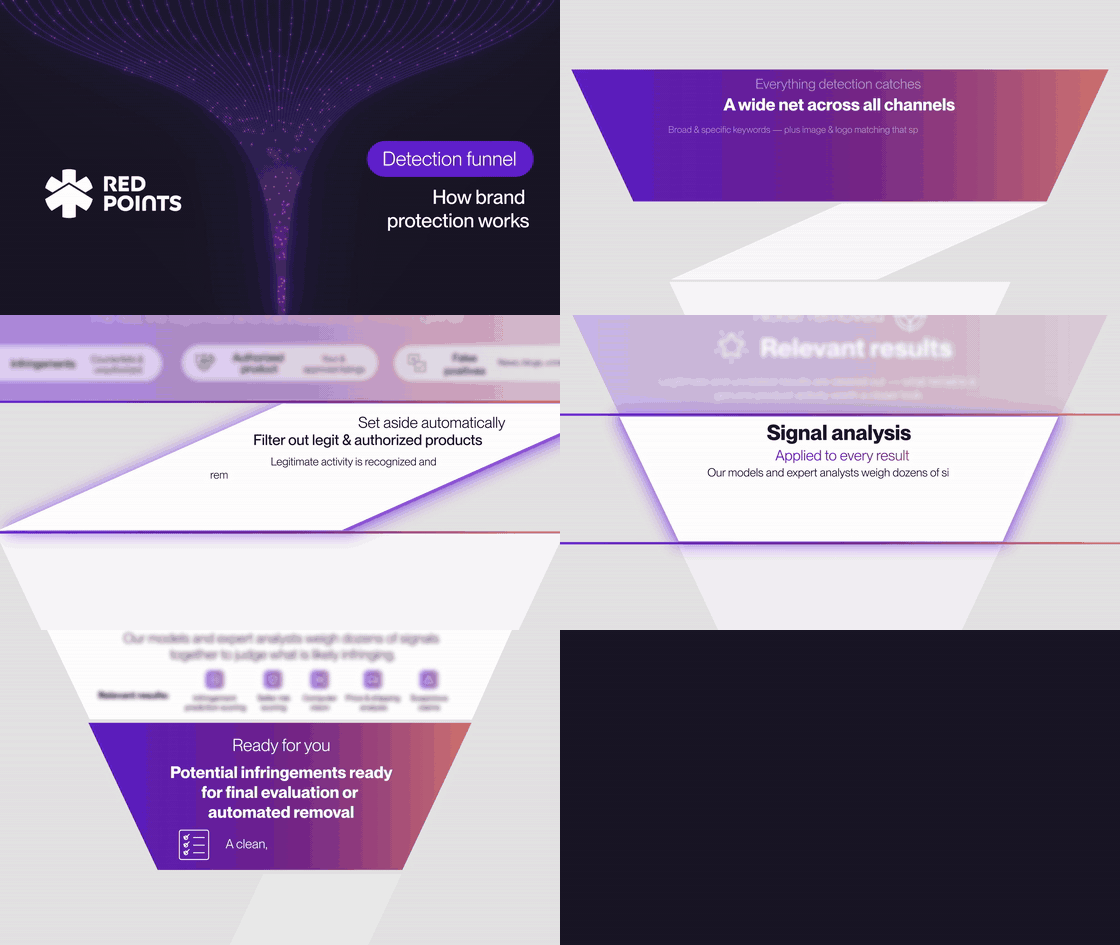
| Layer | What happens | What it filters out |
| 1. Detection | We search marketplaces, social media and websites broadly for your brand | Nothing yet: the net is wide on purpose |
| 2. Allow list and exclusions | Results from your authorized domains, sellers, distributors and accounts are removed, along with news, reviews and other non-commercial content | Your own channels, partners, editorial mentions |
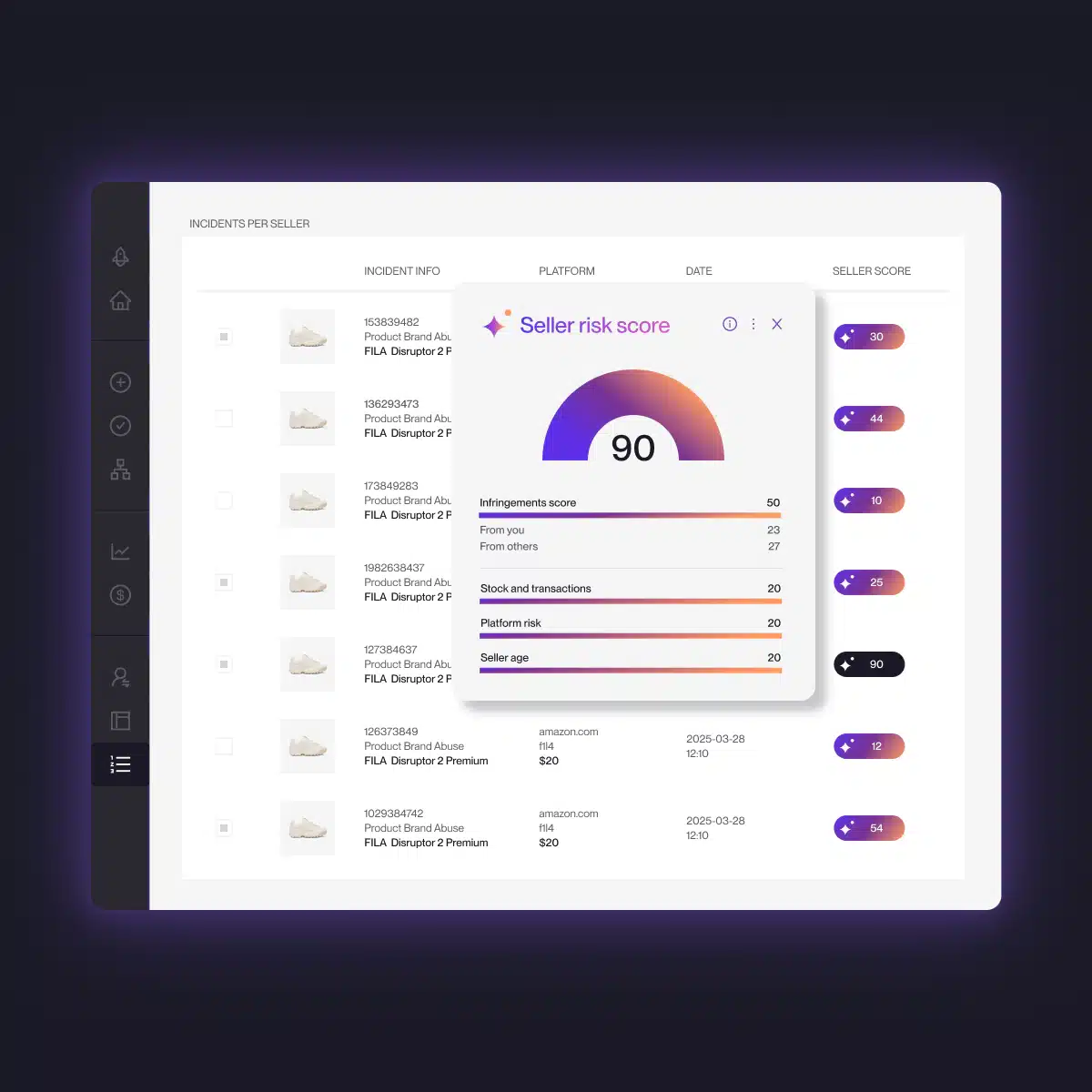
| 3. Relevance and signals | Logo and image recognition, text read from images, price, marketplace, a seller risk score and an infringement prediction score are combined | Same-name businesses, fan posts, genuine resale at normal prices |
| 4. Validation | Remaining results are confirmed, discarded or put on hold, either by agreed automation rules or by people | Edge cases that need judgment |
| 5. Enforcement | Confirmed infringements are submitted to the platform |
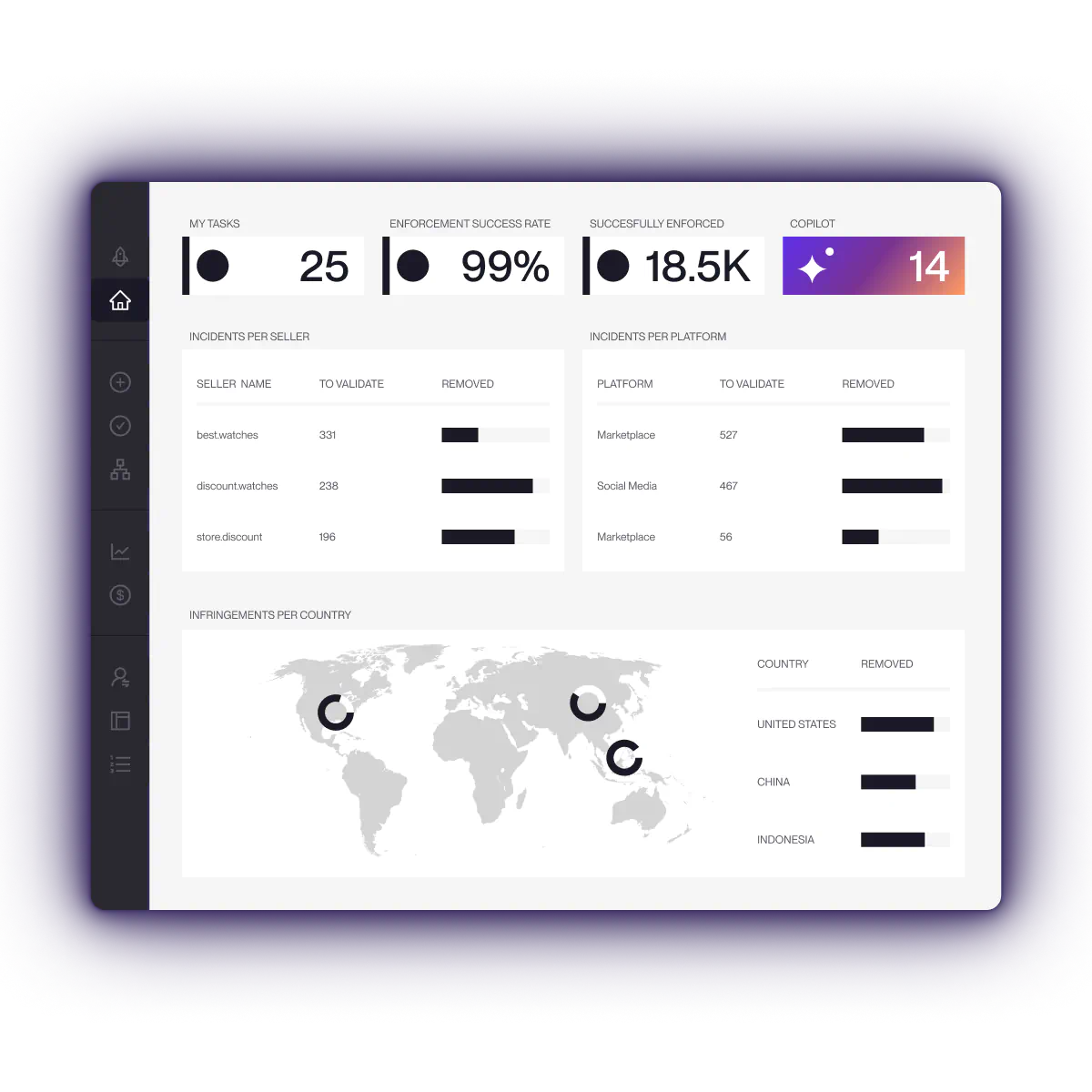
Two details matter here. First, nothing is thrown away: every result, including the ones filtered out, stays visible in your database, so you can always check what was excluded and why. Second, the allow list is what keeps authorized sellers out of enforcement, so it is worth keeping up to date. When a new partner appears in the results, it can be added in one click and the rules are updated to match.
Every decision becomes a rule
The first weeks with a new brand are where most false positives get removed for good. Each time a result is discarded, or a seller is marked as authorized, the system records it, so the same seller or pattern is handled the next time automatically.
For example, if you tell us that listings of a product on a certain marketplace within a certain price range are usually legitimate, that one decision becomes an automation rule that runs around the clock.
The system also looks for patterns in what gets discarded and suggests new rules. Our team reviews those suggestions with you before they are switched on, and if a rule turns out to be too broad or too narrow, it can be adjusted within minutes.
What does an automation rule look like?
An automation rule is a specific scenario you have agreed should be enforced. Most rules combine several conditions, so a single coincidence, like a low price or a logo match, is not enough on its own.
Take a brand that sells insulated water bottles:
| Condition | Example |
| Product | A specific protected water bottle |
| Marketplace | A marketplace included in the brand’s scope |
| Seller | Not on the authorized seller list |
| Image | Matches the protected product |
| Price | Below a minimum threshold the brand considers suspicious |
In this example, enforcement only happens when all five conditions are met. A genuine bottle sold by an authorized retailer fails the seller condition. A genuine bottle resold at a normal price fails the price condition. Neither is enforced automatically.
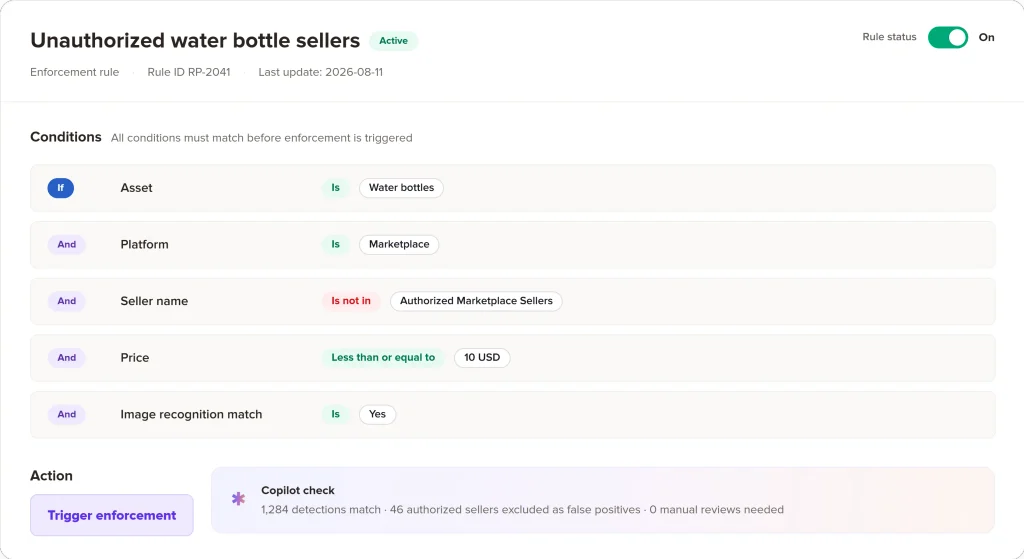
To build rules like this, we need to know which products you want to protect, where they are expected to be sold, what they normally cost, and what you consider infringing. We combine that with what we see across the industry, which is how each brand ends up with a strategy of its own.
How much of enforcement should you automate?
That is always up to you. Red Points can automate anywhere from 0% to 100% of enforcement, depending on the case, and some brands do get to full automation. Others keep every enforcement decision in their own hands, because their products, industry or type of infringement need a closer look.
Whichever way you go, we take a crawl, walk, run approach: start with a small set of clear-cut scenarios, check the results together, and add more as each rule proves accurate. Where a brand prefers no automation at enforcement, the technology still does the searching and filtering, and the brand decides on every case it wants to enforce or discard. Where a brand is comfortable with automation, it is applied to scenarios that have already proven accurate.
Where does AI fit?
AI does the heavy lifting on volume. It processes 2.3 billion data points a month, reads logos and text inside images, scores sellers and listings, and spots patterns a person would never see across millions of results.
It does not decide on its own what counts as an infringement for your brand. Those decisions come from the rules you agree with our team, and our enforcement experts set up and monitor those rules, test new ones before they go live, and handle the cases that are not clear-cut.
Protect your brand without catching your partners
False positives are a fair concern in automated brand protection, and they are not solved by reviewing every result by hand. They are solved by giving the system enough context: who is legitimate, what infringement looks like for your products, and which cases are clear enough to automate.
That is how we deliver more than 5.1 million enforcements a year while keeping brands in control of what is acted on.
Frequently asked questions
How does Red Points avoid flagging a brand’s own websites and accounts?
Your official domains, apps, and social handles are added to an allow list during onboarding. Results from them are filtered out before validation, and anything legitimate that was missed can be added to the list in one click.
How does Red Points avoid taking action on authorized resellers?
Enforcement rules are tailored to each brand, and the authorized seller list is one of the most important inputs. Authorized sellers and distributors are filtered out before results reach validation, and rules take into account how your partners normally sell, so action is only taken where the agreed criteria are met. Adding new partners to the list as soon as they come on board helps keep them out of enforcement from day one.
What is the difference between a false positive and a false negative?
A false positive is a legitimate listing flagged as infringing. A false negative is a real infringement that goes undetected. Searching broadly reduces false negatives; filtering and validation keep false positives away from enforcement.
Does Red Points automatically take down everything it detects?
No. Detection and enforcement are separate steps. Results are filtered and validated first, and automated enforcement applies to scenarios agreed with the brand.
Does AI decide what Red Points enforces?
No. AI scores and groups results at scale and suggests rules. What gets enforced depends on the rules agreed with each brand, which our enforcement experts set up, test, and monitor.
How much of brand protection enforcement can be automated?
Red Points can automate anywhere from 0% to 100% of enforcement, depending on the case. How far to go is always the brand’s decision: some automate everything, while others with complex products or industries confirm every enforcement themselves.
What information should a brand share to reduce false positives?
Your official domains and accounts, authorized sellers, distributors and licensees, the products you want to protect, where they should be sold, typical prices, and what you consider infringing. The more context you share, the fewer false positives reach you.
Can I see what was filtered out?
Yes. Every detection, including discarded results and false positives, stays in your database, so you can check what was excluded and why.