


Alibaba provides dedicated intellectual property protection tools that help rights holders identify, report, and manage suspected IP infringements across its ecommerce ecosystem.
For brands, the most important development is that Alibaba’s IP protection system now uses separate portals for different groups of marketplaces. Choosing the correct portal is therefore the first step before registering rights or submitting a complaint.
This guide explains how the Alibaba IP Protection Platform works in 2026, what intellectual property can be protected, which documents rights holders need, and how Alibaba processes complaints.
If you already have a specific suspected counterfeit listing that you want to report, see our step-by-step guide to remove a counterfeit from Alibaba.
TL;DR
- Alibaba provides dedicated IP protection portals where verified rights holders and their representatives can register IP rights and submit complaints.
- There are now two main routes: the Alibaba International IP Protection Platform and the Taobao & Tmall Group IPP Platform.
- The international portal covers Alibaba.com, AliExpress, Lazada, and Miravia, while the TTG portal covers Taobao, Tmall, and 1688.com.
- Rights holders can use the platforms to protect trademarks, copyrights, patents, and other eligible intellectual property.
- Successful reporting starts with accurate identity information, valid IP documentation, clear listing URLs, and evidence explaining the suspected infringement.
- Alibaba prohibits counterfeit and pirated goods and provides measures that can include listing removal and action against sellers who violate its intellectual property policies.
- Alibaba’s native IP tools can form the platform-specific enforcement layer of a broader marketplace brand protection strategy.
What is the Alibaba IP Protection Platform?
Alibaba’s IP Protection Platform, or IPP, is a rights-holder system designed to help intellectual property owners manage infringement complaints across Alibaba marketplaces.
Once a rights holder has created an account and completed the relevant verification process, the system allows them to register intellectual property, submit complaints against listings they believe infringe those rights, track complaint status, and manage related documentation.
Alibaba describes IPP as an efficient and transparent channel for managing IP enforcement. Its current IPP instructions also explain that verified identity and intellectual property documentation can be retained for future complaints while those documents remain valid.
Alibaba’s approach forms part of its wider commitment to maintaining trusted marketplaces for consumers, sellers, and rights holders. Its policies prohibit the sale of counterfeit and pirated goods as well as other forms of intellectual property infringement.
Which Alibaba IP Protection Platform should you use?
One of the most important changes for rights holders is that there is no longer a single portal covering every Alibaba marketplace.
Since 2024, the international and domestic marketplace groups have separate IPP systems.
| If the suspected infringement is on | IP protection route |
| Alibaba.com | Alibaba International IP Protection Platform |
| AliExpress | Alibaba International IP Protection Platform |
| Lazada | Alibaba International IP Protection Platform |
| Miravia | Alibaba International IP Protection Platform |
| Taobao | Taobao & Tmall Group IPP |
| Tmall | Taobao & Tmall Group IPP |
| 1688.com | Taobao & Tmall Group IPP |
For Alibaba.com, AliExpress, Lazada, and Miravia, rights holders should use the Alibaba International IPP Platform.
For Taobao, Tmall, and 1688.com, rights holders can use the Taobao and Tmall Group IPP Platform.
If your brand previously used Alibaba’s older IPP workflow, check which marketplace the relevant listing appears on before starting a new complaint. Accounts and registered rights may need to be managed separately across the two systems.
Brands focused specifically on AliExpress can also follow our dedicated guide to report counterfeits on AliExpress.
What intellectual property can you protect through Alibaba IPP?
Alibaba’s IP protection process covers several major categories of intellectual property. The exact complaint routes and evidence requirements depend on the marketplace, jurisdiction, and right being asserted.
Common rights include:
- Trademarks: Registered names, logos, symbols, and other marks used to distinguish your products or business.
- Copyright: Original creative works such as product photography, illustrations, written materials, graphics, and other protected content.
- Patents: Eligible invention or design rights supported by valid patent documentation.
- Other eligible rights: Certain marketplace-specific forms of intellectual property may also be supported through the relevant IPP workflow.
Before submitting a complaint, make sure the right you are relying on is active and that the information in your IPP account matches the documentation issued by the relevant intellectual property authority.
If you are still deciding which rights apply to an online incident, our guide to intellectual property infringement explains the differences between trademark, copyright, and patent infringement.
What do you need to register for Alibaba IPP?
Alibaba verifies both the identity of the person or organization filing complaints and the intellectual property being asserted.
Requirements vary depending on the account and portal, but rights holders should generally prepare the following.
Proof of identity
Individual rights holders will be asked for an accepted government-issued identification document.
Companies will need to provide business registration or equivalent corporate documentation.
Alibaba has also introduced updated identity-verification options for its IP protection services to help protect account security and ensure that IP enforcement is carried out by verified users.
Proof of intellectual property rights
You will need documentation demonstrating ownership of the relevant intellectual property.
Depending on the complaint, this can include:
- Trademark registration certificates
- Copyright ownership documentation
- Patent certificates
- Supporting registration records
- Other documentation accepted for the type of right being claimed
Alibaba’s IPP also provides routes for submitting information about trademarks registered outside mainland China.
Authorization documents
If the person or organization filing the complaint is acting on behalf of the rights holder, Alibaba will request both information identifying the rights holder (such as business registration, or an ID), and a valid letter of authorization where it is explicitly stated that the rights owner is providing permission to act on behalf of their business.
Keeping authorization documentation current can prevent unnecessary interruptions when an agency, law firm, or brand protection provider manages enforcement on your behalf.
How to use Alibaba’s IP Protection Platform
The exact interface differs between the international and TTG portals, but the core rights-holder workflow follows a similar sequence.
Step 1: Choose the correct IPP portal
Start by confirming which marketplace contains the listing or content you want to report.
Use the international IPP route for Alibaba.com, AliExpress, Lazada, or Miravia. Use the TTG platform for Taobao, Tmall, or 1688.com.
Making this distinction first helps ensure your IP documentation and complaint are submitted to the appropriate Alibaba system.
Step 2: Register and verify your identity
Create the appropriate rights-holder account and complete the identity-verification process.
Use accurate legal information that corresponds with your corporate or personal documentation. If a representative is creating the account, prepare the relevant authorization documentation as well.
Step 3: Register your intellectual property
Before filing a complaint, add the trademark, copyright, patent, or other supported right on which you intend to rely.
Upload clear copies of the requested documents and check that registration numbers, rights-holder names, jurisdictions, and validity dates are accurate.
For Taobao, Tmall, and 1688.com, Chinese IP registration certificates should be submitted as clear color copies bearing the official red seal (stamp) and must be currently valid, including any applicable renewal or extension documentation.
Once qualifying rights have been verified, they can generally be selected when preparing future complaints without resubmitting the same valid documentation each time.
Step 4: Identify the relevant listing
Locate the specific product listing or other marketplace content that you believe infringes your rights.
Keep an accurate record of:
- The listing URL
- The seller or store
- The product title
- Relevant images
- The date the listing was reviewed
- The specific element that appears to use your IP
Screenshots can also be useful as part of your internal evidence record.
Step 5: Select the relevant IP right and complaint reason
Within the IPP interface, select the registered intellectual property that supports your complaint and choose the appropriate complaint type.
Be precise about the alleged infringement. For example, a trademark complaint should explain the unauthorized trademark use at issue rather than relying only on a general statement that the listing appears suspicious.
Clear categorization helps Alibaba evaluate the notice against the information supplied by the rights holder.
Step 6: Submit the complaint and monitor its status
Review the information before submission and make sure the correct listing URLs, rights, and supporting materials are attached.
After submitting, use the IPP dashboard to follow the complaint.
Alibaba’s system enables rights holders to review their submissions and historical records. Where a valid counter-notification is submitted, the platform can also forward it to the rights holder for an appropriate response.
What happens after you submit an IP complaint?
Alibaba reviews IP complaints according to its intellectual property policies and the evidence provided.
Where a takedown request is verified, the relevant listing may be removed and the seller notified. Alibaba’s IPP documentation also provides for a counter-notification process, giving the relevant parties a structured route for resolving IP disputes.
This process helps protect both intellectual property owners and legitimate marketplace participants by requiring complaints to be supported by appropriate rights and evidence.
Alibaba also makes clear in its intellectual property policies that counterfeit and pirated goods are prohibited. Depending on the circumstances, policy violations can result in measures including product delisting, selling restrictions, or account closure. Alibaba also reserves the right to pursue civil or criminal action where appropriate.
The company has a long history of investing in IP protection technology and cooperation with rights holders, brands, and enforcement authorities. These initiatives are designed to support trust throughout its marketplace ecosystem.
How can you make an Alibaba IP complaint stronger?
A successful IP complaint is based on evidence rather than assumptions.
Before submitting, check that you can clearly connect three things:
- Your enforceable right
- The marketplace content you are reporting
- The reason that content allegedly infringes the right
Useful supporting information can include side-by-side product comparisons, trademark registration information, original product photography, packaging evidence, copyright records, or details identifying the protected design.
Avoid submitting complaints simply because a seller is unfamiliar or is offering a product at a different price. An unauthorized seller is not automatically committing intellectual property infringement.
That distinction matters across every marketplace. IP reporting mechanisms work best when they are used for genuine rights violations and supported with evidence that allows the platform to assess the claim accurately.
Alibaba IPP and ongoing marketplace brand protection
Alibaba’s IP Protection Platforms provide brands with direct, platform-specific mechanisms for enforcing their rights. They are particularly useful when a rights holder has already identified suspected infringement and needs an official route to report it.
A broader marketplace program addresses a different part of the workflow: finding potential infringements across many listings and marketplaces before deciding which incidents should be submitted for enforcement.
A mature process therefore typically separates four activities:
- Detection
- Validation
- Enforcement
- Monitoring after enforcement
Alibaba’s own IP tools can handle the platform-specific complaint process, while a brand’s internal team or external technology can manage detection and prioritization across its wider ecommerce footprint.
This complementary approach lets brands make full use of Alibaba’s established IP protection infrastructure while maintaining visibility across other channels where their products are sold.
What to do next
If you have identified a potential IP infringement, first confirm which Alibaba marketplace hosts the relevant listing and choose the corresponding IPP portal. Make sure your identity, intellectual property documentation, authorization records, and listing evidence are complete before submitting the complaint.
For individual cases on Alibaba.com, our Alibaba counterfeit removal guide provides a more detailed reporting walkthrough.
For a wider program, combine accurate IP registration, Alibaba’s platform-native protection mechanisms, documented internal enforcement rules, and continuous monitoring of the marketplaces that matter most to your brand.
How Red Points complements Alibaba’s IP protection tools
Alibaba provides rights holders with an established route for submitting and managing IP complaints on its marketplaces. Red Points helps brands manage the work that happens around those platform tools when infringement monitoring needs to operate across a much larger ecommerce footprint.
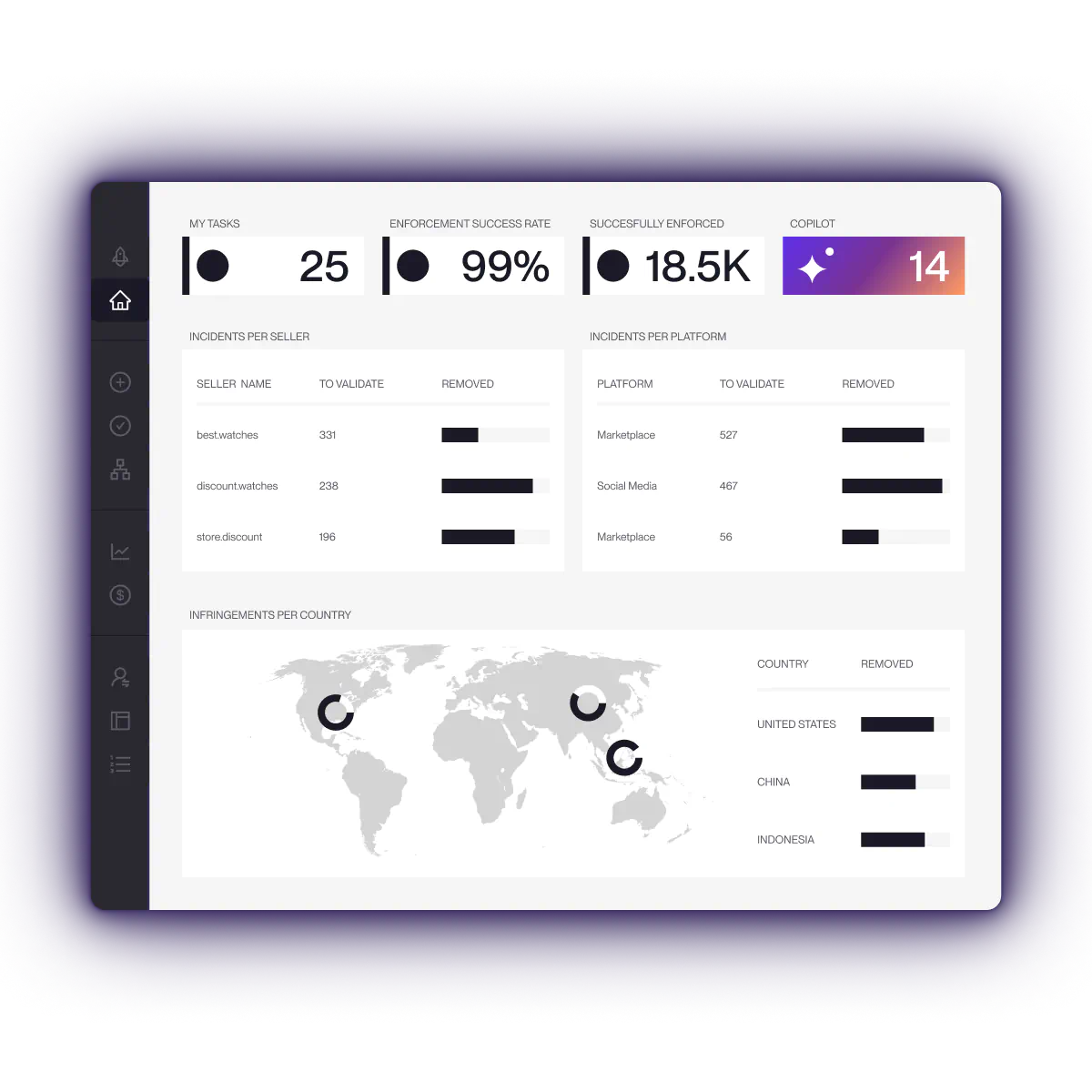
Red Points Marketplace Protection monitors more than 5,000 marketplaces and uses automated detection to identify potential trademark, image, and product infringements.
The workflow has three main stages.
Find
Automated monitoring searches marketplace listings for relevant brand names, images, logos, product characteristics, and other risk signals.
Validate
Potential incidents are assessed against the brand’s approved enforcement strategy so that enforcement focuses on incidents that meet the brand’s approved enforcement criteria, rather than every possible match.
Enforce and measure
Validated incidents can be submitted through the appropriate marketplace enforcement routes where the applicable rights, evidence, and platform requirements support a complaint, while dashboards help brand teams follow activity and measure results over time. The relevant marketplace ultimately determines the enforcement outcome.
Across its wider platform, Red Points performs more than 5.1 million enforcements each year for 1,300+ brands, with a 94–95% enforcement success rate across all channels they cover. Results can vary according to the marketplace, evidence, and infringement type.
For brands dealing specifically with trademarks, trademark monitoring software can also help identify trademark misuse across marketplaces, websites, social media, and domains.
Request a demo to see how Red Points can complement platform-native IP protection tools with cross-channel monitoring and enforcement.
Frequently asked questions
What is Alibaba’s IP Protection Platform?
Alibaba’s IP Protection Platform is a rights-holder system for registering intellectual property and submitting complaints about suspected infringement on Alibaba marketplaces. Verified users can also monitor complaint status and manage their IP documentation.
Is Alibaba IPP free to use?
Alibaba’s IPP materials describe the platform as the official route provided to rights holders for managing IP complaints. Rights holders should review the current registration requirements on the relevant IPP portal before filing.
Which IPP portal covers Alibaba.com?
Alibaba.com is handled through the Alibaba International IP Protection Platform. The same international platform also covers AliExpress, Lazada, and Miravia.
Which IPP portal covers Taobao and Tmall?
Taobao and Tmall use the Taobao & Tmall Group IPP Platform. The TTG portal also covers 1688.com.
Can I protect a trademark registered outside China?
Yes, on Alibaba International, trademarks registered outside mainland China can be submitted for IP protection. For Alibaba TTG, enforcement generally requires IPRs registered in China, or copyrights that do not require registration.
Can an authorized representative file an Alibaba IP complaint?
Yes. Alibaba allows authorized representatives to act for rights holders, subject to the required identity and authorization documentation.
What happens if a seller challenges an IP complaint?
Alibaba’s IPP includes a dispute-resolution process. If an eligible counter-notification is submitted, it can be forwarded to the rights holder so they can review and respond through the applicable process.
Does Alibaba take action against IP policy violations?
Yes. Alibaba prohibits counterfeit and pirated goods and other IP violations. Its published policies state that measures may include product delisting, temporary selling restrictions, permanent account closure, and, where appropriate, civil or criminal action.
Do I need evidence before reporting a listing?
You should have documentation establishing your IP right and information showing why the specific listing allegedly infringes that right. Clear, relevant evidence helps the platform assess the complaint accurately.
Is Alibaba IPP the same as brand protection software?
No. Alibaba IPP is Alibaba’s own platform-specific rights-enforcement system. Brand protection software generally performs additional functions such as detecting possible infringements across multiple marketplaces, validating incidents, monitoring repeat activity, and coordinating enforcement across different channels.