








A marketplace seller uses your trademark in a product title but ships an unrelated item. A competitor copies the appearance of your product without using your logo. A fake website reproduces your images and presents itself as an official store. A former employee shares confidential manufacturing information with another business.
Each incident involves a valuable business asset, but they do not necessarily involve the same intellectual property right or require the same response.
Intellectual property infringements can affect trademarks, copyright, patents, designs, trade secrets, geographical indications, and other legally protected assets. Online, these violations appear through counterfeit products, copied content, pirated media, impersonation accounts, lookalike domains, fraudulent apps, and misleading ecommerce listings.
Identifying the correct infringement type is essential. A trademark complaint will not resolve a patent dispute, a copyright takedown cannot protect an unregistered product idea, and an unauthorized seller is not automatically committing intellectual property infringement.
This guide explains what intellectual property rights are, the main intellectual property infringement types, how intellectual property theft differs from infringement, how violations appear online, and how businesses can prevent and respond to them.
Intellectual property laws differ between countries. This article provides general information and is not a substitute for advice from a qualified intellectual property professional.
TL;DR
- Intellectual property rights protect intangible business assets such as brand identifiers, creative works, inventions, product designs, and confidential commercial information.
- Intellectual property infringement occurs when someone violates an exclusive IP right without permission or another valid legal basis.
- Intellectual property theft is a broader, less precise term that often describes deliberate misappropriation of trade secrets, confidential data, inventions, or creative assets.
- Common infringement types include trademark misuse, counterfeiting, copyright infringement, piracy, patent infringement, design copying, trade secret misappropriation, domain squatting, and brand impersonation.
- A lookalike, dupe, unauthorized seller, or reference to a trademark is not automatically unlawful. The right, jurisdiction, use, authorization, and possible legal exceptions must be assessed.
- Brands should register important rights, document ownership, secure confidential information, monitor relevant channels, apply consistent enforcement rules, and track repeat activity after removal.
What are intellectual property rights?
Intellectual property rights are legal rights that protect creations, identifiers, inventions, designs, and confidential information.
The precise rights and requirements differ between jurisdictions. The WIPO intellectual property overview identifies several major categories, including patents, copyright, trademarks, industrial designs, geographical indications, and trade secrets.
For businesses, the most relevant rights usually include:
| Intellectual property right | What it can protect | Business examples |
| Trademark | Signs that distinguish the source of goods or services | Brand names, logos, slogans, product names, packaging |
| Copyright | Original creative expression | Photographs, videos, website text, software, artwork, music |
| Patent | New inventions or protected technical solutions | Products, machinery, processes, technology |
| Industrial design | The visual appearance of a product | Shape, configuration, ornamentation, surface design |
| Trade secret | Commercially valuable confidential information | Formulas, processes, supplier terms, algorithms, customer strategies |
| Geographical indication | Products whose qualities or reputation are connected to a place | Regional foods, drinks, crafts, and agricultural products |
Several rights may protect the same product.
A branded device could contain a patented technical mechanism, a protected external design, copyrighted software and graphics, a registered trademark, and confidential manufacturing information. An infringer may violate several of these rights at once.
Trademark rights
A trademark identifies the commercial source of goods or services. It can consist of a word, logo, slogan, shape, pattern, color combination, sound, or another sign capable of distinguishing one business from another.
Registration usually gives the owner stronger and more clearly documented enforcement rights. Some jurisdictions also recognize rights created through use.
Trademark protection does not give a business ownership of a word for every purpose. The scope depends on the mark, territory, goods or services, distinctiveness, and the way another party uses it.
Copyright
Copyright protects original expression rather than general ideas, facts, systems, or methods.
For businesses, copyrighted works may include:
- Product photographs
- Marketing videos
- Website copy
- Packaging artwork
- Instruction manuals
- Software code
- Graphic designs
- Music and audio
- Training materials
- Product illustrations
Protection generally arises when an eligible work is created and fixed in a tangible form, although registration can significantly strengthen the remedies available in some countries.
Red Points’ copyright infringement guide explains how ownership, registration, fair use, licensing, and online enforcement interact.
Patent rights
A patent gives its owner the right to prevent specified uses of a protected invention for a limited period within the territory where the patent applies.
Depending on the jurisdiction and patent type, protected conduct may include making, using, selling, offering to sell, or importing the invention.
A patent does not protect a vague idea, brand name, slogan, or general product concept. Patent claims define the protected invention, making claim analysis central to any infringement assessment.
See Red Points’ guide to patent infringement for the evidence and enforcement options used in patent cases.
Industrial design rights
Industrial design rights protect visual product features rather than technical function.
They may cover product shapes, surface decoration, patterns, lines, colors, configuration, and ornamentation.
Some jurisdictions offer registered and unregistered design protection. Copyright, trade dress, or other unfair competition laws may also apply to certain product appearances.
Trade secret rights
Trade secrets protect commercially valuable information that is not generally known and has been subject to reasonable efforts to keep it confidential.
Trade secrets commonly cover formulas, recipes, source code, manufacturing methods, pricing models, supplier conditions, customer information, product road maps, research data, and internal algorithms.
Trade secret protection does not normally require public registration. It depends on maintaining secrecy through appropriate technical, contractual, and organizational controls.
The WIPO trade secret guidance explains that confidential information can qualify as an intellectual property right when the applicable requirements are met.
Geographical indications
A geographical indication identifies goods that have a quality, reputation, or characteristic connected to a particular place.
Protection may apply to agricultural products, food, drinks, crafts, and other regional goods. Misuse can occur when sellers apply the protected designation to goods that do not meet the origin or production requirements.
What is intellectual property infringement?
Intellectual property infringement is conduct that violates one or more exclusive intellectual property rights without authorization or another lawful basis.
The required legal test depends on the right involved.
Trademark infringement may focus on consumer confusion, source, affiliation, sponsorship, or dilution. Copyright infringement considers whether protected expression was copied and whether an exception applies. Patent infringement requires comparison with the patent claims. Trade secret misappropriation involves the improper acquisition, disclosure, or use of protected confidential information.
A complete assessment should consider:
- Which intellectual property right applies
- Who owns or controls the right
- Whether the right is valid and enforceable
- The countries or territories covered
- What the other party has done
- Whether permission was granted
- Whether a licence or contract applies
- Whether the right has expired
- Whether a legal exception or defense may apply
- Which party and provider control the disputed content
What is not automatically intellectual property infringement?
Similarity or lack of authorization does not establish infringement by itself.
The following situations require further analysis:
- A reseller offering genuine products
- A business using a trademark to identify compatible goods
- Commentary, criticism, parody, or news reporting
- Independent creation of a similar work
- Use of material in the public domain
- Use permitted by a licence
- Resale permitted under exhaustion or first-sale rules
- A product with similar functional features that are not protected
- A general idea that copyright does not cover
- Lawful reverse engineering
- A descriptive or non-trademark use of a word
- An unprotected product style or trend
For example, an unauthorized seller may create commercial or distribution problems without violating an intellectual property right. The brand still needs to identify counterfeit goods, trademark misuse, copied content, contract violations, or another enforceable basis before filing an IP complaint.
Overlooking this distinction can result in rejected reports, false positives, damaged partner relationships, and legal challenges.
Intellectual property infringement vs. intellectual property theft
Intellectual property infringement and intellectual property theft overlap, but they are not completely interchangeable.
| Intellectual property infringement | Intellectual property theft |
| A legal violation of a specific exclusive IP right | A broader term describing the deliberate taking or misuse of valuable intangible assets |
| Can occur without physically taking anything from the owner | Often implies intentional acquisition, copying, disclosure, or exploitation |
| Includes trademark, copyright, patent, design, and related violations | Frequently associated with trade secrets, confidential data, inventions, source code, or commercial know-how |
| May result from misunderstanding, negligence, or deliberate conduct | Usually implies dishonest or malicious intent |
| Assessed under the law governing the particular right | May involve IP law, contract law, cybersecurity law, employment law, fraud, or criminal law |
Copyright infringement is possible even when the owner retains the original file. The unlawful act is copying or exploiting protected expression.
Trade secret theft usually involves obtaining or disclosing confidential information through improper means. That could involve a departing employee, compromised account, breached database, deceptive business relationship, or unauthorized transfer of files.
Not every data breach is intellectual property theft. Personal data, financial records, and customer information may be protected under privacy, cybersecurity, or contractual rules without necessarily qualifying as intellectual property. They may become trade secrets when they are commercially valuable, confidential, and appropriately protected.
Intellectual property infringements: types brands should know
The following intellectual property infringement types are among the most common threats facing brands online and offline.
1. Trademark infringement
Trademark infringement occurs when another party uses a protected sign in a way that violates the trademark owner’s rights.
Online examples include:
- Using a brand name in a counterfeit listing
- Placing a logo on an unrelated product
- Creating a confusingly similar store name
- Claiming to be an authorized distributor
- Using branded packaging to misrepresent product origin
- Operating a fake support account
- Registering a misleading domain
Not every reference to a trademark is infringement. The context, goods or services, likelihood of confusion, territory, and possible defenses must be considered.
For enforcement workflows, see Red Points’ guide to reporting trademark infringement.
2. Counterfeiting and replica products
A counterfeit product uses another party’s trademark or closely related brand identifiers to make an unauthorized product appear genuine.
Counterfeiting may also involve:
- Copied packaging
- Copyrighted product photographs
- Protected product designs
- Patent-protected features
- Fake certification marks
- Fraudulent authenticity labels
The word “replica” does not make a listing lawful. A seller may use terms such as replica, mirror copy, inspired version, or one-to-one quality while still displaying protected trademarks and misleading buyers.
However, a reproduction that does not use protected branding is not automatically a counterfeit. It may instead raise design, copyright, trade dress, patent, or unfair competition issues.
Example: A sweatshirt bearing a box logo designed to resemble Supreme’s branding is not made lawful by being described as a “replica.” The copied trademark and presentation are what make the product and listing potentially actionable.
Red Points’ counterfeiting guide examines how counterfeit products are marketed and why the legal analysis can involve several rights simultaneously.
3. Copyright infringement
Copyright infringement occurs when protected creative expression is used without permission or another lawful basis.
Common business examples include:
- Copying product photographs
- Reproducing website text
- Uploading films, music, or books
- Distributing unauthorized software
- Reposting paid training materials
- Copying packaging artwork
- Using illustrations in fake listings
- Replicating substantial parts of another website
The work must contain protectable original expression. Copyright does not generally protect facts, broad ideas, procedures, systems, or commonplace elements.
Online copyright complaints can often be submitted through a platform process or a DMCA takedown.
4. Piracy
Piracy is a form of large-scale or deliberate copyright infringement involving unauthorized copying, distribution, streaming, downloading, or access.
It commonly affects:
- Films and television
- Sports broadcasts
- Music
- Software
- Video games
- Ebooks
- Courses
- Subscription content
- Digital artwork
Piracy networks may operate through streaming sites, cyberlockers, torrent indexes, social groups, messaging apps, search results, apps, and subscription resellers.
A piracy case may require action against several intermediaries rather than only the person who uploaded the content.
5. Patent infringement
Patent infringement occurs when a party carries out an act reserved to the patent owner in relation to a protected invention.
Examples may include:
- Manufacturing a patented product
- Importing infringing goods
- Selling a product covered by patent claims
- Using a protected industrial process
- Offering an infringing product for sale
- Supplying components in circumstances covered by local law
Patent disputes are highly fact-specific. A visual similarity is not enough because infringement depends on whether the product or process falls within the patent claims.
Example: Patent disputes involving the Hovertrax self-balancing scooter illustrate the difference between appearance and claim coverage. Competing hoverboards could look broadly similar, but the legal question was whether their technical features fell within the asserted patent claims.
Marketplace patent complaints should be reviewed carefully before submission. An incorrect patent claim can result in rejection, counterclaims, or liability.
6. Design infringement and trade dress copying
Design infringement involves the unauthorized use of a protected product appearance.
A competing product might copy:
- Overall shape
- Surface decoration
- Packaging configuration
- Pattern
- Product silhouette
- Distinctive visual arrangement
Trade dress can protect the distinctive commercial appearance of a product or its packaging in jurisdictions that recognize it.
A similar product is not automatically infringing. The design must be protected under the relevant law, and functional or commonplace features may receive limited protection.
7. Lookalikes, copycats, and dupes
Lookalike products imitate the appearance, branding style, packaging, or presentation of another product without necessarily copying the trademark exactly.
Examples include:
- Altering one letter in a brand name
- Copying a distinctive color and packaging layout
- Adding or removing a stripe from a logo
- Recreating the shape of a popular product
- Marketing an item as a “dupe”
- Using imagery that strongly evokes another brand
Some lookalikes are lawful competitors. Others may infringe trademarks, design rights, copyright, trade dress, or unfair competition rules.
The term “dupe” is a marketing label, not a legal defense. The actual product, listing, claims, packaging, and consumer impression determine the risk.
Example: A soda placed next to Dr Pepper that uses a similar dark-red palette, typography, and product name can illustrate a lookalike strategy. Whether it infringes depends on the protected elements and the overall consumer impression, rather than any single shared color or packaging feature.
8. Trade secret misappropriation
Trade secret misappropriation involves obtaining, using, or disclosing protected confidential information through improper means.
It may involve:
- An employee downloading files before departure
- A contractor sharing confidential product plans
- A competitor inducing breach of an NDA
- A cyberattack targeting source code
- Unauthorized access to formulas or manufacturing processes
- Misuse of supplier pricing or customer strategies
- Disclosure of non-public research data
A company must be able to show that the information was confidential, commercially valuable, and subject to reasonable protective measures.
Relevant controls can include NDAs, access restrictions, encryption, logging, data classification, employee training, and documented offboarding.
Red Points’ guide to trade secret litigation explains several issues that arise when confidential business information is disputed.
9. Trademark squatting
Trademark squatters register or use another business’s brand in bad faith, often in a market where the original owner has not yet secured registration.
The squatter may attempt to:
- Sell the registration to the genuine brand
- Prevent the brand from entering the market
- Demand a licensing payment
- Sell products under the brand name
- File infringement complaints against the genuine business
- Create leverage during expansion or distribution negotiations
This risk is particularly significant in first-to-file jurisdictions. Businesses planning international expansion should review trademark availability before launching publicly in a new market.
10. Cybersquatting, typosquatting, and lookalike domains
Domain abuse involves registering or using a domain that exploits another party’s trademark or identity.
Common forms include:
- Cybersquatting: registering a trademark-based domain in bad faith
- Typosquatting: registering a common misspelling
- Combosquatting: adding terms such as “shop,” “support,” or “outlet”
- Homograph attacks: using visually similar characters
- Alternative extensions: registering the brand under another top-level domain
- Renewal interception: registering a domain after the genuine owner allows it to expire
Typosquatting is the registration of a domain that imitates a common misspelling of a brand’s web address—for example, by swapping, doubling, or omitting a letter. The typo domain typically hosts ads, a copied storefront, or a phishing page that captures traffic from users who mistype the genuine address.
The domain may be parked, offered for sale, used for counterfeit products, connected to phishing email, or developed into a copied website.
Red Points’ guides to domain trademark infringement and lookalike domain attacks explain the available reporting and dispute routes.
11. Brand impersonation
Brand impersonation involves falsely presenting a person, account, website, or organization as a business, employee, executive, support team, seller, or affiliated organization.
The impersonator may copy:
- Brand names
- Logos
- Executive photographs
- Employee biographies
- Website content
- Product images
- Email signatures
- Support scripts
- Verified-looking profile designs
The objective may be to sell counterfeits, collect payments, steal credentials, distribute malware, redirect invoices, or obtain sensitive information.
Impersonation frequently combines trademark infringement, copyright infringement, fraud, domain abuse, and account compromise.
Social platforms require channel-specific reporting. Red Points’ social media impersonation guide covers the evidence and routes used for fake profiles and accounts.
12. Trademark and copyright misuse in ecommerce listings
An ecommerce listing can infringe intellectual property even when the product is not a counterfeit.
Examples include:
- Using another brand’s name to attract search traffic
- Displaying a logo on an unrelated product
- Copying the genuine brand’s photographs
- Reproducing product descriptions
- Claiming false compatibility or authorization
- Using protected artwork on print-on-demand goods
- Copying product packaging in listing images
The report should identify what is infringing.
“Unauthorized seller” may describe the commercial relationship, but it is usually not a sufficient IP complaint on its own. The enforceable issue may be trademark misuse, copyright infringement, counterfeiting, patent infringement, or a contractual violation.
13. Rogue websites, fake apps, and fraudulent digital assets
A rogue digital asset is a website, app, account, advertisement, or search result that misuses intellectual property to deceive users or divert traffic.
It may appear as:
- A copied ecommerce store
- A fake login page
- An unauthorized mobile app
- A counterfeit storefront
- A fraudulent investment site
- A fake recruitment portal
- A copied customer-support page
- An advertisement leading to a scam site
- A cloned software download page
The strongest report depends on the conduct. A copied website may support copyright, trademark, impersonation, fraud, and phishing reports simultaneously.
For website cases, use a structured fake website takedown process that addresses the site, domain, host, advertising source, payment services, and connected accounts.
14. Geographical indication misuse
A geographical indication is misused when a protected regional designation is applied to goods that do not satisfy the relevant origin or production requirements.
Online misuse may involve:
- False origin claims
- Misleading labels
- Counterfeit certification marks
- Incorrect product categories
- Copied regional packaging
- Unauthorized translations or variations of a protected name
Enforcement may be handled by producer associations, certification bodies, regulators, customs authorities, or other authorized rights holders.
How intellectual property infringement appears online
The same intellectual property violation may appear across several digital channels.
| Channel | Common infringement | Evidence to collect |
| Marketplace | Counterfeits, logo misuse, copied images, design infringement | Listing URL, seller ID, product images, order evidence |
| Social media | Impersonation, copied content, counterfeit promotion | Profile URL, username, posts, messages, connected links |
| Independent website | Fake store, copied content, phishing, unauthorized downloads | Full URL, screenshots, source code, host and registrar |
| Search engine | Infringing results, deceptive ads, pirated content | Search query, result URL, advertisement ID, landing page |
| Mobile app store | Fake apps, copied icons, trademark misuse, piracy | App URL, developer name, screenshots, package details |
| Domain system | Cybersquatting, typosquatting, email impersonation | Domain, registration data, DNS records, email headers |
| Video platform | Pirated streams, copied clips, counterfeit promotions | Video URL, channel ID, timestamps, original work |
| Messaging service | Counterfeit catalogs, piracy groups, impersonation | Group link, username, messages, payment information |
Investigate the entire customer journey. A social advertisement may lead to a lookalike domain, which redirects to a fake store and then moves the buyer into a messaging app.
Reporting only the first asset leaves the rest of the campaign operational.
How does intellectual property infringement affect a business?
Intellectual property infringement can create financial, operational, reputational, and legal harm.
Lost revenue and market share
Counterfeit sellers, pirated services, and copied products can divert transactions from authorized channels.
Price competition from unlawful sellers may also reduce margins, disrupt promotional planning, and make genuine products appear overpriced.
Customer confusion and reputational damage
Customers may believe that poor-quality counterfeit products, fraudulent websites, or misleading support accounts belong to the genuine company.
The legitimate brand may then receive:
- Complaints
- Refund requests
- Negative reviews
- Chargeback questions
- Product-safety reports
- Support requests for orders it never processed
Harm to authorized partners
Distributors and retailers can lose sales to counterfeiters, gray-market sellers, and misleading competitors.
If infringement is not addressed consistently, authorized partners may question the value of following pricing, quality, and territorial rules.
Loss of exclusivity
Uncontrolled trademark, copyright, design, or patent misuse can weaken the commercial value of an asset.
Trade secret protection may be lost entirely when confidential information becomes public, particularly if the owner did not take reasonable steps to maintain secrecy.
Safety and compliance risks
Counterfeit electrical products, medicines, cosmetics, automotive parts, toys, and food products may create health and safety risks.
Consumers may associate the consequences with the real brand even though it did not manufacture or distribute the goods.
Enforcement and operational costs
Teams may need to coordinate legal, ecommerce, security, marketing, finance, and customer-support responses.
Without a central process, the same incident may be investigated several times while evidence and reporting outcomes remain scattered across inboxes and spreadsheets.
How can a business avoid intellectual property infringement?
Businesses need to protect their own rights while ensuring that their products, marketing, software, and content do not infringe the rights of others.
Step 1: Identify every third-party asset you use
Maintain records for photographs, videos, music, fonts, software, code libraries, product designs, illustrations, data, research, brand names, marketing claims, and AI-generated materials.
Record the source, licence, permitted uses, territories, duration, attribution requirements, and restrictions.
Do not assume that material found through a search engine, social platform, or AI tool is free to use.
Step 2: Conduct clearance searches
Before launching a brand, product, design, domain, or campaign, check for existing rights.
The search may cover trademark databases, patent databases, design registers, domain registrations, app stores, marketplaces, company registries, search engines, and industry directories.
A search does not guarantee that use is safe, but it can identify obvious conflicts before investment increases.
Step 3: Obtain written permissions and assignments
Contracts should identify:
- Who owns newly created work
- Which rights are transferred
- Which uses are licensed
- Whether sublicensing is permitted
- The territories covered
- The duration
- Confidentiality obligations
- What happens after termination
Paying a freelancer, agency, photographer, developer, or designer does not automatically transfer every intellectual property right in every jurisdiction.
Step 4: Review contractor and AI-assisted work
Check whether submitted work contains copied images, unlicensed fonts, reused code, protected characters, third-party trademarks, or content taken from another source.
AI-assisted content also requires review. A generated output may reproduce recognizable protected material, create misleading brand references, or rely on inputs the user did not have permission to provide.
Do not treat an AI system’s output as proof of originality or legal clearance.
Step 5: Follow software and open-source licences
Open-source software can be used commercially, but the applicable licence may impose conditions.
Requirements can involve:
- Attribution
- Notices
- Source-code disclosure
- Distribution terms
- Patent clauses
- Licence compatibility
- Modification records
Maintain a software bill of materials and approval process rather than allowing teams to adopt code without review.
Step 6: Train marketing, product, and commercial teams
Intellectual property compliance should not be limited to the legal department.
Employees responsible for product development, ecommerce, social media, advertising, procurement, partnerships, and sales should know:
- Which assets require approval
- Where licensed materials are stored
- How trademarks may be used
- When legal review is required
- How to report a potential conflict
- Which records must be retained
How can brands prevent intellectual property theft?
Preventing intellectual property theft requires legal protection, information security, monitoring, and enforcement.
Step 1: Conduct an intellectual property audit
Create an inventory of the assets that produce competitive or commercial value.
For each asset, record its description, creator or inventor, owner, creation date, registration status, countries covered, licence arrangements, confidentiality status, internal owner, renewal dates, and evidence location.
Rank assets by value and exposure so the most important rights receive protection first.
Step 2: Register priority rights strategically
Register trademarks, patents, and designs in markets that matter to the business.
Priorities may include:
- Manufacturing countries
- Current sales markets
- Planned expansion markets
- Markets with significant infringement
- Countries where important platforms operate
- Territories used for logistics and transshipment
Copyright registration can also strengthen enforcement options where registration systems exist.
Registration should follow a commercial strategy rather than an attempt to file every possible right everywhere.
Step 3: Secure trade secrets
Classify confidential information and limit access according to role.
Controls can include:
- NDAs
- Access permissions
- Encryption
- Device management
- Download restrictions
- Security logging
- Watermarking
- Visitor controls
- Clean-desk policies
- Employee training
- Exit interviews
- Immediate account termination during offboarding
The business should be able to demonstrate that it treated the information as confidential before a dispute occurred.
Step 4: Clarify ownership in every relationship
Employment, contractor, licensing, manufacturing, distribution, and partnership agreements should state who owns existing intellectual property, newly created work, improvements, product tooling, designs, data, accounts, domains, marketing assets, and derivative works.
Unclear ownership can make enforcement impossible even when copying is obvious.
Step 5: Secure domains and platform accounts
Register important domain variants and centralize ownership under controlled company accounts.
Use:
- Multi-factor authentication
- Registrar lock
- Auto-renewal
- Recovery contacts
- Role-based account access
- Approved administrators
- Documented transfer procedures
Enroll eligible rights in marketplace and platform protection programs. These programs can provide more direct reporting routes and better evidence management.
Step 6: Monitor relevant digital channels
Monitoring should cover the places where customers search, shop, communicate, and download content.
Depending on the brand, this may include marketplaces, social networks, websites, domains, search engines, paid advertisements, app stores, video platforms, messaging services, file-sharing networks, domestic ecommerce platforms, and AI-assisted shopping channels.
Continuous trademark monitoring can identify new misuse before it accumulates reviews, search visibility, advertising traffic, or repeat sales.
Step 7: Establish enforcement rules
Define what should be:
- Ignored
- Monitored
- Reported immediately
- Escalated for legal review
- Investigated through a test purchase
- Connected to a wider seller network
- Referred to customs or law enforcement
- Preserved for litigation
This prevents inconsistent decisions and reduces the risk of reporting lawful activity.
What should you do when you find intellectual property infringement?
A structured response improves the quality of reports and makes repeat activity easier to identify.
Step 1: Identify the relevant right
Determine whether the conduct involves:
- Trademark
- Copyright
- Patent
- Design rights
- Trade secrets
- Contractual rights
- Domain abuse
- Impersonation
- Fraud
- Several issues at once
Use the narrowest accurate category rather than submitting every available complaint.
Step 2: Preserve evidence
Capture the evidence before contacting the suspected infringer.
Collect:
- URLs
- Screenshots
- Seller or account identifiers
- Dates and timestamps
- Product IDs
- Domain details
- Advertisements
- Messages
- Payment information
- Test-purchase evidence
- Copies of the original work
- Registration certificates
- Contracts and licences
- Customer complaints
Screenshots should show enough context to identify the platform, account, product, and location.
Step 3: Verify ownership and authorization
Confirm that:
- The reporting party owns the right
- An agent has authority to act
- Registrations are current
- The correct entity owns the registration
- The use is not licensed
- The seller is not authorized
- The content is not covered by an exception
- The target URLs are still live
This validation step helps prevent false positives and rejected reports.
Step 4: Map connected actors and assets
Search for reused:
- Seller names
- Email addresses
- Telephone numbers
- Payment accounts
- Product photographs
- Descriptions
- Domains
- Usernames
- Return addresses
- App developer names
- Advertising creative
Several apparently separate incidents may belong to one operator.
Step 5: Choose the correct enforcement route
The route should match both the right and the provider controlling the content.
| Problem | Possible route |
| Copied image, text, video, or software | Copyright or DMCA report |
| Trademark misuse in a listing | Platform trademark complaint |
| Counterfeit product | Counterfeit or trademark report |
| Patent-protected product | Patent complaint or legal action |
| Fake social profile | Impersonation, fraud, trademark, or copyright report |
| Lookalike domain | Registrar, host, UDRP, URS, or court action |
| Fake website | Host, registrar, platform, search, payment, and IP reports |
| Trade secret disclosure | Internal response, legal notice, injunction, or litigation |
| Known commercial infringer | Cease and desist letter or negotiated resolution |
| Immediate serious harm | Emergency legal relief or law-enforcement report |
A cease and desist letter can be useful when the recipient is identifiable and direct resolution is realistic.
Step 6: Submit a complete report
Provide the information the recipient needs to assess the claim:
- Rights owner
- Authority to report
- Protected asset
- Registration details where relevant
- Exact infringing location
- Explanation of the violation
- Supporting evidence
- Required declarations
- Contact details
Avoid long background narratives when a concise comparison explains the issue more clearly.
Step 7: Track the outcome and recurrence
Record:
- Date submitted
- Provider
- Report type
- Case number
- Response
- Additional information requested
- Removal date
- Rejection reason
- Appeal
- Relaunch
- Connected accounts
Use rejected reports to improve evidence and reporting rules.
A removal is not the end of the process when the operator can relist the product or reopen under a new identity.
Common intellectual property enforcement mistakes
Choosing the wrong intellectual property right
A copied logo may involve trademark and copyright. A product shape may involve design rights, trade dress, copyright, or a patent.
Selecting the wrong category can lead to a rejected report even when the conduct is problematic.
Treating every unauthorized seller as an infringer
A seller can be outside the brand’s authorized network while still selling genuine goods lawfully.
Investigate product authenticity, trademark presentation, territory, warranties, packaging, condition, contracts, and local exhaustion rules before filing an IP complaint.
Reporting without proof of ownership
Platforms usually require more than a statement that the content belongs to the brand.
Maintain accessible registrations, original files, publication records, contracts, assignments, and authorization documents.
Submitting overbroad demands
A complaint should target the infringing material.
Requesting removal of lawful commentary, genuine resale, comparative advertising, or every reference to the brand can undermine credibility and expose the rights owner to challenge.
Contacting the operator before preserving evidence
A malicious operator may remove pages, change seller details, transfer domains, or delete communications after receiving notice.
Capture evidence and map connected assets first.
Stopping after the first removal
High-volume operators often maintain backup accounts, domains, and advertising campaigns.
Monitor for repeated images, names, contact details, payment methods, and seller behavior after enforcement.
What should brands do next?
Start by identifying which intellectual property assets matter most to the business and where they are exposed.
A company with valuable software may prioritize copyright, trade secrets, licence compliance, and piracy monitoring. A consumer brand may focus on trademarks, designs, counterfeit listings, impersonation, domains, and advertisements. A manufacturer may need patent, design, supplier, and customs controls.
Reporting every brand mention wastes enforcement effort and risks hitting lawful sellers. Focus on the conduct that creates real legal, financial, or customer risk, and let the rest go.
Build a process that connects registration, ownership records, monitoring, validation, enforcement, and recurrence tracking. This allows individual incidents to become intelligence about sellers, networks, channels, and markets.
For a broader operational framework, see Red Points’ brand protection guide.
How Red Points helps detect and remove intellectual property infringement
Manual intellectual property monitoring can work for an isolated listing or known infringer. It becomes difficult when violations appear continuously across marketplaces, social media, websites, domains, advertisements, search engines, apps, and piracy networks.
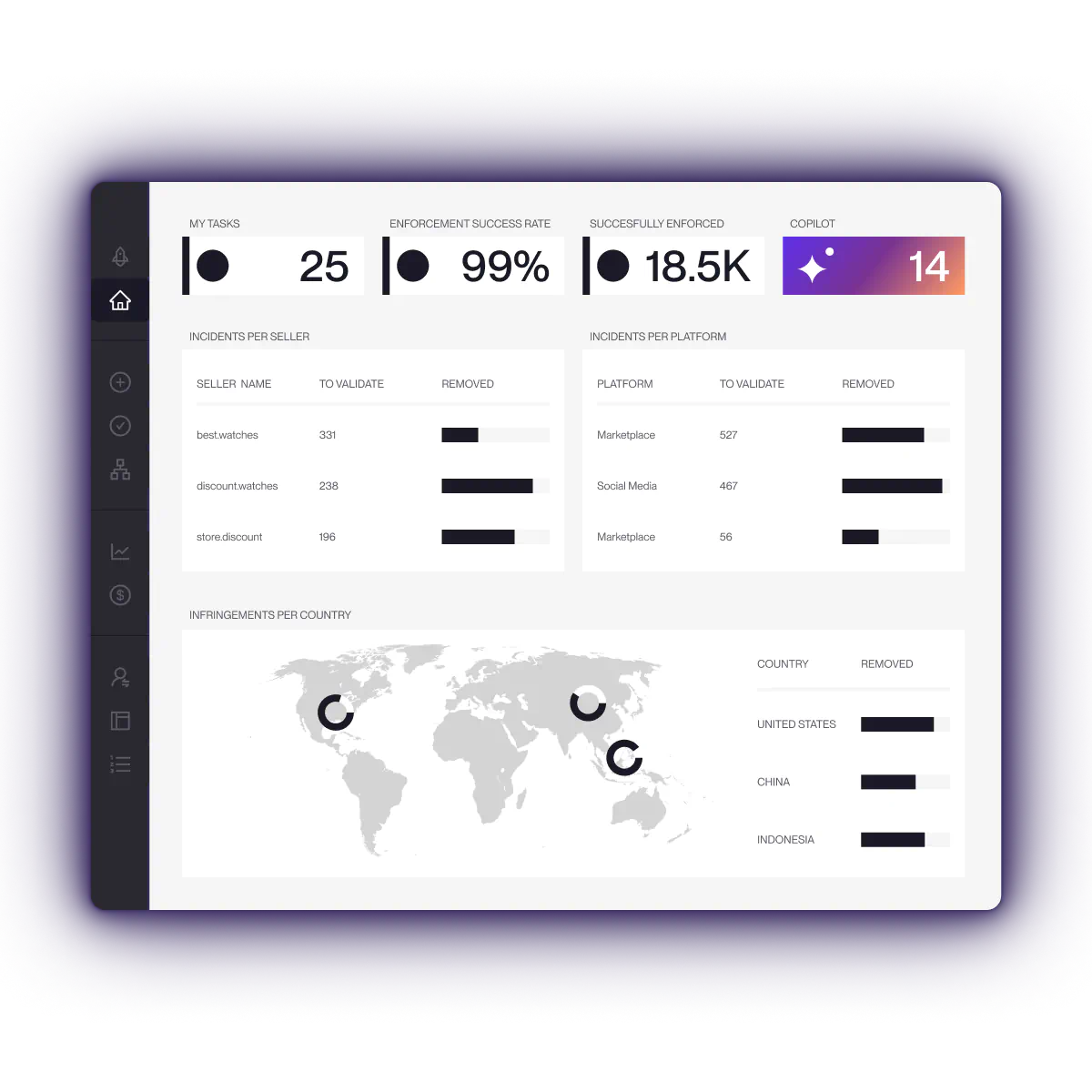
Red Points’ Brand Protection Software helps brands manage the detection-to-enforcement workflow across digital channels.
Red Points can help teams:
- Monitor trademarks, copyright, product images, and other brand assets
- Detect counterfeit listings and suspicious sellers
- Identify fake websites and lookalike domains
- Find impersonation profiles and fraudulent advertisements
- Monitor pirated content and unauthorized downloads
- Collect URLs, screenshots, seller details, and other evidence
- Prioritize high-risk incidents
- Apply validation and approval rules
- Submit platform and intermediary reports
- Track removals, rejections, and response times
- Detect relistings and replacement accounts
- Connect related sellers and assets across channels
- Maintain centralized reporting and enforcement records
The platform processes more than 5.1 million enforcements per year across piracy, websites, marketplaces, social media, search engines, and other digital channels, and is trusted by more than 1,300 brands.
A validation layer helps separate confirmed infringement from lawful resale, authorized partners, commentary, and other possible false positives before enforcement is submitted. Reviewers on G2 describe detection accuracy holding up across complex product catalogs, with IP experts refining detection logic over time.
For businesses that prefer a managed approach, Red Points specialists can operate the ongoing detection and enforcement cycle while the brand retains control over its approval and escalation rules.
Request a demo to see how Red Points helps detect, validate, and remove intellectual property infringements at scale.
Frequently asked questions about intellectual property infringement
What are intellectual property infringements?
Intellectual property infringements are unauthorized acts that violate a trademark, copyright, patent, design, trade secret, geographical indication, or another protected right. The exact legal test depends on the right involved, the jurisdiction, the conduct, whether permission was granted, and any applicable defenses or exceptions.
What are the main types of intellectual property rights?
The principal types of intellectual property rights include trademarks, copyright, patents, industrial designs, trade secrets, and geographical indications. Some countries also recognize rights such as utility models, plant variety rights, database rights, and semiconductor layout protections.
What is the difference between intellectual property infringement and theft?
Intellectual property infringement is the violation of a specific legal IP right, while intellectual property theft is a broader term that usually implies deliberate taking, copying, disclosure, or misuse. Trade secret theft is a common example, while copyright or trademark infringement may occur without the original asset being physically taken from its owner.
What are common examples of intellectual property infringement?
Common examples include counterfeit products, copied photographs, pirated software, trademark misuse, products that infringe patent claims, copied product designs, leaked trade secrets, fake websites, impersonation profiles, and lookalike domains. A single incident may violate several intellectual property rights at the same time.
Are replicas and lookalike products always illegal?
No. The terms “replica,” “lookalike,” and “dupe” do not determine whether a product is lawful. A product may infringe intellectual property when it copies protected trademarks, designs, copyright, patents, or trade dress, while a reproduction that avoids protected elements, shares only functional features, or follows a general trend may be lawful depending on the product and jurisdiction.
Is an unauthorized seller committing intellectual property infringement?
Not necessarily. A seller may operate outside a brand’s authorized network while still selling genuine goods lawfully under applicable resale rules. An intellectual property complaint usually requires an additional issue such as counterfeiting, trademark misuse, copied content, patent infringement, or a misleading claim of affiliation.
Does copyright need to be registered before it is infringed?
Copyright generally arises automatically when an eligible original work is created and fixed in a tangible form. Registration is not normally required for infringement to occur, but it can affect the remedies available and whether the owner can file a lawsuit in certain jurisdictions, including the United States.
How do you prove intellectual property infringement?
The evidence required depends on the intellectual property right involved. A rights owner may need to establish ownership, validity, protected subject matter, the infringing act, similarity or patent-claim coverage, jurisdiction, lack of authorization, and resulting harm through materials such as registrations, original files, contracts, screenshots, test purchases, technical analysis, and records of customer confusion.
Can AI-generated content infringe intellectual property?
Yes. AI-generated content may reproduce protected expression, use trademarks misleadingly, copy a protected product design, imitate a person’s identity, or incorporate confidential information. Whether infringement occurred depends on the output, the inputs, how the content is used, the jurisdiction, and the applicable law.
How can businesses prevent intellectual property theft?
Businesses can reduce the risk by identifying their most valuable assets, registering priority rights, restricting access to confidential information, clarifying ownership in contracts, securing accounts and domains, monitoring relevant channels, and establishing consistent enforcement rules. The controls should reflect the value and exposure of each asset rather than treating every right in the same way.
What is the first step after finding intellectual property infringement?
Preserve the evidence and identify the right involved before contacting the suspected infringer. Confirm ownership, authorization, jurisdiction, and the provider controlling the disputed content, then choose the platform, intermediary, administrative, or legal route that best matches the violation.