



Key takeaway
Effective marketplace brand protection in 2026 is built on AI detection, API enforcement, seller network intelligence, and expert oversight. In practice, these four pillars map to four Red Points capabilities: Vision AI detection, API and priority enforcement routes, Actor Networks and Seller Risk Score intelligence, and dedicated Customer Success Managers plus expert escalation playbooks. Brands that rely on manual workflows will always lag behind. Ultimately, combining automation with human expertise is the only viable way to operate at platform speed.
That distinction determines whether marketplace growth drives sustainable revenue or continuous brand erosion.
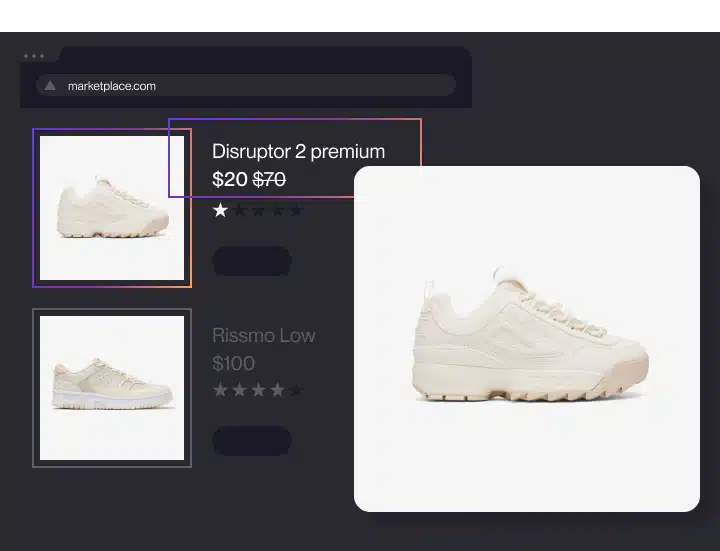
Why marketplace brand protection in 2026 must be AI-driven
Marketplace brand protection in 2026 requires AI-led enforcement to keep pace with scale, speed, and fraud sophistication. Counterfeiting is no longer a niche compliance problem. It is a systemic threat embedded in the same growth engines driving ecommerce.
- Fake goods generate $467 billion annually, equal to 2.3% of global trade.
- EU authorities seized 112 million counterfeit items worth €3.8 billion in 2024.
- Global ecommerce sales were projected to reach $6.8 trillion in 2025, expanding the attack surface in parallel.
The implication is clear. Manual monitoring, delayed reporting, and relationship-based escalation cannot operate at marketplace velocity. Brands that want to protect revenue and customers must deploy automation, AI detection, and platform-level enforcement as core infrastructure, not supplementary tools.
This is exactly where brand protection platforms differ. Red Points runs continuous detection across marketplaces, websites, domains, social media, search engines, and ads, then routes enforcement through platform-specific workflows instead of generic templates. The goal is simple: reduce time-to-action without expanding headcount.
The rise of emerging marketplaces
Emerging marketplaces require continuous, automated brand protection because listings, sellers, and ads now cycle faster than manual review can respond. Risk has shifted decisively toward platforms optimized for speed, volume, and social discovery.
Marketplaces such as Temu, Shein, and TikTok Shop have become primary targets for counterfeit distribution channels due to rapid seller onboarding and minimal friction to launch new storefronts.
Several structural forces explain this shift:
- Social commerce is projected to reach $2.9 trillion by 2026, moving product discovery into feeds and short-lived content.
- 65% of counterfeit seizures now involve small parcels or mail, reflecting a pivot to direct-to-consumer shipping that avoids bulk inspections.
- Sellers and listings routinely disappear and reappear within hours under new identities.
In this environment, protecting a brand means monitoring marketplaces, social feeds, ads, and seller activity continuously, not episodically. Visibility gaps of even a few hours create measurable consumer and revenue risk. This is why working with vendors like Red Points is key to a sustainable brand protection strategy.
Here are 4 strategies brands can implement today to mitigate the impact of counterfeits on their business:
1. Automate enforcement via APIs, not manual reporting
API-based enforcement is the only enforcement model that matches the velocity of modern marketplaces; manual reporting is now operationally obsolete. Automated takedowns remove infringing content in hours rather than days, preventing scale before damage compounds. Red Points supports multi-layer enforcement routes, including API connections, platform priority pathways, and rule-driven automation so repeat infringements can be actioned at scale while still allowing expert review for high-risk edge cases.
API automation enables brands to:
- Submit enforcement actions at platform speed without analyst bottlenecks
- Adapt takedown logic to each marketplace’s enforcement rules
- Maintain continuous enforcement during spikes driven by promotions or viral trends
Marketplace programs such as Amazon Project Zero and eBay VeRO already assume automated integration as the baseline. Relationship-based escalation alone does not meet their operational requirements.
Proven results with Red Points customers:
- Burton – global outdoor apparel brand, turned to Red Points when their customers began reporting that they’d purchased from websites they believed were Burton, only to discover their payment information had been stolen or orders never arrived. Here are some of the results:
- Removed 4,600+ fraudulent websites
- Prevented 5,000+ fraudulent transactions
- Achieved through API-driven detection and enforcement in partnership with Red Points, enabling rapid action across marketplaces and connected web infrastructure
Automation handles scale. Human expertise remains essential for high-risk validation, rule tuning, and escalation strategy. This expert-in-the-loop model that Red Points operates in preserves accuracy while allowing enforcement to operate continuously.
2. Disrupt seller networks with identity clustering
Stopping counterfeits at scale requires disrupting seller networks, not chasing individual listings. Seller identity clustering exposes the infrastructure behind repeat offenders and enables durable enforcement. With Red Points’ brand protection platform, this is operationalized through Actor Networks and Seller Risk Score, which connect repeat infringers across marketplaces and help teams prioritize the sellers most likely to drive revenue loss.
Seller identity clustering connects accounts by analyzing:
- Shared payment instruments
- IP addresses and hosting patterns
- Reused images and image fingerprinting
- Cross-marketplace behavioral signals
This network-level approach shifts enforcement from reactive takedowns to systemic disruption, preventing sellers from reappearing under new storefronts.
Proven results with Red Points customers:
- Keen – a global footwear brand that was targeted via a website spoofing scam, which threatened its reputation and customers’ online safety. After going from zero reports to 1,400 complaints in a single day from customers getting their credit card information stolen through fake ads and rogue websites, Keen partnered with Red Points. These are some of the achievements:
- Removed $35.6 million in counterfeit inventory
- Identified coordinated seller networks operating across channels
- Covered 900+ domains and achieved a 93.5% enforcement success rate
Network intelligence also enables revenue recovery programs, where funds from high-volume counterfeit sellers are frozen and recovered. Enforcement moves from cost containment to measurable financial return. Red Points supports this via its Revenue Recovery Program, where qualified, high-impact cases can escalate beyond takedowns to outcomes focused on account closure and financial recovery, supported by expert oversight.
3. Combat AI-generated fraud and social evasion
AI-generated fraud requires AI-based detection; keyword monitoring alone cannot surface modern counterfeit activity. Counterfeiters now use synthetic content and distribution tactics designed specifically to evade traditional filters. On the Red Points platform, Vision AI flags counterfeit listings that reuse or lightly alter authentic imagery, and ad-to-landing-page detection helps uncover non-indexed storefronts reached through paid social and redirect chains.
Two techniques dominate current attacks:
- Fake-known images
Generic or lightly modified product images used to bypass basic matching systems.
Detection requires Vision AI and image fingerprinting, not text-based rules. - Non-indexed storefronts
Fake websites that never appear in search results and are accessed exclusively through social ads or direct links.
Detection requires scanning paid ad redirects and destination URLs, not search engines.
Example from Red Points customers:
- Cotopaxi – an outdoor apparel and gear brand that, in the lead up to Black Friday 2021, saw over 14 fake websites pop up overnight offering massive discounts, resulting in missing orders, angry customers, and spike in support tickets. After teaming up with Red Points, Cotopaxi was able to:
- Prevent $3.5 million in fraudulent value
- Identify scam patterns tied to social ads and non-indexed sites
- Save over 130 hours of manual effort in just one quarter
AI handles detection at scale. Human review remains critical for evolving fraud patterns, complex edge cases, and escalation decisions that require contextual judgment.
Frequently asked questions about marketplace protection
Why does manual marketplace reporting fail at scale?
Manual reporting fails because it cannot match marketplace velocity. Individual submissions often take days to process, while infringing listings, ads, and sellers can generate significant consumer exposure within hours. On platforms where sellers frequently rotate identities, delayed enforcement allows counterfeit activity to scale faster than brands can react.
How does API-based enforcement improve takedown speed?
API-based enforcement enables continuous, automated takedowns that operate at platform speed. Instead of relying on human analysts to submit reports, API integrations allow brands to remove infringing content in hours, maintain enforcement during traffic spikes, and adapt enforcement logic to each marketplace’s requirements. This is now the baseline for programs such as Amazon Project Zero and eBay VeRO.
Why are Temu, Shein, and TikTok Shop higher risk for counterfeit activity?
Temu, Shein, and TikTok Shop combine massive reach with rapid seller onboarding and social-driven discovery. These platforms are being targeted by counterfeiters to launch storefronts quickly, distribute products via short-lived content, and ship directly to consumers using small parcels.
What is seller identity clustering and why does it matter?
Seller identity clustering connects related seller accounts into networks instead of treating them as isolated listings. By analyzing shared payment methods, infrastructure, image assets, and behavior across marketplaces, brands can disrupt entire counterfeit operations at the source. This prevents sellers from reappearing under new storefronts and enables durable enforcement at scale.
What role do humans still play if enforcement is automated?
Human expertise is essential for accuracy, escalation, and strategic control. While AI handles detection and scale, expert reviewers validate high-risk cases, fine-tune enforcement rules, and manage complex edge scenarios. This expert-in-the-loop model ensures automation remains precise and aligned with real-world enforcement outcomes.
How does marketplace enforcement translate into measurable business impact?
Modern marketplace enforcement directly reduces revenue loss and can recover value. By combining automated takedowns with seller network intelligence, brands can remove counterfeit inventory at scale and participate in revenue recovery programs that freeze funds from high-volume counterfeiters. This shifts brand protection from a cost center to a measurable financial lever.