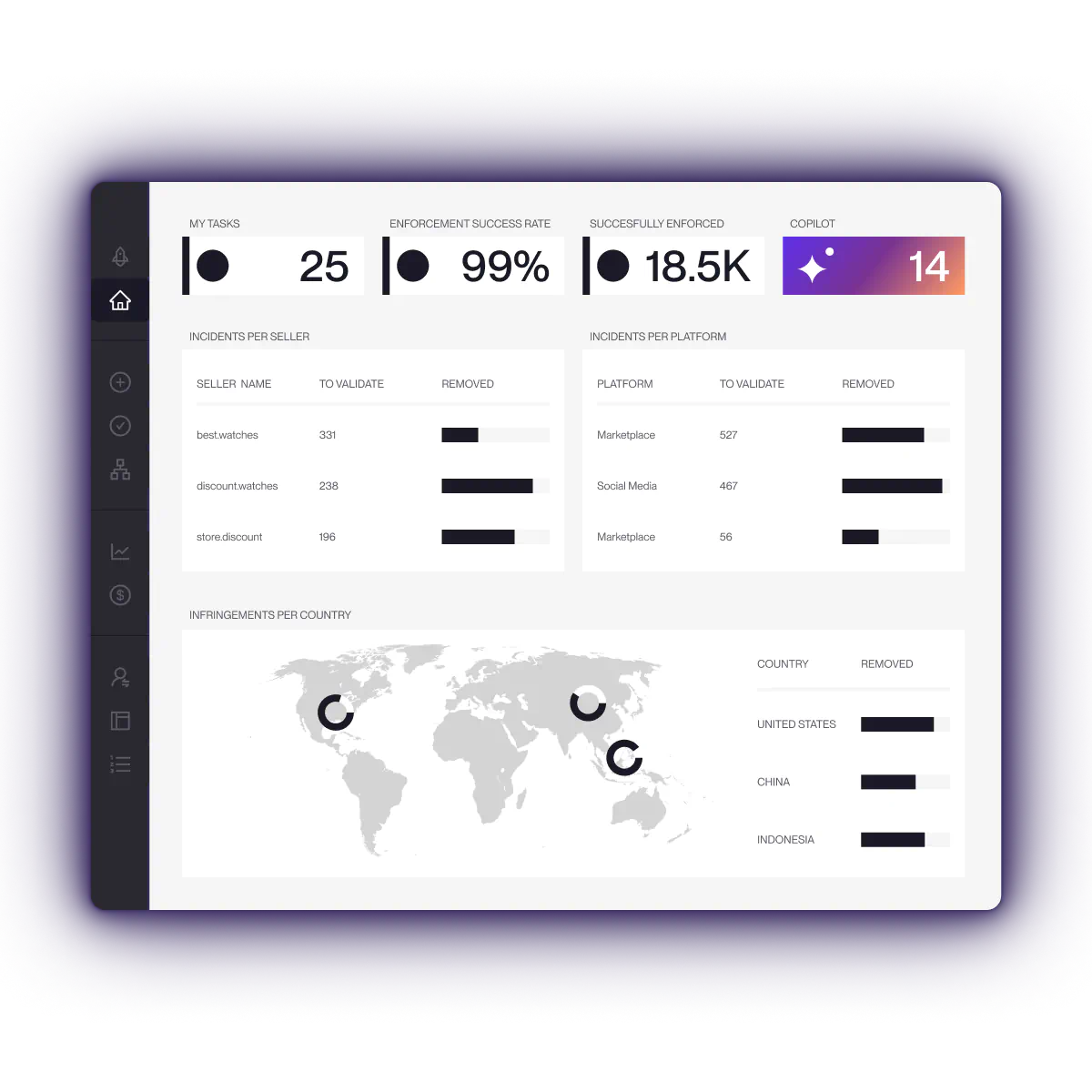









In 2026, trademark infringement is reported across six primary enforcement channels. Each channel has a formal reporting mechanism and can be strengthened through automation.
Quick summary: Key shift defining trademark reporting and enforcement in 2026
- From manual portals to API-based enforcement
- From keyword searches only to Visual AI detection
- From reactive domain takedowns to predictive monitoring
- From manual ad reviews to continuous SERP surveillance
- From static border recordation to intelligence-led seizure
- From isolated takedowns to revenue recovery
From manual reporting to strategic automation
For years, reporting trademark infringement meant one thing: manually filling out forms on platform portals. In 2026, that approach is obsolete. With counterfeiters using AI to generate thousands of listings per day, manual reporting cannot keep pace with the volume of threats.
According to the OECD and EUPO, counterfeit and pirated goods account for up to $467 billion in global trade, representing 2.3% of world imports and nearly 4.7% of EU imports. The scale demands automation.
Here are the 6 most effective ways to report and automate trademark infringement across marketplaces, social media, domains, search engines, and customs in 2026.
1. Online marketplaces: Move from portals to APIs
Reporting infringement on marketplaces like Amazon, eBay, Temu, Shein, and Alibaba requires submitting proof of IP ownership through dedicated portals such as Amazon Brand Registry or eBay VeRO.
- The manual limitation: While these portals exist, they are designed for low-volume reporting. Filing takedowns one by one requires manual data entry for every ASIN or URL, which is impossible during a surge attack.
- The automated solution: Modern protection requires API integrations. Instead of filling out forms, platforms like Red Points connect directly to the marketplace’s backend. This allows you to validate and remove thousands of infringing listings instantly, ensuring scalability that manual portals cannot match.
2. Social Media: Use Visual-AI for “hidden” threats
Social media infringement reporting involves flagging posts, accounts, or paid advertisements that misuse your trademark, requiring separate evidence depending on whether the violation appears in organic content or paid ads.
- The manual limitation: Searching for text keywords (e.g., “fake [Brand] purse”) is a great start, but can lead to limited results if scammers deliberately avoid using brand names in captions to evade detection.
- The automated solution: Red Points’ Visual AI identifies infringements based on visual similarity, product geometry, and design features, enabling enforcement even when trademarks are absent from titles and descriptions.
3. Domains & websites: UDRP and early detection
To remove infringing websites, rights holders must file a UDRP (Uniform Domain-Name Dispute-Resolution Policy) complaint to transfer a domain, or submit DMCA notices to hosting providers to disable the site.
- The process: UDRP actions are effective, but can also be costly and time-intensive. Filing individual cases for hundreds of domains is not scalable
- The strategic edge: While UDRP is a powerful legal tool, it is reactive. An automated strategy uses predictive domain monitoring to flag suspicious registrations (like “brand-outlet-sale.com”) the moment they are purchased, often before they become active scams. Red Points automates global detection of impersonation domains using its 1.4B+ domain discovery tool, achieving 99.5% ccTLD coverage.
4. Search engines: De-indexing at scale
Reporting trademark abuse in search engines requires submitting complaints through ad policy centers to remove paid ads that use your brand name in ad copy or keyword bidding to divert traffic.
- The manual friction: Google, Bing, and Yahoo allow trademark owners to report ads or organic results that infringe on IP, but manual monitoring of search engine results pages (SERPs) is nearly impossible across regions and languages.
- The automated solution: Automated crawlers simulate real user behavior across different geos and devices to uncover these cloaked sites and submit bulk de-indexing requests to search engines. Red Points monitors SERPs 24/7, detects unauthorized ad bidding and hidden redirect URLs, and flags violations automatically through ad network enforcement channels.
5. U.S. customs (CBP): Blocking imports at the source
Recording your trademark with customs authorities such as US CBP enables officers to seize counterfeit shipments at the border before they enter domestic distribution channels.
- The limitation: High-volume micro-shipments bypass traditional container-based inspections. In fact, the OECD data shows that nearly 79% of seizures involve fewer than ten items per shipment.
- The strategic edge: When combined with online intelligence, you can provide CBP with specific data on high-risk shipping routes and manufacturer names identified by your online protection platform, increasing the seizure rate of fake goods. Red Points supports customs enforcement by supplying intelligence on origin points, shipping routes, and seller networks derived from online detection data.
6. Revenue recovery: Turning legal into a revenue center
Revenue recovery enables brands to move beyond removing counterfeit listings and pursue financial redress by freezing merchant accounts and targeting high-volume infringers through structured legal escalation.
- The manual limitation: Infringers often relist under new accounts, continuing financial harm despite enforcement activity.
- The automated solution: By using Revenue Recovery Programs to identify high-risk sellers and coordinating account freezes, asset seizures, and negotiated settlements, brands can disrupt repeat offenders and recover damages. Red Points supports revenue recovery by supplying evidence, seller network intelligence, and escalation workflows that transform enforcement from reactive removal into measurable financial impact.
The business impact: The cost of inaction
Not reporting trademark infringement and letting “go away on its own” falls under the cost of inaction, which includes direct revenue loss, erosion of brand equity, increased customer churn, and exposure to liability from unsafe counterfeit products.
Red Points turns brand protection into measurable ROI. Clients leverage automated detection, bulk enforcement, and network dismantling to reduce counterfeit exposure, preserve revenue, and safeguard consumer trust. With 1,300+ brands protected globally, unlimited detections and takedowns under a flat-fee model, and a 95% average enforcement success rate, protection scales without hidden costs. The Red Points’ Revenue Recovery Program takes this even further, by freezing infringer assets and permanently closing seller accounts, transforming enforcement into real financial recovery.
Real-world impact:
The threat – KEEN
KEEN, a family-owned, values-led global footwear brand based in Portland, United States, became the target of large-scale website spoofing attacks. After a scam ad appeared on Facebook, customer complaints surged from zero to 1,400 in a single day, requiring immediate containment of rogue domains.
The business impact
- $5.7 million in counterfeit product value identified
- 666 domains covered
- 82.9% enforcement success rate
The attacks posed direct reputational risk and customer harm.
How Red Points helps
Through 24/7 monitoring, AI, and machine learning, Red Points detected and removed rogue websites at the source. Continuous detection allows KEEN to respond quickly to evolving scam tactics and prevent future attacks before they scale.
The threat – Burton
Burton, a global snowboarding brand with a digital-first retail model, faced a growing number of scam websites impersonating the brand and stealing customer payment details. Manual enforcement was reactive and unable to keep up with new domains appearing continuously.
The business impact
- 4.6K+ fraudulent websites removed
- 5K+ fraudulent transactions prevented
- 500+ sellers reported
Customer trust and digital commerce operations were at risk.
How Red Points helps
Burton implemented instant URL triggers, AI-driven detection, predictive scoring, and automated enforcement rules. By combining deny/allow lists with infringement prediction, Burton shifted from reactive takedowns to proactive protection, improving enforcement accuracy and accelerating removals.
Conclusion
In 2026, the question is no longer how to file a complaint. It is how to automate enforcement, protect revenue, and dismantle infringer networks before they scale. Request a demo today, and take the first step towards effective brand protection.
Frequently asked questions about reporting trademark infringement in 2026
1. How long does it take to remove an infringing listing?
It can take hours to several days, depending on the platform and reporting method.
Manual reports on Amazon, eBay, or Temu often require review queues. Automated API-based enforcement significantly reduces response time. Red Points operates 24/7 with a 95% average enforcement success rate, accelerating removals at scale.
2. What proof is required to report trademark infringement?
You must provide a registered trademark, the infringing URL or listing, and evidence of unauthorized use.
Platforms typically require trademark certificates and screenshots. UDRP disputes under Internet Corporation for Assigned Names and Numbers require proof of bad faith. Red Points automates evidence capture using OCR and image fingerprinting, ensuring compliance without manual collection.
3. Can brands recover money from counterfeiters?
Yes, through asset freezes, account shutdowns, and legal escalation – not just takedowns.
Basic reporting removes listings but does not address financial harm. Red Points’ Revenue Recovery Program targets seller balances and repeat offenders, turning enforcement into measurable ROI.
4. Is manual reporting enough for global brands?
No, manual reporting does not scale across marketplaces, social media, domains, and paid ads.
Counterfeit trade represents 2.3% of global imports, according to the OECD. Red Points automates detection across 5,000+ marketplaces and 1.4B+ domains, reducing analyst workload while increasing coverage.
5. What’s the difference between a takedown and strategic brand protection?
A takedown removes one listing. Strategic brand protection dismantles entire seller networks.
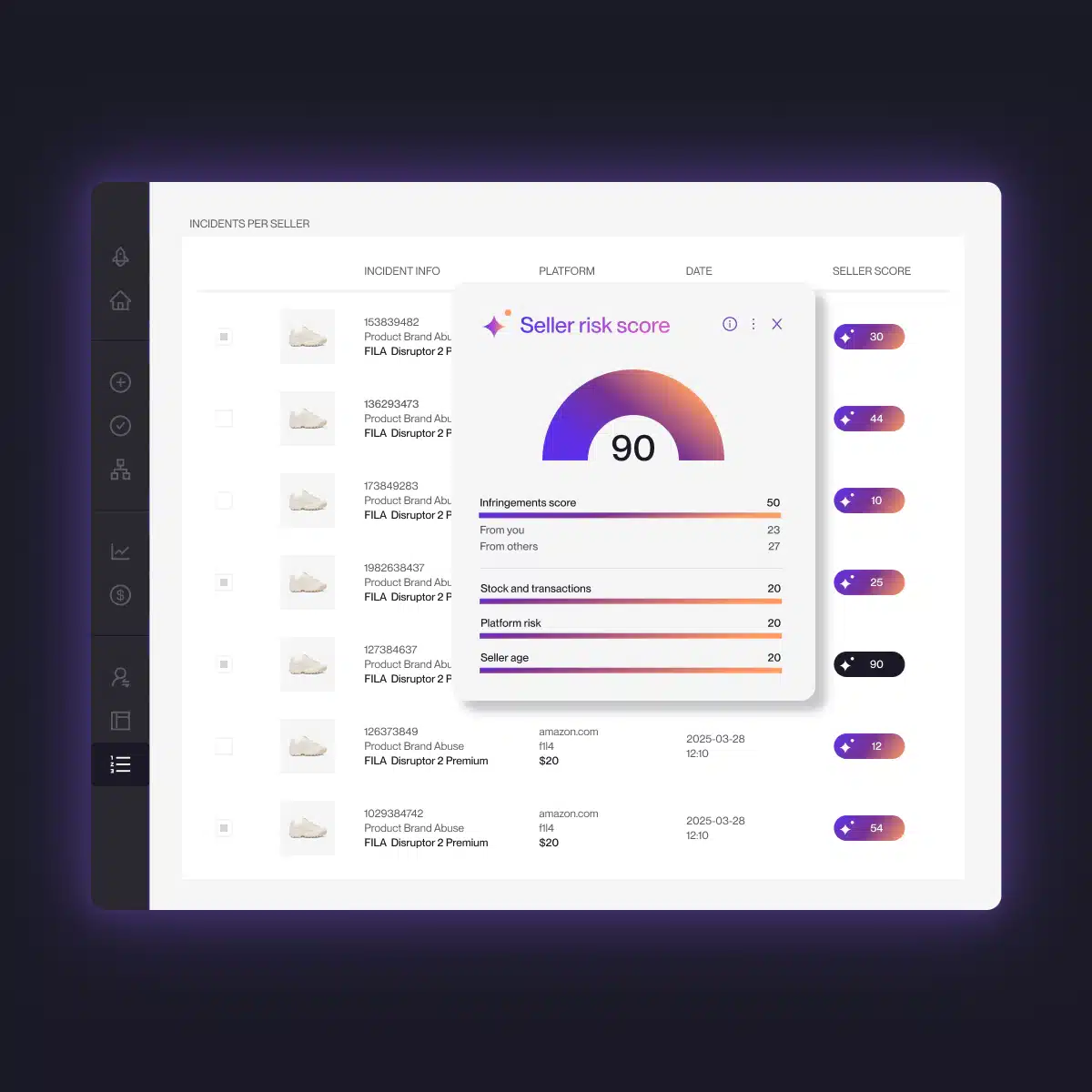
Red Points combines Actor Networks, Seller Risk Scoring, and AI automation to eliminate repeat offenders across platforms like TikTok and Shein, preventing recurrence instead of reacting to it.